
Complete Canvas Example for Flowing Romance Greeting Links
A practical, non-technical blueprint for a complete canvas codebase example for flowing interactive romance greeting links — design patterns, animation ideas, accessibility, performance tips, and how to publish a beautiful shareable page (or build the same look in minutes on SubhSandesh).
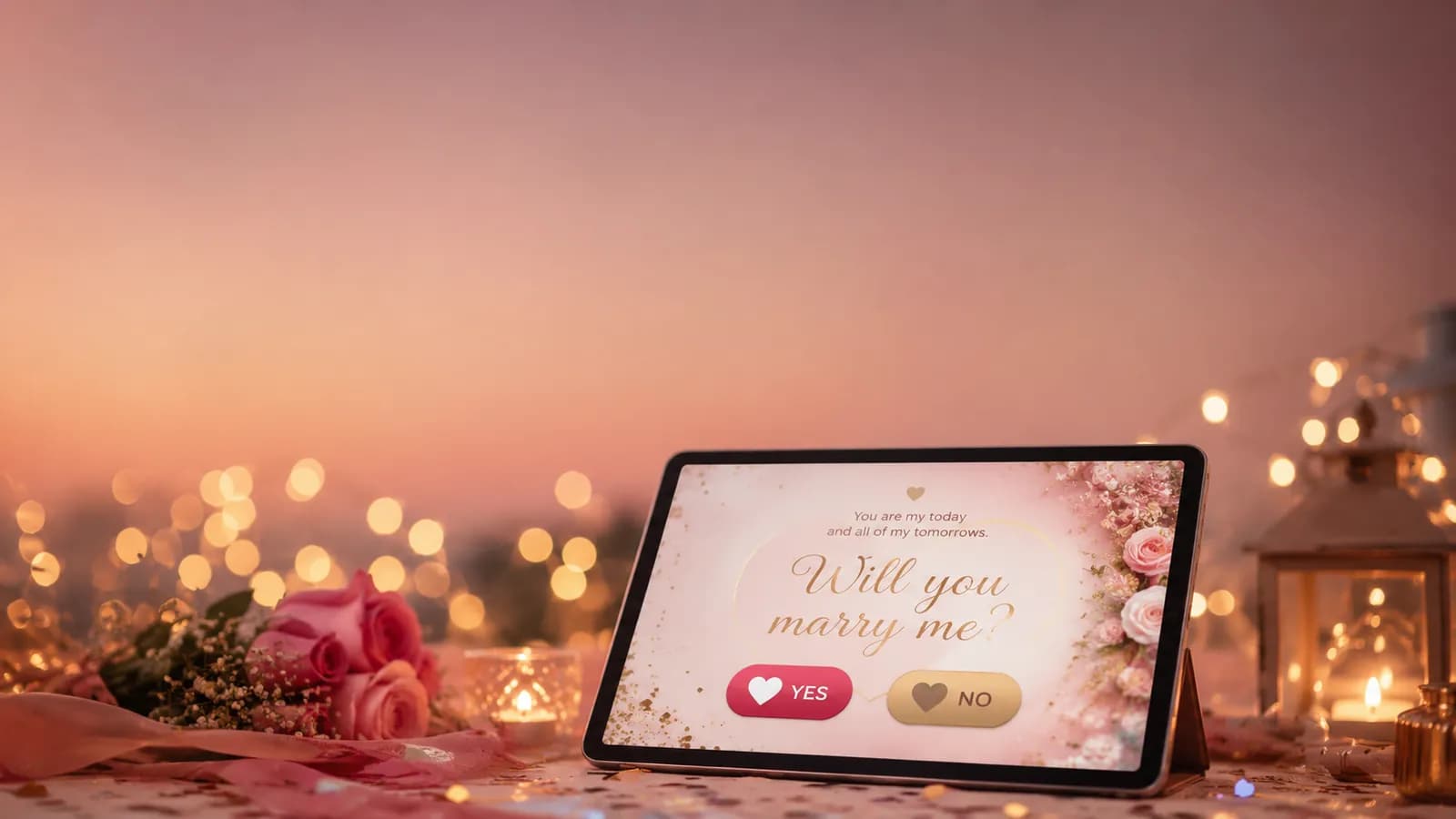
Make this into a page you can send
Photos, a message, music and a ready-to-share link — in a couple of minutes.
Create nowor browse all occasionsKey takeaways
- • A complete canvas codebase example for flowing interactive romance greeting links is a structured set of layers: canvas renderer, asset loader, emitter system, interaction handlers, accessibility fallbacks, and share routing.
- • Design choices (particles, ribbons, floating hearts) affect emotion, performance, and mobile behavior—pick one dominant effect and optimize for lower-end devices.
- • Make interactive links feel intimate: use microcopy, reveal-on-click gestures, sequenced animation, and personalized media to create emotional payoff.
- • Accessibility and progressive enhancement are essential: provide keyboard-focusable link nodes and an HTML fallback so every recipient can view your message.
- • You can build this yourself or create the same look in minutes on SubhSandesh by choosing a romantic template, adding photos and music, and sharing the private link.
On this page
A complete canvas codebase example for flowing interactive romance greeting links explains what pieces you need, how they fit together, and how to design the interactive reveal that makes the recipient smile. Below is a practical, non-technical blueprint you can follow whether you plan to build the animation yourself or recreate the same effect quickly using SubhSandesh templates.
What does a complete canvas codebase example cover and why it matters
Answer first: it describes the structure, assets, interactions, and publishing steps to create shareable romance pages with flowing canvas animations and clickable links that reveal photos, messages, or surprises.
This matters because the feeling of a romantic greeting comes from timing (when something is revealed), motion (how elements flow toward the heart), and intimacy (small microcopy and personalized media). A designed codebase ensures those elements are repeatable, accessible, and performant across devices.
How to build a complete canvas codebase example for flowing interactive romance greeting links
Below is a step-by-step human-friendly plan. Each step explains what to decide, how to test it, and what the emotional goal is.
- Plan the concept and emotional arc
- Decide the occasion and tone (e.g., anniversary warmth, playful proposal, or quiet "I miss you").
- Map the reveal moments: landing animation → interactive node(s) → reveal content (photo, voice note, message) → final micro-interaction (heart burst, confetti).
- Sketch the path users take: open link, see animation, tap or click a heart, read message, optionally replay.
Why this helps: a clear arc creates tension and payoff — the animation draws attention, the interaction creates agency, and the reveal delivers emotion.
- Choose your visual motif and palette
- Particle flow: tiny light particles drifting in a directional current.
- Ribbon trails: slow, smooth ribbons that follow a curve, ideal for elegant messages.
- Floating hearts: soft, buoyant heart sprites that bob and collide gently.
- Parallax photos: layered images that move subtly as the device tilts or the mouse moves.
Match motif to message: floating hearts or ribbons suit romantic reveals; subtle particles and parallax work for nostalgic anniversaries.
- Define the high-level codebase structure (non-technical view)
- Canvas Layer: the visual surface where particles, ribbons, and trails render.
- Asset Manager: loads images, audio, and low-res fallbacks, with progress reporting.
- Emitter/Animation Engine: controls particle spawn, lifespan, velocity, opacity easing, and collisions.
- Interaction Handlers: map taps/clicks/keyboard focus to interactive nodes (link anchors) and manage reveal sequencing.
- State Manager & Scenes: define states (loading, ready, reveal, end) and transitions.
- Accessibility & HTML Fallback: semantic controls and a simple HTML version for devices or users that disable animations.
- Share & Analytics: generate short links and track opens/reveals for UX tuning.
- Asset strategy and optimization
- Use compressed WebP or optimized JPEG for photos; provide 2 sizes (mobile and desktop).
- Sprite atlases for repeating small graphics (hearts, sparkles) reduce HTTP requests.
- Short background audio clips (10–25 seconds) with user play/pause controls.
- Preload critical assets during a small, themed preloader that shows progress.
-
Interaction design for link nodes
-
Present gently pulsing nodes (heart icons or subtle glow) that indicate interactivity.
-
On hover (desktop) or long-press (mobile), give visual feedback—scale + soft shadow.
-
On tap/click, run a short 400–700ms reveal animation, play a soft sound, then display content.
-
Allow keyboard activation and provide ARIA labels for each node.
Emotional tip: use microcopy on nodes like "open this", "for you", or "one small surprise" to feel personal.
- Accessibility and progressive enhancement
- Each reveal should be reachable via keyboard (Tab → Enter/Space).
- Provide ARIA-expanded toggles for reveal panels so screen readers announce state changes.
- Offer a low-motion toggle and an HTML fallback with the same content and images.
- Ensure sufficient color contrast for text overlays and captions.
- Performance tuning
- Cap particle counts per viewport size. For example: desktop 300 particles, tablet 150, mobile 60.
- Use requestAnimationFrame for animation loops and pause animations when tabs are backgrounded.
- Debounce resize and orientation events to avoid layout thrash.
- Lazy-load secondary media until after the initial reveal.
- Publish, share, and iterate
- Host on a fast CDN or use a service that handles thumbnails and private link sharing.
- Test the share preview on messaging apps and email clients: ensure the Open Graph image is attractive.
- Use brief analytics to measure reveal rates and load times, then reduce heavy effects if drop-offs are high.
How a flowing interactive link feels: three recipe examples
- Anniversary (warm): parallax photo layers combined with ribbon trails that guide eyes toward the centered reveal button. Slow easing and a 15-second acoustic guitar loop.
- Proposal hint (playful): small heart particles that gather into a cluster on hover; clicking reveals a short voice note followed by a hidden "Will you…" panel.
- Long-distance "I miss you" (nostalgic): drifting scrapbook photos, slow particle dust, typewriter-style text reveal synced with soft rain audio.
Try variations by changing animation speed, particle size, and sound levels. Small changes change tone dramatically.
Design choices comparison
| Effect Type | Emotional Tone | Performance Impact | Best For |
|---|---|---|---|
| Particle flow | Gentle, dreamy | Medium — many particles can be heavy | Anniversaries, 'miss you' pages |
| Ribbon trails | Elegant, cinematic | Low-medium | Formal reveals, proposals |
| Floating hearts | Playful, intimate | Low | Valentine's, quick surprises |
| Parallax photos | Nostalgic, personal | Low (if limited layers) | Photo-heavy pages, family anniversaries |
Testing checklist before you share
- Content: photos load correctly, captions correct, audio length appropriate.
- Interaction: nodes respond to click/tap/keyboard; reveals open and close cleanly.
- Responsiveness: layout works on portrait phones, tablets, and narrow desktop windows.
- Load: page reaches interactive state in under 3 seconds on mid-range mobile.
- Social preview: Open Graph image and title display nicely when the link is pasted.
UX copy ideas for romance reveals
- Title prompts: "For you", "A small surprise", "Open me".
- Reveal microcopy: "I wrote this for the 100 small things I love about you." or "Tap the heart to see a memory.".
- Closing: "Saved to us — replay anytime." Keep copy short and personal.
When to use a full codebase vs a hosted builder
- Build from scratch when you need total control over physics, bespoke interactions, or want to integrate with custom backends.
- Use a hosted no-code builder when you want speed, polished templates, automatic hosting, and easy sharing.
If you prefer a fast route, SubhSandesh offers ready-made romantic templates where the same flowing-feel can be achieved by selecting a theme, adding photos and a message, and sharing the private link. Try a romantic [I love you] page like this one: [https://subhsandesh.in/love-gf], or pick a themed Valentine's template such as [https://subhsandesh.in/valentine-gf]. For anniversary surprises, start with a tailored anniversary page here. Browse all options on the SubhSandesh templates page at [https://subhsandesh.in/templates].
Mobile-first considerations
- Touch targets must be at least 44x44 CSS pixels for comfortable tapping.
- Reduce animation complexity and particle counts on devices reporting low memory or battery saver mode.
- Offer a clear "Skip animation" button placed where the thumb naturally rests.
Privacy and sharing best practices
- Use randomized private links — avoid indexing by search engines unless you want public invitations.
- Avoid embedding very sensitive personal data; keep messages and photos thoughtfully selected.
- Allow the creator to delete the page after sharing if needed.
Example timeline: building the page (human-friendly hours)
- Planning + assets: 30–60 minutes (pick photos, choose message, select audio).
- Prototype (visual mock): 30–90 minutes.
- Implementation and optimization: 4–10 hours for a developer build, or 5–15 minutes using SubhSandesh templates.
Final design checks and launch
- Preview on multiple devices and send the link to your own test phone first.
- Double-check names, dates, and private messages for typos.
- Set expectations: if you include voice notes, tell the recipient there is sound so they open in a quiet spot.
Ready to make their day? If coding isn’t your thing, build a gorgeous flowing romance page in minutes on SubhSandesh — choose a template, add your photos and message, set a soft track, and share the private link. Browse templates at [https://subhsandesh.in/templates] to get started.
(Short action: pick a template like the romantic [I love you] page at [https://subhsandesh.in/love-gf], or try a themed [Valentine] page at [https://subhsandesh.in/valentine-gf].)
Frequently Asked Questions
Turn this inspiration into an unforgettable surprise
Build a page with photos, a heartfelt message, music and a ready-to-share link.
- Photos, message & music
- Ready-to-share link

Written by
Suyash Agrahari
Founder
Suyash Agrahari is a Software Engineer at HireQuotient and the founder of SubhSandesh and DrawFlow (drawflow.in). He builds AI agents and full-stack products with Next.js, Node.js, and the OpenAI and LangChain ecosystems, having shipped autonomous multi-agent systems, AI copilots, and large-scale outreach platforms — and scaled side projects from a few hundred to millions of users. He writes about AI engineering, web development, and building products that grow through SEO and organic reach.
Stay Connected
Follow SubhSandesh
New templates, festival ideas and step-by-step walkthrough videos — first on our socials.
Keep reading
Which Day Comes After Propose Day, and What Happens Now
Chocolate Day comes after Propose Day — Tuesday 9 February 2027. That is one sentence, so this page covers the four situations you are actually in on …
 Suyash Agrahari· 9 min
When to Propose a Girl to Be Your Girlfriend, and When Not To
The timing question, answered with conditions instead of a date: what has to be true before you ask, what politeness and fast replies do not prove, wh…
Suyash Agrahari· 9 minRomantic Proposal Room Decoration: What the Room Must Do
Romantic proposal room decoration, sorted by the work each setup takes and what the room allows: 7 setups with set-up and reversal times, lighting evi…
Suyash Agrahari· 9 min