Raksha Bandhan Shayari in Hindi for Bhai: 8 Original Shers
Eight Raksha Bandhan shers written for this page, not forwarded: Devanagari, Roman transliteration, English meaning, and the qaafiya, radif and matra count of each. Plus the 05:57 AM rakhi muhurat for Friday 28 August 2026 and a four-step method for writing your own.
Make this into a page you can send
Photos, a message, music and a ready-to-share link — in a couple of minutes.
or browse all occasionsKey takeaways
- • All eight shers here were written for this page — each labelled with its qaafiya, radif and matra count so the metre is checkable rather than claimed.
- • Raksha Bandhan 2026 falls on Friday 28 August; the Delhi thread-ceremony window is 05:57 AM to 09:48 AM, three hours fifty-one minutes, because Purnima Tithi ends at 09:48.
- • A sher is a couplet whose two lines match in metrical weight and whose second line turns on the first; the Academy of American Poets sets five couplets as the minimum for a full ghazal.
- • People rewrite these lines: the median SubhSandesh creator spends 6.8 hours between first save and last edit, sampled over 902 pages.
- • Send it where it survives — 52.5% of shared pages are opened on a phone and 44.7% of creators password-protect theirs before sharing.
On this page
- 1. For a brother in another city
- 2. When you want one line and nothing else
- 3. For the sister who married and moved away
- 4. For a brother in a different timezone
- 5. For the brother who never says it back
- 6. For when you have been rewriting for hours
- 7. On what the thread actually is
- 8. For a brother you have not spoken to in years
Raksha Bandhan Shayari in Hindi for Bhai: 8 Original Shers
Raksha Bandhan shayari in Hindi for bhai has to do three things a wish does not: hold a metre, turn in the second line, and say something only you could say about your brother. The eight shers below were written for this page — Devanagari, Roman transliteration and English meaning for each — and none appears on any page ranking for this phrase.
That matters because these lines get laboured over. Across 2,632 personalised pages created on SubhSandesh since 12 March 2026, the median gap between a creator's first save and their last edit is 6.8 hours, sampled over 902 pages. Nobody dashes this off.
Below: eight shers sorted by situation, the rakhi muhurat for Friday 28 August 2026, a four-step method for writing your own, and where shayari is the wrong thing to send.
What makes a line shayari and not just a rakhi wish
Shayari is metrical verse. Its unit is the sher — a couplet of two misra of matched weight, where the second line turns on the first instead of restating it.
The rhyme rules have names. The qaafiya is the rhyming word, the radif the fixed phrase repeated after it, and both are the form's defining constraint. The Academy of American Poets' glossary entry on the ghazal adds the length rule: minimum five couplets, ceiling fifteen, every line the same length. The rules are exact enough to automate: a 2025 model matches a verse against 290 Arud meters at 94% accuracy.
Most forwarded rakhi lines meet none of this. They are greetings with a line break in the middle. Send one if you like it; it is not a sher.
8 Raksha Bandhan shers in Hindi for your brother
Each is written for one situation, the part a general list cannot give you. Metre is counted in matras — a short vowel scores one, a long vowel two — and a sher's two lines should land within a matra or two.
1. For a brother in another city
राखी तो डाक से चली गई, हाथ रह गया, कलाई तक पहुँचा धागा, पर साथ रह गया।
Raakhi to daak se chali gayi, haath rah gaya, / Kalaai tak pahuncha dhaaga, par saath rah gaya.
Meaning: the rakhi went by post; the hand stayed behind. The thread reached his wrist — the closeness did not.
Form: qaafiya हाथ–साथ, radif "रह गया", 25 matras a line. For the year the parcel arrived and you could not.
2. When you want one line and nothing else
जो भी थोड़ी हिम्मत है, वो तेरे नाम है, जो भी मेरी क़िस्मत है, वो तेरे नाम है।
Jo bhi thodi himmat hai, wo tere naam hai, / Jo bhi meri qismat hai, wo tere naam hai.
Meaning: whatever small courage I have is in your name. Whatever luck I have is in your name.
Form: qaafiya हिम्मत–क़िस्मत, radif "वो तेरे नाम है", 25 matras a line. Both lines carry the radif, making this a matla — a ghazal's opening sher. Use it as a status.
3. For the sister who married and moved away
डोली उठी तो छूट गया पीछे मेरा गाँव, दौड़ता रहा तू साथ, फिर छूटी तेरी छाँव।
Doli uthi to chhoot gaya peechhe mera gaanv, / Daudta raha tu saath, phir chhooti teri chhaanv.
Meaning: when the palanquin lifted, my village fell behind. You ran alongside — then even your shade fell away.
Form: qaafiya गाँव–छाँव, no radif, 26 matras a line. The commonest rakhi situation in India, and the least written about.
4. For a brother in a different timezone
तेरे यहाँ सुबह हुई, मेरे यहाँ है रात, दोनों ने इक चाँद से कह दी है दिल की बात।
Tere yahan subah hui, mere yahan hai raat, / Donon ne ik chaand se kah di hai dil ki baat.
Meaning: morning has broken where you are; here it is night. We both told the same moon what we could not tell each other.
Form: qaafiya रात–बात, no radif, 25 and 26 matras. For the brother whose muhurat has already passed.
5. For the brother who never says it back
वो लड़ता है, चिढ़ाता है, कभी सीधा कहता नहीं, मगर जिस रात मैं रोई, वो चुप-चाप रहता नहीं।
Wo ladta hai, chidhata hai, kabhi seedha kahta nahin, / Magar jis raat main royi, wo chup-chaap rahta nahin.
Meaning: he fights, he teases, he never says it straight. But the night I cried, he did not stay quiet.
Form: qaafiya कहता–रहता, radif "नहीं", 29 and 28 matras. The longest here, and the one that works spoken aloud.
6. For when you have been rewriting for hours
मैंने हज़ार लफ़्ज़ लिखे और सारे काट दिए, तेरे नाम पे आकर सब अल्फ़ाज़ हार गए।
Maine hazaar lafz likhe aur saare kaat diye, / Tere naam pe aakar sab alfaaz haar gaye.
Meaning: I wrote a thousand words and struck them all out. Arriving at your name, every word surrendered.
Form: qaafiya दिए–गए, no radif, 26 matras a line. This is the 6.8-hour median edit gap put into verse, which is why it lands.
7. On what the thread actually is
कलाई पर नहीं, मैं तेरी उम्र बाँधती हूँ, धागा नहीं, हर साल एक और सब्र बाँधती हूँ।
Kalaai par nahin, main teri umr baandhti hoon, / Dhaaga nahin, har saal ek aur sabr baandhti hoon.
Meaning: it is not your wrist I tie, it is your lifespan. Not a thread — each year, one more measure of patience.
Form: qaafiya उम्र–सब्र, radif "बाँधती हूँ", 26 and 27 matras. A matla again, and the one for writing inside a card.
8. For a brother you have not spoken to in years
बरसों से बात नहीं, बरसों से कोई ख़बर, फिर भी हर सावन राखी ढूँढती है डगर।
Barson se baat nahin, barson se koi khabar, / Phir bhi har saawan raakhi dhoondhti hai dagar.
Meaning: years without a word, years without news. Still, every Sawan the rakhi goes looking for the road.
Form: qaafiya ख़बर–डगर, no radif, 25 and 24 matras. The only one here for an estranged sibling, which is exactly why it exists.
Where to send the sher so it survives the day
The useful question is not how fast the line arrives but whether it is still reachable on 29 August. The last column is SubhSandesh's own data across 2,632 pages and 31,081 views.
| How you send it | Reaches him | Findable a year later | SubhSandesh first-party figure |
|---|---|---|---|
| WhatsApp message | Immediately | No — scrolls out of the chat | — |
| Instagram story | Immediately | No — expires in 24 hours | — |
| Card sent by post | Only if posted days ahead | Yes, if he keeps it | — |
| A shareable page link | Immediately, as one link | Yes — the link stays live | 11.8 average views per page; 52.5% opened on a phone; 44.7% password-protected |
A page averaging 11.8 views is being reopened, not merely received; 44.7% of creators lock theirs before sharing.
How to write your own sher in four moves
Writing one beats forwarding one, and the method is mechanical enough to follow in twenty minutes.
One: choose the radif first. Pick the phrase you want repeated — "रह गया", "बाँधती हूँ". Everything is built backwards from it.
Two: find two qaafiya words. They sit immediately before the radif and must rhyme. हाथ and साथ. उम्र and सब्र. Two is enough for a standalone sher; five gets you a ghazal, the Academy of American Poets' minimum.
Three: count the matras. Read both lines aloud, score each syllable one for short and two for long, and bring the totals within one or two. One 2021 study modelled 111 Hindi chhand rules and identified 53 at 95.02% accuracy; every count above was made by ear and hand.
Four: hold the turn for the second line. The first line sets a situation; the second moves it somewhere unexpected. That is the difference between a sher and a greeting with a comma in it.
Write in Devanagari, then transliterate — the vowel weights that make a line scan are invisible in Roman.
When shayari is the wrong thing to send your brother
If he is in the same house, say it out loud. A forwarded couplet to someone ten feet away is a smaller gesture than a spoken sentence, not a bigger one.
If he does not read Hindi comfortably — common for siblings raised outside a Hindi-speaking state — a transliteration helps, but a thirty-second voice note helps more. Metre works only if the listener hears it.
And if his phone is not where he lives, a shareable page is the wrong format outright. 52.5% of SubhSandesh pages are opened on a phone, 16,323 of 31,081 recorded views; a brother who opens a laptop once a week gets less from this than from a posted card.
Getting it to him on Friday 28 August 2026
Raksha Bandhan falls on the Purnima of Shravana, which in 2026 is Friday 28 August. DrikPanchang's muhurat table for Delhi puts the thread-ceremony window at 05:57 AM to 09:48 AM — three hours fifty-one minutes — because Purnima Tithi ends at 09:48 that morning. Bhadra finishes before sunrise, so there is no inauspicious stretch to work around this year.
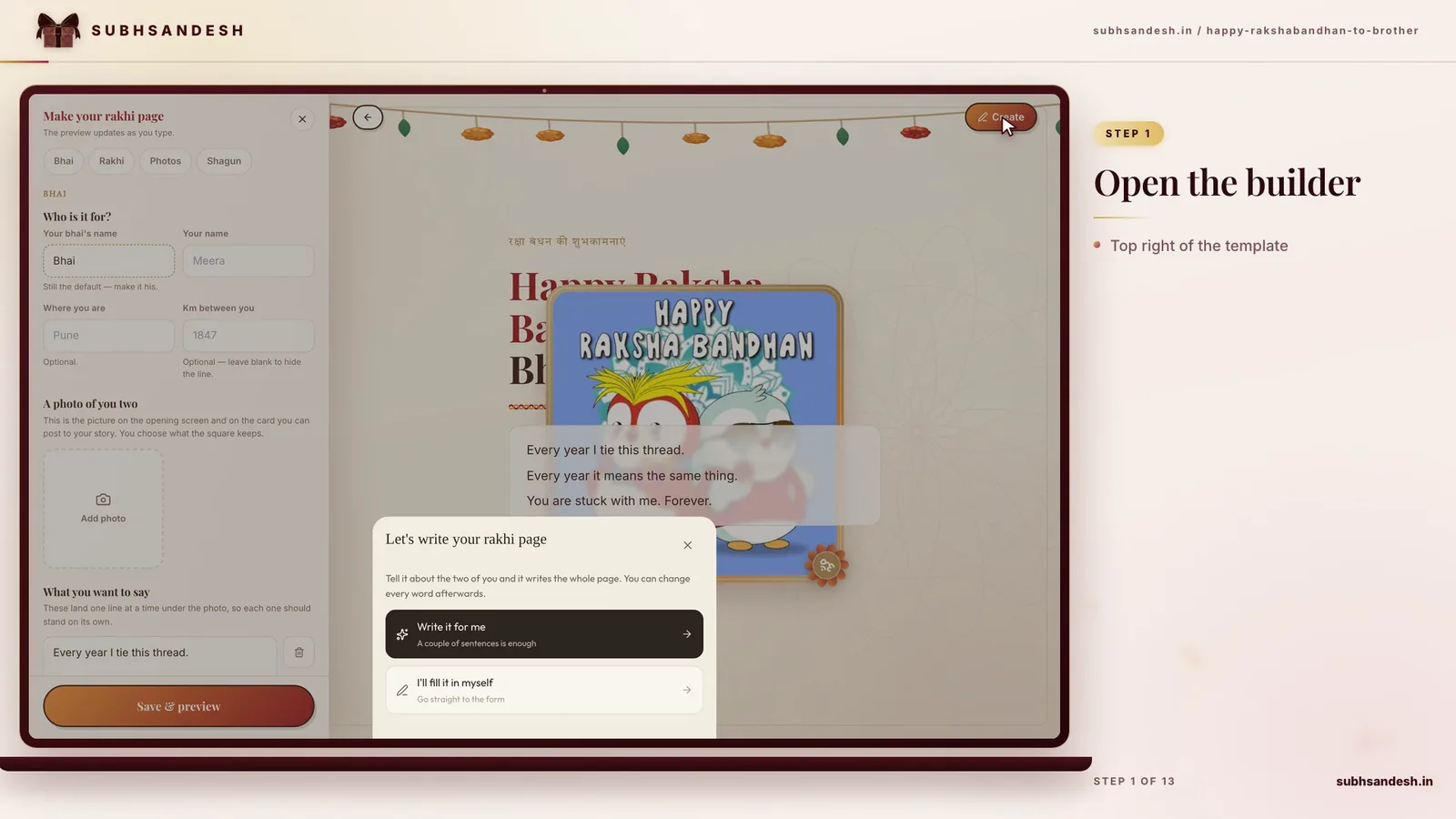
If the words deserve better than a chat thread, the Raksha Bandhan page for a brother takes your sher, his name and a photo and returns one private link, with animated tilak, aarti and rakhi-tying scenes around the verse. Same artifact whether he is in Indore or Toronto.
Two notes from the data: password-protect it if the sher is personal, as 44.7% of creators do, and build it the night before rather than at 05:57 AM, because the median creator spends 6.8 hours between first save and last edit. The animated greeting templates are quick; choosing your words is not.
Whichever of the eight you use, change one word to something only the two of you would understand. That edit is what separates a sent line from a written one.
Sources
- DrikPanchang — 2026 Raksha Bandhan muhurat, Delhi — undated live panchang page
- Academy of American Poets — Ghazal — undated glossary entry
- Audichya & Saini, "Stanza Type Identification using Systematization of Versification System of Hindi Poetry", IJACSA 12(1) — 2021, open access (CC BY 4.0)
- Zaman et al., "UPMVM: A Metrics Verification Model for Urdu Poetry", IJIMAI 9(6) — 2025, open access (CC BY 4.0)
First-party figures come from SubhSandesh's database, measured 13 August 2026.
Frequently Asked Questions
Turn this inspiration into an unforgettable surprise
Build a page with photos, a heartfelt message, music and a ready-to-share link.
- Photos, message & music
- Ready-to-share link

Written by
Suyash Agrahari
Founder
Suyash Agrahari is a Software Engineer at HireQuotient and the founder of SubhSandesh and DrawFlow (drawflow.in). He builds AI agents and full-stack products with Next.js, Node.js, and the OpenAI and LangChain ecosystems, having shipped autonomous multi-agent systems, AI copilots, and large-scale outreach platforms — and scaled side projects from a few hundred to millions of users. He writes about AI engineering, web development, and building products that grow through SEO and organic reach.
Stay Connected
Follow SubhSandesh
New templates, festival ideas and step-by-step walkthrough videos — first on our socials.
Product guide
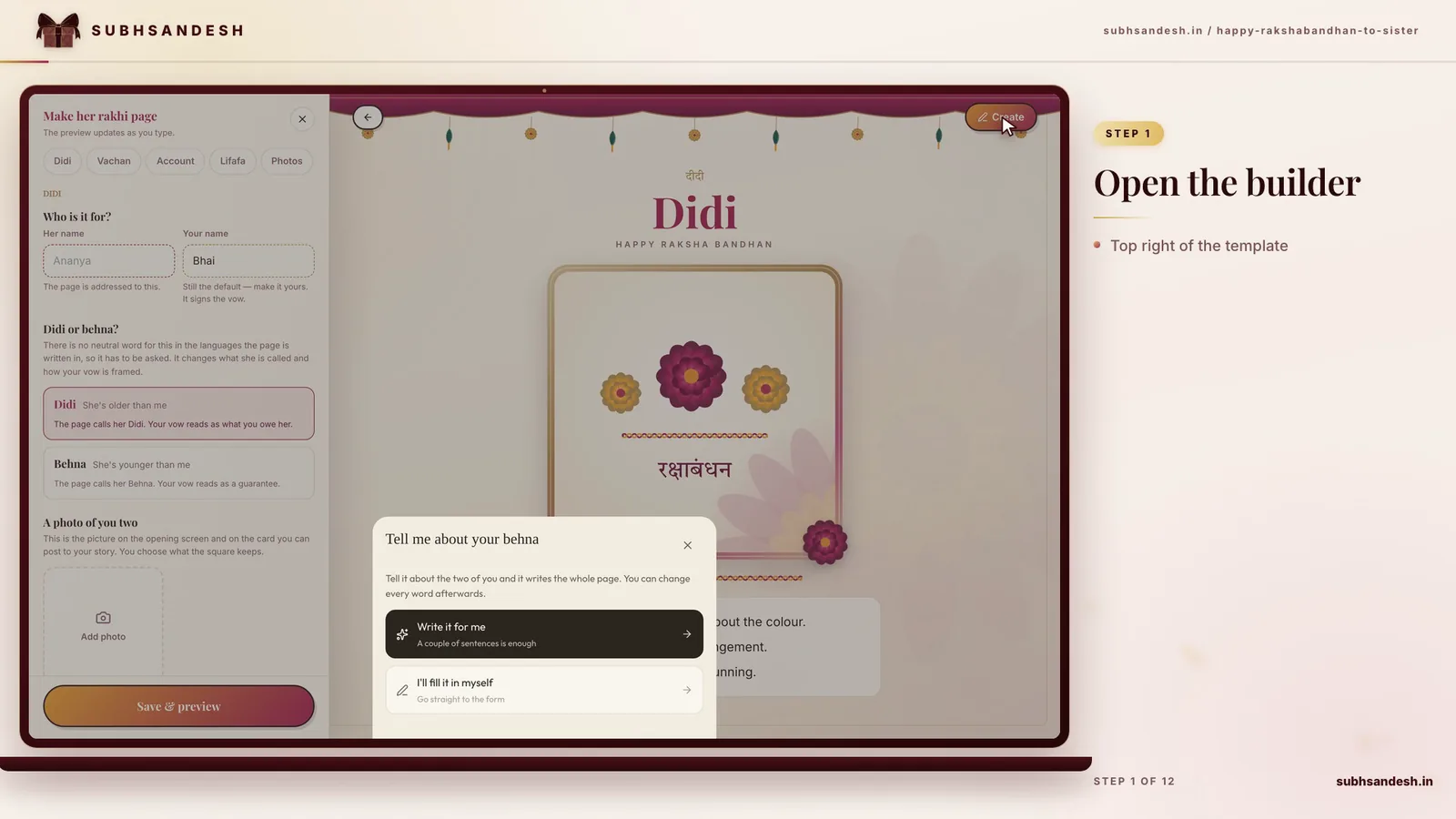
See it built, step by step
Keep reading
Thala Deepavali: A Couple's First Deepavali at the Bride's Home
Thala Deepavali is a Tamil couple's first Deepavali after marriage, at the bride's home. In 2027 it is Thursday 28 October, oil bath 4:40–6:01 AM in C…
 Suyash Agrahari· 9 min
Sugar-Free Diwali Sweets: Swaps, Label Warnings and the Evidence
Five original no-added-sugar Diwali sweets, why jaggery and honey do not count, the warnings FSSAI requires on a sugar-free box, and what an Indian su…
Suyash Agrahari· 9 minShort Diwali Quotes: 34 Original One-Liners Under 10 Words
34 original short Diwali quotes, each under ten words and marked with its word and character count, grouped by mood: lamps, family, friends, gratitude…
Suyash Agrahari· 9 min