
Bhai Dooj 2027: 31 October Tilak Time and a Sibling Far Away
Bhai Dooj 2027 is on Sunday 31 October. Tilak windows for Delhi, Mumbai, Kolkata and Chennai, why the gap after Diwali shrank from three days to two, the Rigveda roots of Yama and Yami, and four ways to mark it from another city.
Make this into a page you can send
Photos, a message, music and a ready-to-share link — in a couple of minutes.
or browse all occasionsKey takeaways
- • Bhai Dooj 2027 is Sunday 31 October; New Delhi's afternoon tilak window is 1:11-3:24 PM and Dwitiya tithi ends at 5:12 PM (Drik Panchang).
- • The gap after Diwali is two days in 2027 (Friday 29 to Sunday 31 October) against three in 2026, when Bhai Dooj fell on Wednesday 11 November.
- • DoPT's 2027 lists make Diwali a gazetted holiday and Bhai Duj a restricted one on a Sunday, giving Delhi central-government staff a three-day weekend.
- • On Raksha Bandhan 2026, the nearest sibling-festival data SubhSandesh holds (n = 89), 86.1% of on-time pages were built within 24 hours of the day.
On this page
Bhai Dooj 2027: 31 October Tilak Time and a Sibling Far Away
Bhai Dooj 2027 falls on Sunday, 31 October 2027, two days after Lakshmi Puja. In New Delhi the afternoon tilak window runs from 1:11 PM to 3:24 PM, and Dwitiya tithi ends at 5:12 PM.
For siblings who cannot share that afternoon, the nearest data SubhSandesh has is Raksha Bandhan 2026, a different festival and a small sample of 89 rakhi pages: of the 79 finished in time, 55.7% were built on the day itself and 86.1% within 24 hours of it. And 48.3% of all shared SubhSandesh pages are opened on a phone, so whatever reaches a far-away sibling will probably be read on one.
What is Bhai Dooj, and what else is it called?
Bhai Dooj is the sibling festival held on Kartika Shukla Dwitiya, the second lunar day after the Diwali new moon, when a sister applies a tilak to her brother's forehead, prays for his long life and feeds him, and he gives her a gift in return. It is the fifth and last day of Diwali.
It is Bhau Beej in Maharashtra, Bhai Phota in Bengal, Bhai Tika in Nepal, and Yama Dwitiya in panchangs. Unlike Raksha Bandhan, where the sister ties a thread, the older shape of Bhai Dooj has the brother travel to his sister's home and eat at her table, so it is the brother who plans the journey.
Bhai Dooj 2027 tilak timings in Delhi, Mumbai, Kolkata and Chennai
The tilak is traditionally given in the aparahna, the early-afternoon part of the day. Drik Panchang's Yama Dwitiya page for 2027 gives that window as 1:11 PM to 3:24 PM for New Delhi, with Dwitiya beginning at 5:51 PM on Saturday 30 October and ending at 5:12 PM on Sunday 31 October. I checked the same panchang for three other cities on 22 October 2026:
- New Delhi: 1:11 PM to 3:24 PM
- Mumbai: 1:31 PM to 3:48 PM
- Kolkata: 12:28 PM to 2:44 PM
- Chennai: 1:02 PM to 3:22 PM
The tithi start and end are single astronomical moments, so they hold across India; only the afternoon window moves with local sunset. Saturday evening is already Dwitiya, but the festival sits on Sunday because Sunday's whole afternoon falls inside it. A tilak after about 5:12 PM on Sunday lands in Tritiya, so a brother arriving on an evening train should aim for lunch instead.
Why the gap after Diwali is two days in 2027 but was three in 2026
Bhai Dooj is fixed by the tithi, not by counting days from Lakshmi Puja. In 2026, Diwali falls on Sunday 8 November and Bhai Dooj on Wednesday 11 November, according to Drik Panchang's 2026 listing. Dwitiya began only at 2:00 PM on 10 November, after the afternoon window had opened, and ran to 3:53 PM on 11 November, so the 11th was the day whose afternoon it fully covered.
In 2027 there is no gap day: Diwali is Friday 29 October, Govardhan Puja Saturday 30 October and Bhai Dooj Sunday 31 October. The same panchang places Bhai Dooj 2028 on Thursday 19 October.
Office calendars line up too. The Department of Personnel and Training's order of 16 July 2026 makes Friday 29 October a gazetted Diwali holiday for central government offices in Delhi, and its restricted list carries Govardhan Puja on 30 October, Bhai Duj on 31 October and Chhath Puja on Thursday 4 November. For a Monday-to-Friday worker that is a three-day weekend ending on Bhai Dooj.
The Yama and Yami story, and the Rigveda hymn behind it
The story recited at Bhai Dooj is short. Yamuna keeps inviting her brother Yama, god of death, to her home; when he finally comes on Kartika Shukla Dwitiya she feeds him and marks his forehead, and he grants that a brother who eats at his sister's house that day will not be taken before his time. It is why the meal, more than the gift, is the centre of the day in many homes.
Rigveda Book 10, Hymn 10, in Ralph Griffith's 1896 translation, is a dialogue between the twins Yama and Yami about where kinship draws its lines. In verse 12 Yama tells his sister, "thy brother seeks not this from thee", and in verse 14 he wishes her a happy marriage with someone else.
The 14 verses mention no meal, no tilak and no month. Later tradition identifies Yami with the river goddess Yamuna and adds the invitation story; the household ritual is a later layer.
How the Bhai Dooj tilak is done, in 7 steps
Customs vary by family, and this is the common northern Indian order. Bhai Phota and Bhau Beej change the paste and food more than the structure.
- The sister bathes in the morning and, in many families, does not eat until the tilak is done.
- She prepares a thali with roli or kumkum, a few grains of rice, a small diya, sweets and dry fruit.
- The brother sits on a low seat, often with a cloth on his head.
- She applies the tilak and presses rice onto it; some families also tie a thread on his wrist.
- She performs aarti with the diya and offers him a sweet.
- She serves him a meal, the part the Yama story is about.
- He gives her a gift, traditionally clothes, money or something according to his means.
In parts of Uttar Pradesh the tilak is given on a chowk, a floor drawing made for the day. A May 2026 study of thirty practitioners in Kanpur district catalogued 39 motifs in this Bhaiya Dooj chowk. Its folk story has the sister strike a dog, her disguised brother, with a pestle; the rite recalls it by tapping a diya-topped thorny branch seven times with a wooden pestle while she prays for his safety, before the tilak.
Four ways to mark Bhai Dooj 2027 from a different city
Distance changes what siblings can do for each other. A 2026 open-access study of 2,663 Finnish adults aged 68 to 74, published in The Journals of Gerontology, found that living close strengthened the exchange of practical help between siblings, with a 10 km threshold approximating it well, though people without a partner or children still helped siblings across long distances. My reading: a yearly meal at a sister's home is the contact distance erodes first.
1. Travel for the Sunday afternoon
What it is: the brother reaches his sister's home before about 1 PM on 31 October. Who it suits: siblings one overnight journey apart or less.
Time needed: the Friday-to-Sunday weekend above. Timing: leave Saturday and eat Sunday lunch inside the window.
2. A video-call tilak inside the window
What it is: a call placed between 1:11 PM and 3:24 PM IST, with the brother applying the tilak himself as she says the words. Who it suits: siblings abroad, with about 20 minutes needed.
Timing: British clocks go back on 31 October 2027, so in London the window is 7:41 AM to 9:54 AM GMT. New York stays on daylight time until 7 November, putting it at 3:41 AM to 5:54 AM, so a Saturday-night call is the realistic compromise there.
3. Send a small tilak kit ahead
What it is: roli, a pinch of rice and one boxed sweet posted by the sister, so the brother has a thali on the day. Who it suits: siblings within India who cannot travel.
Time needed: an hour to pack. Timing: I have no courier data for Diwali week, so post it in the week of 18 October rather than gamble.
4. A greeting page opened on the day
What it is: a private link with photos, a letter and music. Who it suits: siblings abroad, or a brother who cannot take a call at lunch.
Time needed: about five minutes. Timing: the median rakhi page took 5.4 hours from first save to last edit (n = 89), so start that morning.
SubhSandesh has no Bhai Dooj page, so the closest fit is the SubhSandesh interactive Happy Diwali card in family mode: your sibling lights wish diyas, colours a rangoli until your initials glow and opens sky lanterns holding up to six photos, a letter in a shagun liffafa and a box of mithai. It has no tilak scene.
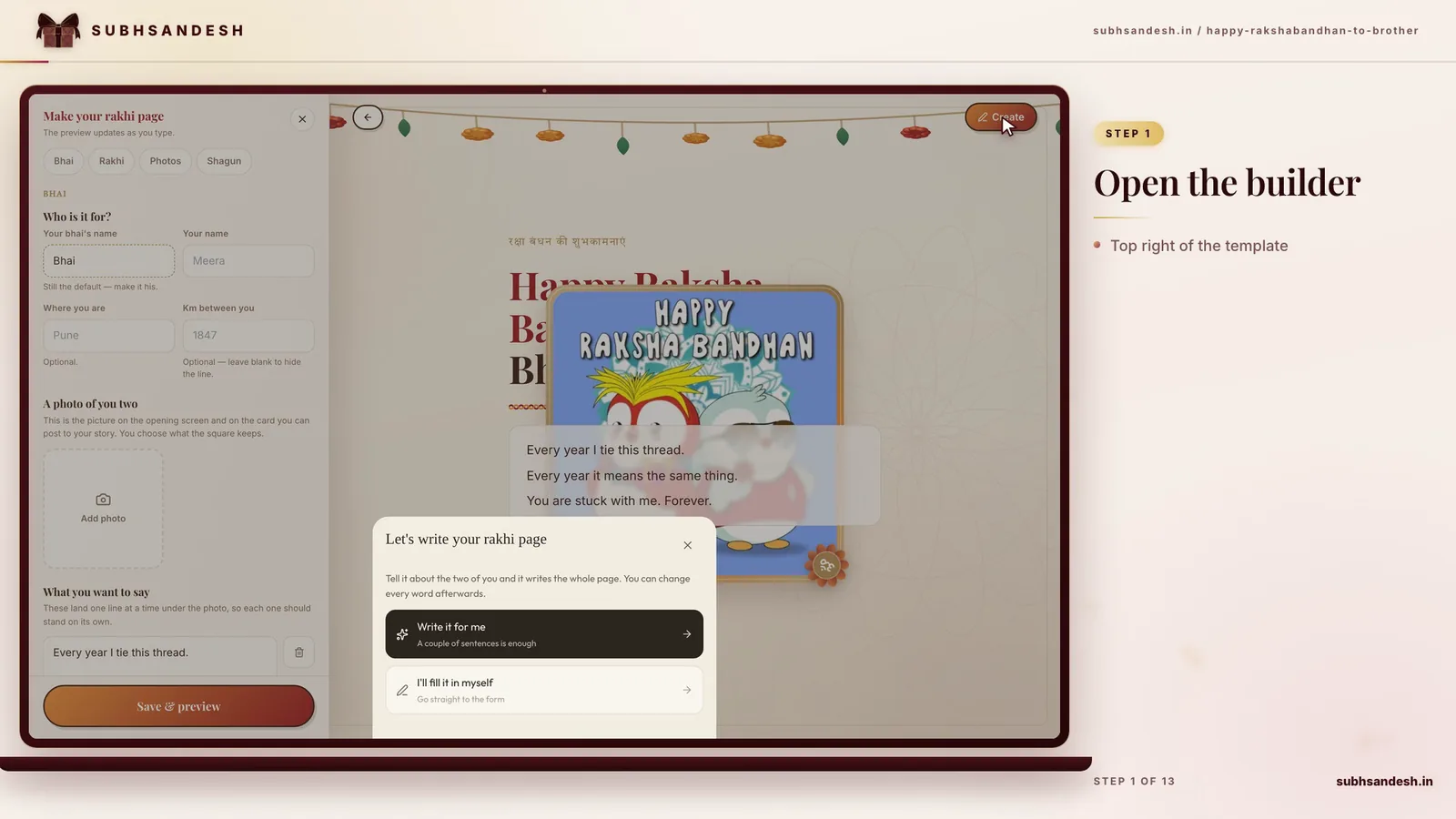
The Raksha Bandhan page for a brother has one, where he does the tilak, mithai and aarti on his phone. But it is a Raksha Bandhan template and ends with him tying a rakhi.
Raksha Bandhan and Bhai Dooj in 2027, side by side
The table sets the two sibling days beside the Diwali dates. Holiday status comes from the DoPT order, the last column from SubhSandesh's own data.
| Occasion | 2027 date | Delhi central-government status | SubhSandesh data |
|---|---|---|---|
| Raksha Bandhan | Tuesday 17 August | Restricted holiday | 89 rakhi pages in 2026; 49.4% built on the day, 11.2% after it passed |
| Diwali (Lakshmi Puja) | Friday 29 October | Gazetted holiday | No Diwali data yet; the template is new |
| Govardhan Puja | Saturday 30 October | Restricted holiday | Not measured |
| Bhai Dooj | Sunday 31 October | Restricted holiday, on a Sunday | Not measured; Rakhi 2026 is the nearest analogue |
Bhai Dooj 2027 needs no leave for most office workers. Our only sibling-festival evidence says people act late: one rakhi page in nine came after Raksha Bandhan.
When a link is the wrong Bhai Dooj gesture
A page does not replace the meal. If you are within a day's journey of your sister, go; the point of the Yama story is that the brother turns up and eats.
The average SubhSandesh page is viewed 11.1 times, so people do return to them, but no link puts food on a plate. A link is also wrong for a sibling who rarely opens them, for families where the tilak must be in person, and for siblings who have fallen out; there, a phone call says more.
Sources
- Drik Panchang, Yama Dwitiya 2027 date and time, New Delhi (date reference, no publication date).
- Griffith, The Hymns of the Rigveda, Book 10, Hymn 10 (1896), Wikisource.
- Artamonova et al., "Support exchange between siblings in later life", Journals of Gerontology B (2026), Europe PMC.
- Pandey et al., "Designing Ritual Narratives: A Semiotic Analysis of Bhaiya Dooj Chowk Poorana Folk Art", The International Journal of Visual Design (8 May 2026), ResearchGate.
Frequently Asked Questions
Turn this inspiration into an unforgettable surprise
Build a page with photos, a heartfelt message, music and a ready-to-share link.
- Photos, message & music
- Ready-to-share link

Written by
Suyash Agrahari
Founder
Suyash Agrahari is a Software Engineer at HireQuotient and the founder of SubhSandesh and DrawFlow (drawflow.in). He builds AI agents and full-stack products with Next.js, Node.js, and the OpenAI and LangChain ecosystems, having shipped autonomous multi-agent systems, AI copilots, and large-scale outreach platforms — and scaled side projects from a few hundred to millions of users. He writes about AI engineering, web development, and building products that grow through SEO and organic reach.
Stay Connected
Follow SubhSandesh
New templates, festival ideas and step-by-step walkthrough videos — first on our socials.
Product guide
See it built, step by step
Keep reading
Thala Deepavali: A Couple's First Deepavali at the Bride's Home
Thala Deepavali is a Tamil couple's first Deepavali after marriage, at the bride's home. In 2027 it is Thursday 28 October, oil bath 4:40–6:01 AM in C…
 Suyash Agrahari· 9 min
Sugar-Free Diwali Sweets: Swaps, Label Warnings and the Evidence
Five original no-added-sugar Diwali sweets, why jaggery and honey do not count, the warnings FSSAI requires on a sugar-free box, and what an Indian su…
Suyash Agrahari· 9 minShort Diwali Quotes: 34 Original One-Liners Under 10 Words
34 original short Diwali quotes, each under ten words and marked with its word and character count, grouped by mood: lamps, family, friends, gratitude…
Suyash Agrahari· 9 min