
Ganesh Chaturthi Greeting Card: What Still Arrives In Time
A Ganesh Chaturthi greeting card posted cross-country needed to be in the box by 7 September for a 14 September festival — India Post allows Speed Post 4–5 days. An image or a link arrives in seconds, which is what 49.4% of measured festival senders needed.
Make this into a page you can send
Photos, a message, music and a ready-to-share link — in a couple of minutes.
or browse all occasionsKey takeaways
- • India Post allows Speed Post 4–5 days to the rest of the country, so a card for Ganesh Chaturthi on 14 September 2026 needed posting by about 7 September.
- • Delivered, a printed card costs ₹146–₹546 (₹99–₹499 plus ₹47 postage, GST extra); an image or a page link costs ₹0 and arrives in seconds.
- • Of 89 rakhi pages we measured for Raksha Bandhan 2026, 49.4% were built on the festival day itself and none more than seven days ahead — a different festival, and a small sample.
- • The printed card wins on being kept: Hill and Dunbar's 43 households sent 2,984 cards mapping networks of about 153.5 people, one envelope-sized decision at a time.
- • 49.6% of our 46,005 recorded page views come from a phone, so a link is the wrong format for a recipient who does not use one.
On this page
Ganesh Chaturthi Greeting Card: What Still Arrives In Time
A Ganesh Chaturthi greeting card comes in four forms — a printed card you post, one you make by hand, a name-style image from an online photo editor, or a link to a page — and only the printed one has a deadline you can miss. Ganesh Chaturthi 2026 falls on Monday 14 September. India Post's own service standard for Speed Post is 4–5 days to the rest of the country, so a posted card had to be in the box by about 7 September; the other three arrive in seconds.
That gap matters, because the one festival we have actually measured says senders do not plan: of 89 rakhi pages built for Raksha Bandhan 2026, 49.4% were built on the festival day itself, and the median lead time was 0 days. Meanwhile 49.6% of our 46,005 recorded page views come from a phone. Below are the real posting dates, the delivered cost of each format, and where a printed card still beats a link.
What a Ganesh Chaturthi greeting card is: four formats, one deadline
A Ganesh Chaturthi greeting card is any object or file carrying a Ganesh Chaturthi wish addressed to a named person — usually "Ganpati Bappa Morya" or "Ganesh Chaturthi ki hardik shubhkamnaye", with the sender's and recipient's names on it. The formats differ on exactly one thing: whether the greeting has to travel physically.
A printed card travels, so it inherits constraints: India Post caps a Speed Post document at 420 × 297 × 24 mm and 500 g, charges for it, and delivers it on a published schedule. An image file and a page link inherit none of that, and that single difference decides what you can still do four days out.
The posting deadline for 14 September 2026 was 7 September cross-country
India Post publishes its delivery norms in the Citizens' Charter of the Department of Posts: Speed Post is 1–2 days local, 1–3 days metro to metro, 1–4 days between state capitals or within a state, and 4–5 days to the rest of the country. Sundays and gazetted holidays are excluded, and anything booked or delivered at a Branch Office takes one extra day.
Counted back from Monday 14 September 2026, the last safe posting day was about Monday 7 September for a cross-country card, Wednesday 9 September metro to metro, and Friday 12 September inside the same city. Ordinary post is slower again: the same charter allows First Class Mail — letters, postcards and inland letter cards — 5–6 days to the rest of the country.
After 9 September the cross-country window is shut. That is not a reason to send nothing; it is a reason to stop shopping for a card.
Four ways to send a Ganesh Chaturthi greeting card, priced
1. A printed card bought off a shelf
Folded religious-festival cards were listed on Indian retail shelves at roughly ₹99–₹499 when we checked the shopping results for this query on 9 September 2026, with wooden and laser-cut cards above that. Nothing is editable once it is posted, and you learn whether it arrived only from the tracking number.
2. A card made by hand
Free if you already own card stock and sketch pens, and it carries more weight per rupee than anything else here. It costs the one thing a late sender has run out of — an evening — and it still has to be delivered.
3. A name-style image from an online photo editor
A Ganesh image with the recipient's name burned into the JPEG, built in a browser in a couple of minutes and sent on WhatsApp for nothing. It lands instantly and it is final: once the file is delivered, a misspelt name stays misspelt in their gallery.
4. A shareable page with a link
A page the recipient opens on their phone, with the names and photo held as live text instead of baked into pixels. It costs nothing, arrives in seconds, and stays editable after the link has gone out.
Card against page: ₹146 and five working days versus ₹0 and seconds
Delivered cost and delivered time for the same wish, with our own measurement in the last column.
| Format | Cost delivered | Reaches them in | What we measured |
|---|---|---|---|
| Printed card, Speed Post to the rest of the country | ₹146–₹546 (₹99–₹499 card + ₹47 postage, GST extra) | 4–5 working days | No first-party data; the 7 September cut-off has passed |
| Printed card, Speed Post inside the same city | ₹118–₹518 (₹99–₹499 card + ₹19 postage, GST extra) | 1–2 working days | No first-party data; same-city cut-off is 12 September |
| Name-style image sent on WhatsApp | ₹0 | Seconds | 49.6% of our 46,005 page views come from a phone |
| Shareable page with a link | ₹0 | Seconds | Median 5.4 hours from a festival page's first save to its last edit (n=89) |
Speed Post rates come from India Post's own domestic Speed Post tariff — ₹47 countrywide, ₹19 local, up to 50 g, GST extra. The table is why the "which is nicer" argument is academic: past 9 September, two of the four rows are gone.
What the printed card does that no page can: 2,984 cards across 43 households
R. A. Hill and R. I. M. Dunbar had people fill in a questionnaire while they were actually addressing their Christmas cards, and collected 43 completed returns covering 2,984 cards for Human Nature in 2003. The mean household sent 68.19 cards, range 11–149. Those lists mapped a social network averaging 153.5 people, of whom roughly 21% were relatives.
That is the printed card's real function, and it is not aesthetic. Writing a card is a decision about who is inside your circle of about 150, made one envelope at a time, and the recipient can feel it. A greeting forwarded into a group of 200 makes no such decision, which is why it reads as traffic rather than as a gift.
The card is also an object. The scholarship on greeting cards treats them as socio-cultural and historical heritage rather than as a means of transmitting information — a 2022 open-access review of greeting-card research makes exactly that point about the postal card of the late nineteenth century.
A card props up on a shelf for the ten days to Anant Chaturdashi on 25 September. A link does not.
Be careful with the Hill and Dunbar numbers, though: 43 British households at Christmas is not 89 Indian senders at a Hindu festival, and neither sample is large.
Why 67% pick the easier channel, and what our 89 rakhi pages say
Asked to reconnect with someone from their past, 67% of 200 participants said they would rather do it by email than by phone — while simultaneously predicting they would form a stronger bond by phone. When the researchers ran it, voice produced stronger bonds and no more awkwardness than text (Amit Kumar and Nicholas Epley, Journal of Experimental Psychology: General, 2020). People reliably pick the lower-effort channel and misprice the richer one.
Our own numbers point the same way on timing rather than on medium.
Across both rakhi collections, n = 89 pages: 6.7% were built four or more days ahead, 5.6% two to three days ahead, 27.0% the day before, 49.4% on the day itself, and 11.2% after the festival had passed. Not one was built more than seven days ahead. Of the 79 that landed in time, 86.1% were finished within 24 hours of the festival.
Two things have to be said about that measurement. It is Raksha Bandhan 2026, not Ganesh Chaturthi — a different festival, and a one-day one, where Ganesh Chaturthi runs ten days to Anant Chaturdashi. The shape is suggestive for this festival, not measured for it.
And n = 89 is small. Do not read a per-template or per-region rate off it, and do not project a count of Ganesh pages from it: occasion-dated pages are 144 of our 3,894 pages, 3.7%, and we have no Ganesh page-creation data at all.
When a link is the wrong answer: 49.6% phone views, 0% on a landline
A link fails outright when the recipient cannot open one. 49.6% of our views arrive on a phone, but a household on a landline is 0% of that, and a printed card is the only format that works there. A mandap noticeboard, a society gate and a card handed to a neighbour all want paper too.
A page is also worse than a card at the one thing a card is unbeatable at: being kept. Nobody puts a URL in a drawer for twenty years.
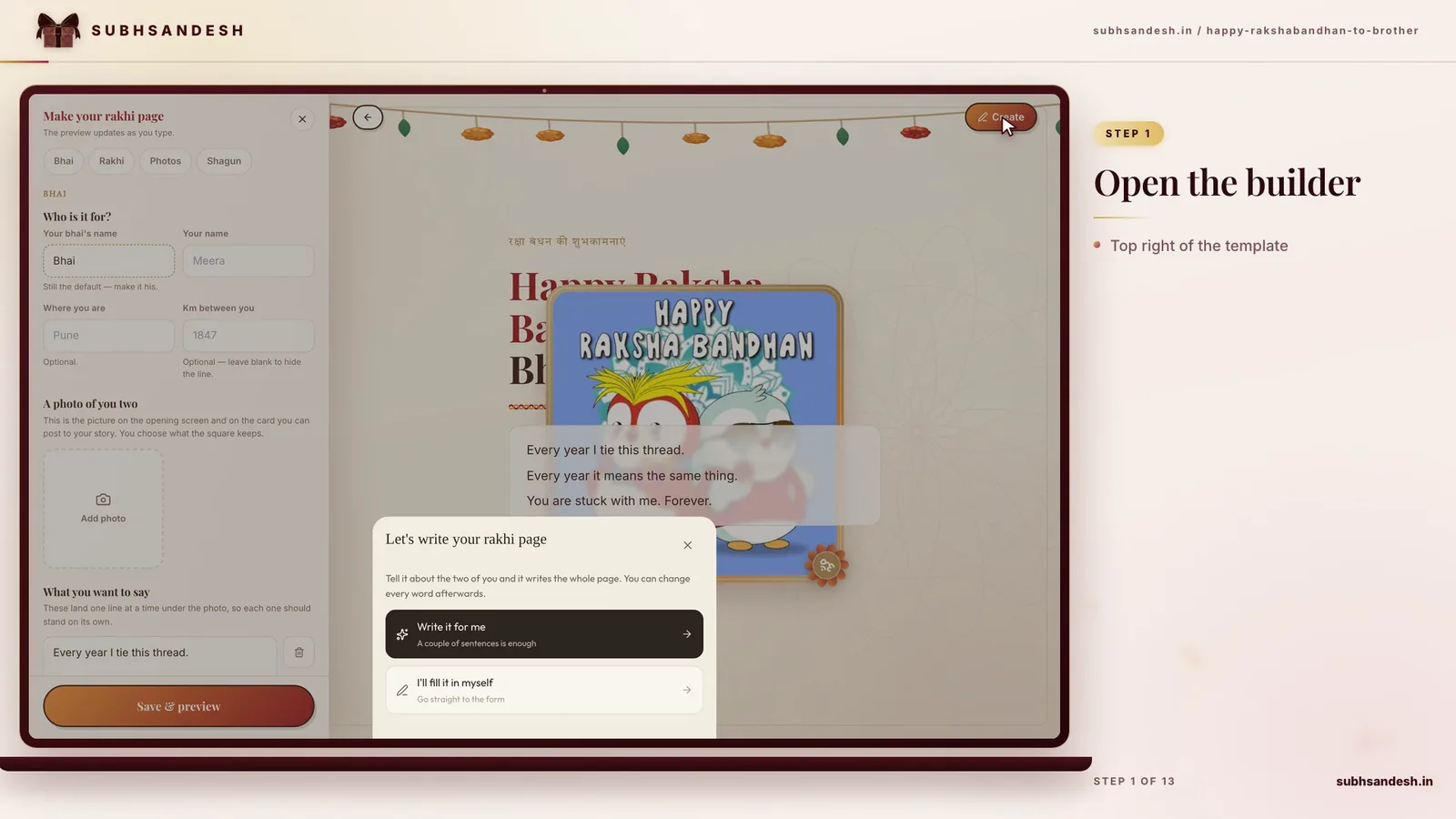
Where the page does win, you can send it tonight. The Ganesh Chaturthi page hands the recipient the ritual — they offer the durva, kumkum, flowers and modak, the aarti thali circles, and they write their prarthana back to you — and the step-by-step build guide walks through making one. The Raksha Bandhan page for a brother is the collection the 89-page measurement above comes from, and the animated shaadi card is the closest thing we have to a card that is also a page.
Watch the page get built
Ninety seconds, start to finish — the aarti going round, the five offerings, and the box at the end where they write a line back to you: Ganesh Chaturthi Wishes Online — Full Walkthrough. More page walkthroughs on Instagram: @subhsandesh_official.
Sources
- India Post, Citizens' Charter of the Department of Posts, 2021 — Speed Post 1–2 days local to 4–5 days countrywide; First Class Mail 5–6 days.
- India Post, Domestic Speed Post Document — ₹47 nationwide, ₹19 local, up to 50 g, GST extra.
- Hill and Dunbar, Social Network Size in Humans, Human Nature 14(1), 2003 — 2,984 Christmas cards, 43 households.
- Kumar and Epley, It's Surprisingly Nice to Hear You, J. Exp. Psychol. General, 2020 — 67% of 200 chose email.
- Davydova, Thematic analysis of greeting-card scholarship, Theory and Practice of Design 1(25), 2022 — open access.
Frequently Asked Questions
Turn this inspiration into an unforgettable surprise
Build a page with photos, a heartfelt message, music and a ready-to-share link.
- Photos, message & music
- Ready-to-share link

Written by
Suyash Agrahari
Founder
Suyash Agrahari is a Software Engineer at HireQuotient and the founder of SubhSandesh and DrawFlow (drawflow.in). He builds AI agents and full-stack products with Next.js, Node.js, and the OpenAI and LangChain ecosystems, having shipped autonomous multi-agent systems, AI copilots, and large-scale outreach platforms — and scaled side projects from a few hundred to millions of users. He writes about AI engineering, web development, and building products that grow through SEO and organic reach.
Stay Connected
Follow SubhSandesh
New templates, festival ideas and step-by-step walkthrough videos — first on our socials.
Product guide
See it built, step by step

Keep reading
Thala Deepavali: A Couple's First Deepavali at the Bride's Home
Thala Deepavali is a Tamil couple's first Deepavali after marriage, at the bride's home. In 2027 it is Thursday 28 October, oil bath 4:40–6:01 AM in C…
 Suyash Agrahari· 9 min
Sugar-Free Diwali Sweets: Swaps, Label Warnings and the Evidence
Five original no-added-sugar Diwali sweets, why jaggery and honey do not count, the warnings FSSAI requires on a sugar-free box, and what an Indian su…
Suyash Agrahari· 9 minShort Diwali Quotes: 34 Original One-Liners Under 10 Words
34 original short Diwali quotes, each under ten words and marked with its word and character count, grouped by mood: lamps, family, friends, gratitude…
Suyash Agrahari· 9 min