
Happy Ganesh Chaturthi With Name: What Actually Lands
A name burned into a JPEG cannot be corrected once it is sent. Five ways to put a name on a Ganesh Chaturthi greeting for 14 September 2026, with what each one costs you when the spelling is wrong.
Make this into a page you can send
Photos, a message, music and a ready-to-share link — in a couple of minutes.
or browse all occasionsKey takeaways
- • Ganesh Chaturthi 2026 is Monday 14 September; visarjan on Anant Chaturdashi is Friday 25 September.
- • A name drawn into a JPEG is permanent at the moment of sending; a name stored as text on a page can still be corrected on the same link.
- • Adding a recipient's name to an email subject line raised opens by 20% and leads by 31% in Stanford GSB field experiments — attention, not information, is doing the work.
- • Across all 3,860 SubhSandesh pages platform-wide (15 page types), 96.1% of started pages are published and shared and 49.6% of 45,656 views are on a phone.
- • The median gap between a page's first save and its last edit is 6.8 hours (sampled on /love-gf, n=1,065) — people keep fixing things after they think they are done.
On this page
Happy Ganesh Chaturthi With Name: What Actually Lands
"Happy Ganesh Chaturthi with name" almost always means a JPEG from a name-on-photo site, with someone's name baked into the pixels. It works, and it has one flaw nothing fixes: the spelling is final the moment you tap send. Ganesh Chaturthi 2026 falls on Monday 14 September, with visarjan on Friday 25 September, so most named greetings go out in a few hours on one morning, at speed, into groups. The alternative is to keep the name as live text on a page rather than as pixels in a file. Across all 3,860 personalised pages SubhSandesh has built since March 2026 — platform-wide, across 15 page types — 96.1% of started pages are actually published and shared, and 49.6% of the 45,656 recorded views are opened on a phone. Below: what the name is really doing, five formats, and where each one breaks.
What "happy Ganesh Chaturthi with name" actually means
It means a Ganesh Chaturthi greeting in which the recipient's name is part of the greeting itself, not the message around it. The name sits on the artwork — under the idol, on a modak, along the border — so it reads as addressed rather than forwarded.
Two things get called by that name and they behave differently. One is an image file, where the name is drawn into the picture and becomes pixels. The other is a page, where the name is stored as text and drawn fresh on every open. Everything below follows from that split.
Why a name on a greeting changes what the recipient does
Your own name is one of the few strings that pulls attention away from whatever you were doing. In a 2024 study in Cognitive Research: Principles and Implications, 39 participants categorising words on screen were measurably slower when their own name played in the background than when other names did, and faster at spotting their own name in a later detection test.
The second half of that study matters here. When the same names were time-compressed, the interference weakened, and it was weakest at the most intense compression — the signal still carried a name, but it stopped commanding attention. Degrade the delivery and you degrade the effect.
The commercial version is well measured. In a Stanford GSB working paper dated 23 October 2016, Sahni, Wheeler and Chintagunta report field experiments in which adding the recipient's name to an email subject line raised the probability of it being opened by 20%, lifted sales leads by 31% and cut unsubscribes by 17% — with no extra product information.
The folk explanation is the name-letter effect — that people prefer letters from their own name, and by extension brands and places sharing them. Be careful with it. Testing it at scale on Twitter and Google+ in 2014, Kooti, Magno and Weber found limited to no support for the name-letter effect online, though a same-name effect held up robustly. The attention finding is solid; the letter-preference story is not.
Five ways to put a name on a Ganesh Chaturthi greeting
Ordered by how well the name survives the trip.
1. A name burned into a JPEG by an online photo editor
A free web tool renders the name onto stock Ganesha artwork and hands you a download. Suits one or two greetings, where you want a file you can forward anywhere. Under a minute per name. What breaks: the name is pixels now, so a typo needs a fresh file, and messaging apps that recompress images degrade the smallest text in the frame first — usually the name.
2. A stock image plus the name typed into the WhatsApp message
You send a generic Ganpati image and write "Happy Ganesh Chaturthi, Meera" above it. Suits bulk sending to a long contact list, seconds per person once the image is saved. What breaks: the name and the greeting are two separate objects — forward the image and the name is gone, and in a group the text reaches one person while everyone else reads a generic picture.
3. A printed card with the name written by hand
A shop-bought card or a mandal's printed invite, name filled in with a pen. Suits neighbours, an office desk drop, elders who do not use WhatsApp. Costs whatever the card costs and requires you to be in the same city. What breaks: distance and time. It cannot reach a cousin in Pune on the morning of the 14th, and there is no version of it that arrives at 6am.
4. The name in an Instagram story caption or a sticker
You post the artwork to your story and tag or type the person's name. Suits public wishes where being seen wishing is part of the point. Free, under a minute. What breaks: it expires in 24 hours, it addresses your whole follower list at once, and the named person may never open it.
5. The name held as live text on a page the recipient opens
A link that renders the name from stored text on every load, alongside whatever else the page does. The Ganesh Chaturthi page the recipient performs themselves works this way — they offer the durva, kumkum, flowers and modak, the aarti thali circles while Karpur Gauram plays, and they write their own prarthana back. What breaks: it needs a browser and a live connection.
Name style: what survives a phone screen
"Name style" usually means the script and the lettering. Both decisions are made for you by the screen the greeting lands on, and that screen is small: 49.6% of the 45,656 views recorded across all 15 SubhSandesh page types are on a phone, and common Indian handsets render a page at roughly 360 to 412 logical pixels wide.
Devanagari and Roman behave differently at that size. Devanagari carries its shirorekha along the top and its matras above and below the baseline, so it needs more vertical room than Roman before conjuncts start closing up. A name in Marathi or Hindi script needs noticeably more line height than the same name in Roman.
Two style habits ruin more named greetings than anything else. Gold lettering on a gold-and-saffron mandap background looks correct on a desktop preview and disappears on a phone in daylight. And a name set at the same weight as the surrounding "Happy Ganesh Chaturthi" reads as decoration rather than address — the name should be the heaviest thing in the frame after the deity.
The practical test is not the preview: open it on your own phone, outdoors, and check that you read the name before anything else. The SubhSandesh template gallery shows how each layout handles a long name.
A JPEG with a name against a page with a name
The comparison that matters is not which looks better, but what happens after you send it — when the name turns out to be Sanket, not Sanjeet.
| Format | Fixing a misspelt name after you send | Recipient needs | SubhSandesh platform-wide data |
|---|---|---|---|
| Name burned into a JPEG | No — send a second file; the wrong one stays in the chat | An image viewer | Not a SubhSandesh format |
| Stock image, name typed in the message | Only inside the delete-for-everyone window | Not a SubhSandesh format | |
| Printed card, name written by hand | No | To be handed it | Not a SubhSandesh format |
| Name as live text on a page | Yes — edit, and the same link updates | A browser and a link | 49.6% of 45,656 views on a phone; 42.1% of 3,860 pages password-protected |
Three of the four treat the name as permanent at the moment of sending. One treats it as something you can still be wrong about.
Getting the spelling right, and fixing it when you get it wrong
Getting a name wrong is not a small error. A 2022 MedEdPORTAL workshop on names by Dali and colleagues, evaluated with 78 post-workshop survey responses across three conferences, is built on the finding that chronic mispronunciation of a name undermines identity and is experienced as a microaggression — the written equivalent is a festival greeting that spells a relative's name the way you have always guessed it.
People do keep editing. The median gap between a page's first save and its last edit on SubhSandesh is 6.8 hours, sampled on the "I love you" page with n=1,065 and measured platform-wide on 8 September 2026. A meaningful share of creators come back the same day and change something.
There is a ceiling on this. A 2025 experiment in Behavioral Sciences with 360 participants found a personalisation backfire effect: once privacy concerns were primed, messages built on personally identifiable information performed no better than a generic message and worse than moderate personalisation. A name is moderate. A name plus their photo plus their family details, from someone they barely know, is the condition that backfired.
So personalise with what the person has already given you. The named-recipient pages we ship — including the Raksha Bandhan page for a brother, same mechanic — ask for a name and a photo you already have, and nothing else.
When a name on a screen is the wrong choice
A page with a name on it cannot put you at the mandap and cannot hand anyone a modak. For the people you will actually see between 14 and 25 September, showing up is the greeting; anything on their phone is a footnote.
It is also wrong for an elder without a smartphone, and for a housing-society or mandal announcement meant to reach everyone at once rather than one named person. Half of all SubhSandesh views — 49.6% of 45,656, platform-wide — are on a phone, which is another way of saying half are not.
And if you are sending to forty people in one broadcast, a named page per person is forty pages. That is real work. A generic image with the name typed above it is the honest answer for bulk sending, and pretending otherwise would be selling you something.
Watch the page get built
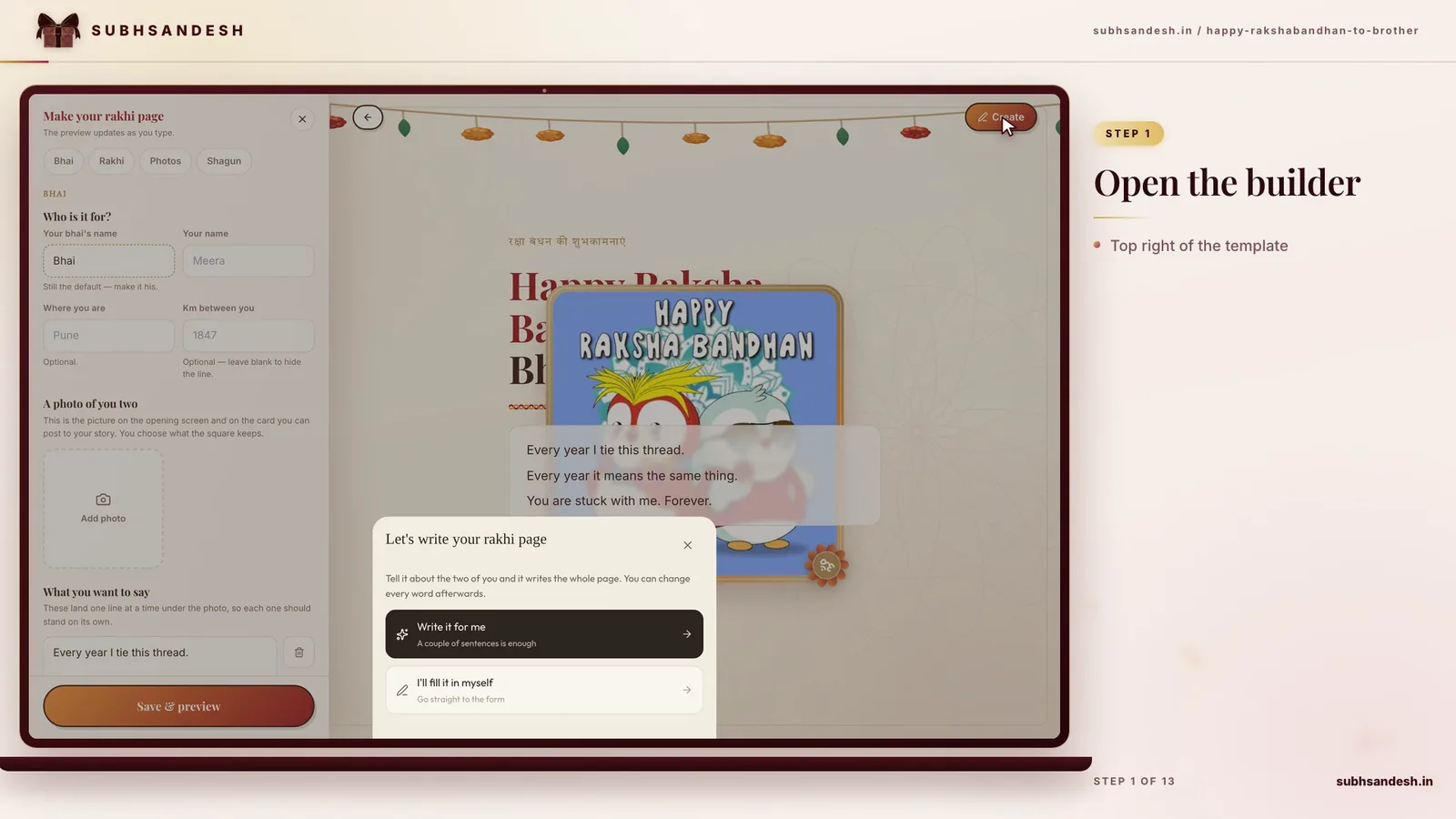
Ninety seconds, start to finish — the aarti going round, the five offerings, and the box at the end where they write a line back to you: Ganesh Chaturthi Wishes Online — Full Walkthrough. More page walkthroughs on Instagram: @subhsandesh_official.
Sources
- Li et al., "Attention capture by own name decreases with speech compression", Cognitive Research, 12 May 2024 (CC BY).
- Sahni, Wheeler & Chintagunta, "Personalization in Email Marketing", Stanford GSB Working Paper 3409, 23 October 2016.
- Kooti, Magno & Weber, "The Social Name-Letter Effect on Online Social Networks", arXiv, 20 November 2014.
- Kim & Han, "Triggering the Personalization Backfire Effect", Behavioral Sciences 15(10):1323, 26 September 2025 (CC BY).
- Dali et al., "Say My Name", MedEdPORTAL, 29 November 2022 (CC BY).
Frequently Asked Questions
Turn this inspiration into an unforgettable surprise
Build a page with photos, a heartfelt message, music and a ready-to-share link.
- Photos, message & music
- Ready-to-share link

Written by
Suyash Agrahari
Founder
Suyash Agrahari is a Software Engineer at HireQuotient and the founder of SubhSandesh and DrawFlow (drawflow.in). He builds AI agents and full-stack products with Next.js, Node.js, and the OpenAI and LangChain ecosystems, having shipped autonomous multi-agent systems, AI copilots, and large-scale outreach platforms — and scaled side projects from a few hundred to millions of users. He writes about AI engineering, web development, and building products that grow through SEO and organic reach.
Stay Connected
Follow SubhSandesh
New templates, festival ideas and step-by-step walkthrough videos — first on our socials.
Product guide
See it built, step by step

Keep reading
Thala Deepavali: A Couple's First Deepavali at the Bride's Home
Thala Deepavali is a Tamil couple's first Deepavali after marriage, at the bride's home. In 2027 it is Thursday 28 October, oil bath 4:40–6:01 AM in C…
 Suyash Agrahari· 9 min
Sugar-Free Diwali Sweets: Swaps, Label Warnings and the Evidence
Five original no-added-sugar Diwali sweets, why jaggery and honey do not count, the warnings FSSAI requires on a sugar-free box, and what an Indian su…
Suyash Agrahari· 9 minShort Diwali Quotes: 34 Original One-Liners Under 10 Words
34 original short Diwali quotes, each under ten words and marked with its word and character count, grouped by mood: lamps, family, friends, gratitude…
Suyash Agrahari· 9 min