
Ganpati Aarti: What to Sing, In What Order, and What It Means
A ganpati aarti is three separate songs, not one. Sukhkarta Dukhharta is Marathi and signed by Samarth Ramdas; Jai Ganesh Jai Ganesh Deva is Hindi and anonymous; Karpur Gauram is Sanskrit and addressed to Shiva. All three in Devanagari, Roman and plain English, in the order they are sung.
Make this into a page you can send
Photos, a message, music and a ready-to-share link — in a couple of minutes.
or browse all occasionsKey takeaways
- • Sukhkarta Dukhharta is Marathi, written by Samarth Ramdas (1608–1682) and signed "Das Ramacha" in its third stanza; Jai Ganesh Jai Ganesh Deva is Hindi and carries no documented author.
- • Karpur Gauram is Sanskrit and addressed to Shiva, not Ganesha — it closes the aarti because it belongs to the camphor flame, so singing it after a Ganesh aarti is correct.
- • Ganesh Chaturthi 2026 runs from Monday 14 September to visarjan on Friday 25 September, with the aarti sung morning and evening throughout.
- • Singing together bonds people faster than doing anything else together: closeness rose 1.04 points for 84 singers against 0.46 for 51 non-singers over seven months (Royal Society Open Science, October 2015).
- • Platform-wide across SubhSandesh's 15 page types, 49.6% of 45,656 shared-page views open on a phone and 96.1% of 3,860 started pages get published — measured 2026-09-08, not Ganesh-specific.
On this page
Ganpati Aarti: What to Sing, In What Order, and What It Means
A ganpati aarti is the lamp-offering song sung in front of the idol, morning and evening, through Ganesh Chaturthi — Monday 14 September 2026 to visarjan on Friday 25 September 2026. Three songs do the work, and they are not one song in three languages. Sukhkarta Dukhharta is Marathi, by Samarth Ramdas (1608–1682), who signs the last stanza. Jai Ganesh Jai Ganesh Deva is Hindi and anonymous. Karpur Gauram is Sanskrit, addressed to Shiva, and closes the aarti. Two numbers for scale, both platform-wide across the 15 page types SubhSandesh runs and not Ganesh-specific: 49.6% of 45,656 shared-page views open on a phone, and 96.1% of 3,860 started pages are published and shared (measured 2026-09-08). Below are all three aartis in Devanagari, Roman and plain English, the order to sing them in, and what follows.
What a ganpati aarti actually is
An aarti is a song sung while a lamp is circled in front of the deity — the word descends from Sanskrit ārātrika. It accompanies a physical act: a thali of lit wicks, or a camphor flame, moving clockwise before the murti while everyone claps.
Two things set it apart from the rest of the puja. It is in the vernacular — Marathi in Maharashtra, Hindi across the north — while the mantras before it are Sanskrit. And it is the part everybody sings; the priest performs the rest largely alone.
That turns a ritual performed at a household into one performed by it, and it is why the aarti is the ninety seconds a Ganeshotsav mandal is audible three streets away.
The three ganpati aartis, in the order they are sung
Get the order right and the sequence closes properly. Mix the languages up and you sing a Shiva shloka as though it were about Ganesha — the commonest error on the pages that rank here.
1. Sukhkarta Dukhharta — the Marathi aarti, sung first
सुखकर्ता दुःखहर्ता वार्ता विघ्नाची । नुरवी पुरवी प्रेम कृपा जयाची । सर्वांगी सुंदर उटी शेंदुराची । कंठी झळके माळ मुक्ताफळाची ॥ जय देव जय देव जय मंगलमूर्ती । दर्शनमात्रे मनकामना पुरती ॥
Roman: Sukhkarta dukhharta, varta vighnachi / Nurvi purvi prem, krupa jayachi / Sarvangi sundar, uti shendurachi / Kanthi jhalke mal muktaphalachi // Jai dev jai dev jai mangalmurti / Darshanmatre mankamana purti.
English, our own gloss: Maker of happiness, remover of sorrow — of obstacles, no news remains. He ends them and grants what is asked; such is his grace. His whole body is beautiful under its coat of shendur, a string of pearls at his throat. Victory to the god, victory to the auspicious form: to see him is to have the wish granted.
The third stanza carries the poet's signature, which is how the attribution is established rather than asserted: दास रामाचा वाट पाहे सदना — Das Ramacha vat pahe sadana, "Rama's servant waits at your door." Printed Marathi Aarati Sangraha collections carry that line and the attribution together. Ramdas set it in raga Jogiya, addressing Mayureshwar of Morgaon, first shrine of the Ashtavinayak circuit.
2. Jai Ganesh Jai Ganesh Deva — the Hindi aarti, sung second
जय गणेश जय गणेश जय गणेश देवा । माता जाकी पार्वती पिता महादेवा ॥ एकदंत दयावंत चारभुजा धारी । माथे सिंदूर सोहे मूसे की सवारी ॥
Roman: Jai Ganesh jai Ganesh jai Ganesh deva / Mata jaki Parvati, pita Mahadeva // Ekdant dayavant, chaarbhuja dhari / Mathe sindur sohe, muse ki savari.
English gloss: Victory to Ganesh, victory to Ganesh, victory to lord Ganesh — whose mother is Parvati, whose father is Mahadev. One-tusked and merciful, bearing four arms; sindur sits well on his forehead, and a mouse is his mount.
This is the one people mean by ganpati ji ki aarti. It is Hindi, not Marathi, and unlike the Marathi aarti it carries no poet's signature and no documented author — it circulates anonymously through printed aarti-sangrah booklets. Outside Maharashtra it is usually the only Ganesh aarti sung; inside Maharashtra it comes after Sukhkarta Dukhharta.
3. Karpur Gauram — the Sanskrit shloka that closes it
कर्पूरगौरं करुणावतारं संसारसारं भुजगेन्द्रहारम् । सदा वसन्तं हृदयारविन्दे भवं भवानीसहितं नमामि ॥
Roman: Karpura-gauram karunavataram samsara-saram bhujagendra-haram / Sada vasantam hridayaravinde bhavam bhavani-sahitam namami.
English gloss: White as camphor, mercy taken form, the essence of the world, the king of serpents for a garland — I bow to Bhava, who lives always in the lotus of the heart, and to Bhavani beside him.
Nothing here is about Ganesha. Bhava is Shiva; Bhavani is Parvati. It is sung as the camphor is lit, which is why Marathi collections file it as karpur-arati and print a Marathi-inflected variant, "कर्पूरगौरा करुणावतारा". Its author is unknown. It closes aartis to almost every deity, so singing it after a Ganesh aarti is correct — the flame, not the addressee, is what it belongs to.
What follows the aarti, from Ghalin Lotangan to Mantrapushpanjali
The aarti is not the end. A Marathi aarti-sangraha runs straight into Ghalin Lotangan, whose closing words are m'hane Nama — the signature of Sant Namdev (c. 1270–1350). Attributable too, and usually printed unattributed.
Then the Sanskrit verses most people know by sound rather than name: Tvameva mata cha pita tvameva, Kayena vacha, Achyutam Keshavam, the Rigvedic ॐ गणानां त्वा गणपतिं हवामहे (Rigveda 2.23.1) and the Ganesha Gayatri, Ekadantaya vidmahe. Mantrapushpanjali finishes it: everyone stands, holds flowers and throws them at the murti on samarpayami. Then "Ganpati Bappa Morya", and the day is done.
Ganesh Chaturthi songs beyond the aarti
"Ganesh Chaturthi songs" covers four repertoires. The aarti set above is fixed, short and sung; the stotra layer is recited rather than sung, and holds Vakratunda Mahakaya and the Ganapati Atharvashirsha.
Marathi bhaktigeet is the recorded devotional light-music tradition that supplies the tune most households carry in their heads. The procession repertoire — dhol-tasha pathaks, the Morya Morya call-and-response, film songs — is the layer that draws noise complaints.
The first two are what you sing; the last two are what you play. Confusing them turns a household aarti into a speaker test.
Why singing it together does something singing alone doesn't
Every lyrics page ranking for this keyword claims aarti has psychological benefits and none cites anything. Nobody has run a controlled study on aarti singers; the group-singing literature is Western, and worth reading with that caveat.
What it shows is specific. Over seven months across seven adult-education classes, singers bonded faster than crafts and creative-writing classes (Pearce, Launay & Dunbar, Royal Society Open Science, October 2015): closeness rose by a mean of 1.04 points for 84 singers against 0.46 for 51 non-singers, and the gap closed by month seven. Singing produced the same bonding sooner, not more of it — and for a ten-day festival that recruits neighbours who barely speak the rest of the year, sooner is the useful property.
Group size does not blunt it. Weinstein and colleagues compared subchoirs of 20–80 singers with a 232-voice megachoir over 90 minutes, finding the effect held in the large group as well as the small (Evolution and Human Behavior, March 2016; abstract only). A crowded sarvajanik mandal is no worse a setting than a family of six.
There is a mechanical reason it feels calming. Vickhoff and colleagues had 15 singers hum, sing a hymn, then sing a slow mantra breathing only between phrases; the mantra's ten-second phrases forced a 0.1 Hz respiratory cycle and marked respiratory sinus arrhythmia (Frontiers in Psychology, July 2013). An aarti at a steady clap tempo is guided breathing nobody has to be instructed in.
Joining in beats attending. Among 1,603 Catholics surveyed, "we become a community when we sing" scored 4.2 out of 5 against 3.6 for feeling connected while others sang and you did not (Wald-Fuhrmann et al., Frontiers in Psychology, September 2020). Standing at the back counts for less than singing badly.
Getting the words in front of twenty people
Someone knows the first stanza, everybody joins the refrain, the third verse dissolves. Four fixes, costed for twenty people; the last column is SubhSandesh's own data, platform-wide across all 15 page types, measured 2026-09-08, not Ganesh-specific.
| Way to carry the words | Cost for 20 people | Hands occupied | SubhSandesh platform-wide signal |
|---|---|---|---|
| Printed Marathi aarti-sangraha | ₹600–₹1,200 (₹30–₹60 a copy) | Two, per person | None — nothing here ships on paper |
| Photocopied A4 sheet | ₹40–₹60 (₹2–₹3 a page) | Two, per person | None |
| Everyone on their own phone | ₹0 | One, per person | 49.6% of 45,656 views are on a phone |
| One shared link, led aloud | ₹0 | One phone in the room | 96.1% of 3,860 pages get published and shared |
Paper is the only option that survives a dead battery; one led voice is the only one that leaves nineteen pairs of hands free to clap.
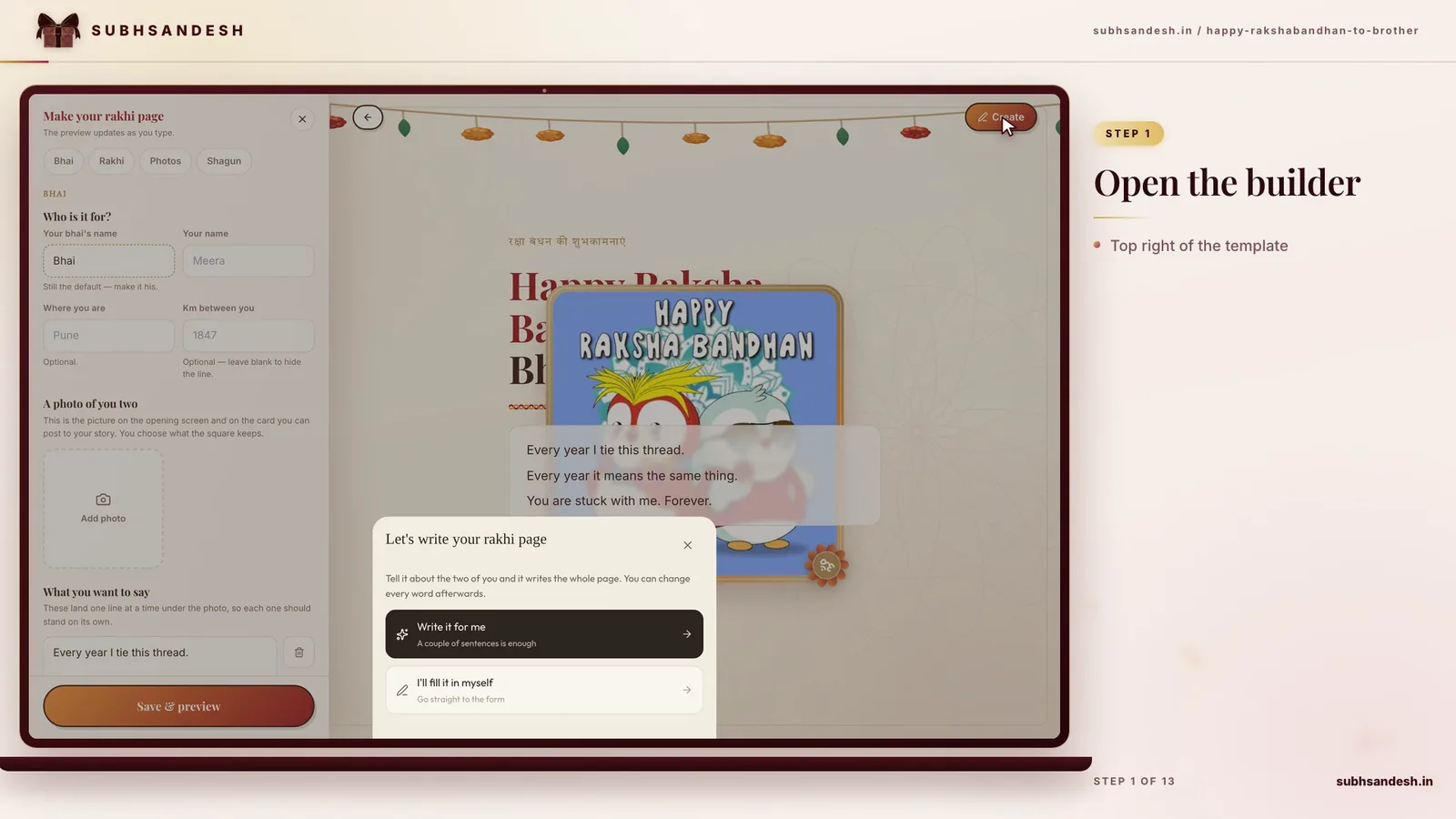
If you want that shared link to be more than a lyric sheet, the Ganesh Chaturthi page the recipient performs themselves is built for this moment: they offer durva, kumkum, flowers and modak, the aarti thali circles on screen while Karpur Gauram plays, and they write their own prarthana back — the closing shloka above, running where it belongs in the sequence. The full template gallery covers the other festivals, and the Raksha Bandhan page for a brother animates the same tilak-and-aarti sequence.
When a shareable Ganpati page is the wrong choice
It cannot hand anyone a modak. It cannot put you in front of the mandap, and it will not carry the murti to the water on 25 September 2026. Those are the two things people most want from this festival.
It is also wrong for the grandparent who does not use a smartphone. Platform-wide, 49.6% of views are on a phone — so half are not — and a recipient with no device is outside the product entirely. A printed aarti book in large Devanagari beats any screen.
If privacy matters, locking a page is a deliberate step people take: 42.1% of creators password-protect before sharing, 1,625 of 3,860 pages platform-wide. A public Ganpati page is public.
Sources
- Pearce et al., "The ice-breaker effect" — Royal Society Open Science, October 2015
- Weinstein et al., "Singing and social bonding" — Evolution and Human Behavior, March 2016 (abstract only)
- Vickhoff et al., "Music structure determines heart rate variability of singers" — Frontiers in Psychology, 9 July 2013
- Wald-Fuhrmann et al., "'He Who Sings, Prays Twice'?" — Frontiers in Psychology, 17 September 2020
- Aarati Sangraha, digitised Marathi collection (no print date)
Frequently Asked Questions
Turn this inspiration into an unforgettable surprise
Build a page with photos, a heartfelt message, music and a ready-to-share link.
- Photos, message & music
- Ready-to-share link

Written by
Suyash Agrahari
Founder
Suyash Agrahari is a Software Engineer at HireQuotient and the founder of SubhSandesh and DrawFlow (drawflow.in). He builds AI agents and full-stack products with Next.js, Node.js, and the OpenAI and LangChain ecosystems, having shipped autonomous multi-agent systems, AI copilots, and large-scale outreach platforms — and scaled side projects from a few hundred to millions of users. He writes about AI engineering, web development, and building products that grow through SEO and organic reach.
Stay Connected
Follow SubhSandesh
New templates, festival ideas and step-by-step walkthrough videos — first on our socials.
Product guide
See it built, step by step

Keep reading
Thala Deepavali: A Couple's First Deepavali at the Bride's Home
Thala Deepavali is a Tamil couple's first Deepavali after marriage, at the bride's home. In 2027 it is Thursday 28 October, oil bath 4:40–6:01 AM in C…
 Suyash Agrahari· 9 min
Sugar-Free Diwali Sweets: Swaps, Label Warnings and the Evidence
Five original no-added-sugar Diwali sweets, why jaggery and honey do not count, the warnings FSSAI requires on a sugar-free box, and what an Indian su…
Suyash Agrahari· 9 minShort Diwali Quotes: 34 Original One-Liners Under 10 Words
34 original short Diwali quotes, each under ten words and marked with its word and character count, grouped by mood: lamps, family, friends, gratitude…
Suyash Agrahari· 9 min