
Rakhi Wishes for Brother in Law: Jiju vs Bhaiya-Bhabhi
Rakhi wishes for a brother in law cover two different relationships. Jiju (your sister's husband) gets a teasing register; bhaiya and bhabhi are greeted as a pair and only bhaiya's wrist takes the thread. 11 Hindi lines with English glosses, plus the 3h51m muhurat window on 28 August 2026.
Make this into a page you can send
Photos, a message, music and a ready-to-share link — in a couple of minutes.
or browse all occasionsKey takeaways
- • Jiju is an affine, not a brother — the rakhi thread is optional for him, and in the jija-saali equation teasing is customary rather than rude.
- • Bhaiya and bhabhi are greeted as a pair, but only bhaiya's wrist takes the thread; bhabhi is welcomed and thanked, not tied.
- • Raksha Bandhan 2026 is Friday 28 August, and the Delhi thread-ceremony window is only 3 hours 51 minutes — 05:57 AM to 09:48 AM.
- • Send it as a link, not a parcel: 52.5% of the 31,081 views on SubhSandesh pages happen on a phone, and 99.4% of started pages get published and shared.
- • Privacy is the default expectation for a personal message — 44.7% of creators password-protect their page before sharing it.
On this page
Rakhi Wishes for Brother in Law: Jiju vs Bhaiya-Bhabhi
Rakhi wishes for brother in law, jiju included, cover two genuinely different relationships and need two different sets of words. Jiju is your sister's husband, an in-law, and North Indian custom gives that pairing a licence to tease. Bhaiya and bhabhi are a separate job: only bhaiya's wrist takes the thread, and bhabhi is greeted beside him. Below are six jiju lines and five bhaiya-bhabhi lines in Hindi with English glosses, each tagged with its register. Delivery decides half of it. Across the 2,632 personalised pages created on SubhSandesh since 12 March 2026, 52.5% of the 31,081 recorded views happened on a phone, and 44.7% of creators password-protect the page before they send it. Raksha Bandhan 2026 falls on Friday 28 August.
Is jiju actually a rakhi relationship?
Jiju — also jija, or jija ji when you want to sound respectful — is the Hindi word for a sister's husband. He is an affine, related by marriage rather than blood, so the rakhi thread does not automatically belong on his wrist.
Families split on this and both practices are normal: plenty tie a rakhi to jiju and treat him as a bhai, plenty keep the thread for brothers only. If unsure, ask your sister.
The wording is awkward for a structural reason, not a sentimental one. A. R. Radcliffe-Brown's 1940 paper on joking relationships, in Africa, argues that where a social structure joins two people and separates them at once, custom settles on either exaggerated respect and reserve or its opposite — familiarity, teasing, even coarse banter. The jija-saali pair took the teasing branch; bhabhi, in most North Indian households, the respect branch. That fork is why one line cannot serve both.
Six rakhi wishes for jiju, in Hindi with English glosses
Each line names its register and where to send it, because a message that lands one-to-one can misfire in a group of forty relatives. A survey of code-switching research covering Indian multilingual contexts, published in January 2023, treats Hindi-English mixing as structured and purposeful rather than careless — which is why these read the way a family writes.
1. The safe one for the family group
जीजू, दीदी के साथ-साथ आप भी हमारे हो गए। रक्षाबंधन की ढेर सारी शुभकामनाएँ। In English: "Jiju, along with didi you became ours too. Many happy wishes on Raksha Bandhan." Who and where: any saali or saala who wants warmth without banter, into the family WhatsApp group or a card elders will read. Nothing here can be misread.
2. The teasing one, in the jija-saali register
जीजू, राखी बाँधना भाई का हक़ है, पर वसूली का हक़ पूरा-पूरा साली का। हैप्पी रक्षाबंधन! In English: "Tying the rakhi is a brother's right, jiju, but collecting the gift is entirely the saali's right. Happy Raksha Bandhan!" Who and where: a saali with an easy, joking equation with her jija, one-to-one only. Radcliffe-Brown notes that teasing in front of certain relatives is a breach of etiquette.
3. The first Raksha Bandhan after your sister's wedding
जीजू, शादी के बाद ये पहला रक्षाबंधन है। दीदी अब भी हमारी ही है — बस पता बदल गया है। In English: "Jiju, this is the first Raksha Bandhan since the wedding. Didi is still ours — only the address has changed." Who and where: a younger sibling in the year the sister moved to her sasural, straight to jiju so he can show her. Affectionate rather than possessive, coming from you.
4. From a saala, the wife's brother
जीजा जी, दीदी को आपने सँभाल लिया, अब हम भी आपके ही खाते में हैं। रक्षाबंधन की शुभकामनाएँ। In English: "Jija ji, you have taken care of didi; now we are on your account too. Raksha Bandhan greetings." Who and where: a brother writing to an elder sister's husband, where "jija ji" and the formal aap are natural. A direct message or call opener; men in this pair usually skip the thread.
5. When you cannot be there on the day
जीजू, इस बार राखी कलाई तक नहीं पहुँच पाई, पर नीयत पहुँच गई। दीदी से कहिएगा, कलाई खाली न रहे। In English: "Jiju, the rakhi could not reach your wrist this time, but the intention did. Tell didi not to let your wrist stay empty." Who and where: anyone in another city, or whose courier missed 28 August, on the morning itself. It names the absence instead of pretending it away.
6. A one-line caption for a status or story
दीदी का साथ और जीजू का हाथ — दोनों सलामत रहें। रक्षाबंधन की शुभकामनाएँ। In English: "Didi's company and jiju's hand — may both stay safe. Raksha Bandhan greetings." Who and where: someone posting a photo of the two of them, as an Instagram story or WhatsApp status. Short enough to sit over an image without wrapping.
Raksha Bandhan wishes for bhaiya and bhabhi, greeted as a pair
Bhaiya and bhabhi need one message addressed to two people with different roles. The thread goes on bhaiya's wrist; bhabhi is greeted and included, but not tied. A wish that flattens them into "my brother and sister-in-law" loses what the day marks.
The pair matters for a reason. Raksha Bandhan is rooted in village exogamy: a bride marries out of her natal village, and the rite affirms she keeps recourse to her parents' home — which is why, per the Raksha Bandhan entry checked on 13 August 2026, large numbers of married Hindu women in rural north India travel back each year. The sister who returns to tie a rakhi returns to a house her bhabhi now runs.
- भैया-भाभी, राखी भैया की कलाई पर बँधती है, पर दुआ दोनों के लिए है। — "Bhaiya-bhabhi, the rakhi is tied on bhaiya's wrist, but the prayer is for both of you." The plainest correct version.
- भैया, आप मेरी ढाल हैं और भाभी, आप मेरी हमराज़। दोनों को रक्षाबंधन की शुभकामनाएँ। — "Bhaiya, you are my shield, and bhabhi, you are my confidante. Raksha Bandhan wishes to you both." Gives each a distinct role.
- भैया, इस बार राखी बाँधने आई तो घर में एक और अपना मिल गया। भाभी, आपका स्वागत है। — "Bhaiya, I came to tie the rakhi and found one more of my own in the house. Bhabhi, you are welcome here." For the first Rakhi after your brother's wedding.
- भैया-भाभी, इस साल मायके नहीं आ पाऊँगी। राखी कूरियर से आएगी, दुआएँ सीधे भेज रही हूँ। — "Bhaiya-bhabhi, I cannot come to my parents' home this year. The rakhi will arrive by courier; the blessings I am sending directly."
- भैया की कलाई और भाभी की हँसी — दोनों के बिना रक्षाबंधन अधूरा है। — "Bhaiya's wrist and bhabhi's laugh — Raksha Bandhan is incomplete without either." A caption-length line.
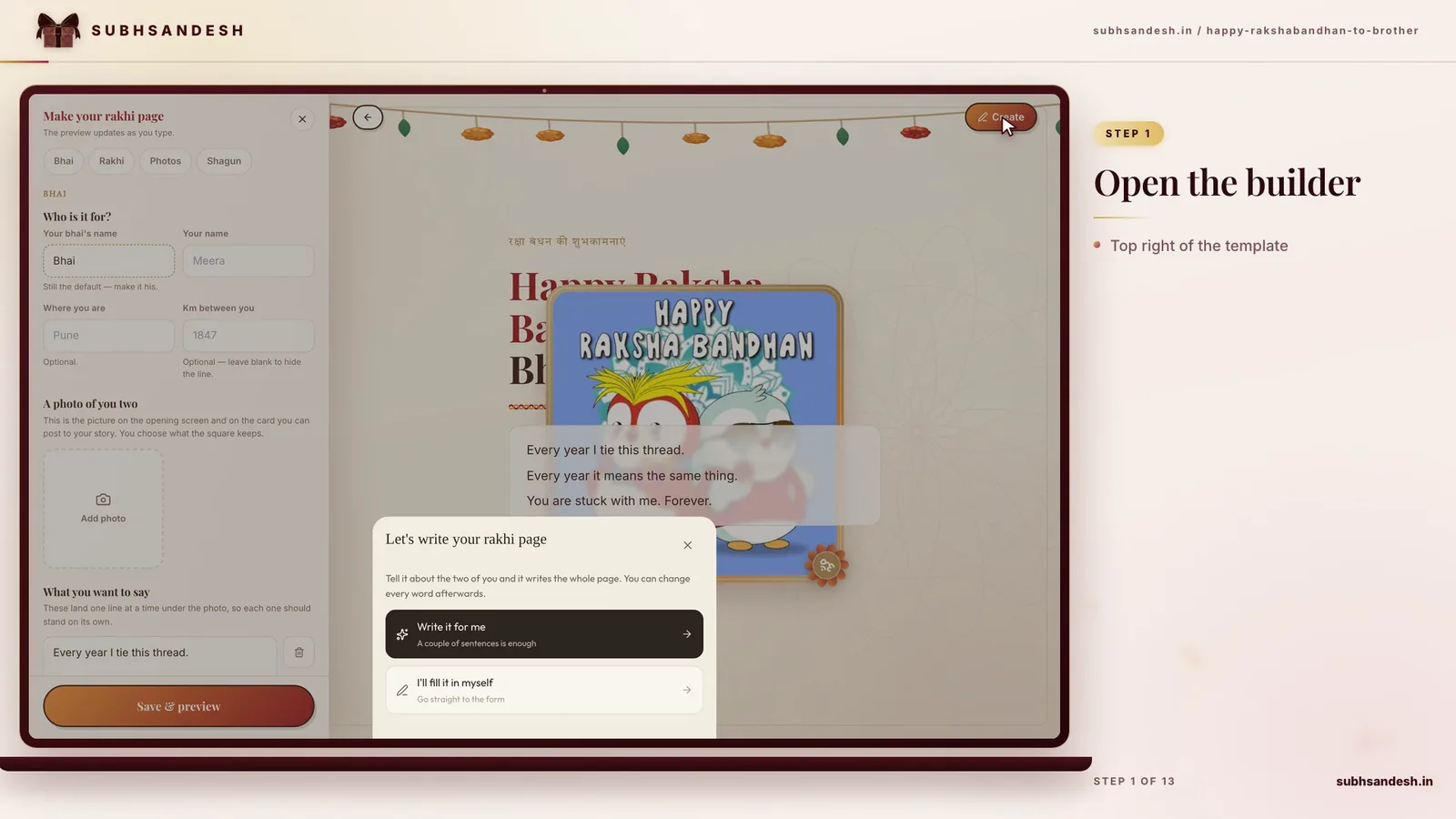
To make those words arrive with his name, your photo and a tilak-and-aarti sequence around them, the Raksha Bandhan page for a brother packs it into one WhatsApp link.
Which register belongs to whom
This is the decision most wishes pages skip: not what to write, but which of the four relationships you are writing to.
| You are greeting | Rakhi thread on the wrist? | Register that works | If you send it as a page |
|---|---|---|---|
| Bhaiya, your own brother | Yes, tied by his sister | Warm, direct, first person | 52.5% of shared pages are opened on a phone, so write for a narrow screen |
| Bhaiya and bhabhi together | Yes for him, greeting only for her | Respectful, welcoming, aap | Put both names in the message; 44.7% of creators add a password before sharing |
| Jiju, from his saali | Optional — many families do tie one | Teasing is licensed (jija-saali) | Send one-to-one, not to the group; pages average 11.8 views each |
| Jiju, from his saala | Rarely tied | Warm and slightly formal, "jija ji" | A short line plus the link does more than a long page |
Only one of those four rows is a rakhi ritual. The other three are greetings, and greetings are allowed to sound like you.
The window on 28 August 2026 is under four hours
Raksha Bandhan 2026 falls on Friday 28 August. Per Drik Panchang's muhurat table for Delhi, checked on 13 August 2026, the thread ceremony window runs 05:57 AM to 09:48 AM — three hours and 51 minutes — because Purnima Tithi ends then. Bhadra is over before sunrise, so the window is clear.
That is a tight slot, and it changes when your message should land. A wish arriving at 11 AM arrives after the ritual it was meant to accompany. Send it the night before, or at sunrise.
The channel is not in doubt. India had 1,294.46 million wireless subscribers at end-May 2026, per TRAI's press release of 25 June 2026, and our own numbers agree: 52.5% of views on shared pages happen on a phone, and 99.4% of started pages get published and shared.
When a rakhi wish for your jiju is the wrong idea
Sometimes it is. If your sister's household keeps Raksha Bandhan strictly as a brother-sister rite, a rakhi wish to jiju reads as a well-meant mistake; greet the couple instead. If your equation is formal rather than easy, drop the teasing lines — the jija-saali licence is a custom, not a guarantee.
SubhSandesh is sometimes the wrong tool too. A page is a link, and a link needs an unlocked phone and someone who opens links. If jiju is 60 and uses his phone for calls, a call beats anything you can build. Only 52.5% of our page views come from phones. And for a jiju in the same room, a thread and a box of mithai beats a URL.
Where these numbers come from
- Drik Panchang, Raksha Bandhan 2026 muhurat for Delhi — thread ceremony 05:57 AM to 09:48 AM on Friday 28 August 2026. Checked 13 August 2026.
- A. R. Radcliffe-Brown, "On joking relationships", Africa 13(3), 1940, pp. 195–210, Cambridge University Press.
- TRAI, Press Release No. 78/2026, 25 June 2026 — 1,294.46 million wireless subscribers at end-May 2026.
- Doğruöz, Sitaram, Bullock and Toribio, "A Survey of Code-switching", arXiv:2301.01967, 5 January 2023.
- Wikipedia, "Raksha Bandhan" — 2026 date and village-exogamy background. Checked 13 August 2026.
- SubhSandesh platform data, measured 13 August 2026, across 2,632 pages and 2,165 registered creators.
Ready to send one? Pick a design from the SubhSandesh template library, or go straight to the animated rakhi page for a brother and have the link in his hands before the muhurat closes.
Frequently Asked Questions
Turn this inspiration into an unforgettable surprise
Build a page with photos, a heartfelt message, music and a ready-to-share link.
- Photos, message & music
- Ready-to-share link

Written by
Suyash Agrahari
Founder
Suyash Agrahari is a Software Engineer at HireQuotient and the founder of SubhSandesh and DrawFlow (drawflow.in). He builds AI agents and full-stack products with Next.js, Node.js, and the OpenAI and LangChain ecosystems, having shipped autonomous multi-agent systems, AI copilots, and large-scale outreach platforms — and scaled side projects from a few hundred to millions of users. He writes about AI engineering, web development, and building products that grow through SEO and organic reach.
Stay Connected
Follow SubhSandesh
New templates, festival ideas and step-by-step walkthrough videos — first on our socials.
Product guide
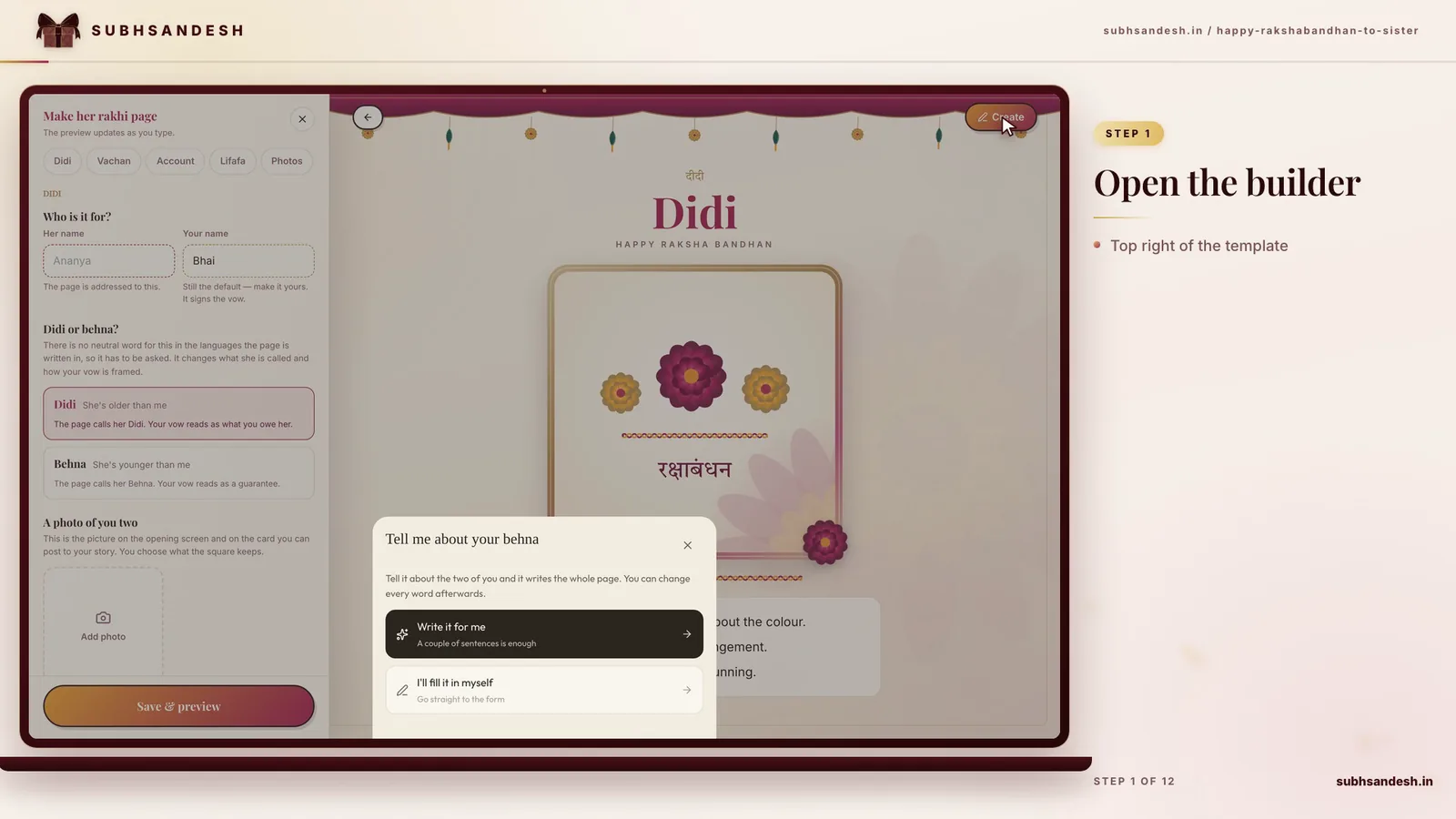
See it built, step by step
Keep reading
Thala Deepavali: A Couple's First Deepavali at the Bride's Home
Thala Deepavali is a Tamil couple's first Deepavali after marriage, at the bride's home. In 2027 it is Thursday 28 October, oil bath 4:40–6:01 AM in C…
 Suyash Agrahari· 9 min
Sugar-Free Diwali Sweets: Swaps, Label Warnings and the Evidence
Five original no-added-sugar Diwali sweets, why jaggery and honey do not count, the warnings FSSAI requires on a sugar-free box, and what an Indian su…
Suyash Agrahari· 9 minShort Diwali Quotes: 34 Original One-Liners Under 10 Words
34 original short Diwali quotes, each under ten words and marked with its word and character count, grouped by mood: lamps, family, friends, gratitude…
Suyash Agrahari· 9 min