
Raksha Bandhan 2027 Quotes That Work as Captions, Not Wishes
Raksha Bandhan 2027 quotes are short portable lines, not addressed wishes. 24 original lines sorted by where they land, each with a word count, the research on what makes a line quotable, and the 17 August 2027 date — plus what our 2,973 shared pages say about public versus private.
Make this into a page you can send
Photos, a message, music and a ready-to-share link — in a couple of minutes.
Create nowor browse all occasionsKey takeaways
- • Raksha Bandhan 2027 falls on Tuesday 17 August 2027, eleven days earlier in the month than Rakhi 2026's Friday 28 August.
- • A quote carries no name and works alone; a wish is addressed to one sibling. Delete the name — if the line survives, it is a quote.
- • 44.2% of SubhSandesh creators password-protect their page before sharing it (1,315 of 2,973), which is the behavioural line between a public caption and a private message.
- • ACL 2012 research found memorable lines are lexically distinctive and portable — general enough to apply in contexts they were not written for.
- • 21 of the 24 lines here need no editing for 2028; only the three that count time do.
On this page
Raksha Bandhan 2027 Quotes That Work as Captions, Not Wishes
Raksha Bandhan 2027 quotes are short lines that stand on their own — no name in them, no context around them — which is what lets one sit in an Instagram caption, a WhatsApp status or the inside of a card. A wish is a different object: addressed to one sibling, and it collapses the moment you remove the name. That split is not cosmetic. On SubhSandesh, 44.2% of creators password-protect their page before sharing it (1,315 of 2,973 pages) — plain evidence that much of what people write for a sibling was never meant to be broadcast. Another 51.1% of shared pages are opened on a phone (18,497 of 36,202 views), so a line that needs scrolling has already lost. Below: 24 original lines sorted by where they land, what the research says makes a line portable, and the 17 August 2027 date.
What a Raksha Bandhan quote is, and how it differs from a wish
A Raksha Bandhan quote is a self-contained sentence about the sibling bond that carries no name, no date and no reply expected. A Raksha Bandhan wish is a message addressed to a specific person, usually opening with "dear" and closing with a blessing.
Almost every page ranking for this phrase treats the two as synonyms, which is why a reader wanting a caption is handed a two-paragraph letter. The test is mechanical: delete the name. If the line still means something it is a quote; if it becomes a fragment it is a wish, and it belongs in a private message rather than a public status.
That also decides where it goes. A quote is broadcast to everyone who follows you. A wish goes to one wrist.
Six kinds of Raksha Bandhan 2027 quote, and where each one lands
Each type states what it is, who it suits, the lines, and the length that fits. All 24 are original.
1. The four-word caption
What it is: the shortest usable form — a noun phrase or single clause, with no tense tying it to one year. Who it suits: anyone posting a photo of the thali or the tied wrist, where the image already carries the story. The lines: "One thread, one whole childhood." / "Same house, same war, same side." / "Tied first, argued later." / "My oldest witness." Length: four to seven words. Past that the caption competes with the photo.
2. The line for a brother
What it is: an observation about a brother rather than a message to him, so it survives as a caption. Who it suits: anyone who finds "my protector" too formal to type. The lines: "A brother is the only person who remembers the version of you nobody else met." / "He never asks how the day went; he just knows when it went badly." / "Protection was never the thread. It was the phone call at eleven at night." / "Half my instincts are borrowed from a boy who grew up two rooms away." Length: eight to fourteen words.
3. The line for a sister
What it is: the same shape pointed the other way, and worth writing properly, because sister lines on most pages are the thinnest. Who it suits: brothers posting on the day, and sisters writing about a sister — which almost no page provides for. The lines: "A sister keeps the receipts of every promise you forgot you made." / "She corrected me in public and defended me everywhere else." / "The house was never quiet and I have never once missed the quiet." / "She learned my moods before I had names for any of them." Length: eight to fourteen words.
4. The distance line
What it is: a line that names the gap without apologising for it, so it reads as a statement rather than a complaint. Who it suits: siblings in different cities or countries — now the default for most families. The lines: "Two cities, one time zone we both keep checking, and a thread that arrived last Tuesday." / "Distance settled the argument about who calls first. Neither of us. We just call." / "The rakhi came by post this year; the wrist it was meant for is in another country." / "We have not shared a Purnima in four years and we have not missed one either." Length: ten to sixteen words.
5. The thread line
What it is: a line about the ritual rather than a person, which makes it the most reusable type here. Who it suits: family group chats, a shared status, or a card several people will read. The lines: "A thread costs nothing, weighs nothing, and outlasts almost everything else in the house." / "Raksha means protection. The thread is only the receipt." / "One knot, one sweet, one promise nobody writes down." / "The thali is set before anyone is awake. That is the actual ritual." Length: nine to fifteen words.
6. The funny line
What it is: the affectionate insult — fine on a caption, bad in a card to an elder relative. Who it suits: siblings close enough in age to have fought over the remote. The lines: "Tied a thread, invoiced a gift. Standard procedure." / "Decades of unpaid emotional labour, still no bonus." / "She blocked me on Instagram and still turned up with the thread. Family." / "One knot, one sweet, one negotiation about the gift budget." Length: six to twelve words.
If a line is close but you want the sibling's name, photo and a longer message under it, that is a page rather than a caption — our Raksha Bandhan page for a brother puts the short line on top and the private part behind the link.
What makes a line quotable, according to people who measured it
Two things, both testable. Work presented at ACL 2012 by Danescu-Niculescu-Mizil, Cheng, Kleinberg and Lee — You Had Me at Hello: How Phrasing Affects Memorability, ACL 2012 — built a corpus of movie quotes annotated for memorability, controlling for speaker and setting.
Memorable lines were lexically distinctive: less common word choices sitting on a scaffolding of ordinary syntax. They were also more general in a way the authors call portability — easy to apply in new contexts, with fewer markers pointing at nearby text.
Portability is what separates a quote from a wish. "Dearest sister, on this auspicious occasion" points at one reader; "she corrected me in public and defended me everywhere else" points at nothing, and therefore travels.
A 2026 preprint from Fudan University, What Makes an Ideal Quote? (8 April 2026, not yet peer-reviewed), adds the other half from a user study: readers prefer quotations that are unexpected yet rational — contextually novel while still coherent. Which is why a forwarded line fails: rational, entirely expected.
Writing in The Week on 27 January 2018, Annifred Solomon counted at least three forwarded good-morning greeting images arriving every morning — stock photograph, inspirational line pasted over. A rakhi line from the same well reads as one of those.
What our own page data says about sending the line
We cannot see what happens to a caption once it reaches Instagram. We can see the 2,973 pages created on SubhSandesh since 12 March 2026, and four figures bear on how a rakhi line should be sent.
| What we measured | Figure | Base | What it implies for a rakhi line |
|---|---|---|---|
| Creator adds a password before sharing | 44.2% | 1,315 of 2,973 pages | Close to half of these messages were never meant to be public |
| Page opened on a phone | 51.1% | 18,497 of 36,202 views | The line must land on one screen, unscrolled |
| Started page that gets published and shared | 99.4% | 2,956 of 2,973 pages | People who begin writing something personal finish it |
| Views per created page | 12.2 | 36,202 views ÷ 2,973 pages | A page gets reopened; a status is seen once and buried |
The password figure is the one worth sitting with. Nobody locks a caption. When people write the version with the name in it, nearly half put a wall around it first — the behavioural form of the quote-versus-wish split.
When a Raksha Bandhan quote is the wrong thing to send
If you only need a caption, you do not need us: copy the line, post the photo, close the tab. Building a page for four words is a worse use of ten minutes than tying the rakhi.
Three more cases where this page loses. A sibling in the same house should get a thread and a sweet, not a link; nothing beats being in the room. Our 51.1% phone figure has an inconvenient other half: 48.9% of views arrive on desktop or tablet, so anything built only for a portrait screen is wrong about half the time. A relative who reads links as phishing will not open it.
One honest limit on the research, too. The sibling study in the Journal of Family Psychology (March 2020) sampled 608 white older adults in the rural Midwestern United States. Sister–sister pairs being the warmest is a finding about that sample, not a law about Indian families.
Raksha Bandhan 2027: the date, and how to re-date these lines
Raksha Bandhan 2027 falls on Tuesday 17 August 2027, on Shravana Purnima, per mpanchang's 2027 festival page. Rakhi 2026 was Friday 28 August 2026, so 2027 arrives eleven days earlier — worth knowing if you post parcels.
Twenty-one of the 24 lines above need no editing for 2027, or for 2028, because they carry no year and no tense tied to one festival. That is the practical payoff of portability.
The three that need a look are distance lines: "a thread that arrived last Tuesday" and "we have not shared a Purnima in four years" both count from somewhere, so check the arithmetic first.
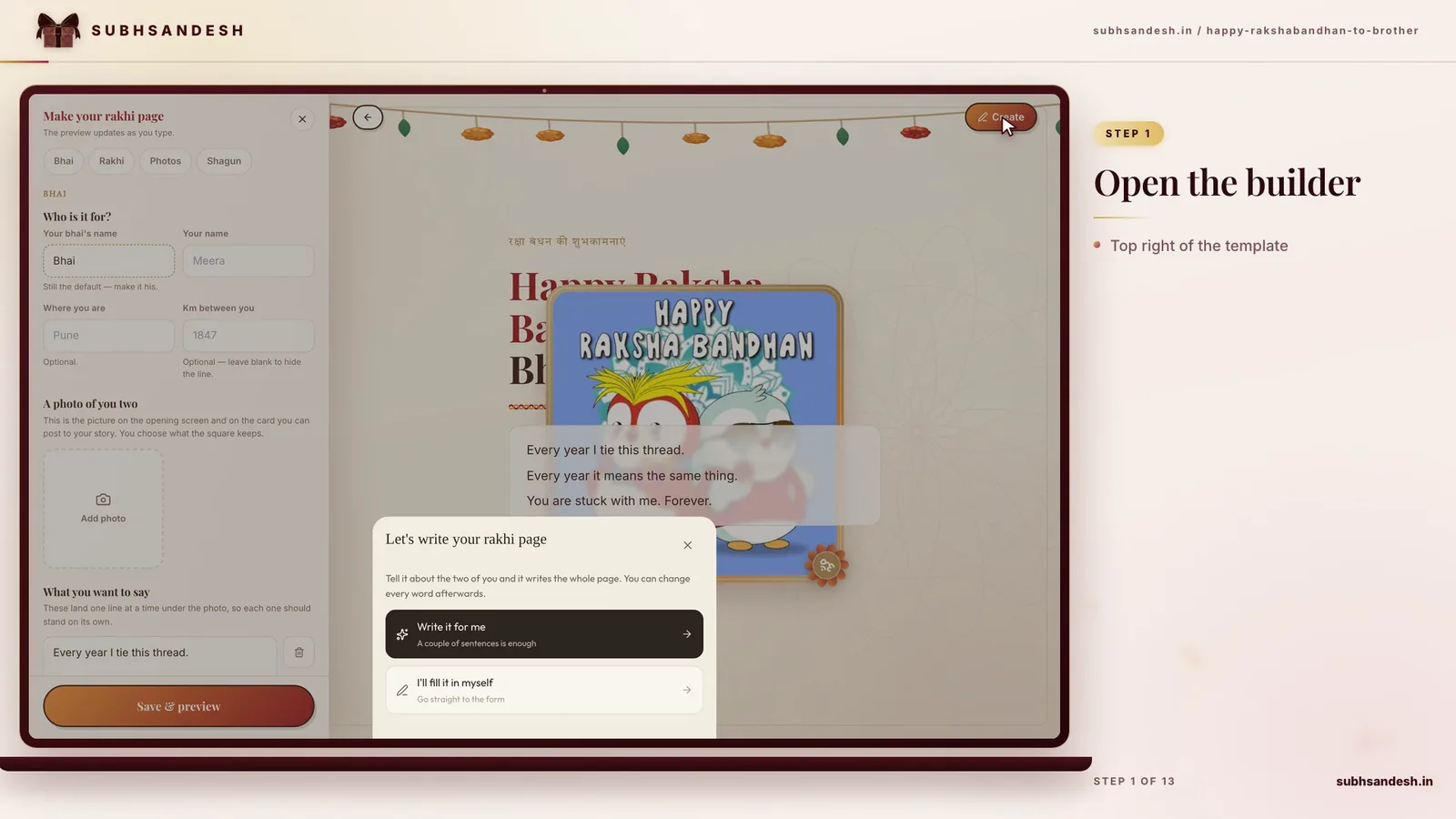
Want the longer version behind a private link instead of a public caption? Browse the SubhSandesh templates, add the photo and the line, and send the URL.
Sources
- Danescu-Niculescu-Mizil, Cheng, Kleinberg & Lee, You Had Me at Hello, Proceedings of ACL 2012, pp. 892–901 — July 2012.
- Zhang et al., What Makes an Ideal Quote?, Fudan preprint — 8 April 2026.
- Sibling Relationships in Older Adulthood, Journal of Family Psychology — March 2020.
- Solomon, Good morning on WhatsApp? No, thank you, The Week — 27 January 2018.
- Raksha Bandhan 2027 date, mpanchang — no publication date given.
- SubhSandesh platform data, measured 25 August 2026 (n = 2,973 pages).
Frequently Asked Questions
Turn this inspiration into an unforgettable surprise
Build a page with photos, a heartfelt message, music and a ready-to-share link.
- Photos, message & music
- Ready-to-share link

Written by
Suyash Agrahari
Founder
Suyash Agrahari is a Software Engineer at HireQuotient and the founder of SubhSandesh and DrawFlow (drawflow.in). He builds AI agents and full-stack products with Next.js, Node.js, and the OpenAI and LangChain ecosystems, having shipped autonomous multi-agent systems, AI copilots, and large-scale outreach platforms — and scaled side projects from a few hundred to millions of users. He writes about AI engineering, web development, and building products that grow through SEO and organic reach.
Stay Connected
Follow SubhSandesh
New templates, festival ideas and step-by-step walkthrough videos — first on our socials.
Product guide
See it built, step by step
Keep reading
Thala Deepavali: A Couple's First Deepavali at the Bride's Home
Thala Deepavali is a Tamil couple's first Deepavali after marriage, at the bride's home. In 2027 it is Thursday 28 October, oil bath 4:40–6:01 AM in C…
 Suyash Agrahari· 9 min
Sugar-Free Diwali Sweets: Swaps, Label Warnings and the Evidence
Five original no-added-sugar Diwali sweets, why jaggery and honey do not count, the warnings FSSAI requires on a sugar-free box, and what an Indian su…
Suyash Agrahari· 9 minShort Diwali Quotes: 34 Original One-Liners Under 10 Words
34 original short Diwali quotes, each under ten words and marked with its word and character count, grouped by mood: lamps, family, friends, gratitude…
Suyash Agrahari· 9 min