
Raksha Bandhan 2027 Wishes for Every Sibling You Have
Raksha Bandhan 2027 falls on Tuesday 17 August 2027. Wishes grouped by recipient — elder brother, younger brother, sister, cousin, sibling abroad, status caption — with SubhSandesh's own 36,202 recorded views and 12.2 average reopens per page behind each option, plus when to send on a workday.
Make this into a page you can send
Photos, a message, music and a ready-to-share link — in a couple of minutes.
Create nowor browse all occasionsKey takeaways
- • Raksha Bandhan 2027 is Tuesday 17 August 2027, on Shukla Purnima in Shravana — a working weekday, where Rakhi 2026 fell on Friday 28 August and ran into a weekend.
- • SubhSandesh's shared pages have recorded 36,202 views at an average of 12.2 views per created page, so a page gets reopened roughly a dozen times where a forwarded line is read once.
- • 99.4% of pages that get started are published and shared (2,956 of 2,973), and the median creator keeps editing for 6.9 hours — start on the evening of Monday 16 August, not on the morning itself.
- • Routine greeting messages made up 3.5% of virally forwarded WhatsApp content in one rural Indian village study, which is why two clumsy sentences of your own beat four polished ones you did not write.
- • The honest limit: rakhi templates account for 39 of 36,202 recorded views, so every figure here is platform-wide behaviour rather than rakhi-specific.
On this page
Raksha Bandhan 2027 Wishes for Every Sibling You Have
Raksha Bandhan 2027 falls on Tuesday, 17 August 2027, on Shukla Purnima in the month of Shravana, per the Samvat panchang for 2027. The Raksha Bandhan 2027 wishes below are grouped by who you are sending to, and every one is written to be sent on a working Tuesday rather than a holiday.
Here is the part no other wishes list will tell you. Across SubhSandesh, shared pages have recorded 36,202 views, an average of 12.2 views per created page — meaning a page gets opened and reopened roughly a dozen times, while a forwarded line gets read once and scrolled past. And 99.4% of pages that get started are actually published and shared (2,956 of 2,973), so the effort almost never goes to waste.
This page covers the exact 2027 date and weekday, wishes sorted by recipient, a comparison of what each sending method costs in time, when to send on a Tuesday, and where a written wish is the wrong call.
What is Raksha Bandhan 2027, and what day does it fall on?
Raksha Bandhan is the Hindu festival where a sister ties a thread — the rakhi — on her brother's wrist, and the brother commits to protecting her. In 2027 it falls on Tuesday, 17 August, on Shukla Purnima of Shravana.
The weekday matters more than anyone admits. Rakhi 2026 landed on Friday 28 August, so it flowed into a weekend.
In 2027 the festival sits mid-week, on a working Tuesday, which means most siblings will be at a desk or in transit when the thread is meant to be tied. Every wish on this page is written for that reality.
Raksha Bandhan 2027 wishes, sorted by who you're sending them to
Six groups, because "wishes for brother" and "wishes for sister" leave out most of the people who actually tie a rakhi. Each one gives the line, who it suits, when to send it on 17 August, and how long it takes to put together.
1. For an elder brother (bhaiya)
"You were the one who got shouted at first so I wouldn't be. I've never said thank you for it properly. Shubh Raksha Bandhan, bhaiya."
Who it suits: an elder brother you are genuinely close to, where a generic line would land as a formality. When to send: before 9am on Tuesday 17 August, ahead of his working day. Time to write: two minutes, and it should name one specific thing he did.
2. For a younger brother
"You are still the kid who broke my things, and you are also the person I'd call first at 3am. Both are true. Happy Rakhi."
Who it suits: a younger brother where affection is usually expressed as teasing. When to send: any point during the day — younger siblings are the least likely to be watching the clock. Time to write: one minute. Specificity beats sentiment here; name the thing he broke.
3. For a sister who ties for you
"You have kept every promise you made me and I have kept about half of mine. Working on it. Happy Raksha Bandhan, and thank you for the thread."
Who it suits: a sister expecting a reply rather than a broadcast. When to send: the same morning she ties, or immediately after the video call if she cannot. Time to write: two minutes, and an honest admission does more work than a compliment.
4. For a cousin, or a sibling you chose
"No shared parents, no shared surname, and you still show up like family. Rakhi doesn't check paperwork. Shubh Raksha Bandhan."
Who it suits: cousins, a friend who became a sibling, a bhabhi or a jiju. This is the group every SERP page reduces to one token line. When to send: midday on 17 August, once the immediate family messages have cleared. Time to write: two minutes.
5. For a sibling in another city or another country
"The thread can wait for December. The promise behind it can't. Tie it on a chair if you have to — I'm counting it. Happy Rakhi from too far away."
Who it suits: a sibling you will not see on the day. Distance does less damage than people assume: research on adult siblings using Add Health data (N = 1,366) found that fewer contacts do not necessarily mean less emotional closeness during emerging adulthood. When to send: convert to their timezone first — a 9am Indian message reaches a US sibling at 11.30pm the night before. Time to write: three minutes, plus the timezone maths.
6. For a WhatsApp status or an Instagram caption
"One thread. One promise. Twenty-six years of evidence that he means it. #RakshaBandhan2027"
Who it suits: a broadcast, not a message — write it knowing your sibling is one of several hundred readers. When to send: evening of 17 August, after the photos exist. Time to write: one minute. Put a real number in it; a count is the one thing a copied caption never has.
If you want the wish itself to be the gift rather than the covering note, the Raksha Bandhan page for a brother runs the tilak, aarti and rakhi-tying scenes with your photo and your message inside a single shareable link.
Forwarded, typed, called or a shared page: what each one costs
The four options are not equivalent, and the honest differences are in time and in whether the thing gets reopened. The reopen column is SubhSandesh's own measured data.
| How you send it | Time it takes you | Measured reopens | What the recipient needs |
|---|---|---|---|
| Forwarded WhatsApp line | 10 seconds | not measurable; forwarded greetings are their own genre — 3.5% of all virally forwarded content in one rural Indian village study | |
| Typed personal message | 2–3 minutes | read once, rarely revisited | |
| Video call | 15–30 minutes | nothing to reopen afterwards | both people free at once |
| Personalised shareable page | 20–40 minutes | 12.2 average views per created page, 36,202 recorded views in total | a link and a browser; 51.1% open it on a phone |
The takeaway is narrow and worth stating plainly: a page is the only option on that list with a measured reopen figure, and the only one that costs you more than three minutes. Those two facts are the same fact.
When on Tuesday 17 August should you actually send it?
Send the message before 9am IST and the page link the evening before. A working Tuesday compresses the window: the muhurat sits in the morning, but so does the commute and the first meeting of the day.
The build time is the part people misjudge. Across 931 pages of SubhSandesh's most-used template, the median gap between a creator's first save and their last edit is 6.9 hours — not because the tool is slow, but because people keep coming back to change the wording. Starting on the evening of Monday 16 August is the difference between finishing and abandoning.
There is a reason the extra hours read as effort rather than waste. A longitudinal study of Diwali across two Indian communities, surveying 486 participants before, during and after the festival, found that time invested in the ritual was associated with social bonding and subjective wellbeing. The investment is legible to the person receiving it.
Does a forwarded rakhi wish still count?
It counts for less, and there is research that explains why. A study of viral WhatsApp content in a rural Indian village hand-coded 604 "forwarded many times" messages out of 53,389 messages across 164 groups, and found that routine greeting messages formed 3.5% of everything going viral — a recognisable, high-volume genre that recipients have learned to read as a category rather than as a message.
Your sibling has seen a hundred of them. That is not an argument against sending anything; it is an argument for two sentences of your own, badly phrased, over four polished ones you did not write.
The same village study found 26% of viral messages carried misinformation — more than carried entertainment — which tells you what the forwarding habit is optimised for: volume, not the person at the other end. A rakhi message is the one place that trade is worth reversing.
When a written wish is the wrong choice
If you are in the same house on 17 August, put the phone down. Rakhi is a physical ritual — thread, tilak, sweets, a wrist — and a link cannot beat being in the room. No amount of design closes that gap.
A page also loses when the recipient has no smartphone or no reliable data. Only 51.1% of SubhSandesh's 36,202 page views came from a phone, so nearly half arrive on a desktop the recipient may not open for days — and an elderly relative who reads WhatsApp voice notes but not links is genuinely better served by a call.
And the honest limit on our own side: the rakhi templates are new. They account for 39 of 36,202 recorded views, roughly 0.1%, so the reopen figures quoted on this page come from platform-wide behaviour across 2,973 pages and 15 page types, not from rakhi pages specifically. If you want the numbers behind a template with real usage history, browse the full template library and pick one that has been used a thousand times instead.
Sources
- Samvat — Raksha Bandhan 2027: Rakhi Date, Purnima Tithi & Calculation — Tuesday, 17 August 2027, Shukla Purnima, Shravana. No publication date stated.
- Deciphering Viral Trends in WhatsApp: A Case Study From a Village in Rural India — arXiv:2407.08172, 28 June 2024.
- Time investments in rituals are associated with social bonding, affect and subjective health: a longitudinal study of Diwali in two Indian communities — Philosophical Transactions of the Royal Society B 375(1805), 17 August 2020.
- Life Course Statuses and Sibling Relationship Quality during Emerging Adulthood — Journal of Family Issues 43(5), May 2022.
- First-party figures throughout are from SubhSandesh's own database, measured 2026-08-25.
Frequently Asked Questions
Turn this inspiration into an unforgettable surprise
Build a page with photos, a heartfelt message, music and a ready-to-share link.
- Photos, message & music
- Ready-to-share link

Written by
Suyash Agrahari
Founder
Suyash Agrahari is a Software Engineer at HireQuotient and the founder of SubhSandesh and DrawFlow (drawflow.in). He builds AI agents and full-stack products with Next.js, Node.js, and the OpenAI and LangChain ecosystems, having shipped autonomous multi-agent systems, AI copilots, and large-scale outreach platforms — and scaled side projects from a few hundred to millions of users. He writes about AI engineering, web development, and building products that grow through SEO and organic reach.
Stay Connected
Follow SubhSandesh
New templates, festival ideas and step-by-step walkthrough videos — first on our socials.
Product guide
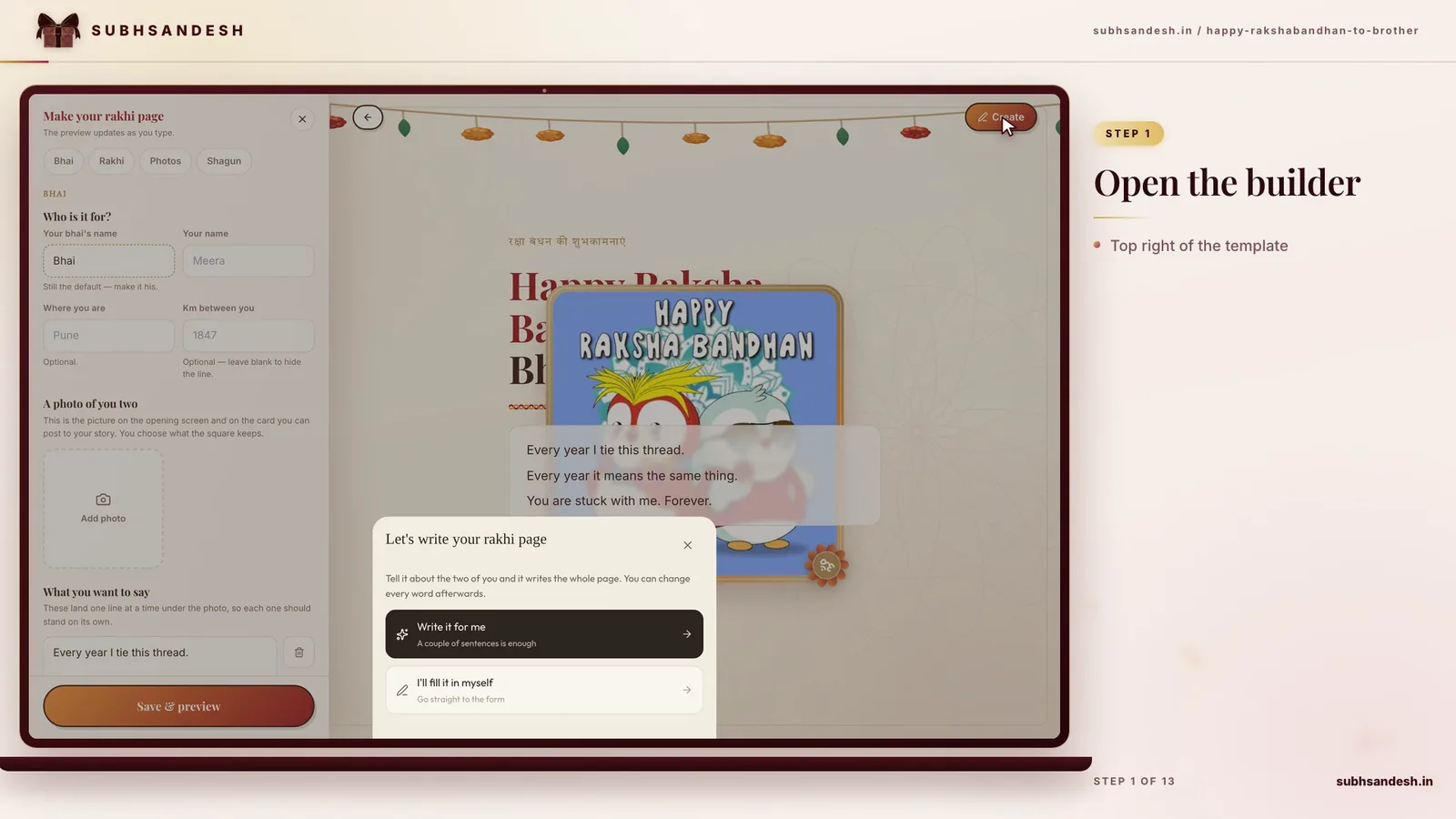
See it built, step by step
Keep reading
Thala Deepavali: A Couple's First Deepavali at the Bride's Home
Thala Deepavali is a Tamil couple's first Deepavali after marriage, at the bride's home. In 2027 it is Thursday 28 October, oil bath 4:40–6:01 AM in C…
 Suyash Agrahari· 9 min
Sugar-Free Diwali Sweets: Swaps, Label Warnings and the Evidence
Five original no-added-sugar Diwali sweets, why jaggery and honey do not count, the warnings FSSAI requires on a sugar-free box, and what an Indian su…
Suyash Agrahari· 9 minShort Diwali Quotes: 34 Original One-Liners Under 10 Words
34 original short Diwali quotes, each under ten words and marked with its word and character count, grouped by mood: lamps, family, friends, gratitude…
Suyash Agrahari· 9 min