Raksha Bandhan Greetings Online Free — Where Free Stops
Every free Raksha Bandhan greeting site says free and almost none says what free excludes. The five things it usually costs — watermark, signup wall, locked download, tracking, expiry — and how to check each in 90 seconds.
Make this into a page you can send
Photos, a message, music and a ready-to-share link — in a couple of minutes.
Create nowor browse all occasionsKey takeaways
- • "Free" on a rakhi greeting site describes the design step, not the finished card — the charge, where there is one, sits at download, branding removal or hosting.
- • 99.4% of pages started on SubhSandesh are published and shared (2,956 of 2,973), which is what happens when no wall sits between the last edit and the send.
- • Check the export, not the preview: watermarks show up in the downloaded file, and one throwaway export in your first minute settles it.
- • 44.2% of creators password-protect a page before sharing it (1,315 of 2,973) — worth knowing when the card carries a sibling's photo.
- • Raksha Bandhan 2027 falls on Tuesday 17 August 2027, so build something re-datable rather than something you rewrite each year.
On this page
Raksha Bandhan Greetings Online Free — Where Free Stops
Search raksha bandhan greetings online free and every result promises free. Almost none says what free excludes. On our own platform, 99.4% of started pages are actually published and shared — 2,956 of 2,973, measured 25 August 2026 — and that is what a card looks like when nothing sits between the last edit and the send.
Seventeen pages were abandoned in total. That number is low because nothing interrupts the flow — no watermark in the export, no account wall at the save button, no download priced at the last step.
This page sets out the five things free commonly costs on a Raksha Bandhan greeting, how to spot each in under two minutes, and where a shareable link genuinely beats a downloaded image.
What does "free" mean on a Raksha Bandhan greeting site?
A free Raksha Bandhan greeting is one you can design and send without paying, but free is a claim about the entry point, not about the finished card. Most free greeting tools are freemium: designing is free, and one specific step near the exit — download, high resolution, removing branding, or keeping the link alive — is where money enters.
That model has a measured shape. In a two-year randomised field experiment covering 680,588 users across 190 countries, published in Frontiers in Psychology in June 2025, the control group's immediate paid-conversion rate was 0.22% and free-trial adoption was 0.86%. Fewer than one free user in a hundred even started the paid path.
So a freemium greeting tool is built on the assumption that you will never pay. It earns its money from the friction you meet on the way out, which is why the friction is placed where it is.
Five things a free rakhi greeting can cost you
The word free does more work than it should. Shampanier, Mazar and Ariely showed in Marketing Science in 2007 that dropping a price to zero shifts behaviour out of all proportion to the discount: when the cheaper chocolate moved from 1¢ to free, its share among the students who took one rose from 27% to 69% while the better product's fell from 73% to 31%. A one-cent change flipped the majority.
None of what follows is accidental design either. Crawling roughly 53,000 product pages across about 11,000 shopping sites, Mathur and colleagues catalogued 1,818 dark-pattern instances across 15 types — "hidden costs" among them — on 1,254 of those sites, and found 22 third-party firms selling those patterns as an off-the-shelf product.
1. A watermark or the tool's own branding
What it is. The finished card carries the platform's logo, usually in a corner or across the base.
How you spot it. The preview is clean and the export is not. Inspect the downloaded file, never the editor window.
What it costs. No money, and a good deal of the thing you actually wanted — a card that reads as yours rather than as an advertisement addressed to your brother.
What to do instead. Export one throwaway design in the first minute and open the file. Do that before you spend twenty minutes on the real one.
2. An account before you can save
What it is. An email-and-password wall placed between designing and keeping.
How you spot it. The Save or Download button opens a signup form instead of a file dialog.
What it costs. An email address, usually a marketing list, and often the session itself — a card lost to a login rarely gets rebuilt.
What to do instead. If registration is unavoidable, do it before you start designing. Forty seconds up front beats losing a finished card.
3. A download locked behind an upgrade
What it is. Free to make, paid to keep. The editor costs nothing; the export costs a one-off fee or a subscription.
How you spot it. Pricing appears only at the export step, never on the landing page.
What it costs. The sunk twenty minutes does the work. Santana, Dallas and Morwitz found across six studies in Marketing Science in 2020 that consumers shown surcharges late tend to stay on the higher total-cost option, and that almost nobody restarts — 15.9% of participants began again in study 1a, and 5.8% in study 1b.
What to do instead. Find the pricing page before you open the editor. If there isn't one, that is itself the answer.
4. Your data, and your recipient's
What it is. Free hosting is paid for by advertising, and advertising is paid for with tracking.
How you spot it. Count the third-party requests. The Markup's September 2020 scan of more than 80,000 of the world's most popular sites found 69,293 loading at least one third-party tracker, more than 5,000 fingerprinting visitors even when third-party cookies were blocked, and more than 12,000 running session recording that logs scrolls and clicks.
What it costs. On a greeting the payload is unusually personal: a sibling's name, a photograph, sometimes an address. And the person who pays is the recipient, who agreed to nothing.
What to do instead. Treat the photo upload as a decision rather than a step. 44.2% of creators here password-protect a page before sharing it — 1,315 of 2,973 — which suggests people do weigh this when the control is actually offered.
5. A link or a file that quietly expires
What it is. The card lives on somebody else's server, and the free tier caps how long it stays there.
How you spot it. Search the terms for "expire", "retention" and "delete". Most galleries say nothing at all, which is not the same as forever.
What it costs. Nothing this month, and the entire card next August. A rakhi greeting is a thing people reopen.
What to do instead. Keep your own copy of the image or the text regardless of what the tool promises.
Free to make, free to send, or free to keep?
Three formats get called "free Raksha Bandhan greetings" and they fail in different places. The first-party rows below come from our own platform; the others are the questions to put to whatever tool you pick.
| Question to ask | Downloadable image | E-card from a gallery | Shareable personalised page |
|---|---|---|---|
| Does the export carry branding? | Often, unless you pay to remove it | Almost always the site's | Check the export before you send |
| What does the recipient need? | An app that opens image files | A working email inbox | A link, nothing installed |
| How does it open on a phone? | Depends on the aspect ratio | Frequently desktop-first | 51.1% of our 36,202 recorded views are phone opens |
| Can you lock it? | No | Rarely | 44.2% of creators do — 1,315 of 2,973 |
| How many people finish? | Not published | Not published | 99.4% here — 2,956 of 2,973 |
The pattern: a downloadable image is the most portable and the most likely to be branded, a gallery e-card is the least flexible, and a hosted page is the easiest to open and the most dependent on whoever hosts it.
What a 99.4% completion rate actually tells you
The interesting number is not how many people start a free greeting. It is how many finish. Across 2,973 personalised pages built here since 12 March 2026, 2,956 were published and shared. Seventeen were not.
Be clear about what that does and does not prove. It is a platform-wide figure, not a rakhi one: rakhi templates account for 39 of 36,202 recorded views, so this says nothing specific about rakhi cards and everything about what happens when no wall sits at the end of the flow. Set it against the freemium experiment above, where 0.86% of free users in the control group even began a trial.
People also take their time. The median gap between a page's first save and its last edit is 6.9 hours, sampled on the "I love you" template at n=931. A draft that expires overnight, or hides behind a login the next morning, is fighting that behaviour rather than serving it.
When a free online greeting is the wrong choice
If your brother has no smartphone, or a connection that struggles with a photo, an envelope beats a link and it is not close. 48.9% of our recorded views are not phone opens, and "not a phone" is often a shared family desktop — which is precisely where a private message should not land.
If you are in the same house, hand them something physical. If the card is meant to sit on a shelf for a decade, a web page loses permanently; print it.
And one honest limit on this post: our facts file does not currently record SubhSandesh's own free-tier terms, so we are not going to print a price here we cannot stand behind. Check the Raksha Bandhan page for a brother for what it includes today, or browse every SubhSandesh template if the occasion turns out to be a different one.
Checking any free rakhi tool in 90 seconds
- Open the pricing page before the editor.
- Export a throwaway design and inspect the file for branding.
- Count the fields on the signup form, if there is one.
- Search the terms for "expire", "retention", "delete".
- Decide on the photo before you upload it; that is the hardest thing to take back.
- Send the finished link to your own phone first. 51.1% of opens here are on a phone, so that is the screen that matters.
Raksha Bandhan 2027 falls on Tuesday 17 August 2027, which leaves plenty of time to test a tool properly rather than at midnight the day before.
Sources
- Shampanier, K., Mazar, N. and Ariely, D., "Zero as a Special Price: The True Value of Free Products", Marketing Science 26(6), November–December 2007.
- "Longer or shorter? A large-scale randomized field experiment on the impact of free trial duration on sustainable user conversion in the Freemium model", Frontiers in Psychology, 18 June 2025.
- Mathur, A. et al., "Dark Patterns at Scale: Findings from a Crawl of 11K Shopping Websites", Princeton WebTAP project page, Proc. ACM Hum.-Comput. Interact. 3(CSCW), November 2019.
- Santana, S., Dallas, S. K. and Morwitz, V. G., "Consumer Reactions to Drip Pricing", Marketing Science 39(1), January–February 2020.
- Sankin, A. and Mattu, S., "The High Privacy Cost of a 'Free' Website", The Markup, 22 September 2020.
Frequently Asked Questions
Turn this inspiration into an unforgettable surprise
Build a page with photos, a heartfelt message, music and a ready-to-share link.
- Photos, message & music
- Ready-to-share link

Written by
Suyash Agrahari
Founder
Suyash Agrahari is a Software Engineer at HireQuotient and the founder of SubhSandesh and DrawFlow (drawflow.in). He builds AI agents and full-stack products with Next.js, Node.js, and the OpenAI and LangChain ecosystems, having shipped autonomous multi-agent systems, AI copilots, and large-scale outreach platforms — and scaled side projects from a few hundred to millions of users. He writes about AI engineering, web development, and building products that grow through SEO and organic reach.
Stay Connected
Follow SubhSandesh
New templates, festival ideas and step-by-step walkthrough videos — first on our socials.
Product guide
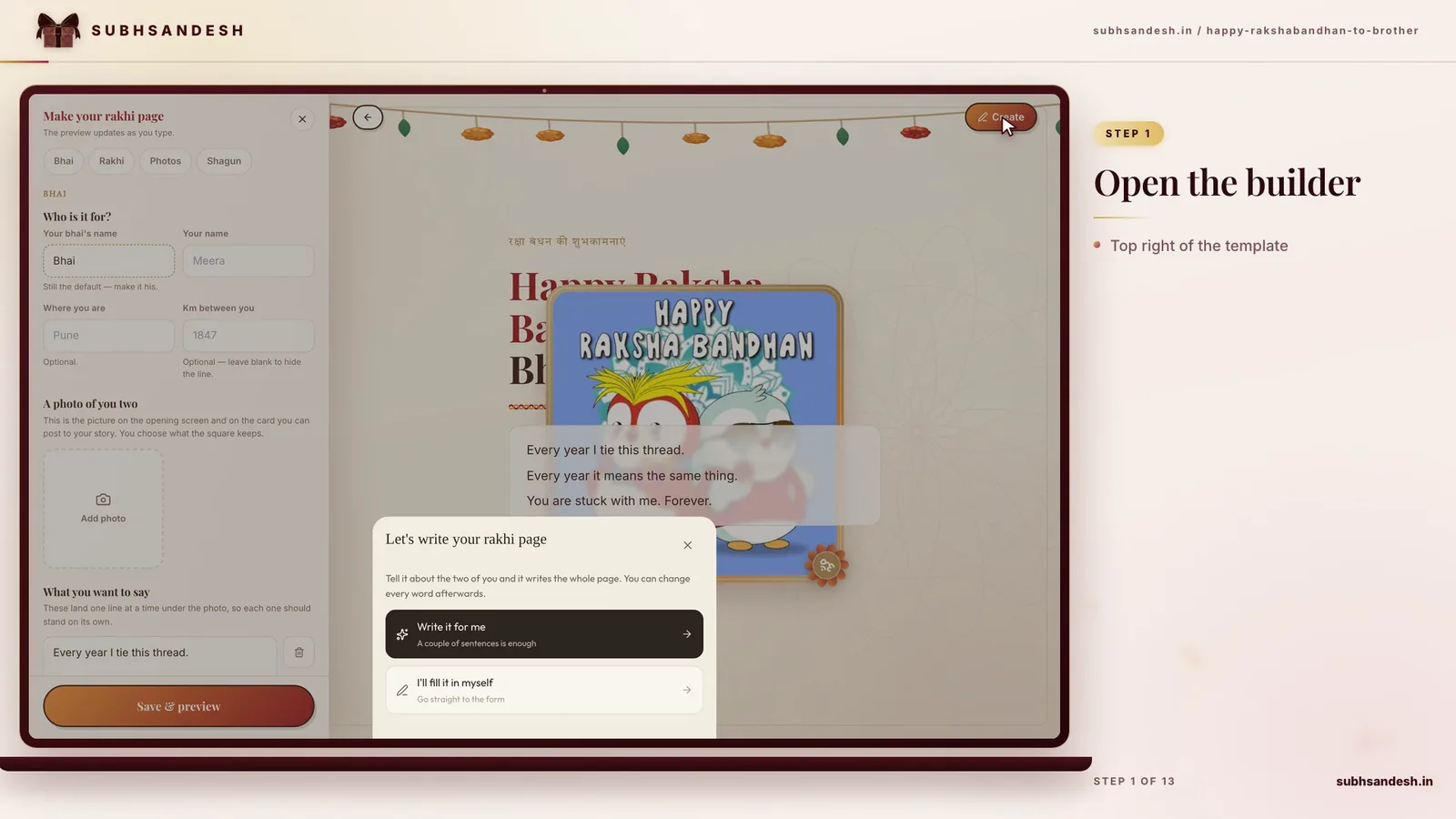
See it built, step by step
Keep reading
Thala Deepavali: A Couple's First Deepavali at the Bride's Home
Thala Deepavali is a Tamil couple's first Deepavali after marriage, at the bride's home. In 2027 it is Thursday 28 October, oil bath 4:40–6:01 AM in C…
 Suyash Agrahari· 9 min
Sugar-Free Diwali Sweets: Swaps, Label Warnings and the Evidence
Five original no-added-sugar Diwali sweets, why jaggery and honey do not count, the warnings FSSAI requires on a sugar-free box, and what an Indian su…
Suyash Agrahari· 9 minShort Diwali Quotes: 34 Original One-Liners Under 10 Words
34 original short Diwali quotes, each under ten words and marked with its word and character count, grouped by mood: lamps, family, friends, gratitude…
Suyash Agrahari· 9 min