
Raksha Bandhan Letter for Brother: How to Write One He Keeps
A Raksha Bandhan letter for a brother is not a long wish. Six parts, a 350-500 word target, and why you should not copy the worked example - grounded in a 6.9-hour median edit gap across 931 pages.
Make this into a page you can send
Photos, a message, music and a ready-to-share link — in a couple of minutes.
Create nowor browse all occasionsKey takeaways
- • A Raksha Bandhan letter works in six parts: dated opening, one specific memory, the year since, the sentence you have never said, one concrete promise or none, and a close without "always".
- • Aim for 350-500 words. That is the shortest length that carries all six parts, and short enough that he reads it in one go.
- • Budget a day of elapsed time, not hours of typing - the median gap between a SubhSandesh page's first save and its last edit is 6.9 hours across 931 pages.
- • Pick one incident you can date to a month and a place; Matsumoto and colleagues showed in 2021 that retelling general memories actively weakens recall of the specific ones.
- • For a 400-word letter, paper beats a screen. Use a shareable page when you are in different cities and need it to arrive on the day.
On this page
Raksha Bandhan Letter for Brother: How to Write One He Keeps
A Raksha Bandhan letter for a brother is not a wish that ran long. Write it in six parts — a dated opening, one specific memory, what changed since last rakhi, the sentence you have never said out loud, one concrete promise or none at all, and a close that avoids the word "always".
Expect it to take a day rather than ten minutes. On SubhSandesh the median gap between a personalised page's first save and its last edit is 6.9 hours (n=931, sampled on the /love-gf page type), and 99.4% of started pages are published and shared (2,956 of 2,973). People leave something open, come back to it, and finish it — but only when they are writing for one named reader.
That is letter behaviour, not greeting-card behaviour. Which is why copying a sample letter removes the only advantage a letter has.
What a letter does that a wish cannot
A wish is broadcast. It goes to a family group, a status, six cousins, and it is written so that any of them could be the recipient. A letter has exactly one addressee and it fails immediately if it reads like it could have gone to anyone else.
Three consequences. It can be long, because one person reads it slowly. It can be specific, because you are not protecting a general audience from an in-joke. And it gets kept, so it will be read again in five years.
Every page ranking for this phrase hands over a finished letter. I read seven, from 244 to 2,186 words; not one carried a citation, a table or a number. This page gives you a structure instead, because a letter you did not write is a card with extra steps.
The six-part structure of a Raksha Bandhan letter
Use these in order. Parts two and four are the ones that do the work; the rest exist to hold them up.
1. Open with a date and a place, not a greeting
"17 August 2027, from the flat in Pune" beats "Dear Bhai, hope this letter finds you well." A date and a location anchor the letter as a record of a particular year, which is what makes it worth keeping. It also stops you writing three sentences of throat-clearing.
2. Name one specific memory, not a category of memories
Not "you always protected me." One incident, with a place and a season: the evening he paid your auto fare and never mentioned it, the exam he sat outside for. One memory told properly beats four told vaguely, and there is research on why — see the section below.
3. Say what changed in the year since the last rakhi
This is the part a copied letter can never supply. A new job, a move, a diagnosis, an unresolved fight, a nephew who now talks. Two or three sentences. If nothing changed, write that — it is still a year he was in.
4. Write the sentence you have never said out loud
Every sibling pair has one — usually an apology, an admission of jealousy, or a thank-you you never gave. Write it plainly, once, without softening it into a joke. If you cannot write it, write why you cannot; that is also true, and better than a couplet.
5. Make one concrete promise, or make none
"I will call on the first Sunday of every month" is a promise. "I will always be there for you" is a decoration. A promise you will not keep is worse than no promise, because he will still be holding the letter in March. If you have nothing you can commit to this year, skip part five entirely.
6. Close without "always", "forever" or "eternal"
Those three words end almost every sample letter online, which is exactly why they read as filler. Close on something small and true: what you are sending with the letter, when you will next see him, or simply your name and the date again.
How long should a Raksha Bandhan letter be?
Length is a decision about how many of the six parts you will do properly. Four bands cover most cases.
| Length | What it can hold | Realistic drafting time | Best delivery | First-party signal from SubhSandesh |
|---|---|---|---|---|
| 60–90 words | One memory fragment and a close | 10–20 minutes | Card insert or WhatsApp | 51.1% of shared pages are opened on a phone (18,497 of 36,202 views) — short text survives a phone screen |
| 150–250 words | Parts 1, 2, 3 and 6 | One sitting, plus one reread | Card, or a shared page | Average of 12.2 views per created page — a short piece gets reread, not skimmed once |
| 350–500 words | All six parts, done honestly | Two to four sittings across a day | Paper, with a page as the delivery note | Matches the 6.9-hour median between first save and last edit (n=931) |
| 700+ words | A life letter — one per decade, not per year | Several days | Paper, hand-delivered | Only 0.6% of started pages are abandoned (17 of 2,973); long does not mean unfinished |
Aim at the 350–500 band. It is long enough for part four and short enough that he reads it in one go, on the day.
Choosing the memory: why specific beats sentimental
There is a measurable reason a general memory is a weak choice. In three experiments reported by Matsumoto and colleagues in 2021, repeatedly retrieving general autobiographical memories reduced later recall of the specific memories attached to the same cue — an effect that held even with new retrieval cues, and grew when the general and specific memories competed directly.
Read that as a writing instruction: every time you retell "you always looked after me", the actual evening gets harder to reach. The generalisation crowds out the incident.
The clinical literature runs the same way. A 2017 systematic review by Hitchcock and colleagues identified 15 controlled studies of autobiographical episodic memory-based training, Memory Specificity Training among them — programmes built on practising specific recall rather than summary. Use the finding, not the therapy: sit with one evening until you can name the month, then write that.
A worked example — do not copy this one
This exists so you can see the joints, not so you can send it. If you send it, you have sent a stranger's letter about a stranger's brother.
17 August 2027, from the flat in Kothrud.
Bhai — I have been trying to write this since Thursday. I keep coming back to the September you drove to Nashik at eleven at night because I said on the phone that I was fine. You never brought it up again.
This year moved. I changed teams in March and hated it until June. Amma's knee is better than she says. I did not call you enough and I know exactly which weeks.
Here is the part I have never said: I spent most of my twenties measuring myself against you, and it made me smaller than I needed to be. That was mine, not yours. I am done with it.
I am not promising anything vague. First Sunday of every month, I will call. Rakhi is in the post and should reach you by Friday.
— Meera, 17 August 2027
Now delete every fact in it and put yours in. The structure survives the swap; the content must not.
What a letter cannot fix
Write this for him, not as therapy for yourself. The largest evidence review in this area — Nyssen and colleagues' 2016 Health Technology Assessment, which screened 14,658 citations, reviewed 284 full texts and included 64 studies, 59 of them randomised trials — found very little or no evidence of benefit from unfacilitated expressive writing across most long-term conditions. The single meta-analytic exception was a short-term reduction in disease severity in inflammatory arthropathies (n=191, standardised mean difference −0.61, 95% CI −0.96 to −0.26).
So: a letter is a gift to a reader, not a treatment for a writer. Nor will it reopen a relationship by itself. If you have not spoken in three years, a 500-word letter is an opening move, not a resolution, and it should say so.
The gratitude half is firmer. Portocarrero and colleagues' 2020 meta-analysis aggregated 404 effect sizes from 158 samples (N = 100,099) and found dispositional gratitude moderately to strongly correlated with well-being — a disposition, not something one letter buys.
Paper, page, or both
For a 400-word letter, paper wins. Handwriting carries effort that a screen flattens, it can be folded into a drawer, and it does not depend on a link staying live. I would not pretend otherwise: this is a case where a digital page is the weaker artefact.
The page earns its place when you are not in the same city as him. Then the letter is the payload and the page is the envelope — a Raksha Bandhan page for a brother carries the text with his name, a photo and the tilak animation, and it arrives on the day rather than four days later. 51.1% of shared pages are opened on a phone, so set the letter in short paragraphs if it is going that way. If you want to see the other formats before deciding, the full template library is browsable without signing up.
Best case is both: post the paper early, send the page on the morning of rakhi.
Raksha Bandhan 2027: when to start writing
Raksha Bandhan 2027 falls on Tuesday, 17 August 2027. Working back from the 6.9-hour median edit gap, that means opening a draft on the Saturday before — not because the writing takes six hours of typing, but because the useful version arrives on the second visit.
Posting paper within India, add four working days. Posting abroad, start two weeks out and send the page as the on-the-day copy.
Sources
- Nyssen OP and colleagues, Does therapeutic writing help people with long-term conditions? Systematic review, realist synthesis and economic considerations, Health Technology Assessment, 1 April 2016 — Oxford University Research Archive
- Matsumoto N and colleagues, Repeated retrieval of generalized memories can impair specific autobiographical recall, September 2021 — Apollo, University of Cambridge
- Hitchcock C and colleagues, Autobiographical episodic memory-based training for the treatment of mood, anxiety and stress-related disorders, March 2017 — Apollo, University of Cambridge
- Portocarrero FF and colleagues, A meta-analytic review of the relationship between dispositional gratitude and well-being, 10 June 2020 — LSE Research Online
Frequently Asked Questions
Turn this inspiration into an unforgettable surprise
Build a page with photos, a heartfelt message, music and a ready-to-share link.
- Photos, message & music
- Ready-to-share link

Written by
Suyash Agrahari
Founder
Suyash Agrahari is a Software Engineer at HireQuotient and the founder of SubhSandesh and DrawFlow (drawflow.in). He builds AI agents and full-stack products with Next.js, Node.js, and the OpenAI and LangChain ecosystems, having shipped autonomous multi-agent systems, AI copilots, and large-scale outreach platforms — and scaled side projects from a few hundred to millions of users. He writes about AI engineering, web development, and building products that grow through SEO and organic reach.
Stay Connected
Follow SubhSandesh
New templates, festival ideas and step-by-step walkthrough videos — first on our socials.
Product guide
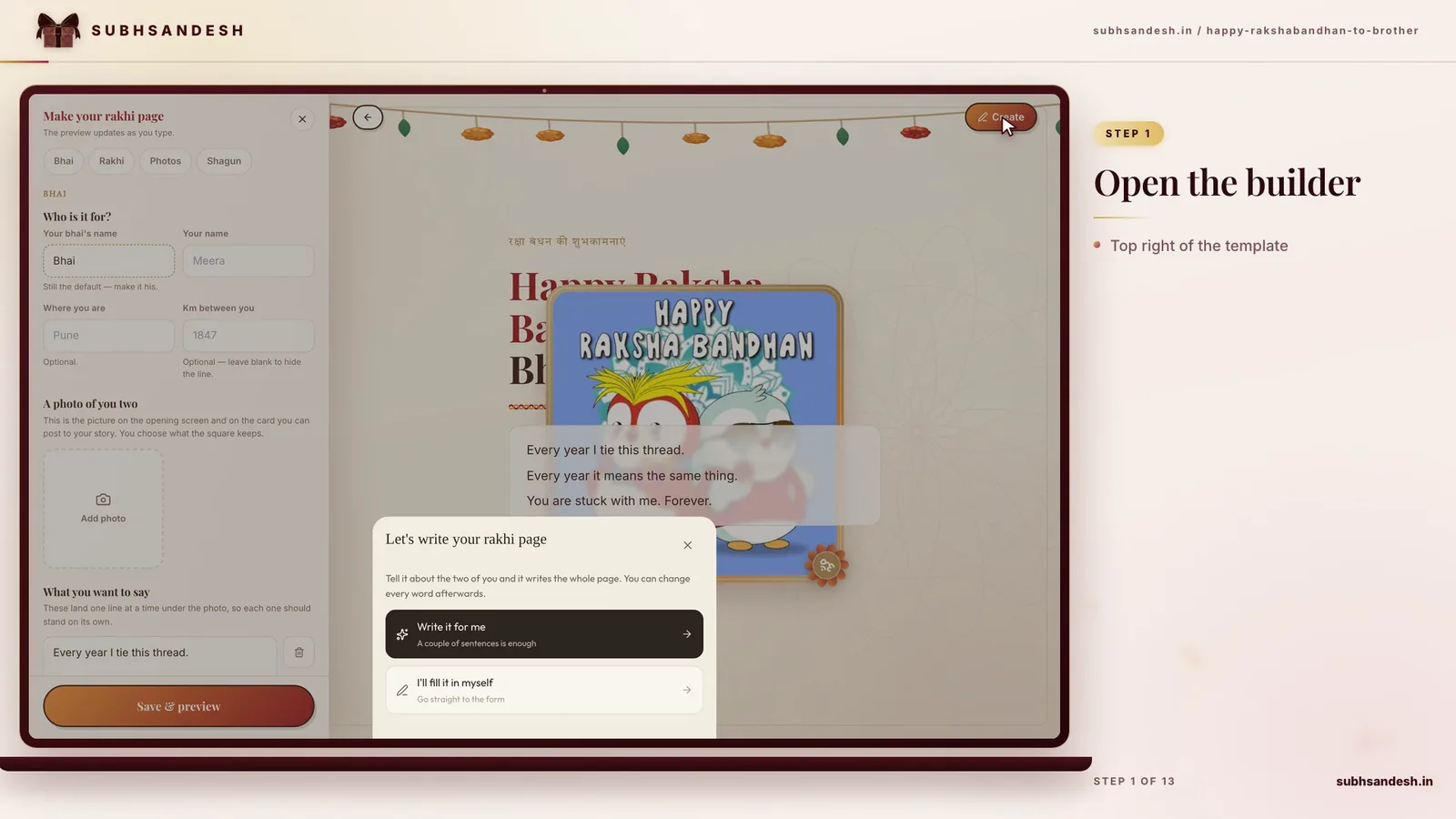
See it built, step by step
Keep reading
Thala Deepavali: A Couple's First Deepavali at the Bride's Home
Thala Deepavali is a Tamil couple's first Deepavali after marriage, at the bride's home. In 2027 it is Thursday 28 October, oil bath 4:40–6:01 AM in C…
 Suyash Agrahari· 9 min
Sugar-Free Diwali Sweets: Swaps, Label Warnings and the Evidence
Five original no-added-sugar Diwali sweets, why jaggery and honey do not count, the warnings FSSAI requires on a sugar-free box, and what an Indian su…
Suyash Agrahari· 9 minShort Diwali Quotes: 34 Original One-Liners Under 10 Words
34 original short Diwali quotes, each under ten words and marked with its word and character count, grouped by mood: lamps, family, friends, gratitude…
Suyash Agrahari· 9 min