
Raksha Bandhan Reply to Brother Wishes Without Over-Thanking
A reply to a brother's Raksha Bandhan wish has to acknowledge what came with it — money, a gift, a promise — without opening an account. Seven worked replies grouped by what arrived, a time budget per format, and the 6.9-hour median edit gap that explains why you cannot match his effort.
Make this into a page you can send
Photos, a message, music and a ready-to-share link — in a couple of minutes.
Create nowor browse all occasionsKey takeaways
- • Thank him once, in a subordinate clause, and never write the amount down — itemising a rakhi transfer turns it into an invoice.
- • An extended replication published in Social Influence (2019) failed: receiving help did not predict reciprocation, and neither gratitude nor indebtedness explained it. The urge to pay him back is felt, not demonstrated.
- • The median SubhSandesh page takes 6.9 hours from first save to last edit (n=931), so a one-minute reply should not try to imitate a made thing.
- • Sibling ties fade once nobody convenes them — Kalmijn and Leopold found sibling relations among adult orphans weaken long-term (N = 3,812).
- • 51.1% of shared pages are opened on a phone (18,497 of 36,202 views), so whatever you send is read on a small screen in a queue.
On this page
- 1. He sent a forwarded rakhi image and nothing else
- 2. He wrote you a real paragraph
- 3. He sent money or a UPI transfer with the wish
- 4. He promised a gift that has not arrived
- 5. He wished you first and you are the one running late
- 6. He posted it in the family group and not to you
- 7. You did not send him a rakhi this year
Raksha Bandhan Reply to Brother Wishes Without Over-Thanking
A Raksha Bandhan reply to brother wishes has one job: acknowledge what he sent, decline the ledger it opens, and name one thing only the two of you know. Over-thanking is the specific failure on this side of the exchange — "thank you so much for the gift" turns a sibling bond into an account with a balance. Effort is why people freeze before answering. On SubhSandesh the median gap between a page's first save and its last edit is 6.9 hours (sampled on the "I love you" page, n=931, measured 2026-08-25), and 51.1% of shared pages are opened on a phone (18,497 of 36,202 views). Something built across hours lands on a screen someone is holding in a lift. You cannot match that in a reply, and you are not meant to.
What a Raksha Bandhan reply to a brother actually has to do
A reply is not a wish. A wish opens; a reply closes something he started, and it is judged against what he sent — which on Raksha Bandhan often includes money, a gift, or a promise of one.
That makes it a different problem from replying to a sister. The material half of the rakhi exchange runs one way: she ties, he gives. So a reply travelling back toward a brother is answering something that already carries an obligation.
Three parts make it work. An acknowledgement that names the specific thing, one line that refuses the accounting, and one detail from the last twelve months that no template could contain. Drop any of the three and it reads as a forward.
The fourth thing it quietly does is keep the tie alive. Kalmijn and Leopold's fixed-effects analysis of the Netherlands Kinship Panel Study (N = 3,812, waves 2003–2015) found that sibling contact intensifies after a parent's death but that among adult orphans sibling relations fade in the long run — the ties hold while somebody convenes them. One annual message is thinner than most people think.
Why leading with "thank you for the gift" backfires
Gratitude is not neutral. A 2026 International Theory article on gift-giving in the Soviet–Cuban and US–Ukraine alliances sets out the sequence: assistance framed as a gift generates a debt of gratitude, which then prescribes "an emotional performance of acknowledgment and deference".
That is diplomacy, not siblings, and the mechanism is what I am borrowing, not the finding. But the shape is recognisable to anyone who has thanked an elder brother three times for a transfer and felt smaller with each one.
The folklore is also weaker than it sounds. An extended replication of Bartlett and DeSteno's 2006 study, published in Social Influence (early online 31 December 2019), failed: receiving help did not promote reciprocal behaviour, and neither gratitude nor indebtedness was associated with reciprocating. The urge to pay him back is felt, not demonstrated.
Practical version: thank him once, inside a subordinate clause, and spend the rest of the message on him rather than on the thing.
7 Raksha Bandhan replies to a brother, by what came with the wish
Grouped by the obligation each message opens, not by the mood it was written in.
1. He sent a forwarded rakhi image and nothing else
Forwarded greeting graphics are their own genre in India. The Week described the good-morning version of it in January 2018 — three of them a day, a line of text pasted onto a photo of a flower — and the rakhi image is the same object with a different caption.
It is not an insult. It is a cheap ping, and the correct answer is a cheap reply plus one thing a forward cannot carry: "Got the flowers, bhai 🌸 Happy Rakhi. Are you home this weekend or is this another video-call rakhi?"
2. He wrote you a real paragraph
The trap is length-matching. You do not have hours and, in most cases, neither did he.
One sentence of receipt, one specific callback, one line pointing forward: "Read this twice. The bit about the hostel year — I'd forgotten you remembered that. Happy Raksha Bandhan, bhai, and I'm holding you to December."
3. He sent money or a UPI transfer with the wish
Do not itemise the amount. "Thank you so much for ₹5,100" converts a rakhi into an invoice, and once the number is in writing it stays there.
Acknowledge, joke, redirect to presence — presence is the only currency in this exchange that creates no debt: "Received, and already spent, don't ask. Happy Rakhi. Next year I'm tying it in person."
4. He promised a gift that has not arrived
Say the true thing without turning it into a complaint, which also covers the case where you suspect it is not coming.
"Nothing here yet — courier's problem, not yours. The wish landed on time and that was the part I wanted." If it does arrive later, one line then is enough; there is no need to reopen it now.
5. He wished you first and you are the one running late
Name the delay in about six words and stop apologising after that. Extended apology makes the reader manage your guilt on their own festival.
"Late, sorry, phone died on me. Happy Raksha Bandhan, bhai. Video call at nine tonight if you're free?" A late reply carrying a plan reads better than a same-day reply carrying nothing.
6. He posted it in the family group and not to you
Answer in both places, differently. The group message is for the room and can be short; the direct one is the actual reply.
Group: "Happy Raksha Bandhan, everyone 🌺" Direct: "Saw yours in the group. Saying the real thing here — you've been the one who calls first this whole year, and I've noticed."
7. You did not send him a rakhi this year
Do not open on an apology and do not invent a story about the post office. Honesty costs one sentence and buys the rest of the message.
"No rakhi from me this year and I'm not going to pretend otherwise. Happy Raksha Bandhan, bhai — the thread was always the smaller half of this."
What your reply can afford: an honest time budget
The reply does not have to be expensive. It has to be unmistakably addressed to him. Here is what each format actually costs and what it signals.
| Reply format | Your time | Arrives in | What it signals | SubhSandesh number |
|---|---|---|---|---|
| One-line text | under 1 minute | seconds | you saw it, and little else | — |
| Voice note, 20–40 seconds | 2–3 minutes | seconds | a tone he can hear, hard to fake | — |
| Video call at a fixed hour | 10–20 minutes | scheduled | presence, and no ledger opened | — |
| Personalised rakhi page | 20 minutes to a few hours | seconds, as a link | matched effort | median 6.9 h from first save to last edit (n=931); 12.2 average views per page |
| Posted return gift | 2–7 days plus cost | 2–7 days | reciprocation, account opened | — |
The dashes are honest: SubhSandesh carries no data on plain texts or phone calls. The number worth taking is the 6.9 hours — what a made thing costs, and why a minute-long reply should not imitate one.
Brother-to-brother replies, and cousin brothers
A brother answering a brother has no gift to acknowledge, which removes the ledger problem and leaves a plainer one: neither of you has a script. Rakhi phrasing is built for a sister's voice, so borrowed lines sound borrowed.
Answer flatly and specifically instead: "Happy Raksha Bandhan, bhai. Odd festival for the two of us, but I'll take the excuse to message you." Flat and true beats warm and generic.
Timing matters here too. Raksha Bandhan falls on Friday 28 August 2026 and then Tuesday 17 August 2027 — a working day, so the 2027 reply gets written in a lunch break. A two-line answer at 1 pm beats a paragraph at midnight.
For a cousin brother the risk is the opposite one — overshooting. A cousin who sent a two-line wish is not asking for a paragraph about childhood, and a reply that outsizes the message reads as performance. Match his length within roughly one sentence, then add a single concrete detail: a name, a place, a date.
When a page is the right reply, and when it is overkill
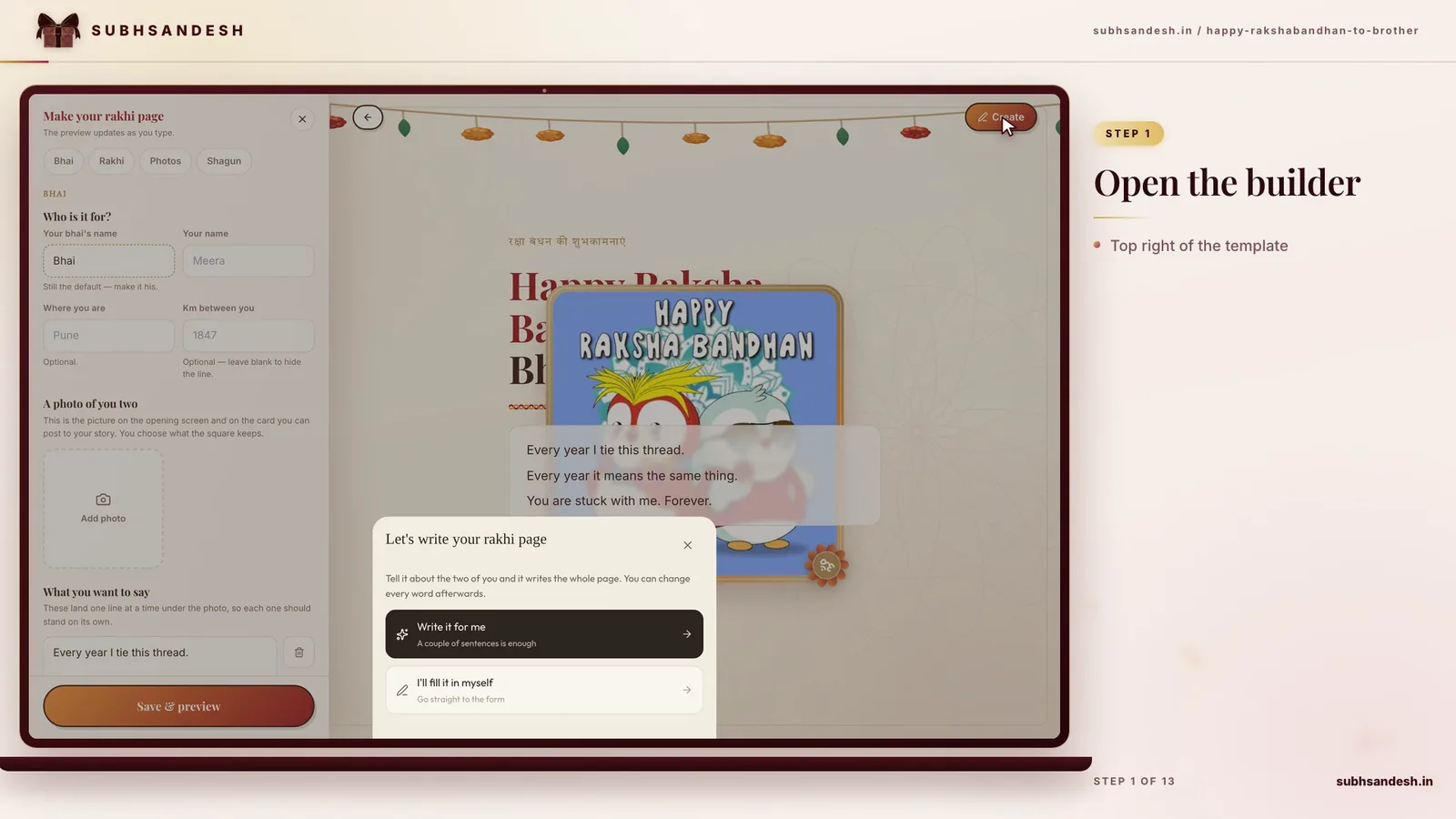
A made page is a poor reply to a one-line forward and a good reply to a brother you have not seen in two years, because the format itself says how long you spent. SubhSandesh's Raksha Bandhan page for a brother takes his photo, his name and animated tilak and rakhi-tying scenes, and gives you a link.
Two honest limits. The rakhi templates are new and lightly used compared with the rest of the catalogue, so treat them as young rather than proven. And 99.4% of pages people start here get published and shared (2,956 of 2,973) — the format is easy to finish, but the thing that makes a reply land is still the sentence you write on it, not the animation behind it.
If the moment is small, do not build. A voice note beats a page for a brother who messaged you eleven minutes ago. If you do build one, it is a link like any other, so it opens on a phone in a queue — write for that. Browse the full template catalogue if the relationship needs something that is not a festival page at all, and note that 44.2% of creators password-protect before sharing (1,315 of 2,973), which matters if the reply is going somewhere it might be forwarded.
Sources
- Kalmijn, M., & Leopold, T. — Changing Sibling Relationships After Parents' Death: The Role of Solidarity and Kinkeeping, Journal of Marriage and Family 81(1), 99–114, early online 11 July 2018. N = 3,812. Abstract read; publisher full text not accessible.
- Peng, C., Malafosse, C., Nelissen, R., & Zeelenberg, M. — Gratitude, Indebtedness, and Reciprocity: An Extended Replication of Bartlett & DeSteno (2006), Social Influence, early online 31 December 2019. Abstract read via the University of Manchester repository.
- The disciplinary power of gratitude: gift-giving and moral indebtedness in Cuba (1962–1963) and Ukraine (2022–2025), International Theory, 2026, open access. Abstract read.
- Solomon, A. — Good morning on WhatsApp? No, thank you, The Week, 27 January 2018.
Frequently Asked Questions
Turn this inspiration into an unforgettable surprise
Build a page with photos, a heartfelt message, music and a ready-to-share link.
- Photos, message & music
- Ready-to-share link

Written by
Suyash Agrahari
Founder
Suyash Agrahari is a Software Engineer at HireQuotient and the founder of SubhSandesh and DrawFlow (drawflow.in). He builds AI agents and full-stack products with Next.js, Node.js, and the OpenAI and LangChain ecosystems, having shipped autonomous multi-agent systems, AI copilots, and large-scale outreach platforms — and scaled side projects from a few hundred to millions of users. He writes about AI engineering, web development, and building products that grow through SEO and organic reach.
Stay Connected
Follow SubhSandesh
New templates, festival ideas and step-by-step walkthrough videos — first on our socials.
Product guide
See it built, step by step
Keep reading
Thala Deepavali: A Couple's First Deepavali at the Bride's Home
Thala Deepavali is a Tamil couple's first Deepavali after marriage, at the bride's home. In 2027 it is Thursday 28 October, oil bath 4:40–6:01 AM in C…
 Suyash Agrahari· 9 min
Sugar-Free Diwali Sweets: Swaps, Label Warnings and the Evidence
Five original no-added-sugar Diwali sweets, why jaggery and honey do not count, the warnings FSSAI requires on a sugar-free box, and what an Indian su…
Suyash Agrahari· 9 minShort Diwali Quotes: 34 Original One-Liners Under 10 Words
34 original short Diwali quotes, each under ten words and marked with its word and character count, grouped by mood: lamps, family, friends, gratitude…
Suyash Agrahari· 9 min