
Raksha Bandhan Wishes for Bhaiya and Bhabhi in English
English gives you one word, sister-in-law, for five Hindi relations — so keep bhaiya and bhabhi untranslated. Seven English lines, a four-format table, a seven-term kinship glossary, and the honest answer on whether bhabhi gets a rakhi.
Make this into a page you can send
Photos, a message, music and a ready-to-share link — in a couple of minutes.
Create nowor browse all occasionsKey takeaways
- • Keep bhaiya and bhabhi in Hindi inside an English message: English has one word, sister-in-law, for five Hindi relations, so translating deletes whose wife she is.
- • Apply the deletion test — cut your brother's name and check whether the remaining sentence still addresses bhabhi. If it does not, she is cc'd rather than greeted.
- • Siblings-in-law are the thinnest leg of the family triangle: across 109 sibling/spouse/sibling-in-law triads, they reported the least affectionate communication of the three.
- • Whether bhabhi gets a rakhi is regional, not settled — the lumba is standard in Marwari and Rajasthani families and unknown across much of eastern and southern India.
- • 99.4% of started SubhSandesh pages get published and shared (2,956 of 2,973), at 12.2 views each — the sending is not the bottleneck, the wording is.
On this page
Raksha Bandhan Wishes for Bhaiya and Bhabhi in English
Write one English message that names them separately, and keep the words bhaiya and bhabhi in Hindi instead of translating them. On SubhSandesh, 99.4% of started pages are actually published and shared (2,956 of 2,973) — people who begin a greeting finish it, so the hard part was never the sending. It is deciding what to call her. English gives you one word, sister-in-law, for five different Hindi relations, so the moment you translate, the sentence stops naming anyone in particular. And 51.1% of the 36,202 views on shared pages open on a phone (18,497 of them), which means the line has to land inside two thumb-scrolls. Below: seven English lines you can send as they are, a table of the four formats and which one actually reaches her, the honest answer on whether bhabhi gets a rakhi, and a glossary of the Hindi kin terms an English message still needs.
What "in English" actually changes about this wish
A Raksha Bandhan wish for bhaiya and bhabhi in English is a message written in English that keeps its Hindi address terms. That is not sloppiness — it is the only way the sentence holds its meaning.
English has exactly six affinal kin terms — the ones for relatives by marriage — and all six share one suffix: father-in-law, mother-in-law, son-in-law, daughter-in-law, brother-in-law, sister-in-law. Dwight Read sets this out in his Kinship Terminology entry for the International Encyclopedia of the Social & Behavioral Sciences (2015): terms like aunt are "defined disjunctively", doing consanguineal and affinal duty at once.
Hindi splits that single sister-in-law slot at least five ways: bhabhi, nanad, jethani, devrani, salhaj. Translate and you delete the information — "sister-in-law" tells the reader nothing about whose wife she is.
Read also separates address terms from terms of reference. Bhabhi is an address term, used to her face; sister-in-law is a reference term, used about her to a stranger. A greeting is address, so the Hindi word is the correct one.
Keep the Hindi word, translate it, or use her name?
Three options, and they are not interchangeable.
Keep it — "Bhaiya and Bhabhi". The default, and right in almost every case. It is accommodation in the technical sense: you match the words the family already uses. Rittenour and Soliz's 2009 study of 190 daughters-in-law in Western Journal of Communication modelled shared family identity as the mediator between communication behaviour — supportive communication, self-disclosure, nonaccommodation — and a daughter-in-law's intentions about future contact. Their subject is mothers-in-law, not sisters-in-law, so read the study as adjacent evidence, not proof.
Translate it — "my brother and sister-in-law". Only for a mixed audience: an Instagram caption a colleague will read, or a note to a friend who has no Hindi. Inside the family it reads like a form.
Use her first name. Warmest and riskiest. Fine if you already call her by name; in families where a younger sibling never does, it reads as disrespect, and Raksha Bandhan is a bad day to test it.
Seven Raksha Bandhan wishes for bhaiya and bhabhi in English
Each line is written to be sent unchanged. Take the one whose situation matches yours.
1. The plain one, readable in three seconds
"Happy Raksha Bandhan, Bhaiya and Bhabhi. Thank you for the home I can turn up at without warning."
Best for a first message of the day, or the family group. It names something she does — running the house you visit — not only what he does. Send it on rakhi morning, before the calls start; at fifteen words it survives a notification preview.
2. The one that gives bhabhi her own sentence
"Happy Raksha Bandhan, Bhaiya. And Bhabhi — you are the reason this house still feels like mine."
Best once she has been in the family a year or more. Apply the deletion test: cut the first sentence and the second still stands alone. That is the difference between addressing her and cc-ing her. Send it to her directly, not only to him.
3. The first Raksha Bandhan after the wedding
"Bhaiya, my rakhi is on your wrist. Bhabhi, welcome to the part of the family that argues at 11 pm."
Best for the first festival after his marriage, when she is still working out where she stands. It offers membership rather than praise, which is harder to get wrong. Send it the evening before, ahead of the crowd.
4. The formal one for a much older bhaiya
"Bhaiya ji, Bhabhi ji — happy Raksha Bandhan. May the year ahead be kind to you both."
Best where the age gap is ten years or more, or in families that use aap. English has no aap/tum distinction, so ji is the only politeness marker you have left — dropping it flattens a register that matters.
5. From a brother, not a sister
"Happy Raksha Bandhan, Bhaiya and Bhabhi. No rakhi from me, just the same promise."
Best for a younger brother, whom every wishes list on this subject quietly ignores. Rakhi is tied between sisters, between cousins, and brother to brother in plenty of families. Send it plainly — the joke about having no rakhi to give has been made too often.
6. The long-distance one
"Happy Raksha Bandhan, Bhaiya and Bhabhi. Different time zones, same knot — the rakhi is in the post and the photo is attached."
Best when you will not be in the same country and the parcel may not arrive on time. It sets an expectation instead of apologising for one. Send it at their morning, not yours, with a photo of the posted rakhi attached.
7. The one for a strained year
"Happy Raksha Bandhan to you both."
Best when anything warmer would be read as sarcasm. Six words make no claim about closeness, ask for no reply, and keep the door open at its current width. Send it once. A short correct greeting is not coldness; it is accuracy.
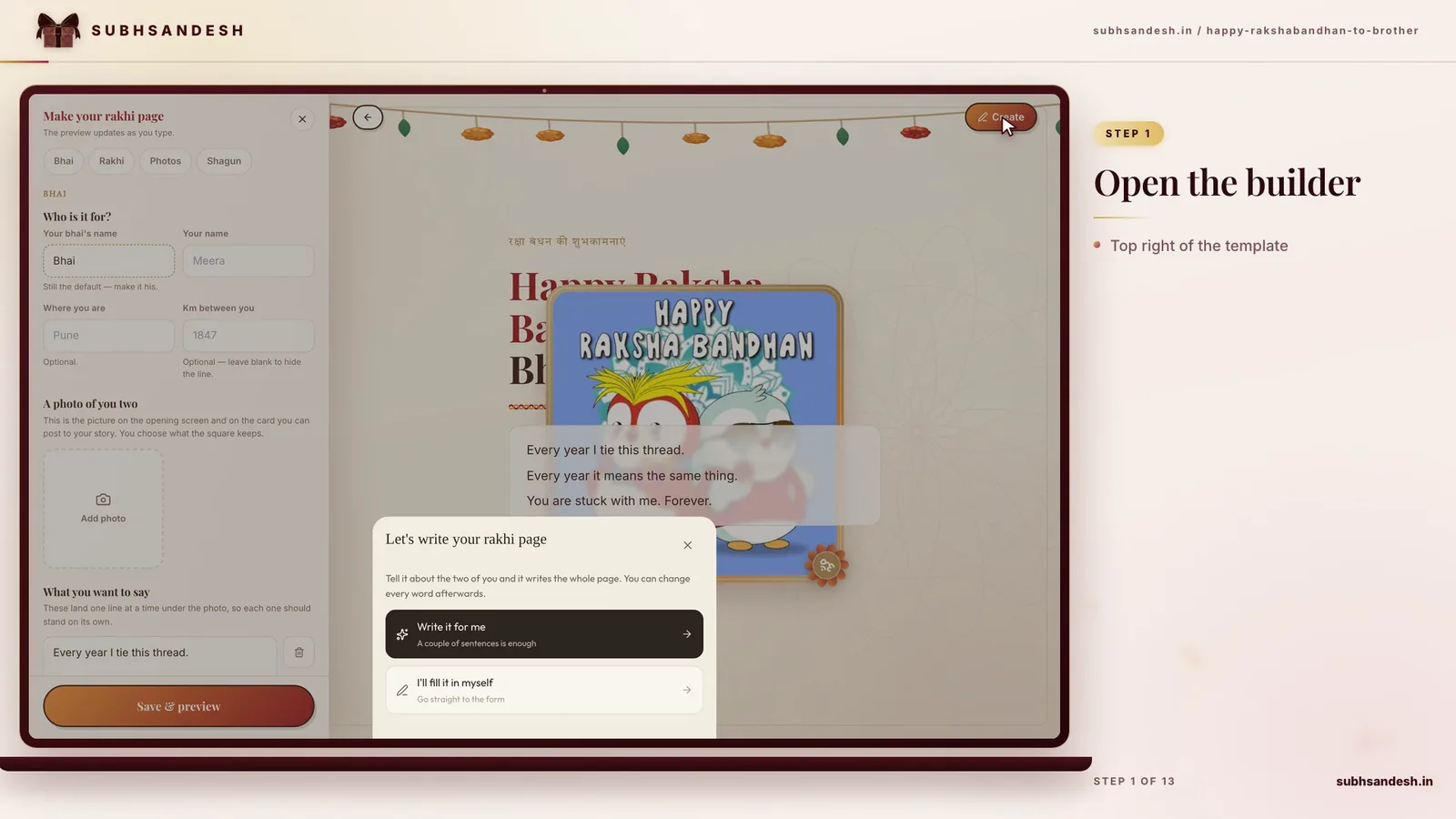
You can put any of these on a Raksha Bandhan page for a brother with both names on it, so bhabhi is greeted on the same screen rather than in a forwarded copy.
Which format actually reaches bhabhi
The same words, four ways, compared by whether she is addressed or merely present.
| Format | Bhabhi addressed by name | Time to prepare | Typical reach |
|---|---|---|---|
| One WhatsApp text to bhaiya | No — she reads it over his shoulder | 30 seconds | 1 reader |
| Two separate texts | Yes | 2 minutes | 2 readers |
| Post in the family group | No — 20 to 40 people, none of them addressed | 1 minute | 20–40 readers |
| One shared page carrying both names | Yes, on the same screen | 10–15 minutes | 12.2 views per page, averaged across 2,973 SubhSandesh pages |
The group post is the most common choice and the weakest. If the message says something you would rather the wider family did not read, note that 44.2% of SubhSandesh creators password-protect a page before sharing it (1,315 of 2,973).
Does bhabhi get a rakhi, and how do you ask?
It is unsettled, and anyone telling you otherwise is describing their own region. In Marwari and Rajasthani families the lumba — a rakhi tied to bhabhi's bangle rather than her wrist — is standard; in much of eastern and southern India nobody has heard of it. We found no study quantifying how common it is, so treat it as a question about your family, not a rule.
Why the separate line matters anyway: Floyd and Morr surveyed 327 people in 109 sibling/spouse/sibling-in-law triads and found spouses reported communicating the most affection, siblings less, and siblings-in-law least of the three (Communication Quarterly 51:3, 2003 — abstract only; full text paywalled). The in-law leg is the thinnest by default, so one sentence addressed to her personally does more than three addressed to the pair.
The English phrasing that avoids a test: "Do you do lumba in your family?" That asks about practice. "Do you want a rakhi?" asks her to declare a preference in front of everyone.
The Hindi kin terms an English message still needs
People searching in English often do not know the precise term. The set worth knowing:
- Bhaiya — elder brother. Bhai is brother generally; bhaiya is the respectful, usually elder, form.
- Bhabhi — elder brother's wife. English: sister-in-law.
- Nanad — husband's sister. Your bhabhi's word for you, if you are a woman. English: sister-in-law again.
- Jethani / devrani — husband's elder brother's wife, and his younger brother's wife. English: sister-in-law, twice over.
- Devar — husband's younger brother. Your bhabhi's word for you, if you are a man.
- Jija or jijaji — sister's husband. English: brother-in-law.
- Salhaj — wife's brother's wife.
Four of those seven land on "sister-in-law" in English. That collapse, which Read's entry describes, is the structural reason the Hindi word survives inside English sentences.
When one English message to both is the wrong choice
If bhabhi does not read English comfortably, this page is the wrong page. Write to her in Hindi, Marathi or whatever her first language is — a plain sentence in her language beats an elegant one in yours.
If she is mid-work, timing beats wording. Analysis of India's National Sample Survey Office Time Use Survey (January–December 2019), published in The Indian Journal of Labour Economics in June 2023, found daughters-in-law spend significantly more time on unpaid domestic and care work than daughters in comparable households. On a festival morning your bhabhi is plausibly cooking for the people who came to see her husband. A link she opens at 9 pm reaches her; a call at 10 am interrupts her.
If you are in the same room, say it out loud. If your brother would rather have your voice, call — a page is a poor substitute. And if the relationship has been silent for three years, build nothing: line seven, sent once, is the right size.
When a page is the right call, browse the SubhSandesh templates and put both names on one screen.
Sources
- Dwight Read, "Kinship Terminology", International Encyclopedia of the Social & Behavioral Sciences, 2nd ed., Vol. 13, 2015, pp. 61–66.
- Rittenour and Soliz, "Shared Family Identity in Mother-in-Law/Daughter-in-Law Relationships", Western Journal of Communication 73:1, January 2009, pp. 67–90.
- Floyd and Morr, "Affectionate communication in the sibling/spouse/sibling-in-law triad", Communication Quarterly 51:3, 2003, pp. 247–261 (abstract read; full text paywalled).
- "Beyond the Clock: Women's Domestic Roles in India", The Indian Journal of Labour Economics, 16 June 2023.
Frequently Asked Questions
Turn this inspiration into an unforgettable surprise
Build a page with photos, a heartfelt message, music and a ready-to-share link.
- Photos, message & music
- Ready-to-share link

Written by
Suyash Agrahari
Founder
Suyash Agrahari is a Software Engineer at HireQuotient and the founder of SubhSandesh and DrawFlow (drawflow.in). He builds AI agents and full-stack products with Next.js, Node.js, and the OpenAI and LangChain ecosystems, having shipped autonomous multi-agent systems, AI copilots, and large-scale outreach platforms — and scaled side projects from a few hundred to millions of users. He writes about AI engineering, web development, and building products that grow through SEO and organic reach.
Stay Connected
Follow SubhSandesh
New templates, festival ideas and step-by-step walkthrough videos — first on our socials.
Product guide
See it built, step by step
Keep reading
Thala Deepavali: A Couple's First Deepavali at the Bride's Home
Thala Deepavali is a Tamil couple's first Deepavali after marriage, at the bride's home. In 2027 it is Thursday 28 October, oil bath 4:40–6:01 AM in C…
 Suyash Agrahari· 9 min
Sugar-Free Diwali Sweets: Swaps, Label Warnings and the Evidence
Five original no-added-sugar Diwali sweets, why jaggery and honey do not count, the warnings FSSAI requires on a sugar-free box, and what an Indian su…
Suyash Agrahari· 9 minShort Diwali Quotes: 34 Original One-Liners Under 10 Words
34 original short Diwali quotes, each under ten words and marked with its word and character count, grouped by mood: lamps, family, friends, gratitude…
Suyash Agrahari· 9 min