
Virtual Gift Website for Boyfriend: How to Pick One That Works
Pick a virtual gift website for a boyfriend on five things: whether he needs an account, whether you can edit after sending, whether it locks, what it costs, and whether the link survives. With data from 4,357 real pages.
Make this into a page you can send
Photos, a message, music and a ready-to-share link — in a couple of minutes.
or browse all occasionsKey takeaways
- • Choose the service on five things, not the templates: signup, editability, password, price and how long the link lives.
- • 40.6% of SubhSandesh creators password-protect the page before sharing it — 1,767 of 4,357 — so treat a lock as a normal feature, not a paranoid one.
- • Nobody finishes at publish: the median gap between a page's first save and its last edit is 6.2 hours, so a builder that freezes the page at publish is the wrong one.
- • Link rot is real — the Internet Archive cites Pew's finding that 38% of 2013 webpages were gone a decade later, so screen-record the page once it is live.
- • If he is in the same room, buy the object. A link is for the night you are 2,000 km away.
On this page
Virtual Gift Website for Boyfriend: How to Pick One That Works
The right virtual gift website for boyfriend surprises is decided by five things, and none of them is the template gallery. Can he open it without an account; can you still edit after you send the link; can the page be locked; does the price show before you build; and is the link still alive next year.
Our own numbers say why the choice is worth ten minutes. 40.6% of creators password-protect their page before sharing it (1,767 of 4,357), 94.1% of started pages are actually published and shared (4,098 of 4,357), and the average registered creator has made 1.29 pages. Most women pick a service once, build one thing for one person, and never open a builder again.
So the test below runs before the build, not after it. Get it wrong and a good idea lands as a signup form, a paywall, or a dead URL at 11pm.
What a virtual gift website actually is, and what it is not
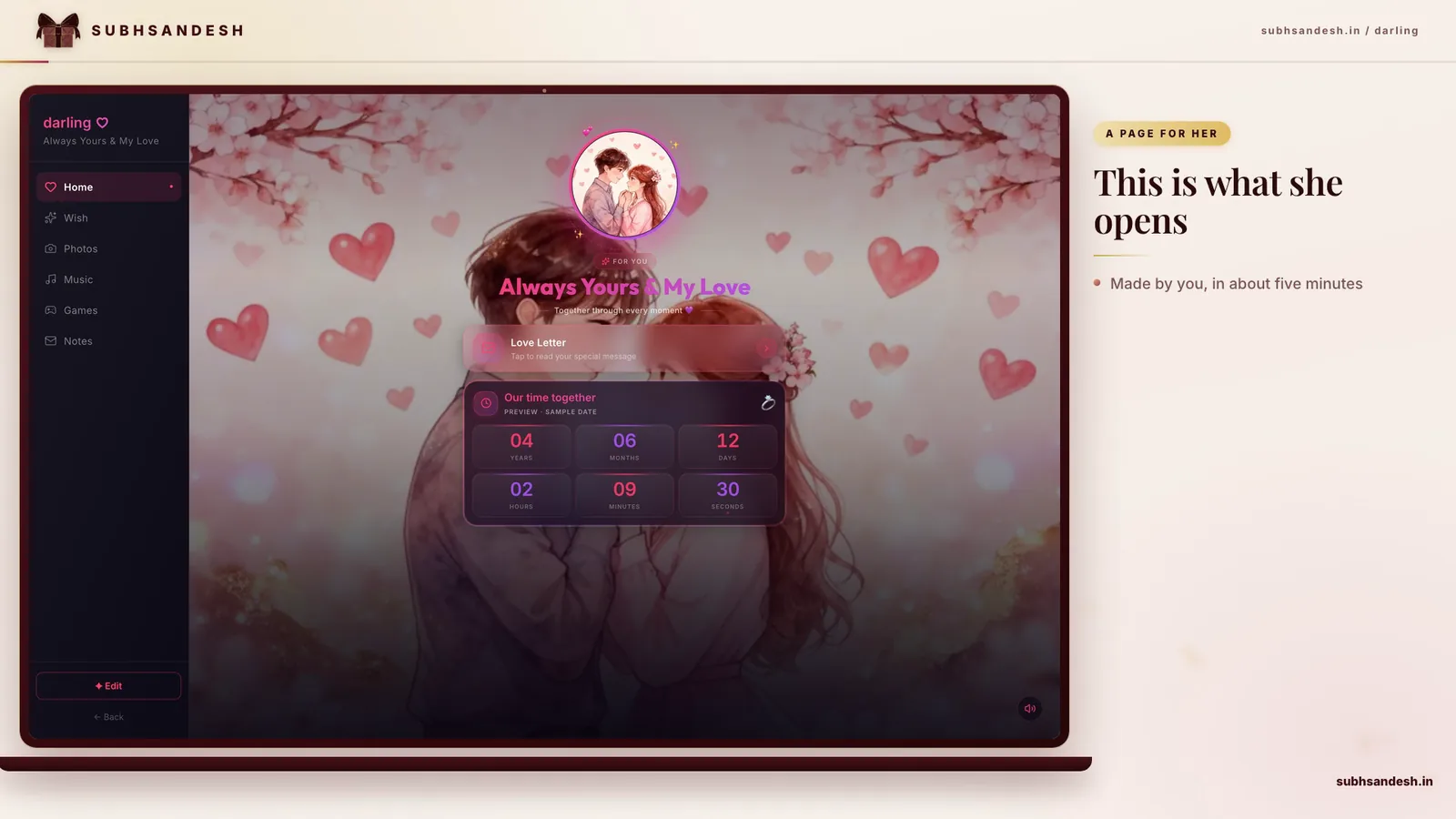
A virtual gift website is a builder that produces one web page addressed to one person, reachable by a private link, instead of shipping an object. You choose a layout, add photos and a message, sometimes audio or a small interaction, publish, and send the URL.
It is not a checkout and it is not a gift card. Nothing arrives at his door. Across 4,357 pages created since 12 March 2026 on SubhSandesh, the page is the entire product, and 49.0% of the 49,968 recorded views happen on a phone — what he receives is a link in a chat window, opened one-handed.
That is the honest boundary. If you want something he can hold, buy the thing. This is for the night you are 2,000 km away and no courier can help.
Five checks to run on a virtual gift website before you build anything
Run them in this order. The first three you can answer from the builder's own homepage in under a minute each; the last two need a look at what it charges and at its terms.
1. Does he need an account to open it?
Ask before you build: can he open the link with no signup, no app install, no email address? Nielsen Norman Group's trust pyramid, published 6 March 2016, sets out five levels of commitment a site has to earn in order, with requests for personal information sitting near the top — a site that asks at the bottom of the pyramid simply loses the visitor.
A gift is the worst possible moment to run that experiment. If the service makes him register to read what you wrote, you have sent him a form.
2. Can you edit the page after you have sent the link?
Almost nobody is finished at publish. The median gap between a page's first save and its last edit is 6.2 hours, sampled on the "I love you" page with n=1,125 — people come back the same evening and change a line, swap a photo, fix a name.
So check that the URL is stable while the contents are not. A builder that freezes the page at publish, or mints a fresh link on every edit, turns a small correction into a second send.
3. Can you lock the page, and can you unlock it again?
40.6% of creators password-protect the page before sharing it — 1,767 of 4,357. That is rarely about strangers on the internet. It is a shared phone, a screen mirrored to a TV, a cousin scrolling through someone's chat.
Check two things, not one: that a password exists at all, and that you can take it off later without rebuilding. A keepsake he has to type a password into every time stops being reopened.
4. Does the price appear before you build?
The US Federal Trade Commission published a report on dark patterns on 15 September 2022. It names burying key terms and junk fees, and making a recurring charge hard to cancel, among the design tactics it is acting against.
The gifting version is a builder that reveals a charge at the share step, after twenty photos are already uploaded. Find out what it costs before you upload anything, and read what an unpaid page holds back: watermark, view cap, expiry date, and whether a charge repeats monthly.
5. Will the link still be alive next year?
This is the check nobody runs. The Internet Archive's analysis of the dead web, 23 April 2026, cites Pew's finding that 38% of webpages from 2013 were unreachable a decade later, and an Old Dominion University study in which about 65% of 27.3 million sampled URLs were dead on the live web when tested in 2023.
A gift page is a keepsake or it is nothing. Ask whether the page expires, whether it survives you closing the account, and take a screen recording the day it goes live.
What actually differs between the ways of sending something digital
Access, editability and privacy are where these options separate. The gallery of designs is not.
| Option | He needs an account to open it | You can edit after sending | Privacy control |
|---|---|---|---|
| Personalised page on a private link | No — the link opens it | Yes; median 6.2 hours of edits after first save | Password optional, used by 40.6% of 4,357 creators |
| Digital gift card code | No | No | Readable by anyone who sees the email |
| Shared cloud folder of photos | Often yes, or a sign-in prompt | Yes | Link-only; no password on most free tiers |
| Instagram post or story | Yes, to see it at all | No — delete and repost | Visible to every follower you have |
| Video file on WhatsApp | No | No | Forwardable in one tap |
Only the first row leaves you in control after you have sent it. That is the whole argument for a page over a post.
Why your gut feeling about a gifting site is only half reliable
Antonina Bauman's 2016 study in the Journal of International Technology and Information Management asked shoppers in Germany, Russia and the USA to judge websites they had never seen. It found fourteen categories of online trust cue, of which only three were shared across all three countries and eleven were culture-specific.
The practical reading for an Indian buyer: whether a site "looks legitimate" is partly a local instinct, and a polished foreign-built gifting page can read as trustworthy to you and as nothing to him. Bauman also notes the participants only examined sites rather than buying, so treat it as a guide to what to look at, not a scoring system.
Look at the concrete things instead. A published price, a reachable contact route, a privacy policy that names what happens to uploaded photos, and a preview you can see before you create an account.
What you are uploading, and what he never agreed to
A gift page usually carries photos of two people, and only one of them chose to upload them. Yao Li and Xinning Gui's study of co-owners in collaborative photo sharing, published in Computer Supported Cooperative Work in March 2022, found that a co-owner's privacy concern depends on several contextual factors at once rather than on any one of them. We read the abstract; the full text sits behind a paywall.
The link itself leaks in ways people do not expect. The private link privacy pattern points out that an unlisted URL stays in the recipient's browser history and can be forwarded by anyone holding it, and that a service should let you revoke or reset that link rather than merely hide it.
Three habits cover most of it: keep his phone number, address and workplace off a page that lives at a guessable URL, use the password if it holds anything he would not show a colleague, and tell him the page exists rather than letting him find it indexed six months later. None of that costs you anything at build time.
What to put on the page once you have picked the service
The build is the short part. Three photos beat thirty, one specific memory beats a paragraph of adjectives, and one thing to tap beats an autoplaying song.
Pick the format to the relationship rather than the occasion. A straight romantic page like the Darling template is the fourth most-built page type here, with 427 created; a LoveFlix streaming page suits a couple whose evenings are a shared watchlist; and a radio dedication with your recorded voice works when he is the one who never reads long messages.
Then send it when he can actually sit with it. Average views per created page run at 11.5, so these pages do get reopened — but only if the first open was not during a meeting.
When a virtual gift website is the wrong choice for your boyfriend
If he is in the same room, buy the thing. A link you hand someone across a table is a worse gift than a badly wrapped box, and no amount of animation fixes that.
It is also wrong when he has a weak connection or an old phone, when the surprise needs to be physically unwrapped in front of family, or when the relationship is new enough that a page about "us" is more commitment than the occasion carries. Occasion-dated pages are only 3.7% of everything built here — this platform is for ordinary Tuesdays far more than for milestones, and a milestone sometimes deserves an object.
And if he genuinely dislikes being the centre of attention, a public post is a bad idea even when a private page is a good one. The 40.6% password rate exists because the difference is real.
Sources
- Katie Sherwin, "Hierarchy of Trust: The 5 Experiential Levels of Commitment", Nielsen Norman Group, 6 March 2016 — nngroup.com
- US Federal Trade Commission, "FTC Report Shows Rise in Sophisticated Dark Patterns Designed to Trick and Trap Consumers", 15 September 2022 — ftc.gov
- Internet Archive, "Gone but Not Forgotten: Recovering the Dead Web", 23 April 2026 — blog.archive.org
- Antonina A. Bauman, "Online Trust Cues: Perceptions and Application", Journal of International Technology and Information Management 25(4), 2016 — scholarworks.lib.csusb.edu
- Yao Li and Xinning Gui, "Examining Co-Owners' Privacy Consideration in Collaborative Photo Sharing", Computer Supported Cooperative Work 31(1), March 2022 — abstract read, full text paywalled — pure.psu.edu
- "Private link", Privacy Patterns catalogue, no publication date given — privacypatterns.org
Frequently Asked Questions
Turn this inspiration into an unforgettable surprise
Build a page with photos, a heartfelt message, music and a ready-to-share link.
- Photos, message & music
- Ready-to-share link

Written by
Suyash Agrahari
Founder
Suyash Agrahari is a Software Engineer at HireQuotient and the founder of SubhSandesh and DrawFlow (drawflow.in). He builds AI agents and full-stack products with Next.js, Node.js, and the OpenAI and LangChain ecosystems, having shipped autonomous multi-agent systems, AI copilots, and large-scale outreach platforms — and scaled side projects from a few hundred to millions of users. He writes about AI engineering, web development, and building products that grow through SEO and organic reach.
Product guide
See it built, step by step
Keep reading
What Is a Virtual Gift and How to Send One That Gets Opened
A virtual gift arrives as a link, a code or an in-app item instead of a parcel, and four different things go by that name. Here is how to send each on…
 Suyash Agrahari· 9 min
What Is a Digital Gift? The Four Kinds, and Which to Send
A digital gift arrives as a file, a code or a link. Four families — stored value, access, downloads and personalised pages — compared on delivery, Ind…
Suyash Agrahari· 9 minWhat Can I Gift My Girlfriend? Four Questions That Settle It
Buy something physical if you will hand it over in person and she has named what she wants. Send a personalised page if you are apart, out of time, or…
Suyash Agrahari· 9 min