
20 Questions Game for Couples: How to Spend the Twenty
The 20 questions game for couples is a guessing game with a budget: twenty yes-or-no questions to name something from your shared life. Six rules, the splitting arithmetic, 40 prompts with examples, and how to run a round from two different cities.
Make this into a page you can send
Photos, a message, music and a ready-to-share link — in a couple of minutes.
or browse all occasionsKey takeaways
- • The 20 questions game for couples is a guessing game with a budget: one written answer from your shared life, twenty yes-or-no questions to name it, and a wrong guess costs a question.
- • Each question can at best halve the field, which is how twenty questions distinguish between 2^20 = 1,048,576 objects — the same logic as a binary search.
- • People are good at recognising a strong question and poor at inventing one: of 605 questions written by 40 participants in a Battleship-style guessing task, the best in the set were asked by only a small fraction of them.
- • It is the one couple game that survives being asynchronous, because the answer is fixed before play starts — SubhSandesh's median gap from a page's first save to its last edit is 7.2 hours across 987 "I love you" pages.
- • The "I love you" page is SubhSandesh's most-created and most-viewed template: 987 pages, 29.2% of 3,377, and 14,607 views, 35.2% of 41,486.
On this page
20 Questions Game for Couples: How to Spend the Twenty
The 20 questions game for couples is a guessing game with a fixed budget: one of you picks something from your shared life, the other gets twenty yes-or-no questions to name it. The budget is the whole game — twenty questions that each halve the field separate over a million possibilities, while twenty hopeful guesses separate almost nothing.
On SubhSandesh the "I love you" page is the template couples build most: 987 of the 3,377 pages created since 2026-03-12, or 29.2% of everything made, and the most-viewed at 14,607 views, 35.2% of all 41,486 recorded views. Its Games tab runs a Love Quiz whose answers are set by whoever built the page. Below: the rules, the arithmetic of spending twenty well, forty topics, and how to play from two cities.
What is the 20 questions game for couples?
Twenty questions is a spoken parlour game in which one player thinks of something and the other asks up to twenty yes-or-no questions to identify it. The couples version changes one rule: the answer must come from your shared life — a place, an object, a person, one specific evening.
Wikipedia's entry on twenty questions dates the game to at least the eighteenth century, and records Hannah More teaching "the play of twenty questions" at a London dinner party in the 1780s. Lying is not allowed; if the twenty run out with no correct guess, the answerer wins.
A second, unrelated game trades under the same name: a curated set of twenty questions you take turns answering. That is a disclosure game — no secret, no budget, no winner. Only the first is actually twenty questions, and confusing them is why rounds die at question six.
20 questions game: how to play, in six rules
- Pick roles. One answerer, one questioner. The answerer holds a secret; the questioner spends twenty.
- Set the field first. "Something from our first year" is playable. "Anything at all" is not — with an unbounded field nothing can halve it.
- Write the answer down. An unwritten answer drifts to fit whatever the questions imply, and then nobody has played anything.
- Yes or no, one at a time, counted out loud. Say the number before you ask; couples who stop counting lose track around eleven and start guessing.
- A guess spends a question. Name it at question four and that is question four gone.
- Then swap. One person asks all twenty here, and asking is the half that earns the warmth: across three studies, Huang and colleagues found people who ask more questions, particularly follow-up questions, are better liked by their partners (Journal of Personality and Social Psychology, 2017), with perceived responsiveness explaining the effect — and people do not anticipate it. If only one of you guesses, only one of you gets that.
How to spend twenty questions instead of wasting them
A yes-or-no question can at best halve what is left. The same Wikipedia entry states the arithmetic: if each question eliminates half the objects, twenty questions distinguish between 2^20 = 1,048,576 objects, and the process is analogous to a binary search. A question that rules out one candidate — "is it the Goa trip?" — leaves nineteen more of the same.
The skill is splitting, not guessing — and people are bad at inventing splitting questions on the spot. Rothe, Lake and Gureckis had 40 participants write free-form questions to resolve uncertainty in a Battleship-style guessing task across 18 board layouts. The 605 questions produced were creative and sensitive to the particular board, yet the best questions in the set were asked by only a small fraction of participants (Computational Brain & Behavior, 2018).
A second experiment gave 45 people six ready-made questions per layout to rank instead of writing their own, and they strongly preferred the ones the models rated best — in 74% of cases their favourite was the one they had ranked top. The authors place the bottleneck in generating questions, not judging them. Which is the case for bringing a list: you are not bad at recognising a good question, you are bad at producing one while your partner waits.
40 twenty questions game topics, with examples
Rounds 1 to 3 are yes-or-no questions for the guessing version, ordered so each splits what the last left. Rounds 4 and 5 are the disclosure version. Use one set or the other.
1. Category splits, for questions 1 to 4
- Is it something you can hold?
- Is it a place?
- Is it a person other than us?
- Is it a moment, not an object?
- Was it before we met?
- Do we still have it?
- Would a stranger recognise it?
- Did I give it to you?
2. Time splits, for questions 5 to 9
- Was it in our first year?
- Was it in the last six months?
- Was it a weekday?
- Was it after dark?
- Was it a birthday or an anniversary?
- Did it take longer than a day?
- Was it planned?
- Have we mentioned it this month?
3. Place and people splits, for questions 10 to 16
- Were we in the same city?
- Were we indoors?
- Have we been back since?
- Was anyone else there?
- Did it happen on a screen?
- Was there food involved?
- Did it involve a train or a flight?
- Did I choose it?
A worked example with answers: Is it something you can hold? — No. Was it in our first year? — Yes. Were we in the same city? — No. Did it happen on a screen? — Yes.
Four questions in, the field has narrowed to one long-distance evening; sixteen remain unspent.
4. Deep 20 questions for couples, for the disclosure version
- What decision of mine did you never say you disagreed with?
- Which of my habits have you quietly started copying?
- What do you think I underestimate about myself?
- When did you last feel I was properly listening?
- What do you want this year that you have not said aloud?
- What is the argument we keep having in different words?
- What should I do if you go quiet for three days?
- What will we be like at forty?
5. Flirty 20 questions for couples, kept clean
- What was the exact moment you decided you liked me?
- What do I do that you find unreasonably attractive?
- Which photo of me is your favourite, and why?
- How would you introduce me to a stranger in one sentence?
- What do you notice first after time apart?
- What compliment have you thought and never said?
- Where would you take me if the day were yours?
- Which song has quietly become about me?
Which SubhSandesh page a 20-questions round fits
Three of the four most-created templates are not built for a game round. The counts are first-party, measured 2026-09-02 across the 3,377 pages created since 2026-03-12.
| Page type | Pages created | Share of all 3,377 | Fit for a 20-questions round |
|---|---|---|---|
"I love you" page (/love-gf) | 987 | 29.2% | Best fit — Games tab runs a Love Quiz you set |
Digital bouquet (/bouquet-gf) | 789 | 23.4% | Poor — a bouquet, no game surface |
Apology dashboard (/apology-dashboard) | 736 | 21.8% | Poor — a guessing round on an apology reads as avoidance |
Darling page (/darling) | 349 | 10.3% | Second choice — same occasion, darker tone, fewer creators |
If the round should outlast the evening, the "I love you" page is the one with a quiz in it.
Playing 20 questions with your girlfriend when you are not in the same room
Every page ranking for this keyword assumes a sofa. Twenty questions is the one couple game that survives being asynchronous: the answer is written and fixed before play starts, so a six-hour gap between question nine and question ten changes nothing. That is not true of a disclosure round, where a delayed answer loses the room, nor of a dare, which needs someone watching.
Two first-party numbers describe how couples behave in that gap. The median distance between a page's first save and its last edit is 7.2 hours across the 987 "I love you" pages — these get built over an evening and the next morning. And 42.8% of creators password-protect a page before sharing, 1,444 of 3,377 — the instinct that says a written answer should not be readable by whoever picks up the phone.
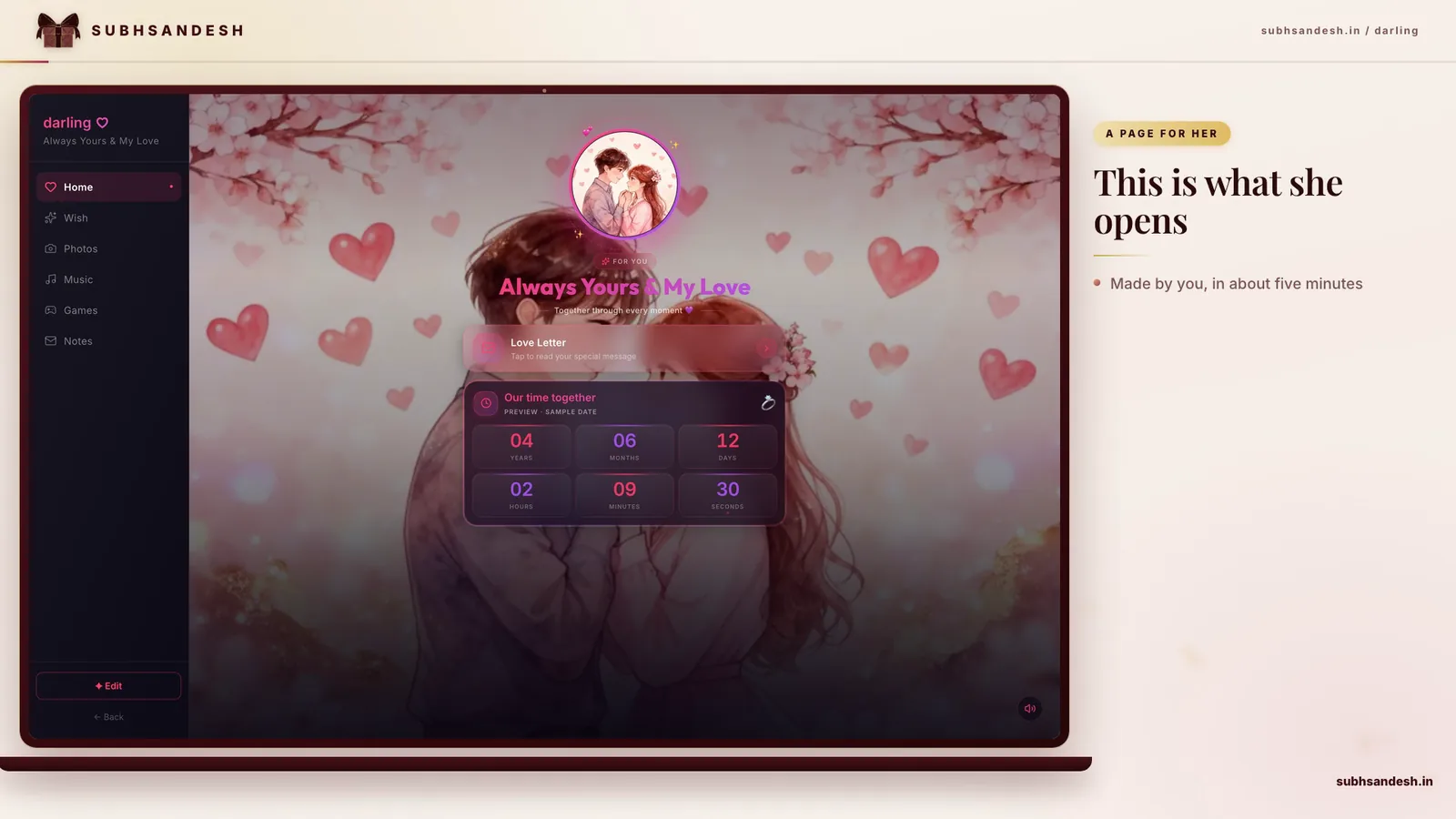
So set the answer inside the Love Quiz on the "I love you" page, where the answers are yours to write and the recipient opens a private link. For a darker version of the same occasion there is the Darling romantic page, and if the round is really a birthday wrapper, the birthday page for a partner fits better. One constraint: 50.3% of shared pages are opened on a phone, 20,853 of 41,486 views, so keep the questions short.
When a 20 questions round is the wrong choice
Skip it if something is actually wrong between you. Twenty questions has a winner, and a game with a winner is the worst available container for a live grievance.
Skip it too if you expect it to do a conversation's work. Savitsky and colleagues gave 24 married couples ambiguous phrases to convey and found speakers expected their spouse to understand them better than strangers did, while accuracy for spouses and strangers came out statistically identical (Journal of Experimental Social Psychology, 2011).
Speakers were also more confident of being understood by their spouse, 6.27 out of 10 against 5.00 for strangers. Closeness makes you a worse estimator of whether you have landed.
And the limit on running this through a page: a page cannot hear a voice. The best minute of a round is the one after the reveal, when the guesser asks why that answer and not another. Set the answer on a page if it helps; take the follow-up to a call.
Sources
- Rothe, Lake & Gureckis, Do People Ask Good Questions?, Computational Brain & Behavior 1, 69–89 (9 July 2018).
- Huang, Yeomans, Brooks, Minson & Gino, It Doesn't Hurt to Ask, Journal of Personality and Social Psychology 113(3), 430–452 (2017).
- Savitsky, Keysar, Epley, Carter & Swanson, The closeness-communication bias, Journal of Experimental Social Psychology 47(2), 269–273 (2011).
- Twenty questions, Wikipedia — history and binary-search arithmetic. No publication date.
Frequently Asked Questions
Turn this inspiration into an unforgettable surprise
Build a page with photos, a heartfelt message, music and a ready-to-share link.
- Photos, message & music
- Ready-to-share link

Written by
Suyash Agrahari
Founder
Suyash Agrahari is a Software Engineer at HireQuotient and the founder of SubhSandesh and DrawFlow (drawflow.in). He builds AI agents and full-stack products with Next.js, Node.js, and the OpenAI and LangChain ecosystems, having shipped autonomous multi-agent systems, AI copilots, and large-scale outreach platforms — and scaled side projects from a few hundred to millions of users. He writes about AI engineering, web development, and building products that grow through SEO and organic reach.
Stay Connected
Follow SubhSandesh
New templates, festival ideas and step-by-step walkthrough videos — first on our socials.
Product guide
See it built, step by step

Keep reading
Which Day Comes After Propose Day, and What Happens Now
Chocolate Day comes after Propose Day — Tuesday 9 February 2027. That is one sentence, so this page covers the four situations you are actually in on …
 Suyash Agrahari· 9 min
When to Propose a Girl to Be Your Girlfriend, and When Not To
The timing question, answered with conditions instead of a date: what has to be true before you ask, what politeness and fast replies do not prove, wh…
Suyash Agrahari· 9 minRomantic Proposal Room Decoration: What the Room Must Do
Romantic proposal room decoration, sorted by the work each setup takes and what the room allows: 7 setups with set-up and reversal times, lighting evi…
Suyash Agrahari· 9 min