
Anniversary Gift for Boyfriend: Unique, Not Just Unusual
Unique means your relationship could have produced it and nobody else's could. Seven anniversary gifts for a boyfriend built from material you already have, what open relationship research supports about novelty, and where a shared page is the wrong choice.
Make this into a page you can send
Photos, a message, music and a ready-to-share link — in a couple of minutes.
or browse all occasionsKey takeaways
- • Uniqueness is a swap test, not a scarcity test: if the same gift would land just as well with someone else's partner, it is unusual rather than unique.
- • In three dyadic studies published in April 2023, partners tracked each other's relational boredom accurately but overestimated it overall — you probably think he is more bored than he is.
- • Open research supports novelty in a planned shared activity rather than in a bought object; two 2025 experiments with 183 and 141 couples found no main effect of novel virtual activity on self-expansion or relationship satisfaction.
- • 3,425 personalised pages have been created across 15 page types since 12 March 2026, and the median page sits 7.2 hours between first save and last edit, sampled on /love-gf with n=1,001.
- • 50.2% of views land on a phone (21,130 of 42,099), so a desktop-first recipient opens something intimate in the least private setting he has.
On this page
Anniversary Gift for Boyfriend: Unique, Not Just Unusual
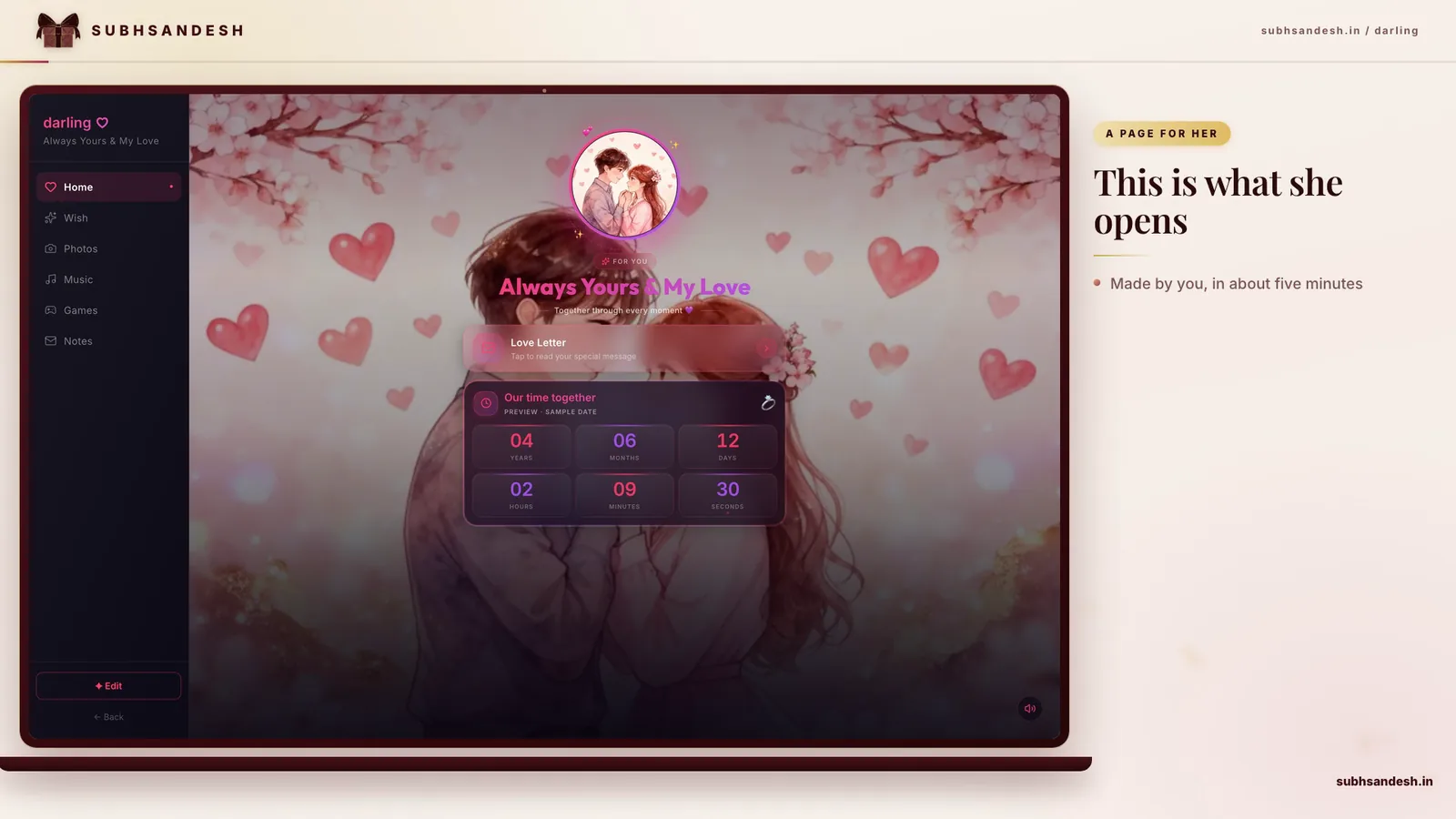
A unique anniversary gift for a boyfriend is one that could only have come from your relationship — his own words, your own places, a date only the two of you mark — rather than an object that happens to be rare in a shop. On SubhSandesh, 3,425 personalised pages have been created since 12 March 2026 across 15 page types, and the fourth most-created is the Darling page, a dark and dramatic romantic page for a partner: 349 pages, 10.2% of everything built. That is evidence the less obvious format gets chosen often. The research that exists supports novelty in what you do together rather than novelty in what you buy, and it is blunt about the limits of delivering novelty through a screen. Below: seven gifts your relationship can produce, the four routes compared, and where a shared page is wrong.
What makes an anniversary gift unique, precisely
A unique gift is one whose meaning cannot be transferred to another couple. That is different from scarcity: a limited-edition object is rare in a market but says nothing another buyer's identical object would not.
The working test is a swap test. If you could hand the same gift, unchanged, to someone else's partner and it would land just as well, it is unusual rather than unique.
By that test a personalised photo frame is usually unusual: the frame is generic and the photograph is the only unique part, so it reads as a category rather than a gesture. A recording of the eleven minutes he spent explaining offside to you is unique — nobody else has it, and nobody else would want it.
The anxiety underneath the word "unique"
People do not search for "unique" when things feel settled. They search for it when they suspect the relationship needs topping up, and there is direct evidence that the suspicion runs hot.
A 2023 paper in the Journal of Social and Personal Relationships by Dobson, Stanton, Balzarini and Campbell ran three dyadic studies on how accurately partners read each other's relational boredom. Partners tracked each other's boredom accurately — and overestimated it overall.
The consequence in that data is specific: relationship quality dropped only where someone accurately perceived a partner who was genuinely highly bored. In every other case, including overestimation, their own relationship quality was preserved.
So you probably think he is more bored than he is. That does not make effort pointless; it means the panic premise — that an ordinary gift confirms a decline already under way — is usually not your situation.
What the research actually supports about novelty
You will read everywhere that givers systematically mispredict what recipients want, over-valuing surprise while recipients want usefulness. I could not verify it in that strong form — the papers most cited for it are closed-access — so this post claims only what open research shows.
What open research does support is that novelty works when it is planned and shared. In a 2021 study in the same journal, Harasymchuk, Walker, Muise and Impett asked people to plan a date for their partner, then followed up a week later. Those with stronger approach relationship goals planned more exciting dates, reported more self-expansion from doing them, and more closeness afterwards. Planning aptitude, not shopping aptitude, carried the effect.
The second supported point is about occasions. In three studies with 120, 327 and 561 participants, two of them pre-registered, Oishi, Lee, Koo and Cha found that indebtedness was the only reliable predictor of whether someone gave a thank-you gift; gratitude, fondness and respect did not predict it. Those studies were about school teachers, not partners, so read the transfer as suggestive. Still, the mechanism is recognisable: a fixed date can turn a gift into a debt payment, and a frantic hunt for something unique is often what that looks like from the inside.
Seven anniversary gifts only your relationship could produce
Each is built from material you already have, and each entry covers the same four things in the same order: what it is, who it suits, what it asks of you, and where it fails.
1. Things he actually said, dated
A collected list of his own sentences — the throwaway line about his father, the thing he said at the bus stop — each carrying the date you heard it. Suits a boyfriend who talks far more than he writes. Asks of you: a habit of noting things down, which you either have or must reconstruct honestly. Fails if you invent quotes to fill it out, which is detectable in one reading.
2. The first-month reconstruction
Rebuild the first month in routes and orders: the auto you took, the exact thing he ordered, the seat you sat in, the film you walked out of. Suits couples whose beginning was ordinary rather than cinematic. Asks of you: chat scrollback and an evening. Fails when that month was unremarkable to him, where the reconstruction reads as your nostalgia rather than a shared one.
3. Twelve voice notes, in order
Twelve voice notes he sent you, one for each month of the year, arranged chronologically with the date on each. Suits anyone whose default is a voice note rather than a paragraph. Asks of you: an evening of scrolling and exporting. Fails if he dislikes hearing his own voice, a common enough aversion to check for first.
4. Five people, one question
Ask five people who know him — a sibling, an old flatmate, a colleague, a school friend, his mother — the same single question, and keep the answers verbatim. Suits a boyfriend with a wide and scattered set of people. Asks of you: five slightly awkward messages and a fortnight of waiting. Fails where his relationships with those people are strained.
5. The annotated playlist
His songs, kept in his order, with your annotation on each: where you were, what he was doing, what you did not say at the time. Suits couples who send each other music instead of messages. Asks of you: real honesty on two or three tracks. Fails when the list runs long — twelve tracks annotated beats forty tracks bare.
6. A map of your ordinary places
Not landmarks. The tea stall, the metro exit, the stairwell, the terrace, each marked with the date of the thing that happened there. Suits couples who share a city and therefore share a geography. Asks of you: an hour of remembering and a layout that stays legible. Fails in a long-distance relationship, where the shared map is thin.
7. A standing appointment, not an object
A recurring commitment with a start date: the first Sunday of every month, this specific thing, beginning now. Suits the boyfriend who insists he does not want anything. Asks of you: willingness to be held to it, which is the entire gift. Fails the moment you miss the second one, which is worse than never having offered.
If two or three of these belong on one page rather than in a box, the "I love you" page is the format most people reach for — 1,001 created, 29.2% of every page built here. If your relationship runs darker than that register, the Darling page is the less obvious choice, and the one 349 creators picked.
The four routes to uniqueness, compared
There are only four ways a gift can be unique, and each is unique against a different thing.
| Route | Unique compared with | What it asks of you | What SubhSandesh data says |
|---|---|---|---|
| An object marketed as unique | other buyers of the same object | a search and a delivery date | nothing — we hold no data on bought gifts |
| Something handmade | mass production | a skill you have or must learn | nothing — not our data to have |
| A shared experience with a date on it | your own routine | a plan and a slot you both keep | nothing |
| A page built from your own material | every other page, because the words are yours | median 7.2 hours between first save and last edit, sampled on /love-gf, n=1,001 | 3,425 pages created since 12 March 2026, at 12.3 recorded views per created page |
Three of those rows sit outside anything we can measure. The one we can says the work happens across hours, not minutes.
Where novelty through a screen does less than you think
This is the part a company that builds shareable pages should say out loud. Two in-lab experiments published in Behavioral Sciences in January 2025 by Balzarini, Sharma and Muise, with 183 couples and then 141, tested whether a shared novel activity delivered through virtual reality would produce self-expansion and better relationship quality.
Presence rose and boredom fell, but there were no main effects on self-expansion or on relationship satisfaction, and the authors concluded that virtual interactions may have less potential than in-person interaction to promote self-expansion. Screens carry words, voice and sequence well. Presence is the thing they carry badly.
So the cases where a SubhSandesh page is the wrong anniversary gift are specific. If you live in the same house, something in his hands beats a link, and a link can read as the easier route even when it was not. Half of all views land on a phone — 50.2%, or 21,130 of 42,099 — so a desktop-first recipient opens something intimate in the least private place he has. And 42.7% of creators password-protect before sharing, sensible on a shared laptop and pure friction for a boyfriend who has never voluntarily remembered a password. If he is in another city on the day, the "I miss you" page for a partner is a more honest framing than an anniversary page that pretends the distance is not the fact of it.
Sources
- Are you tired of "us?" Accuracy and bias in couples' perceptions of relational boredom — Dobson, Stanton, Balzarini and Campbell, Journal of Social and Personal Relationships, 3 April 2023 (CC BY).
- Planning date nights that promote closeness: the roles of relationship goals and self-expansion — Harasymchuk, Walker, Muise and Impett, Journal of Social and Personal Relationships, 17 March 2021 (CC BY).
- Virtually connected: do shared novel activities in virtual reality enhance self-expansion and relationship quality? — Balzarini, Sharma and Muise, Behavioral Sciences, 14 January 2025 (CC BY).
- The psychology of a thank-you gift: who gives it and why? — Oishi, Lee, Koo and Cha, Applied Psychology: Health and Well-Being, 7 May 2025. Abstract read; the studies concern school teachers, not partners.
Frequently Asked Questions
Turn this inspiration into an unforgettable surprise
Build a page with photos, a heartfelt message, music and a ready-to-share link.
- Photos, message & music
- Ready-to-share link

Written by
Suyash Agrahari
Founder
Suyash Agrahari is a Software Engineer at HireQuotient and the founder of SubhSandesh and DrawFlow (drawflow.in). He builds AI agents and full-stack products with Next.js, Node.js, and the OpenAI and LangChain ecosystems, having shipped autonomous multi-agent systems, AI copilots, and large-scale outreach platforms — and scaled side projects from a few hundred to millions of users. He writes about AI engineering, web development, and building products that grow through SEO and organic reach.
Stay Connected
Follow SubhSandesh
New templates, festival ideas and step-by-step walkthrough videos — first on our socials.
Product guide
See it built, step by step

Keep reading
How to Surprise Someone on Their Birthday at Midnight
The Indian midnight birthday wish, treated as a timing problem: aim for 23:55 rather than 00:00, check the Bedtime schedule that silences a 00:00 noti…
 Suyash Agrahari· 9 min
How to Surprise Husband on Birthday When the Day Is His Alone
A birthday is his day, not a shared one, so unlike an anniversary the contents can genuinely surprise him — and the gesture fails when it becomes abou…
Suyash Agrahari· 9 minHow to Surprise Best Friend on Friendship Day in India
Friendship Day in India falls on the first Sunday of August — a different date from the UN's International Day of Friendship on 30 July. Four things w…
Suyash Agrahari· 9 min