
Anniversary Surprise for Girlfriend Online, Planned Backwards
She already knows the date, so an online anniversary surprise is an execution problem, not a shopping problem. Here is the schedule worked backwards — seven days out to the last hour — with the 7.2-hour median build window from 987 pages and the reveal-hour maths across time zones.
Make this into a page you can send
Photos, a message, music and a ready-to-share link — in a couple of minutes.
or browse all occasionsKey takeaways
- • An anniversary is the one romantic occasion whose date both people already know, so the surprise is an execution problem: what lands, and at what hour.
- • The median gap between a page's first save and its last edit is 7.2 hours on the "I love you" page (n=987), which makes the night before realistic and the same morning tight.
- • 99.5% of started pages are published and shared (3,359 of 3,377) — the build almost never fails, the calendar does.
- • Planning backwards from a deadline cut prediction error from 1.93 days to 0.18 days among 125 people finishing a real project (Judgment and Decision Making, March 2016).
- • Choose the reveal hour first: couples one time zone apart had three or four evening hours together, versus about one hour across two coasts (CHI 2012).
On this page
Anniversary Surprise for Girlfriend Online, Planned Backwards
An anniversary surprise for girlfriend online is an execution problem, not a shopping problem: she already knows the date, so the only things you control are what lands and when it lands. SubhSandesh's own numbers point the same way — the median gap between a page's first save and its last edit is 7.2 hours (sampled on the "I love you" page, n=987), and 99.5% of started pages are actually published and shared (3,359 of 3,377) — almost nobody abandons the build, they run out of calendar. What follows is the schedule worked backwards from the date, the version for when you have hours instead of days, the hour the reveal should land, and the case where a page is the wrong call.
What an online anniversary surprise actually is
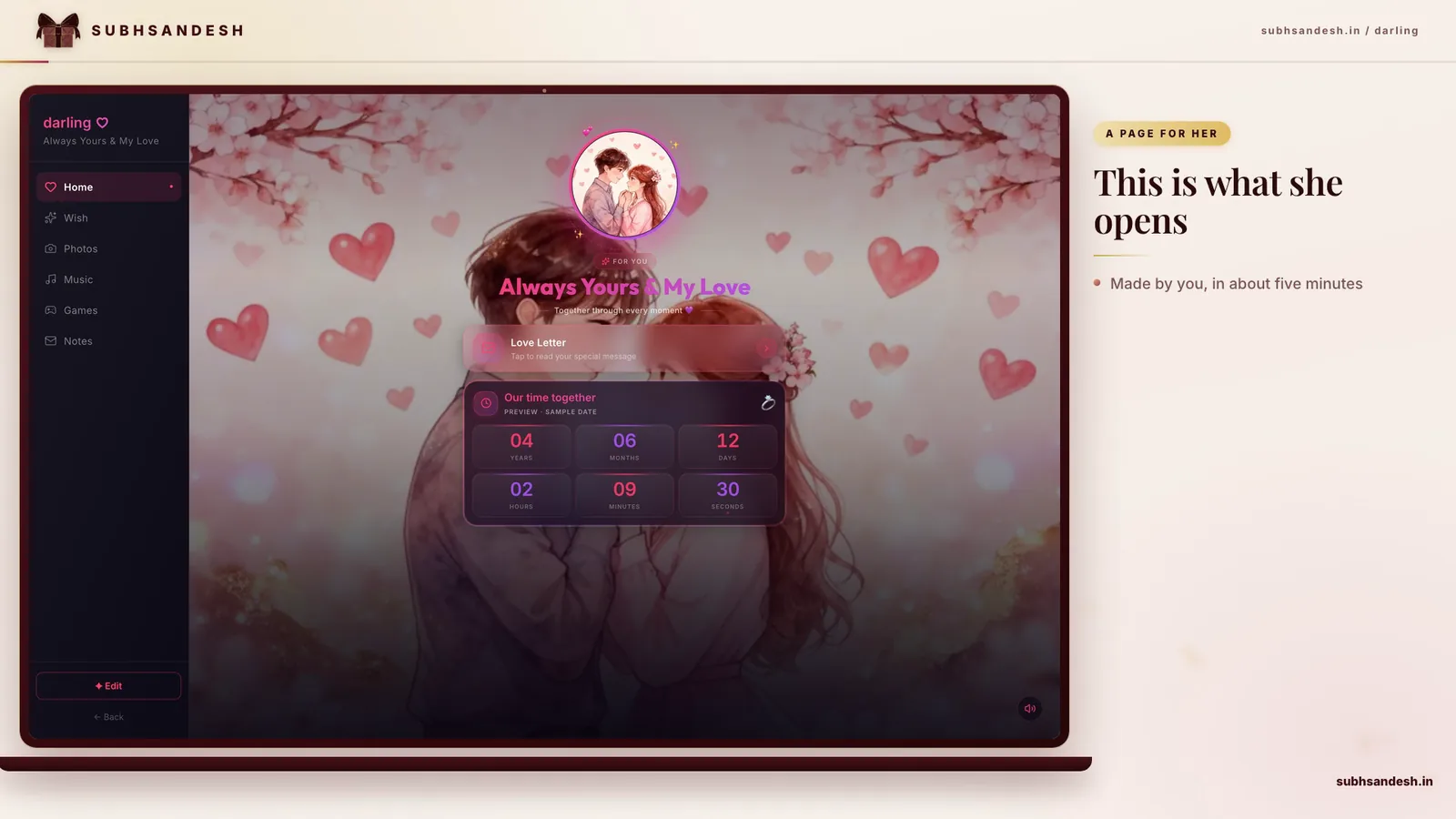
An online anniversary surprise is a private web page, built ahead of time and released at a chosen moment, carrying the letter, the photos, the music and the small interactive pieces you would otherwise hand over in person. It arrives as a link, so there is no courier cut-off and no delivery window to miss. Across 3,377 pages built on SubhSandesh since 2026-03-12, spread over 15 page types, this is the format people reach for when the recipient is not in the room.
The distinction that matters is against a birthday. A birthday greeting can arrive late and still work. An anniversary carries a shared count — the first, the third, the tenth — and something that lands on the 3rd when the date was the 2nd reads as a different message, however good it is.
Why an anniversary surprise is a deadline problem, not a gift problem
Every other romantic occasion has slack in it. An anniversary has a date both of you already remember, which removes the "will she notice" question and leaves only the schedule.
Two pieces of research argue for planning it in reverse. Wiese, Buehler and Griffin ran four experiments on backward planning and predictions of task completion time (Judgment and Decision Making, March 2016). In Study 4, among the 125 participants who finished a real two-week project, those who had planned forward finished 1.93 days later than they predicted, while those who planned backwards from the deadline were out by 0.18 days.
The second concerns the deadline itself. Ariely and Wertenbroch's study of self-imposed deadlines (Psychological Science, May 2002) found that students who chose their own submission dates scored lower than a section given evenly spaced deadlines — 85.67 against 88.76 — and 77 against 86 on the final project. Self-set deadlines do help; people simply set them too late.
The anniversary is the one deadline you cannot move. The lesson is to treat the internal ones as immovable too.
The backwards schedule, from a week out to the last hour
Five points, counted back from the date. Each names what you do, why it belongs at that point, roughly how long it takes, and the specific failure it prevents.
7 days out: pick the one thing the page is about
Decide the single idea — the year you both survived, the day you met, one running joke — before you open a template. A week out is when you still have the attention to choose rather than collect.
It takes twenty minutes of thinking and no building at all. It heads off the most common failure: a page holding thirty photos that says nothing in particular.
3 days out: write the letter before you choose a template
Write the message in a plain notes app, unformatted. Three days out you can leave it, reread it once, and cut the lines that were written for you rather than for her.
Expect an hour, split across two sittings. Doing it here stops the letter being typed straight into a live editor at 1 a.m., which is where generic sentences come from.
The night before: build it in one sitting
Assemble the thing — cover, letter, gallery, music, and a quiz or a story timeline if the template carries one. The 7.2-hour median between first save and last edit across 987 "I love you" pages is roughly one long evening, so the night before is realistic rather than heroic. One sitting also prevents the split-session build where you lose track of which photos you already added.
The morning of: password it, then open the link on a phone
Set the password, then open the finished link on your own phone exactly as she would. 42.8% of creators password-protect a page before sharing it (1,444 of 3,377), and 50.3% of views arrive on a phone (20,853 of 41,486 recorded views).
Ten minutes is enough. It catches the two failures nobody tests for: a layout that breaks on a six-inch screen, and a password she has no way to guess.
Hours left: cut the photo count, never the letter
With a few hours, drop to a cover, the letter and five photos, and skip the music entirely. The letter is the part she will reread; the gallery is the part that eats the most time per unit of feeling.
Thirty to ninety minutes. It prevents the worst same-day outcome, which is a half-assembled page sent because the clock ran out.
What time the reveal should land, and what a time zone does to it
Choose the hour before you build, because the hour decides the content. A page opened at 7 a.m. before work gets two minutes of attention; the same page opened at 10 p.m. gets the gallery and the music.
Distance narrows that window sharply. Neustaedter and Greenberg's interviews with 14 people in long-distance relationships (CHI 2012) found that couples in one time zone commonly had three or four hours together in the evening, while a couple split across two coasts of North America might have only one hour before one of them had to sleep. Four of their participants were 10–12 hours apart and worked around it by aligning work hours, shifting sleep, or moving their shared time to the weekend.
On a fixed date across a time-zone gap, then, the reveal hour is not a preference. It is the intersection of two schedules, and it has to be picked first.
How the four starting points compare
This table sets each starting point against the working window it leaves and what realistically fits inside it, with SubhSandesh's own build data in the last column.
| Start point | Working window | What realistically fits | First-party signal |
|---|---|---|---|
| 7 days out | about 6 days of slack | letter, 15 photos, music, quiz, timeline | five times the 7.2-hour median edit span (n=987) |
| Night before | 8–14 hours | letter, 10 photos, music | matches the 7.2-hour median almost exactly |
| Morning of | 3–6 hours | letter, 5 photos, one song | under the median; expect to publish mid-edit |
| Two hours out | 1–2 hours | cover and letter only | 99.5% still get published (3,359 of 3,377) |
The pattern is consistent: the letter survives every row, and the gallery is the first thing the clock takes. The interactive "I love you" page, which is where the 7.2-hour figure comes from, and the darker Darling romantic page — 987 and 349 pages built respectively — are both four-tab builds, so the same ordering holds for either.
Keeping it hidden when she already knows the date
You cannot hide the date, so hide the artefact instead. A password gate does that work: 42.8% of creators set one before sharing (1,444 of 3,377), which turns a link she might open early into one she opens when you give her the word.
The other half is your own restraint. Do not send a screenshot, do not ask her which photo she prefers, and do not test the link from her laptop. Build it on the anniversary page for a partner or one of the romantic templates, keep the tab shut on shared devices, and send the link and the password as two separate messages, so a glance at a notification gives nothing away.
When an online anniversary surprise is the wrong choice
If you will be in the same room on the date, a link is the weaker option. Handing over something physical while she is standing in front of you beats asking her to look at a phone, and the page turns into something to open later rather than the moment itself.
It also loses when the recipient does not use a smartphone comfortably — 50.3% of views arrive on a phone, so the format quietly assumes one — or when she has said she wants something she can keep on a shelf. A 2026 review of long-distance romantic relationships in Psikiyatride Güncel Yaklaşımlar reports that trust, commitment, communication and shared goals are what carry couples through separation. A page can carry a message; it cannot stand in for the part of the anniversary that is your attention on the day.
And it is the wrong choice if you are building it to be seen building it. A page assembled in an hour and sent with an apology attached reads worse than a phone call.
Sources
- Wiese, J., Buehler, R., & Griffin, D. — Backward planning: Effects of planning direction on predictions of task completion time, Judgment and Decision Making 11(2), 147–167, March 2016. journal.sjdm.org
- Ariely, D., & Wertenbroch, K. — Procrastination, Deadlines, and Performance: Self-Control by Precommitment, Psychological Science 13(3), May 2002. web.mit.edu
- Neustaedter, C., & Greenberg, S. — Intimacy in Long-Distance Relationships over Video Chat, CHI 2012 (May 2012). ucalgary.scholaris.ca
- Sayar Bolelli, Z., Sönmez, İ., & Yavuz Güler, Ç. — Long Distance Romantic Relationships, Psikiyatride Güncel Yaklaşımlar 18(3), 877–889, 2026. dergipark.org.tr
Frequently Asked Questions
Turn this inspiration into an unforgettable surprise
Build a page with photos, a heartfelt message, music and a ready-to-share link.
- Photos, message & music
- Ready-to-share link

Written by
Suyash Agrahari
Founder
Suyash Agrahari is a Software Engineer at HireQuotient and the founder of SubhSandesh and DrawFlow (drawflow.in). He builds AI agents and full-stack products with Next.js, Node.js, and the OpenAI and LangChain ecosystems, having shipped autonomous multi-agent systems, AI copilots, and large-scale outreach platforms — and scaled side projects from a few hundred to millions of users. He writes about AI engineering, web development, and building products that grow through SEO and organic reach.
Stay Connected
Follow SubhSandesh
New templates, festival ideas and step-by-step walkthrough videos — first on our socials.
Product guide
See it built, step by step

Keep reading
How to Surprise Someone on Their Birthday at Midnight
The Indian midnight birthday wish, treated as a timing problem: aim for 23:55 rather than 00:00, check the Bedtime schedule that silences a 00:00 noti…
 Suyash Agrahari· 9 min
How to Surprise Husband on Birthday When the Day Is His Alone
A birthday is his day, not a shared one, so unlike an anniversary the contents can genuinely surprise him — and the gesture fails when it becomes abou…
Suyash Agrahari· 9 minHow to Surprise Best Friend on Friendship Day in India
Friendship Day in India falls on the first Sunday of August — a different date from the UN's International Day of Friendship on 30 July. Four things w…
Suyash Agrahari· 9 min