
Bhai Behan Shayari for Raksha Bandhan: Couplets That Answer Each Other
Bhai behan shayari is written for the pair, not for one sibling addressing the other. Seven do-tarfa shers where the sister speaks line one and the brother answers in line two, each labelled with its qaafiya and radif, in Devanagari, Nastaliq and Roman with an English sense line.
Make this into a page you can send
Photos, a message, music and a ready-to-share link — in a couple of minutes.
or browse all occasionsKey takeaways
- • Bhai behan shayari is about the pair, so write it as a do-tarfa sher: line one in the sister's voice, line two answering in the brother's, sharing one radif.
- • The form allows it — Liboiron's UBC thesis records that each couplet of a ghazal "is itself a complete text", and a peer-reviewed 2024 Swar Sindhu paper notes a ghazal's 5 to 8 couplets are each complete alone.
- • Sibling research already works this way: Chacko and Mohan analysed five Indian sibling dyads and found "communication quality, rather than frequency, determines emotional intimacy".
- • Send it where it lands — 51.1% of shared SubhSandesh pages are opened on a phone (18,497 of 36,202 views, measured 2026-08-25), so a line that wraps loses its shape.
- • A caution against the mythology: across 101 Indian young adults, Law and Imran found sister pairs reported higher warmth than brother-sister pairs, significant at the 0.05 level.
On this page
Bhai Behan Shayari for Raksha Bandhan: Couplets That Answer Each Other
Bhai behan shayari is written for the pair, not for one sibling addressing the other — and the two-line sher is built to carry exactly that. Line one in the sister's voice, line two answering in the brother's, sharing one rhyme. Seven are below, each labelled with its qaafiya and radif so you can check the form rather than take my word for it.
Send it where it will be read. Of 36,202 recorded views of shared SubhSandesh pages, 51.1% were opened on a phone — 18,497 of them (measured 2026-08-25), and a created page averages 12.2 views. That is a real limit on how long a line can be.
What bhai behan shayari is, and what it is not
A rakhi wish is a sentence with good manners: happy Raksha Bandhan, stay well. A shayari is a metrical object — it has a rhyme it must hit and a length it cannot exceed, and the pleasure is watching the second line pay off the first. A full ghazal runs 5 to 8 couplets in Vedabala and Paul's account; a single sher is one of them, standing on its own.
The difference matters for the pair specifically. Almost everything published under this keyword is addressed to somebody: प्यारे भैया, सुन मेरे भाई, ओ बहना. That is a monologue with a named audience.
Bhai behan shayari, taken literally, is about the two of you at once. Which means somebody has to speak second.
Why a two-line sher can hold two voices
Because the couplet is already a finished thing. In his thesis on the Urdu ghazal, Paul Liboiron puts it plainly: although a ghazal is a set of couplets, "each couplet of a ghazal is itself a complete text", and each verse "remains an independent description of its world."
Vedabala and Paul, in the peer-reviewed Swar Sindhu in 2024, arrive from musicology at the same place: "every couplet is a little poem by itself and a complete statement", which is why the ghazal "has tremendous quotability because two lines can make the complete statement."
Two lines, one complete statement. That is two slots that close. Give one to each sibling and the sher still works — nothing about the form objects.
The rhyme holds the voices together. Liboiron: the rhyming syllable is the qaafiya, the complete word finishing every line is the radif. His English analogy is deceive me, believe me, receive me — deceive is the qaafiya, me the radif. A first couplet whose both lines rhyme is a matla.
Seven do-tarfa shers for bhai and behan
Do-tarfa means two-sided. The first line is one sibling's, the second is the other's reply. The qaafiya changes; the radif is shared, which is what makes two lines one couplet instead of two fragments.
1. The matla, where both lines rhyme
बहन: तेरी कलाई पे जो बाँधा, वो धागा नहीं था भाई: मेरी कलाई ने जो माँगा, वो धागा नहीं था
terī kalāī pe jo bāndhā, vo dhāgā nahīṁ thā merī kalāī ne jo māṅgā, vo dhāgā nahīṁ thā
What I tied on your wrist was never the thread. — What my wrist was asking for was never the thread.
Qaafiya: bāndhā / māṅgā. Radif: vo dhāgā nahīṁ thā. Both lines rhyme, so this is a matla — the opening couplet, setting the rhyme for everything after.
2. For the sibling who moved cities
बहन: शहर बदल गए, तेरा नाम नहीं बदला भाई: सफ़र बदल गए, तेरा नाम नहीं बदला
shahar badal gaye, terā nām nahīṁ badlā safar badal gaye, terā nām nahīṁ badlā
The cities changed; your name did not. — The journeys changed; your name did not.
Qaafiya: shahar / safar. Radif: badal gaye, terā nām nahīṁ badlā.
3. For the years when you barely spoke
बहन: बात कम हुई, तो क्या हुआ — हिसाब कम नहीं भाई: मुलाक़ात कम हुई, तो क्या हुआ — हिसाब कम नहीं
bāt kam huī, to kyā huā — hisāb kam nahīṁ mulāqāt kam huī, to kyā huā — hisāb kam nahīṁ
We spoke less. So what — the reckoning is no less. — We met less. So what — the reckoning is no less.
Qaafiya: bāt / mulāqāt. Radif: kam huī, to kyā huā — hisāb kam nahīṁ.
4. Where the protection cliché gets reversed
बहन: जिसे सब ढाल कहते हैं, उसे मैंने सँभाला है भाई: जिसे सब फूल कहते हैं, उसी ने मुझे पाला है
jise sab ḍhāl kahte haiṁ, use maiṁne sambhālā hai jise sab phūl kahte haiṁ, usī ne mujhe pālā hai
The one everybody calls a shield — I am the one who held him up. — The one everybody calls a flower — she is the one who raised me.
Qaafiya: sambhālā / pālā. Radif: hai. The couplet pools never contain this one, because it needs both voices to land: the shield gets protected, the flower did the raising.
5. Hinglish, for siblings who text in two languages
बहन: तेरी हर बात का reply आता है, देर से भाई: मेरी हर बात का reply जाता है, देर से
terī har bāt kā reply ātā hai, der se merī har bāt kā reply jātā hai, der se
Every message of yours gets a reply — late. — Every message of mine gets one sent — late.
Qaafiya: ātā / jātā. Radif: hai, der se. Code-mixing an English noun into a Hindi line is not a failure of the form; the qaafiya and radif still do their work.
6. In the Urdu register, with Nastaliq
बहन: तुझे लिखते हुए मेरा क़लम नहीं रुका भाई: मुझे पढ़ते हुए तेरा करम नहीं रुका
تجھے لکھتے ہوئے میرا قلم نہیں رُکا مجھے پڑھتے ہوئے تیرا کرم نہیں رُکا
tujhe likhte hue merā qalam nahīṁ rukā mujhe paṛhte hue terā karam nahīṁ rukā
Writing to you, my pen never stopped. — Reading you, your kindness never stopped.
Qaafiya: qalam / karam. Radif: nahīṁ rukā. The vocabulary here sits in the Perso-Arabic register, which is what makes Nastaliq the honest script for it.
7. The closing couplet, after the thread comes off
बहन: धागा उतर गया, निशान रह गया भाई: बरस गुज़र गया, निशान रह गया
dhāgā utar gayā, nishān rah gayā baras guzar gayā, nishān rah gayā
The thread came off; the mark stayed. — The year went by; the mark stayed.
Qaafiya: utar / guzar. Radif: gayā, nishān rah gayā.
Devanagari, Nastaliq or Roman: which one to send
Send the script the recipient reads fastest, which is often not the one the poem "belongs" in. This is a delivery decision, not a literary one.
The register question underneath is real. Glottolog 5.3, the Max Planck Institute's language catalogue, classifies Hindustani as a family-level languoid with Hindi and Urdu as separate languoids beneath it, citing Masica (1993) and Kogan (2017). Shared grammar, divergent literary vocabularies, two scripts. A couplet built on qalam leans Urdu; one built on dhāgā leans Hindi.
| What you send | Reads correctly for | First-party signal |
|---|---|---|
| Devanagari only | Hindi readers; the default for most Indian recipients | Fits the phone screen 51.1% of views arrive on |
| Nastaliq (Urdu script) | Urdu readers; correct for the Perso-Arabic register | Needs an image or a page — most keyboards will not render it in chat |
| Roman transliteration | Siblings abroad who speak but do not read the script | Safest single choice; survives any device |
| All three stacked | A sibling you are unsure about | Four extra lines on a 12.2-views-per-page share |
Stacking all three is the low-risk answer when you do not know.
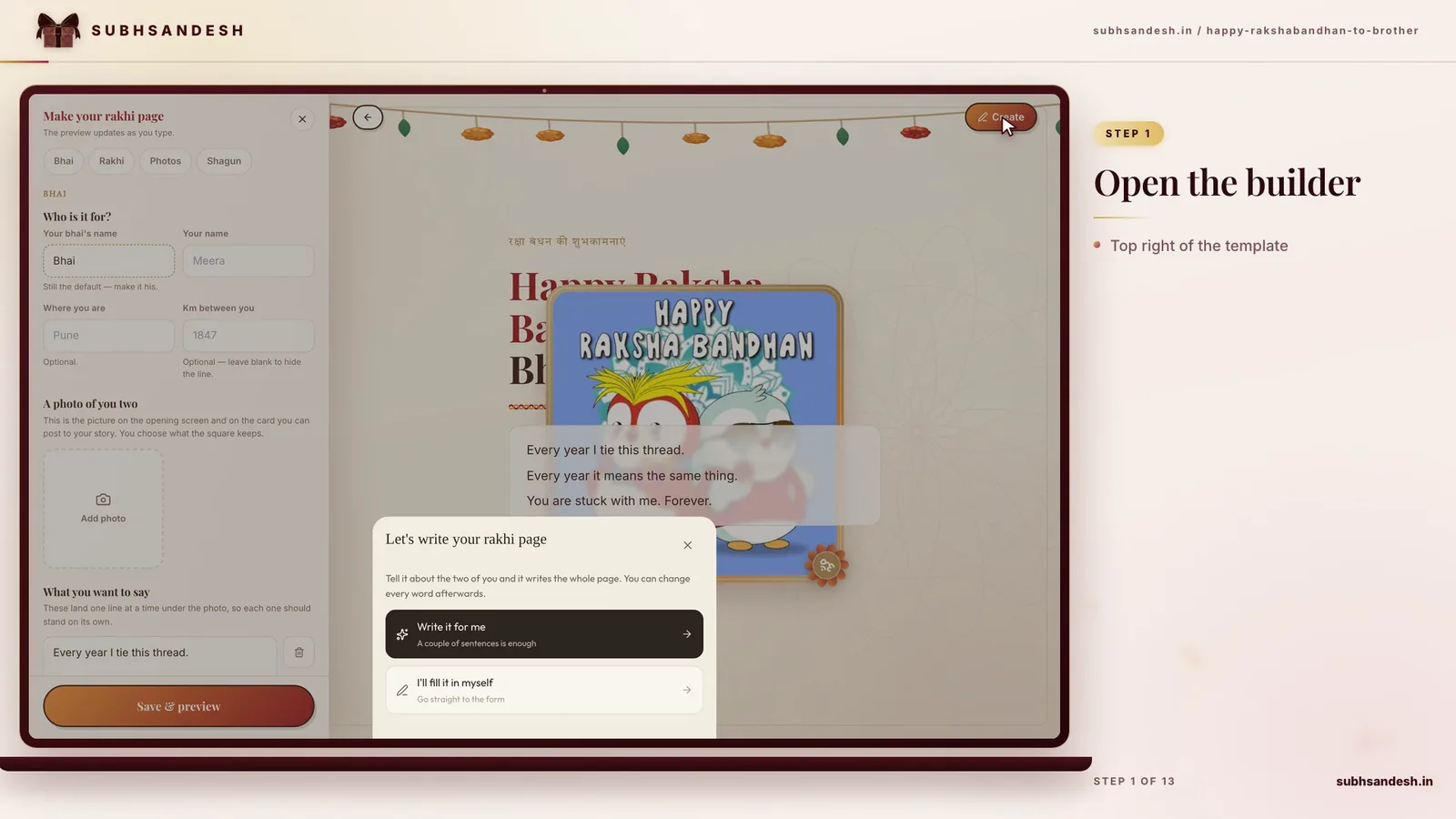
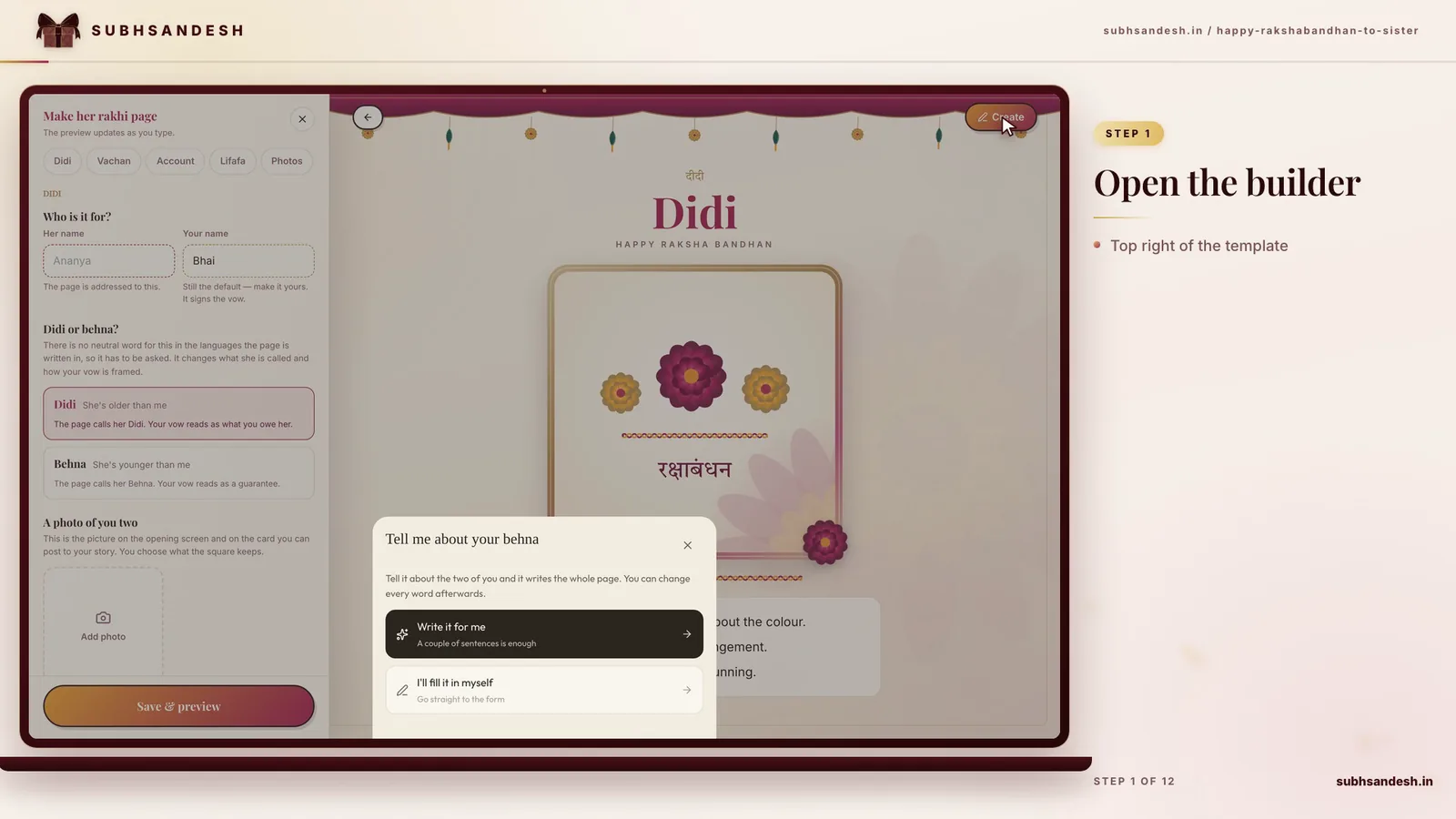
Once you have picked a script, a page carries it better than a chat window: a Raksha Bandhan page for your brother or a Raksha Bandhan page for your sister holds Devanagari, Nastaliq and transliteration together without a keyboard mangling any of them.
What sibling research measures: the pair, not the person
This is what justifies the two-voice idea, and it is not my invention. Chacko and Mohan's 2025 study of Indian young-adult siblings does not interview individuals — it interviews five sibling dyads, same-sex and different-sex, analysed with a framework of dyadic analysis. The dyad is the unit.
Their central finding is that siblings "rely substantially on emotional reciprocity, in which reciprocal trust and openness build closeness." Reciprocity requires two turns.
And the line worth carrying into any rakhi message: "Communication quality, rather than frequency, determines emotional intimacy among young adult sibling dyads." One couplet actually made for the two of you beats twenty forwards. They also found humour resolved conflict — permission to be funny in a sher, not only solemn.
Where a couplet actually lands
On a phone, in a hurry. That is the delivery context: 18,497 of 36,202 recorded views, across 2,973 created pages and 15 page types.
Two consequences. A line longer than a phone's width wraps and loses its shape, which for a metrical form is the whole point gone. And 44.2% of creators password-protect a page before sharing (1,315 of 2,973), which for a sibling message is often right: a do-tarfa sher naming both of you is not really for a family group.
The full template library is browsable without signing up.
When a do-tarfa sher is the wrong thing to send
When the second voice is a guess. A two-voice couplet puts words in your sibling's mouth. If you are estranged, mid-fight, or unsure they feel it back, writing their line for them is presumptuous rather than tender. Send a one-directional piece, or a plain sentence.
There is also a finding that cuts against the festival's own mythology. Law and Imran surveyed 101 Indian young adults — 50 older and 51 younger siblings, aged 18 to 30, on the Adult Sibling Relationship Questionnaire. Both groups reported "low levels of conflict and average levels of warmth." But sister pairs reported higher warmth than brother-sister pairs, significant at the 0.05 level. The bhai-behan bond is the most celebrated dyad in the Indian calendar and, on that instrument in that sample, not the warmest one.
The case where SubhSandesh is the wrong tool: if your sibling is next to you, say it out loud. A page is for distance. Our rakhi templates are new and lightly used next to the rest of the library, so they carry far less real-world wear than pages we have run for years.
And the honest caveat about these seven pieces: I wrote them for this page. They are not from any published poet, and the qaafiya and radif labels are my own reading of my own lines. Treat them as drafts to adapt, not canon to quote.
Frequently Asked Questions
Turn this inspiration into an unforgettable surprise
Build a page with photos, a heartfelt message, music and a ready-to-share link.
- Photos, message & music
- Ready-to-share link

Written by
Suyash Agrahari
Founder
Suyash Agrahari is a Software Engineer at HireQuotient and the founder of SubhSandesh and DrawFlow (drawflow.in). He builds AI agents and full-stack products with Next.js, Node.js, and the OpenAI and LangChain ecosystems, having shipped autonomous multi-agent systems, AI copilots, and large-scale outreach platforms — and scaled side projects from a few hundred to millions of users. He writes about AI engineering, web development, and building products that grow through SEO and organic reach.
Stay Connected
Follow SubhSandesh
New templates, festival ideas and step-by-step walkthrough videos — first on our socials.
Product guide
See it built, step by step
Keep reading
Thala Deepavali: A Couple's First Deepavali at the Bride's Home
Thala Deepavali is a Tamil couple's first Deepavali after marriage, at the bride's home. In 2027 it is Thursday 28 October, oil bath 4:40–6:01 AM in C…
 Suyash Agrahari· 9 min
Sugar-Free Diwali Sweets: Swaps, Label Warnings and the Evidence
Five original no-added-sugar Diwali sweets, why jaggery and honey do not count, the warnings FSSAI requires on a sugar-free box, and what an Indian su…
Suyash Agrahari· 9 minShort Diwali Quotes: 34 Original One-Liners Under 10 Words
34 original short Diwali quotes, each under ten words and marked with its word and character count, grouped by mood: lamps, family, friends, gratitude…
Suyash Agrahari· 9 min