
Celebrate Raksha Bandhan When Siblings Are in Different Cities
Different Indian cities, same festival day - so the real question is whether to travel. Indian Railways' 60-day booking window for Friday 28 August 2026 opened on 29 June, which changes the answer. Here is the go-or-stay maths and what to send if nobody moves.
Make this into a page you can send
Photos, a message, music and a ready-to-share link — in a couple of minutes.
or browse all occasionsKey takeaways
- • Raksha Bandhan 2026 is Friday 28 August, and Indian Railways' 60-day reserved booking window for that date opened on 29 June 2026 - if you are deciding in August, the reserved train has almost certainly gone.
- • Tatkal is the last reserved-train route: 10:00 AM for AC classes and 11:00 AM for non-AC on Thursday 27 August, and online Tatkal has needed Aadhaar-based OTP authentication since 15 July 2025.
- • The festival lands on a Friday, so Saturday 29 and Sunday 30 August are a separate booking day - tie the rakhi on video on the Friday and do the reunion on the weekend.
- • Living in different cities is the normal adult condition: of 987,486 Swedes aged 65-84, only about 35% had their closest sibling within 10 km.
- • If nobody travels, a shared page is the only option with no deadline: 2,718 SubhSandesh pages created since 2026-03-12, 51.9% of their 32,683 views opened on a phone.
On this page
Celebrate Raksha Bandhan When Siblings Are in Different Cities
If you and your sibling live in different Indian cities, the real question on Raksha Bandhan is not which greeting to send — it is whether to travel, and that decision has a deadline that has probably already passed. Raksha Bandhan 2026 falls on Friday 28 August. Indian Railways' reserved window is 60 days, so seats for that date opened on 29 June 2026; by mid-August the trunk-route AC classes are waitlisted and Tatkal on Thursday 27 August is what is left. If nobody travels, a shared page is the fastest thing you can put in their hands: SubhSandesh has recorded 2,718 personalised pages created since 2026-03-12 across 13 page types, and 51.9% of the 32,683 views of those pages happened on a phone. This post gives the go-or-stay maths, how to split a day when both of you have in-laws elsewhere, and what to do on the Friday if the trip is off.
What changes when siblings are in different cities on Raksha Bandhan
Different cities inside India is a distance problem without a time problem. You share a calendar date, a timezone and a language, so the muhurat is the same for both of you — what you do not share is a train seat, a leave day, or a spare Friday.
That makes it a mobility question, and India's mobility is not marginal. A Ministry of Labour and Employment reply in Parliament records 4,14,22,917 inter-state migrant workers in Census 2011 and a total migration rate of 28.9% in the MoSPI Periodic Labour Force Survey for 2020–21.
Living apart from a sibling is the normal adult condition, not a failure to manage. Swedish register data covering 987,486 people aged 65–84 found that only about 35% had their closest sibling within 10 km (Demographic Research, 4 August 2023) — and Sweden is a small, well-connected country. Two-thirds of siblings, even in old age, are a journey apart.
Five ways to spend Friday 28 August, ranked by how late you can still choose
These are ordered by the latest moment you can commit, not by cost. Read them backwards if you are reading this in the last week: the options at the bottom stay open longest.
1. Fly out and back on the same day
Two flights, no hotel, no leave beyond the Friday itself: leave at dawn, tie the rakhi by mid-morning, be back by night. Indicative one-way economy fares booked inside ten days on routes like Delhi–Mumbai or Delhi–Bengaluru sit in a ₹5,000–14,000 band, so budget ₹12,000–28,000 return per person — a band from published fare ranges rather than a live quote, so check the real fare before committing. Bookable until check-in closes, roughly 45–60 minutes before departure.
2. The overnight train you should have booked in June
The cheapest civilised option and the one most likely to be gone. Indian Railways cut the advance reservation period from 120 days to 60 days with effect from 1 November 2024, so bookings for 28 August 2026 opened on 29 June 2026. A 3AC berth costs a fraction of the flight and eats a night rather than a working day, but if you are seeing WL numbers now, this option has closed.
3. The Tatkal attempt on Thursday morning
Tatkal opens one day before the train departs its originating station. Indian Railways' own release on the Tatkal rule changes (11 June 2025) describes the opening-day window as 10:00 AM for AC classes and 11:00 AM for non-AC, with authorised agents barred for the first 30 minutes. Since 15 July 2025 online Tatkal booking needs Aadhaar-based OTP authentication, so link Aadhaar to the IRCTC profile on Wednesday, not at 09:58 on Thursday.
4. Intercity bus or a shared cab
The option nobody plans and plenty of people use. Sleeper buses and shared cabs stay bookable until departure, and on 300–700 km pairs they are competitive with the train on money and door-to-door time. The honest cost is the arrival state: a 14-hour bus followed by a ritual at 10 AM is not a celebration, it is an endurance test.
5. Nobody travels, and you build the day instead
Fix a slot, run the ritual on video, send something that outlasts the call. This is the only option with no booking deadline at all, and it is the one most people end up on.
Travel or stay: cost, time and the last moment you can decide
One table, five choices, and the last honest moment to pick each. Costs are indicative bands for metro-to-metro travel drawn from published fare ranges, not live quotes.
| Option | Latest you can commit for Fri 28 Aug | Indicative one-way cost | Door-to-door time | First-party signal from SubhSandesh (measured 2026-08-18) |
|---|---|---|---|---|
| Fly, same-day return | Check-in close, ~45–60 min pre-departure | ₹5,000–14,000 | 5–9 hours | 51.9% of 32,683 page views are on a phone, so the link reaches them from the airport |
| Reserved overnight train | Closed — window opened 29 June 2026 | ₹1,000–3,500 (3AC/2AC band) | 15–20 hours | 99.4% of started pages get published (2,701 of 2,718) |
| Tatkal | 10:00 AM (AC) or 11:00 AM (non-AC), Thu 27 Aug | Base fare plus Tatkal premium | 15–20 hours | 12.0 average views per created page |
| Sleeper bus or shared cab | Until departure | ₹800–2,500 | 8–20 hours | 44.3% of creators password-protect a page (1,205 of 2,718) |
| Nobody travels | Minutes before the call | ₹0 | 0 | 2,718 pages created since 2026-03-12 across 13 page types |
The pattern is blunt: the cheapest option closed in June, and everything still open either costs money or costs sleep.
When both of you have in-laws in different cities
The version of this problem nobody writes about is not distance, it is competing obligations in three cities at once. A married sister may be expected at her in-laws' on the Friday; a married brother may have his wife's family expecting a Bhai Dooj-style visit later; the parental home is somewhere else again.
Split the day rather than negotiating it. Fix a 20-minute video slot in the morning for the tie, keep it out of anyone's lunch or puja, and move the sibling meeting itself to a weekend nobody else has claimed.
Family location is not an accident either. The family-ties perspective on internal migration set out in Demographic Research on 5 December 2018 argues that ties to relatives outside the household shape both moving and staying — people stay near kin, and they move partly to be near kin. Whoever has the shorter journey and fewer competing claims is usually the one who should travel, and saying that out loud beats taking turns to be resentful.
Doing the ritual twice: video on the Friday, in person on the weekend
Raksha Bandhan 2026 lands on a Friday, and the weekend follows immediately: Saturday 29 and Sunday 30 August. That is the single most useful fact in this post for anyone in the same country.
So separate the ritual from the reunion. Do the tie on video at the muhurat on Friday because that is when it belongs, then travel on Saturday morning and do the whole thing properly — thali, tilak, sweet, the second rakhi — with nobody watching a clock. Two rakhis, one festival, and no leave day burned.
This also fixes the Tatkal problem. Saturday and Sunday departures are a separate booking day from Friday, so a berth that does not exist for 28 August may well exist for 29 August.
When one of you travels and the other cannot
Asymmetry is the normal case, and pretending otherwise is what makes it sting. The same Demographic Research register study of 987,486 older Swedes found that adults without partners or children were more likely to live close to a sibling — household size shapes proximity, and it plausibly shapes who can disappear for two days as well.
Name it as a rota, not a verdict. Whoever travels this year is owed the trip next year, and writing that down — in the message, in the group chat, anywhere — removes the quiet scorekeeping that otherwise runs for a decade.
If the sister cannot travel, post the rakhi ahead of the date and let a proxy tie it while she watches, then do the blessing live. If the brother cannot travel, the tie still happens at his end on camera and the sweet is fed by whoever is in the room. Neither version is a downgrade; both are a festival with two locations.
When travelling is the wrong call — and when a page is
Travelling is the wrong call when the trip consumes the thing it was meant to protect: an eight-hour road journey each way for a two-hour visit, a Tatkal gamble that leaves a sister standing in a queue on the morning of the festival, or a fare that quietly becomes the family's argument for the next month.
A digital page is the wrong call too, in two specific cases. If your sibling is in the same city and you are choosing a link over a visit, send nothing and go — a shared page cannot compete with being in the room. And if the recipient does not use a smartphone comfortably, a link is a chore: 51.9% of SubhSandesh page views come from phones, which is the wrong statistic to lean on for someone who does not open links.
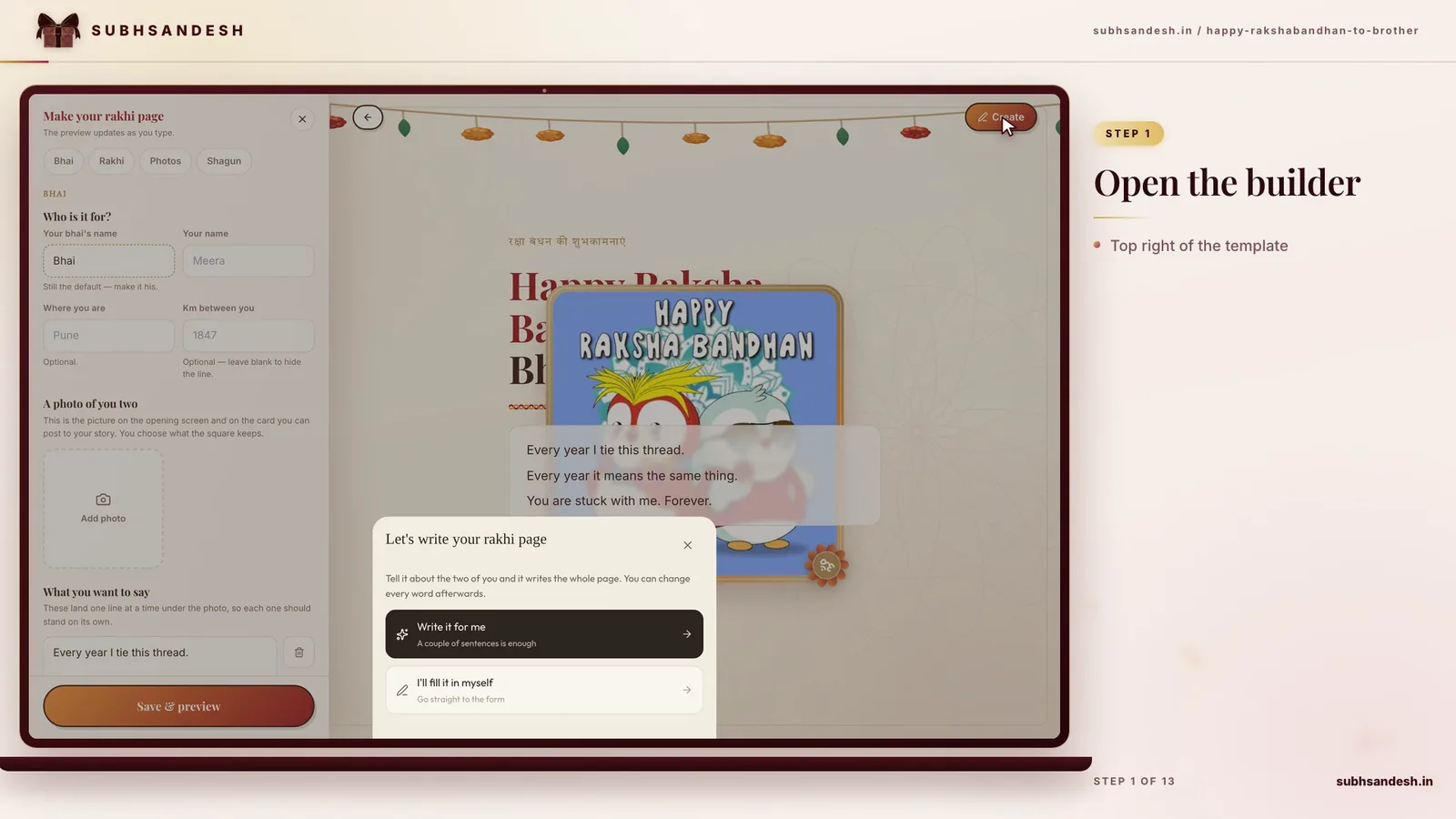
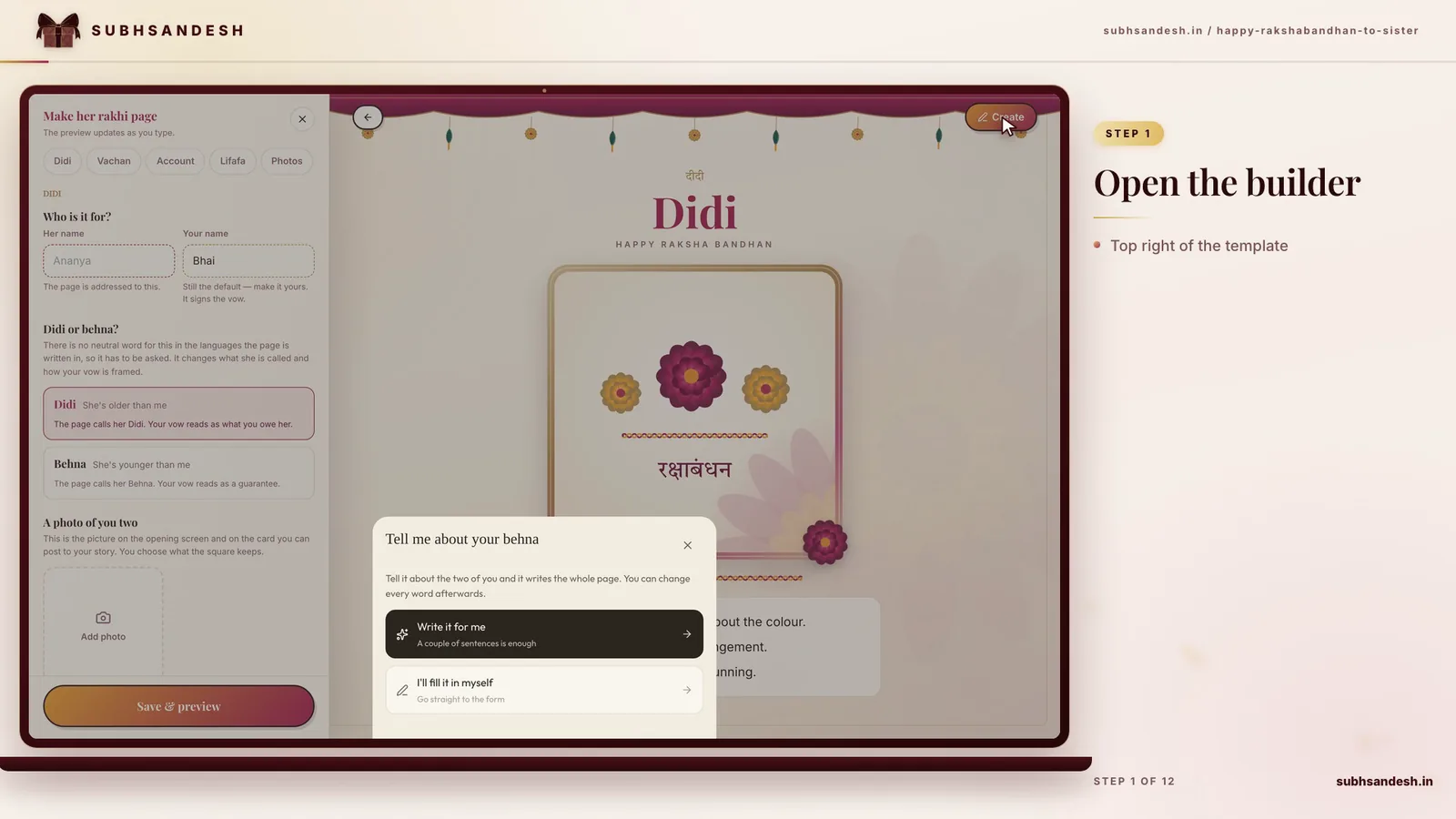
Where a page does earn its place is as the thing that survives the day. If you are staying put, the Raksha Bandhan page for a brother carries the animated tilak, aarti and rakhi-tying scenes with your own photos and a private link; note that it is written brother-first, so a sister-to-sister or gender-neutral version means picking something else from the full SubhSandesh template gallery. Across 2,718 pages the average is 12.0 views each, which is the argument for a page over a WhatsApp forward: people go back to it.
Sources
- Migration of Labour in the Country — Press Information Bureau, 20 July 2023.
- Geographic proximity to siblings in older adulthood — Artamonova & Gillespie, Demographic Research 49(7), 4 August 2023.
- Ties to nonresident family, internal migration, and immobility — Mulder, Demographic Research 39(43), 5 December 2018.
- Advance ticket booking period cut from 120 to 60 days — Akashvani News, 18 October 2024.
- Aadhaar authentication for Tatkal tickets — Ministry of Railways, Press Information Bureau, 11 June 2025.
Frequently Asked Questions
Turn this inspiration into an unforgettable surprise
Build a page with photos, a heartfelt message, music and a ready-to-share link.
- Photos, message & music
- Ready-to-share link

Written by
Suyash Agrahari
Founder
Suyash Agrahari is a Software Engineer at HireQuotient and the founder of SubhSandesh and DrawFlow (drawflow.in). He builds AI agents and full-stack products with Next.js, Node.js, and the OpenAI and LangChain ecosystems, having shipped autonomous multi-agent systems, AI copilots, and large-scale outreach platforms — and scaled side projects from a few hundred to millions of users. He writes about AI engineering, web development, and building products that grow through SEO and organic reach.
Stay Connected
Follow SubhSandesh
New templates, festival ideas and step-by-step walkthrough videos — first on our socials.
Product guide
See it built, step by step
Keep reading
Thala Deepavali: A Couple's First Deepavali at the Bride's Home
Thala Deepavali is a Tamil couple's first Deepavali after marriage, at the bride's home. In 2027 it is Thursday 28 October, oil bath 4:40–6:01 AM in C…
 Suyash Agrahari· 9 min
Sugar-Free Diwali Sweets: Swaps, Label Warnings and the Evidence
Five original no-added-sugar Diwali sweets, why jaggery and honey do not count, the warnings FSSAI requires on a sugar-free box, and what an Indian su…
Suyash Agrahari· 9 minShort Diwali Quotes: 34 Original One-Liners Under 10 Words
34 original short Diwali quotes, each under ten words and marked with its word and character count, grouped by mood: lamps, family, friends, gratitude…
Suyash Agrahari· 9 min