
Corporate Raksha Bandhan Greeting for Employees: What to Send
A corporate Raksha Bandhan greeting should come from the company to the person, not about their siblings. Four employer-framed wordings, how to word it for a mixed workforce, whether your logo belongs on it, and when to send nothing.
Make this into a page you can send
Photos, a message, music and a ready-to-share link — in a couple of minutes.
or browse all occasionsKey takeaways
- • Write from the company to the employee, never about their siblings — the sibling-framed wording the SERP publishes assumes every recipient has one.
- • Send it to everyone, not the top performers: a thank-you card given to a whole group raised performance 5.2%, while selective cards lifted recipients only 3.3%.
- • 82% of Indian adults say they are currently Hindu, so on a 200-person roster roughly 36 people are not — name the festival, but write "to everyone celebrating".
- • Keep the logo small and in the signature; a president-signed symbolic card raised performance about 12 percent, and the signature carried it, not the branding.
- • Assume a phone: 51.9% of shared SubhSandesh pages are opened on mobile (16,952 of 32,683 views, measured 18 August 2026).
On this page
Corporate Raksha Bandhan Greeting for Employees: What to Send
A corporate Raksha Bandhan greeting for employees should be written from the company to the person, not about the person's siblings. That one change fixes most of what goes wrong — it marks the festival, thanks the employee for their work, and assumes nothing about who they tie a rakhi with or whether they observe it at all. Send it somewhere it opens cleanly on a phone: 51.9% of shared SubhSandesh pages are opened on a mobile (16,952 of 32,683 views, measured 18 August 2026). Give yourself two days to write it, because the median gap between a creator's first save and their last edit on SubhSandesh is 6.9 hours — almost nobody gets a message like this right in one sitting. Below are four employer-framed wordings, how to word the greeting for a workforce that is not all Hindu, whether your logo belongs on it, the channel decision, and the cases where sending nothing is the better call.
What a corporate Raksha Bandhan greeting is, and what it is not
A corporate Raksha Bandhan greeting is a message sent by an organisation to its staff on the day of Raksha Bandhan — Friday 28 August 2026 — acknowledging the festival and the people who observe it. It is not a rakhi wish: a rakhi wish is addressed to a sibling, and an employer is not one.
That distinction is where most published "corporate wishes" collapse. Lines like "warm greetings to you and your loving sibling" are sibling wishes with a corporate label. Sent to 400 people, they comment on the recipient's family and assume every recipient has one.
The greeting has one job: to show the organisation noticed a day that matters to a lot of its people. Anything more belongs in a different message.
Four wordings that work when the employer is the sender
Each wording below: what it says, who it suits, where to send it, what to leave out.
1. The observance note
What it says: the festival is today, the company is aware, and anyone celebrating is wished a good one. Two sentences, no metaphor. Who it suits: any organisation over roughly 50 people, and any first attempt. Where to send it: a company-wide email or one Slack or Teams announcement, the evening before rather than mid-morning on the day. What to leave out: "family", "you and your siblings", and any instruction to celebrate.
2. The appreciation note
What it says: thank you for a specific stretch of work, with the festival as the occasion rather than the subject. Who it suits: teams that closed something recently — a release, an audit, a quarter. Where to send it: from a named manager to their own team, not a shared HR address. What to leave out: a company-wide version. In a field experiment on unannounced recognition, a thank-you card sent to only the best three of eight workers produced a gain coming mostly from those who didn't get one — their output rose more than 10%, recipients' 3.3% (Bradler et al., IZA Discussion Paper 8311, July 2014). Selective praise is read as a ranking, and a festival greeting is the wrong vehicle for it.
3. The colleague-bond note
What it says: it borrows the festival's idea of protection and applies it to how the team covers for each other, without claiming anyone is anyone's brother or sister. Who it suits: small teams and founders who can write in their own voice. Where to send it: the team channel, signed by a person. What to leave out: "we are one big family" — the sentence every employee has learned to distrust. In the same study, a thank-you card given to everyone in a group raised subsequent performance 5.2%, which is the pattern a staff-wide greeting should follow: universal, not ranked.
4. The logistics note
What it says: the practical facts — Raksha Bandhan 2026 falls on a Friday, who can leave early, how to book the day. Who it suits: organisations with shift work or a large in-office population. Where to send it: wherever your rota lives, plus the notice board. What to leave out: the festive artwork; this is an operations message and reads better plain.
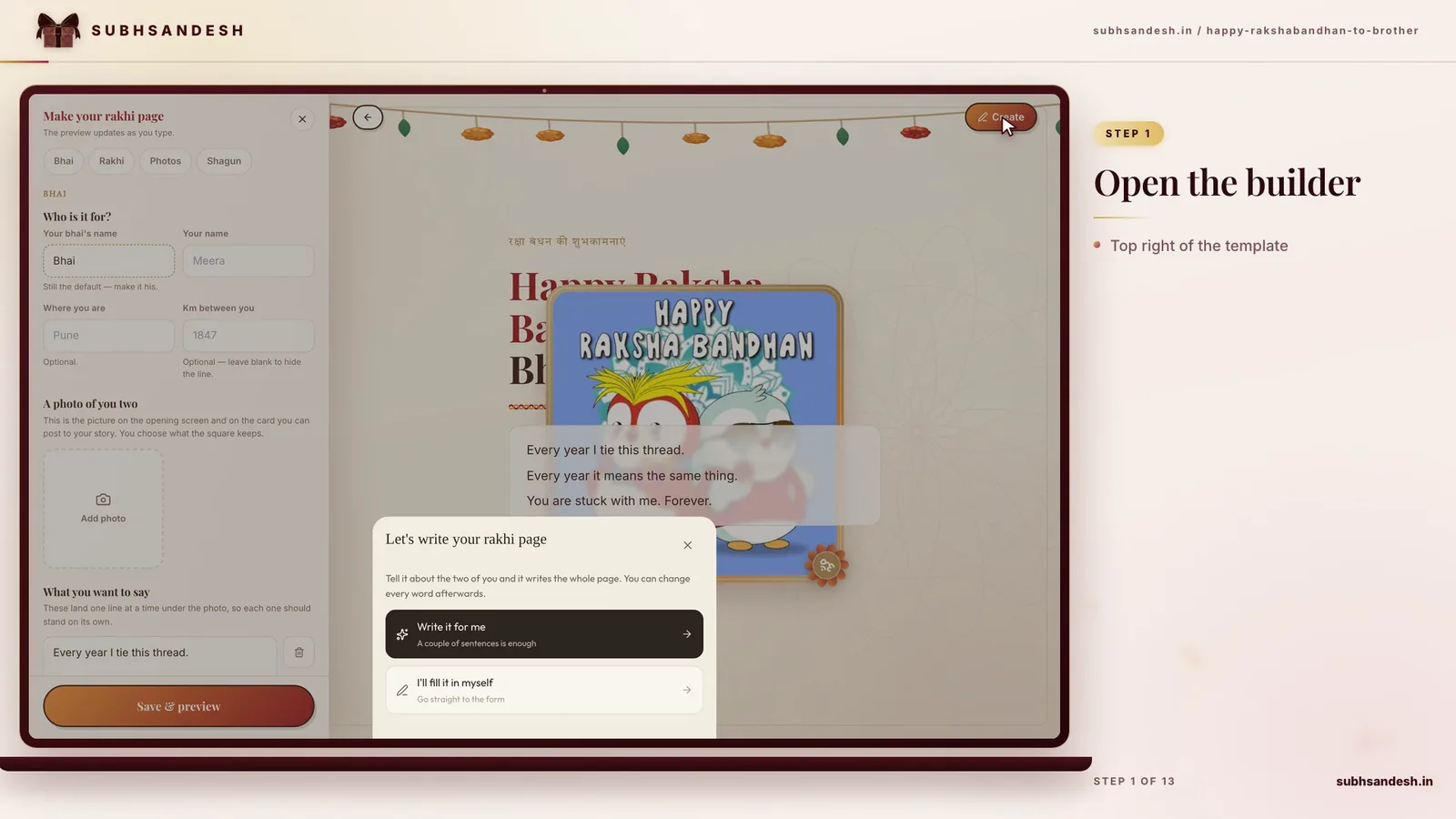
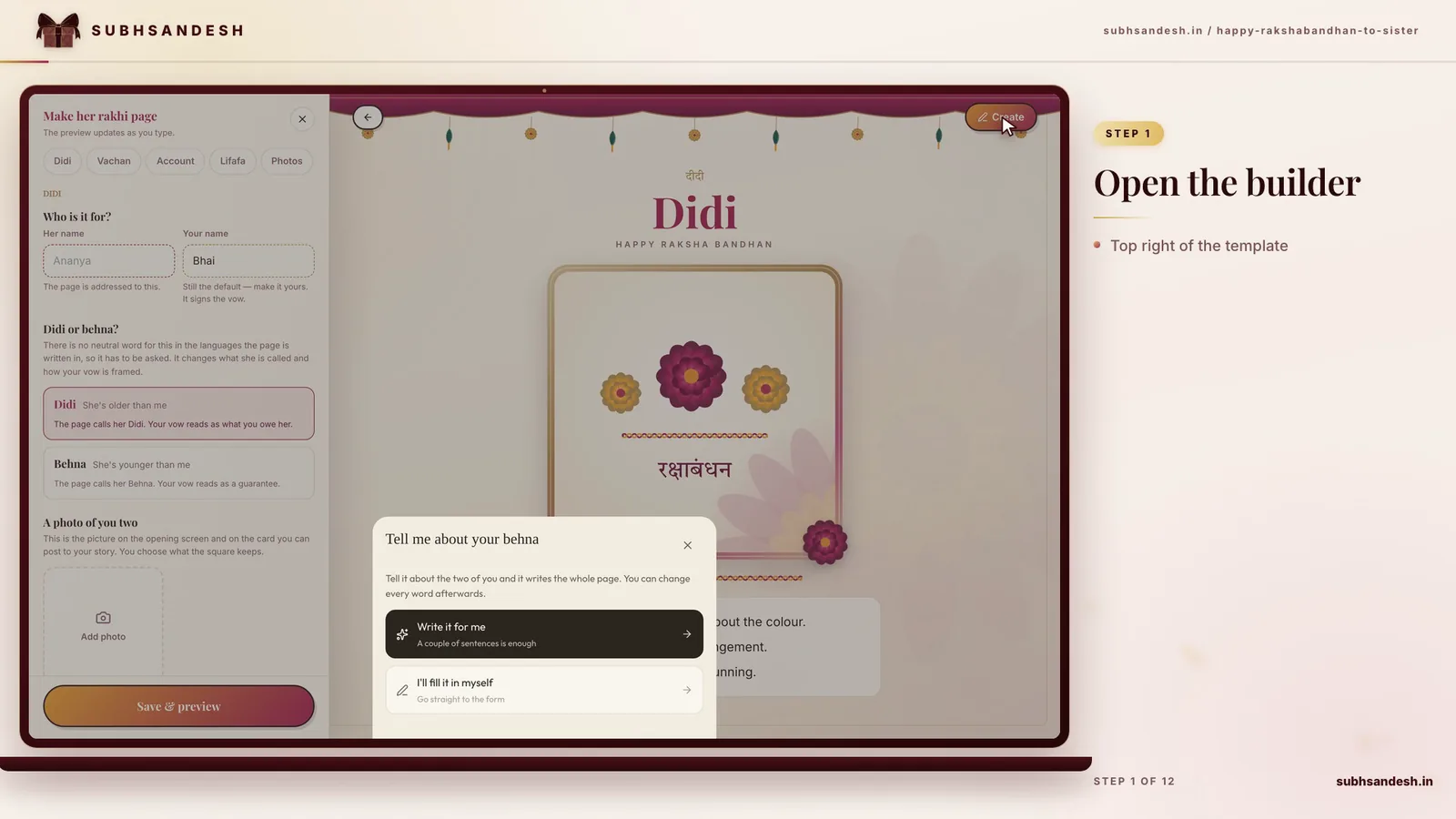
For a page rather than a paragraph, the Raksha Bandhan greeting page template supplies the artwork and a shareable link, and the wordings above drop into it.
How to word it when your workforce is not all Hindu
Raksha Bandhan is a Hindu festival; a staff list is not a Hindu staff list. Pew Research Center's survey of 29,999 Indian adults found 82% say they are currently Hindu — so on a 200-person roster roughly 36 people are not, before counting Hindus who don't observe this festival (Religion in India: Tolerance and Segregation, 29 June 2021).
The instinct is to strip the festival out and send something bland about "the festive season". The research points the other way. A systematic review of 53 studies on religious identity at work recommends supporting religious expression while maintaining a broader climate of inclusion, endorsing respectful pluralism — a climate that is "value-expressing, not value-free", resisting favouring one religion while accepting everyone's right to expression (Héliot et al., Human Resource Management 59(2), 2020).
In practice that means three edits. Name the festival rather than hiding it behind "the occasion". Write "to everyone celebrating" instead of "to all of you celebrating", which quietly conscripts the whole list. And make participation optional in fact, not just in tone — no mandatory rakhi-tying, no photo submission, no team game.
The other half of respectful pluralism is the calendar. If Raksha Bandhan gets a company email and Eid does not, the greeting has told your Muslim colleagues something you did not intend to say. Religion is also one of seven grounds named in ILO Convention 111, adopted in 1958. A greeting is not discrimination, but a calendar that runs one way is worth checking before August.
A neutral note is better in two situations: a workforce where religious identity is already a live tension, and any organisation that cannot commit to greeting the other festivals too.
Should your company logo be on the greeting?
Small and in the signature, yes. Locked up with the rakhi artwork as the visual centre, no — the card becomes an advertisement wearing a festival as a costume, and employees read it as one instantly.
There is measured support for the softer version. In one field experiment, a purely symbolic congratulatory card — no money attached — signed by the organisation's president raised performance about 12 percent (Kosfeld and Neckermann, American Economic Journal: Microeconomics 3(3), August 2011). The signature carried the effect, not the branding.
So sign it from a human being. "Ravi, and everyone at [company]" beats "Team HR", and beats a logo standing alone. Save the full brand lockup for the client version, where the company name is the point.
Email, chat, or a link: where to send it
Four channels, compared on the things that actually decide the outcome. The last column is what SubhSandesh's own numbers say, measured on 18 August 2026 across 2,718 pages and 32,683 views.
| Channel | Reaches non-desk staff | Personalisation ceiling | Effort for 200 people | What our data says |
|---|---|---|---|---|
| Company-wide email | Poor for shift and field staff | First name only | 20 minutes | Assume a phone screen; 51.9% of opens are mobile |
| Slack or Teams announcement | Only if they have an account | None — one message for all | 5 minutes | No read receipt; treat it as a notice, not a note |
| Shareable greeting page | Good — a link works anywhere | Name, photo, message, music | 30–45 minutes | 99.4% of pages started are published and shared |
| Printed card at the desk | Best for on-site staff | Handwritten signature | 2–3 days and a print cost | Nothing digital reaches an employee with no work email |
A link is the only option that survives a mixed workforce of desk, shift and remote staff, and the only one you can make look made rather than sent. The SubhSandesh template gallery shows how one reads on a phone.
Personalising 200 greetings without sounding like a mail merge
Name-substitution is not personalisation, and everyone sees the seam: "Dear {{first_name}}" firing at 9:00 a.m. reads worse than an unnamed message.
Segment instead. Write three or four versions — one per office, function or shift pattern — each landing from someone that group reports to. Four honest messages beat 200 identical ones with a variable in them.
Then leave it a day. The 6.9-hour median gap between first save and last edit in SubhSandesh's data is a fair guide to how long a short message takes to get right, and the sentence you cut on the second read is usually the one about family.
One inversion worth naming: 44.3% of SubhSandesh creators password-protect a page before sharing it, which is right for a private message and wrong here. A staff greeting should open in one tap.
When a corporate rakhi greeting is the wrong call
Skip it in a week when the company has announced layoffs or held back salaries. A festival greeting from a team that just cut jobs does not read as warmth; it reads as changing the subject, and it will be quoted back.
Skip it if your workforce is largely non-Hindu, or if you cannot extend the same courtesy to Eid, Christmas and Gurpurab. Skip the digital version for a plant or warehouse where most employees have no work email — a printed notice and an early finish beat a link nobody opens.
Be honest about the tool, too. SubhSandesh's 13 page types are built for one person writing to one person: the rakhi template is addressed to a brother, and none of the 2,718 pages created since 12 March 2026 is a corporate template. It suits a founder writing to a small team, or a manager writing to one colleague. For a 5,000-person announcement, plain email is the better instrument, and we would rather say so than sell you a page.
Sources
- Bradler et al., Employee Recognition and Performance — IZA DP 8311, July 2014
- Kosfeld and Neckermann, Symbolic Awards and Worker Performance — AEJ: Microeconomics 3(3), August 2011
- Héliot et al., Religious identity in the workplace — Human Resource Management 59(2), 2020
- Pew Research Center, Religion in India — 29 June 2021
- ILO, Convention No. 111 — adopted 25 June 1958
- SubhSandesh platform data — measured 18 August 2026
Frequently Asked Questions
Turn this inspiration into an unforgettable surprise
Build a page with photos, a heartfelt message, music and a ready-to-share link.
- Photos, message & music
- Ready-to-share link

Written by
Suyash Agrahari
Founder
Suyash Agrahari is a Software Engineer at HireQuotient and the founder of SubhSandesh and DrawFlow (drawflow.in). He builds AI agents and full-stack products with Next.js, Node.js, and the OpenAI and LangChain ecosystems, having shipped autonomous multi-agent systems, AI copilots, and large-scale outreach platforms — and scaled side projects from a few hundred to millions of users. He writes about AI engineering, web development, and building products that grow through SEO and organic reach.
Stay Connected
Follow SubhSandesh
New templates, festival ideas and step-by-step walkthrough videos — first on our socials.
Product guide
See it built, step by step
Keep reading
Thala Deepavali: A Couple's First Deepavali at the Bride's Home
Thala Deepavali is a Tamil couple's first Deepavali after marriage, at the bride's home. In 2027 it is Thursday 28 October, oil bath 4:40–6:01 AM in C…
 Suyash Agrahari· 9 min
Sugar-Free Diwali Sweets: Swaps, Label Warnings and the Evidence
Five original no-added-sugar Diwali sweets, why jaggery and honey do not count, the warnings FSSAI requires on a sugar-free box, and what an Indian su…
Suyash Agrahari· 9 minShort Diwali Quotes: 34 Original One-Liners Under 10 Words
34 original short Diwali quotes, each under ten words and marked with its word and character count, grouped by mood: lamps, family, friends, gratitude…
Suyash Agrahari· 9 min