
Digital Gift Ideas for Girlfriend: What Lands and What Flops
The digital gifts that land arrive as an experience she opens, not a file she downloads. 14 ideas with a real rupee price or free, what she has to do to receive each, and the four that read as low effort.
Make this into a page you can send
Photos, a message, music and a ready-to-share link — in a couple of minutes.
or browse all occasionsKey takeaways
- • Digital gifts arrive in exactly four forms — a file, a subscription, a credit or an experience she opens — and the form decides how much admin you are handing her.
- • The experience form is the only one that is measurable: pages built here average 12.3 views each, and 50.3% of all 40,864 views happen on a phone.
- • An unpersonalised e-gift card is the weakest option in the list; a Psychology & Marketing paper from 14 February 2024 found conspicuous monetary spending can make recipients suspicious of a giver's motives.
- • A ₹0 gift can outperform a ₹2,000 one: the median personalised page here takes 6.9 hours to build, and effort reads better than expenditure.
- • If she has been hinting at one specific physical object for a month, buy the object — the gift-registry research says substituting your own idea serves you, not her.
On this page
- 1. A personalised page with your letter, her photos and her song
- 2. A recorded voice letter, five minutes, unedited
- 3. A shared playlist ordered by your timeline
- 4. A live online class you both attend
- 5. A digital bouquet page
- 6. A commissioned illustration of the two of you
- 7. A domain in her name with one page on it
- 8. A subscription she already pays for herself
- 9. An audiobook or e-book she mentioned once
- 10. A countdown page to the next date you'll share a city
- 11. Quietly paying for something she has been putting off
- 12. A donation to a cause she has named herself
- 13. A printable set bought from a marketplace
- 14. An unpersonalised e-gift card
Digital Gift Ideas for Girlfriend: What Lands and What Flops
The digital gift ideas for girlfriend searches that actually land are the ones she opens in one tap and can come back to — not files she has to download and manage. Across 3,335 personalised pages created on SubhSandesh since 12 March 2026, the most-created gift is the romantic "I love you" page: 975 pages, 29.2% of everything built, and 14,396 views, 35.2% of the 40,864 recorded. Every created page averages 12.3 views, so these get reopened rather than glanced at once.
Below: 14 ideas with a real rupee price or "free", the work each hands her, and the four that read as low effort — an unpersonalised e-gift card included.
What is a digital gift, and which four forms does it arrive in?
A digital gift is anything given without a physical object changing hands: it reaches her as a link, a code, a file or an invite. Every one arrives in one of four forms — a file she downloads, a subscription she accepts, a credit she redeems, or an experience she opens.
The form matters more than the idea: it decides how much work you are handing her. Half of everything shared here is read on a phone: 50.3% of those 40,864 views. A 40 MB printable PDF does not survive that; a link does.
14 digital gift ideas for a girlfriend, ranked by what lands
Ranked best first: price, her workload, the signal, the failure mode.
1. A personalised page with your letter, her photos and her song
Costs time, not money — the median build runs 6.9 hours between first save and last edit across 975 "I love you" pages, and she taps one link, nothing to install. Signals hours rather than rupees. Breaks if she has no signal right then.
2. A recorded voice letter, five minutes, unedited
Free, and she plays it in WhatsApp. Signals nerve, rarer than money. Breaks if she can't listen privately, so warn her first.
3. A shared playlist ordered by your timeline
Free on Spotify's ad-supported tier; she follows one link. Signals attention to dates. Turns to mush unless each track carries a line about when it happened.
4. A live online class you both attend
₹500–₹2,500 a seat for cooking, pottery or drawing; she picks a slot and shows up. The textbook experiential gift. Breaks when two calendars won't agree.
5. A digital bouquet page
Free to build, and she opens a link to watch the flowers animate. Second most-created type here: 783 pages, 23.5%. Breaks if the occasion needed something she can smell.
6. A commissioned illustration of the two of you
₹800–₹4,000 from an independent artist; she waits three to ten days for a file. Signals money and taste. Breaks because it is still a file to store.
7. A domain in her name with one page on it
₹700–₹1,200 a year for a .in domain; she opens a URL that is her name. Signals permanence. Breaks the year you forget to renew.
8. A subscription she already pays for herself
Spotify Premium from ₹119 a month, Kindle Unlimited from ₹169; she accepts an invite or code. Signals that you noticed what she uses. Breaks when a trial renews on her card.
9. An audiobook or e-book she mentioned once
₹200–₹700, delivered as a code by email and redeemed in an app she has. Signals that you were listening in October. Breaks if she never named a title.
10. A countdown page to the next date you'll share a city
Free; she pins the link and checks it. Signals a plan rather than a feeling — what long-distance couples run short of. Breaks if the date slips and nobody updates it.
11. Quietly paying for something she has been putting off
₹300–₹2,500: an app renewal, a gym month, a phone bill — nothing arrives, it is handled. Signals practical care. Too flat alone — pair it with something she opens.
12. A donation to a cause she has named herself
₹500 upward, receipt forwarded. Signals shared values. Breaks if you pick the cause, not her.
13. A printable set bought from a marketplace
₹99–₹599 for love-coupon or wall-art PDFs; she downloads a ZIP, finds an unzip app, then a printer. Signals a purchase. The category's commonest failure: a file she must manage is a chore wearing a bow.
14. An unpersonalised e-gift card
₹500 is the usual minimum at Indian retailers, and a code lands in her inbox. It signals, accurately, that time ran out. See below on why price without visible effort reads badly.
File, subscription, credit or experience: the four types compared
The taxonomy predicts the friction, and friction decides whether a gift is opened twice.
| Arrives as | Real price | What she has to do | What our own data shows |
|---|---|---|---|
| A file (printable PDF, ZIP, illustration) | ₹0–₹4,000 | Download it, find an app that opens it, store it | Not measurable — a saved file leaves no trace |
| A subscription (music, audiobooks, video) | ₹119–₹500 a month | Accept an invite or code, handle renewal | Not measurable — the platform owns the relationship |
| A credit (e-gift card, wallet top-up) | ₹500 minimum | Redeem the code, then shop on your behalf | Not measurable — the shopping is now her task |
| An experience she opens (a personalised page) | ₹0 to build; about 6.9 hours of your time | Tap one link: no app, no account | 12.3 views per page; 50.3% of 40,864 views on a phone |
The first three hand her admin; only the fourth is measurable, which is why this page can quote reopen numbers.
Digital gift for girlfriend free: what ₹0 actually buys
A genuinely free digital gift for a girlfriend comes down to three things that cost only time: a voice letter, a playlist with notes, and a page you write yourself.
Three catches first. Free page builders often expire the link — 24 hours is common, and an expired link is worse than no gift. Free trials bill her card, not yours, when they roll over, and free printables are watermarked in preview and paid at download.
One first-party note: 42.9% of creators here password-protect the page before sharing, 1,432 of 3,335 — a habit, not a paid feature. If the occasion is her birthday, the birthday surprise page for a partner is the fifth most-created type at 258 pages, 7.7% of the total.
The best digital gift for a girlfriend is the one she can reopen
For the best digital gift for girlfriend occasions rather than the cheapest, research points at experiences over objects — with a caveat. In Chan and Mogilner's Journal of Consumer Research study of 59 friend pairs given $15, published 29 December 2016, experiential gifts improved recipients' relationship strength more than material ones: 0.66 versus 0.40, p < .001.
Two details beat the headline. The emotion doing the work is felt while the gift is consumed, not when it is received — so a gift that only impresses on opening spends its budget wrong. And the effect held whether or not the giver was present (p = .50), which matters at 1,800 km.
The caveat is real: those experiential gifts were consumed over 3.41 days on average, against 118.98 days for material ones. Experiences end. A page sits between the two — an experience she opens that is still there in March.
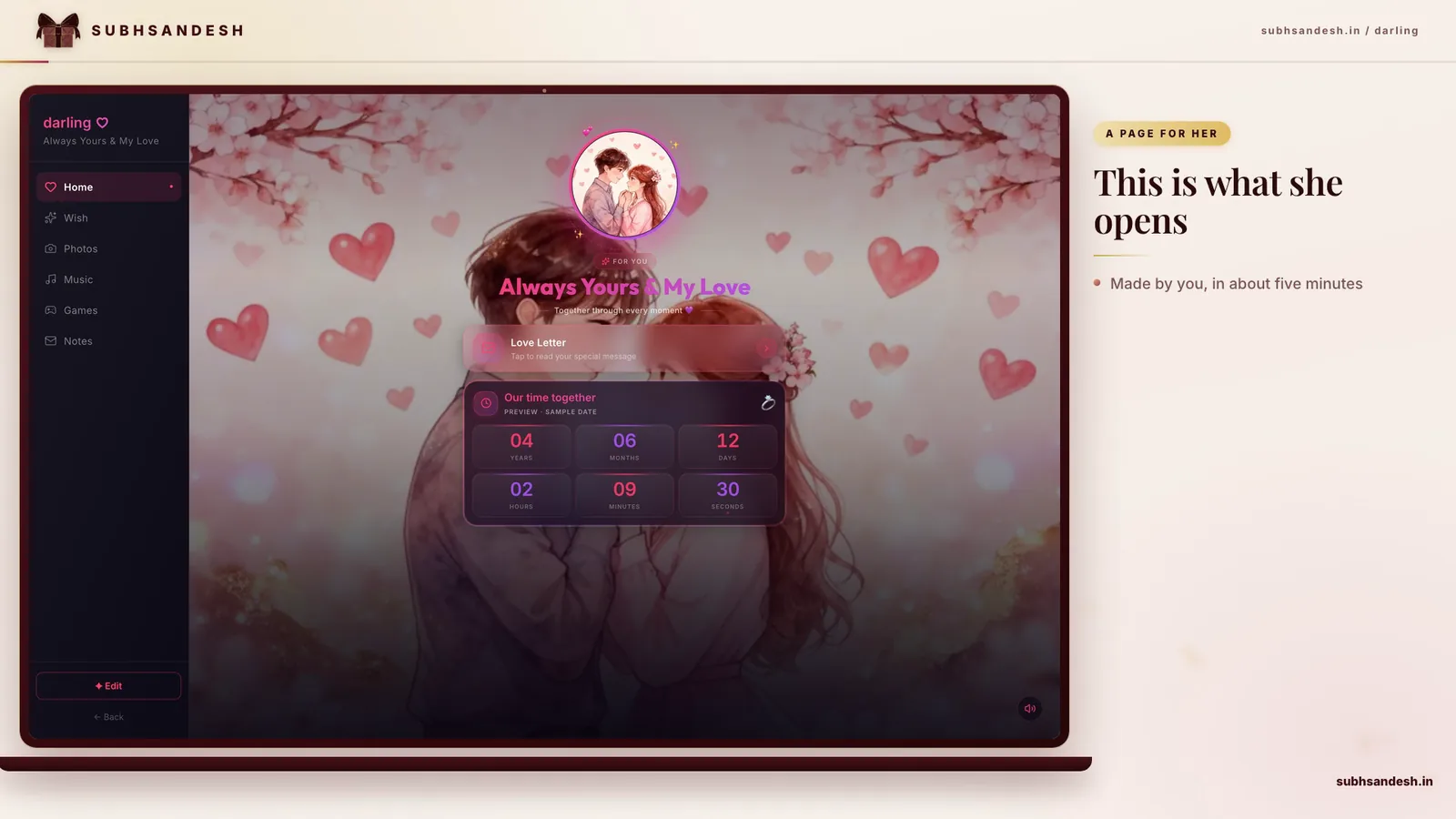
That is the design brief behind the romantic "I love you" page for a girlfriend: a letter, a photo gallery, background music, notes, a Love Quiz and Truth-or-Dare behind an optional password. If her taste runs darker than soft-focus romance, the dramatic "Darling" page for a partner is the moodier build — 343 made, 10.3% of the total.
One check on the theory: a 2022 Journal of Consumer Psychology paper with four preregistered studies and 3,288 participants found material and experiential qualities both relate positively to happiness, with no inherent trade-off. When you must choose, choose the experience.
Which digital gifts read as low effort, and why an e-gift card is one
Four forms read as low effort regardless of amount: an unpersonalised e-gift card, a stock e-card with your name typed in, a forwarded reel, and a free trial in her name that later bills her.
Four studies by Mutluoglu, Ashworth and Robitaille, written up by their own school on 19 July 2022 and peer-reviewed in Psychology & Marketing on 14 February 2024, found conspicuous monetary spending makes recipients suspicious of the giver's motives. Money, but not effort, triggered it: a winery tour drew less suspicion than a bottle of wine. Suspicious recipients also felt less close to the giver, which is the opposite of the point.
Going off-list is not automatically thoughtful, either. Ward and Broniarczyk's five gift-registry studies in the Journal of Marketing Research, December 2016 found close givers went off-registry 35.71% of the time against 17.14% for distant givers — and only when their name would be attached to the choice. Ignoring her stated ask serves the giver.
When a digital gift is the wrong choice
If she has been pointing at one specific physical object for a month, buy the object. That is the honest read of the registry research above: substituting your idea for her stated request is a signal about you. A page is not the answer that week.
Three more cases where this loses. You are in the same room and can hand her something, or she shares a phone and lives with family who read over her shoulder — even the 42.9% who password-protect are not covered there. And if the moment needs something that survives a dead battery, a printed photo wins.
A limit on our numbers, too: they cover pages built here since 12 March 2026, where 99.5% of started pages get published, 3,317 of 3,335. That describes people already committed to sending something; it cannot say how the gift landed emotionally. No analytics can.
Sources
- Chan and Mogilner, "Experiential Gifts Foster Stronger Social Relationships than Material Gifts", Journal of Consumer Research, 29 December 2016.
- Weingarten et al., "Decoupling the experiential-material continuum", Journal of Consumer Psychology, 2022.
- Mutluoglu, Ashworth and Robitaille, "Looking a gift horse in the mouth", Psychology & Marketing, 14 February 2024 — read via Smith School of Business's write-up, 19 July 2022.
- Ward and Broniarczyk, "Ask and You Shall (Not) Receive", Journal of Marketing Research, December 2016 — accepted manuscript, Kellogg School of Management.
- SubhSandesh first-party data, 1 September 2026.
Frequently Asked Questions
Turn this inspiration into an unforgettable surprise
Build a page with photos, a heartfelt message, music and a ready-to-share link.
- Photos, message & music
- Ready-to-share link

Written by
Suyash Agrahari
Founder
Suyash Agrahari is a Software Engineer at HireQuotient and the founder of SubhSandesh and DrawFlow (drawflow.in). He builds AI agents and full-stack products with Next.js, Node.js, and the OpenAI and LangChain ecosystems, having shipped autonomous multi-agent systems, AI copilots, and large-scale outreach platforms — and scaled side projects from a few hundred to millions of users. He writes about AI engineering, web development, and building products that grow through SEO and organic reach.
Stay Connected
Follow SubhSandesh
New templates, festival ideas and step-by-step walkthrough videos — first on our socials.
Product guide
See it built, step by step

Keep reading
How to Surprise Someone on Their Birthday at Midnight
The Indian midnight birthday wish, treated as a timing problem: aim for 23:55 rather than 00:00, check the Bedtime schedule that silences a 00:00 noti…
 Suyash Agrahari· 9 min
How to Surprise Husband on Birthday When the Day Is His Alone
A birthday is his day, not a shared one, so unlike an anniversary the contents can genuinely surprise him — and the gesture fails when it becomes abou…
Suyash Agrahari· 9 minHow to Surprise Best Friend on Friendship Day in India
Friendship Day in India falls on the first Sunday of August — a different date from the UN's International Day of Friendship on 30 July. Four things w…
Suyash Agrahari· 9 min