
Happy Raksha Bandhan Replies to Sister, by What She Sent
A good Raksha Bandhan reply answers in the register she used, names the delay if you are late, and adds one detail only you would know. Six replies sorted by what she actually sent, plus what to say when you are a week behind.
Make this into a page you can send
Photos, a message, music and a ready-to-share link — in a couple of minutes.
or browse all occasionsKey takeaways
- • A reply is judged against what it answers, not on its own — match her register, name the delay, and add one detail only you would know.
- • "Same to you" fails because she can see the effort ratio: paragraphs, a photo or a voice note answered with four words that would fit any sender.
- • Reply to a voice note with a voice note; answering audio with text is the clearest downgrade a chat app allows.
- • Late still lands — in a 742-person replication, senders predicted appreciation at 4.46 while recipients rated it 4.77.
- • Answer in the family group AND directly: the group line is a receipt, the private message is the reply. Sending only the group line is the commonest mistake.
On this page
Happy Raksha Bandhan Replies to Sister, by What She Sent
A good Happy Raksha Bandhan reply to your sister does three things: it answers in the register she used, names the delay if you are late, and includes one specific detail only you would know. "Same to you" fails all three, which is why it reads as a dismissal rather than a wish. Reply size is part of the message — on SubhSandesh the median gap between a page's first save and its last edit is 6.9 hours (sampled on the "I love you" page, n=913, measured 2026-08-18), so real effort was never sent in the same minute. Whatever you send, send it phone-first: 51.9% of shared pages are opened on a phone (16,952 of 32,683 views, measured 2026-08-18). Below: replies sorted by what she sent, then how late you are.
What a Raksha Bandhan reply is, and why it is not a wish
A Raksha Bandhan reply is the second message in an exchange your sister started — an answer to one specific thing, not a greeting you could have sent anybody. A wish initiates; a reply is judged against what it responds to.
That asymmetry is measurable. Conversational response time is modally ~200 ms, and in the 2022 PNAS study Fast response times signal social connection in conversation (Study 1, n = 66), felt connection tracked how fast the other person answered.
In a chat the equivalent is proportion, not milliseconds: whether the reply looks written for her, or pasted.
Why "same to you" reads as a dismissal
Because she can see the ratio: three paragraphs, a photo of the rakhi she bought, or a voice note, answered with four words that would fit any sender on any festival. The problem is not politeness; it is the effort gap.
The thing she is scanning for has a name: perceived partner responsiveness — the impression that the other person is understanding, caring and validating. In Lightening the Load (JPSP, 2022), a preregistered experiment (N = 548) found higher perceived responsiveness made an already-made sacrifice feel less costly and less regrettable.
Read it in the direction that matters: the effort she already spent gets cheaper when your reply shows you registered it, dearer when it doesn't.
Match not her word count but her direction of effort: answer the specific thing she sent, and add one detail she cannot get from a forward.
6 Raksha Bandhan replies for a sister, sorted by what she sent
Matching her register is not a style preference. Language style matching — how closely two people's phrasing tracks — predicted stability in Ireland et al. (2011): across 86 couples' instant messages, odds ratio 1.95 at three-month follow-up, 76.7% still together. Answer funny with funny.
1. She sent a long sentimental paragraph
She sent: several hundred words, probably before 9 AM. She is checking: whether you read it. Reply: "Read this three times. You are wrong about one thing — I was the one who needed protecting, not you. Remember the [specific incident]? Happy Raksha Bandhan, and thank you for the whole thing, not just today." Why it works: it quotes her, contradicts her once, adds a memory. Forty words answering 300 is fine; four is not.
2. She sent a one-line "Happy Rakhi 🌸"
She sent: one line, low effort by design. She is checking: nothing; she is being efficient. Reply: "Happy Rakhi 🌸 Tilak pending until you're back in Pune. Call tonight?" Why it works: it matches her length; a paragraph reads as overcompensation. Add one thing she must answer — a date, a call, a question — so the thread does not die on two emojis.
3. She sent a joke or a roast
She sent: a meme, or a photograph of you aged nine. She is checking: whether you will play. Reply: "This is defamation. Happy Raksha Bandhan to the only person who has original footage. The rakhi is safe, my dignity isn't." Why it works: sentiment in answer to a roast lands as a mismatch and usually gets an "aww ok" and silence. Joke first, then one warm clause.
4. She sent a photo — the rakhi, the thali, or her wrist
She sent: an image — effort you can see. She is checking: whether you look at it. Reply: "That thali is better than anything Amma used to set out, and I'm telling her you said it. Send me a close-up of the blue one — that's the one I'm keeping." Why it works: it proves you opened the photo by naming something inside it. Send an image of your own wrist if the rakhi has arrived.
5. She sent a voice note
She sent: thirty to ninety seconds of her actual voice. She is checking: whether you will spend the same. Reply: a voice note of your own, same length, no script — the date, one memory, what you are bad at. Why it works: answering audio with text is the clearest downgrade a chat app allows — it turns something she recorded into something you typed while doing three other things.
6. She sent a formal message in the family group
She sent: something written for an audience — chachas, cousins, an aunt who forwards everything. She is checking: whether you show up in public. Reply: a short, warm, correctly-punctuated line in the group, addressed to her by name, then a real reply in your direct chat. Why it works: the group message is a receipt; the private one is the reply. Sending only the group line is the commonest mistake here.
Replying late: the same day, the next day, a week on
Raksha Bandhan 2026 falls on Friday 28 August, and most sisters send before the ceremony — so most brothers are already behind when they pick up the phone.
Within the day: no apology — one at 4 PM for a 9 AM message invents a problem she had not raised and makes the reply about you.
The next day: one clause, then move on: "Yesterday got away from me and I hate that — here's what I wanted to say." Do not explain the meeting.
A week or more: drop the excuse and say the true thing: "I'm ten days late and there's no version of this where that's fine. What I actually wanted to say was —". Then say it.
What stops most late replies is the belief that it is too late to matter. That is measurably wrong. In an independent replication (Report #7, October 2023) of a 2023 study on reaching out, initiators predicted appreciation at 4.46 while recipients rated their own at 4.77 (n = 742, d = 0.25, p < .001). Senders underestimate the message they hesitate over.
Gratitude is worth spending words on. In a 2024 Scientific Reports study of 825 people in relationships over six months, perceived responsiveness was the path from gratitude to satisfaction. "Thank you for remembering every single year" outperforms any wish you can copy.
Which reply format to use, and what each one signals
Each format tells her something different about what you spent. Figures below come from SubhSandesh's 2,718 created pages (measured 2026-08-18).
| Reply format | Time it takes | What she can tell | Our data |
|---|---|---|---|
| "Same to you" text | 4 sec | Nothing specific to her | — |
| Matched text reply, one memory | 3–5 min | You read her message | 51.9% of shared pages open on a phone |
| Voice note, same length as hers | 1–2 min | You spent her currency, not yours | — |
| Photo of the rakhi on your wrist | 2 min | The rakhi arrived and you wore it | — |
| Personalised page with her name and photos | 20–40 min | You built something | Median 6.9 h between first save and last edit (n=913) |
The two cheapest options in time — a matched text reply and a voice note — carry most of the signal; the built page is for the year you owe her more than a message. The edit-gap number is the caveat on that last row: these are not finished in one sitting, so a page is not a same-minute option. Start from a ready-made Raksha Bandhan page or the template gallery, not a blank screen.
Family group chat or direct reply — the answer is both
A group reply and a direct reply do different jobs — two messages, not a choice. The group reply is public acknowledgement: short, her name in it, no inside jokes that exclude the aunts.
The direct reply is the actual one, and where the specifics go. Anything you would not want a cousin screenshotting belongs here — which is why 44.3% of SubhSandesh creators password-protect a page before sharing it (1,205 of 2,718, measured 2026-08-18) rather than dropping it in a group.
If the group message came first, reply there within the hour, then take the real conversation private that evening.
When a warm reply would be a lie
Some sibling relationships are distant, some damaged. A reply full of borrowed warmth is transparent, and usually makes the next message harder.
Short and accurate works. "Thank you for the message — I hope this year is a good one for you" is honest, complete, and does not promise a relationship you do not have. Do not promise protection you will not provide; she will remember next August.
If what is owed is an apology, do not smuggle it into a festival reply. Send it separately — an apology page is one way, and 99.4% of pages started get published and shared (2,701 of 2,718, measured 2026-08-18): the hard message tends to get sent once built.
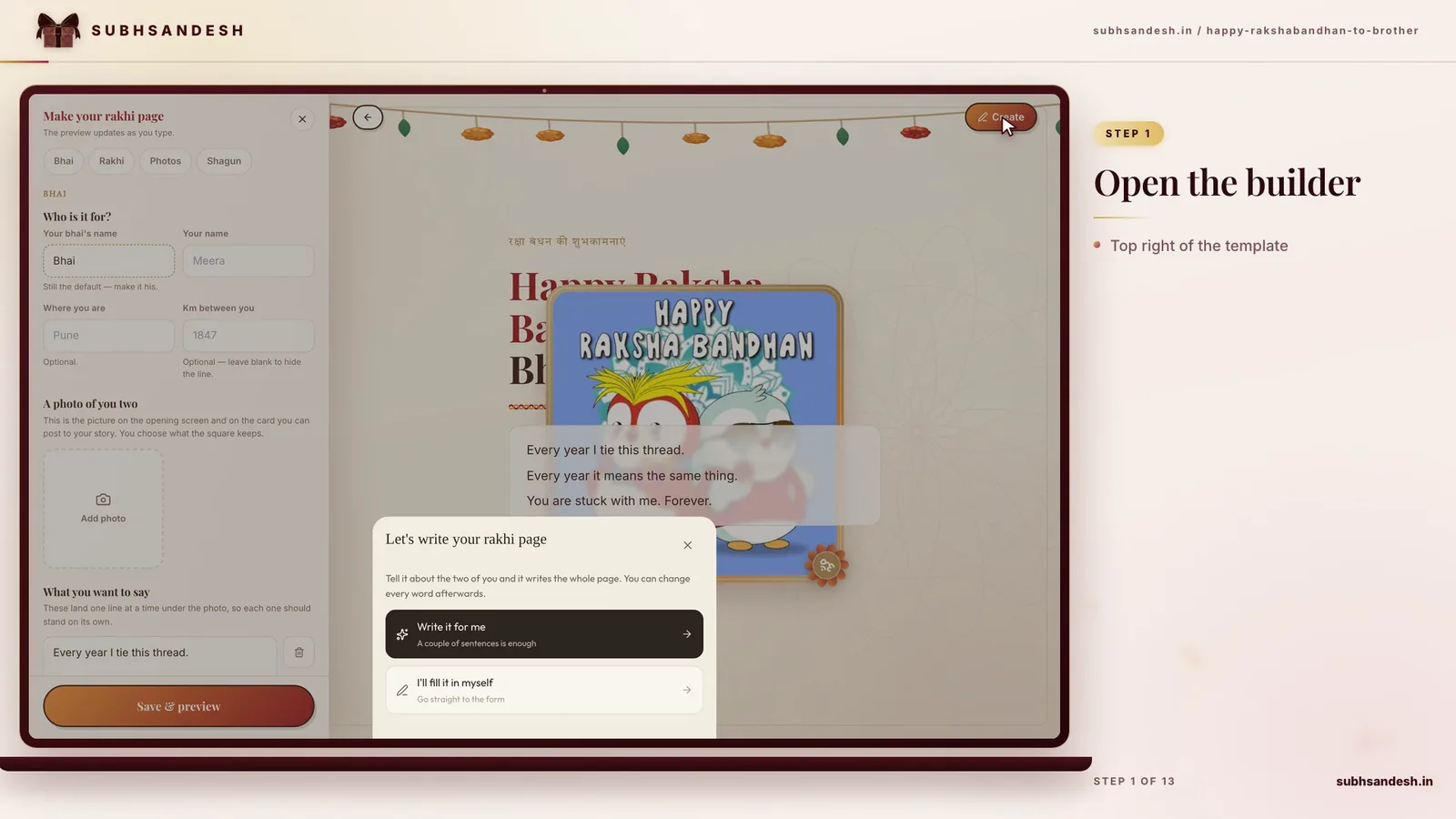
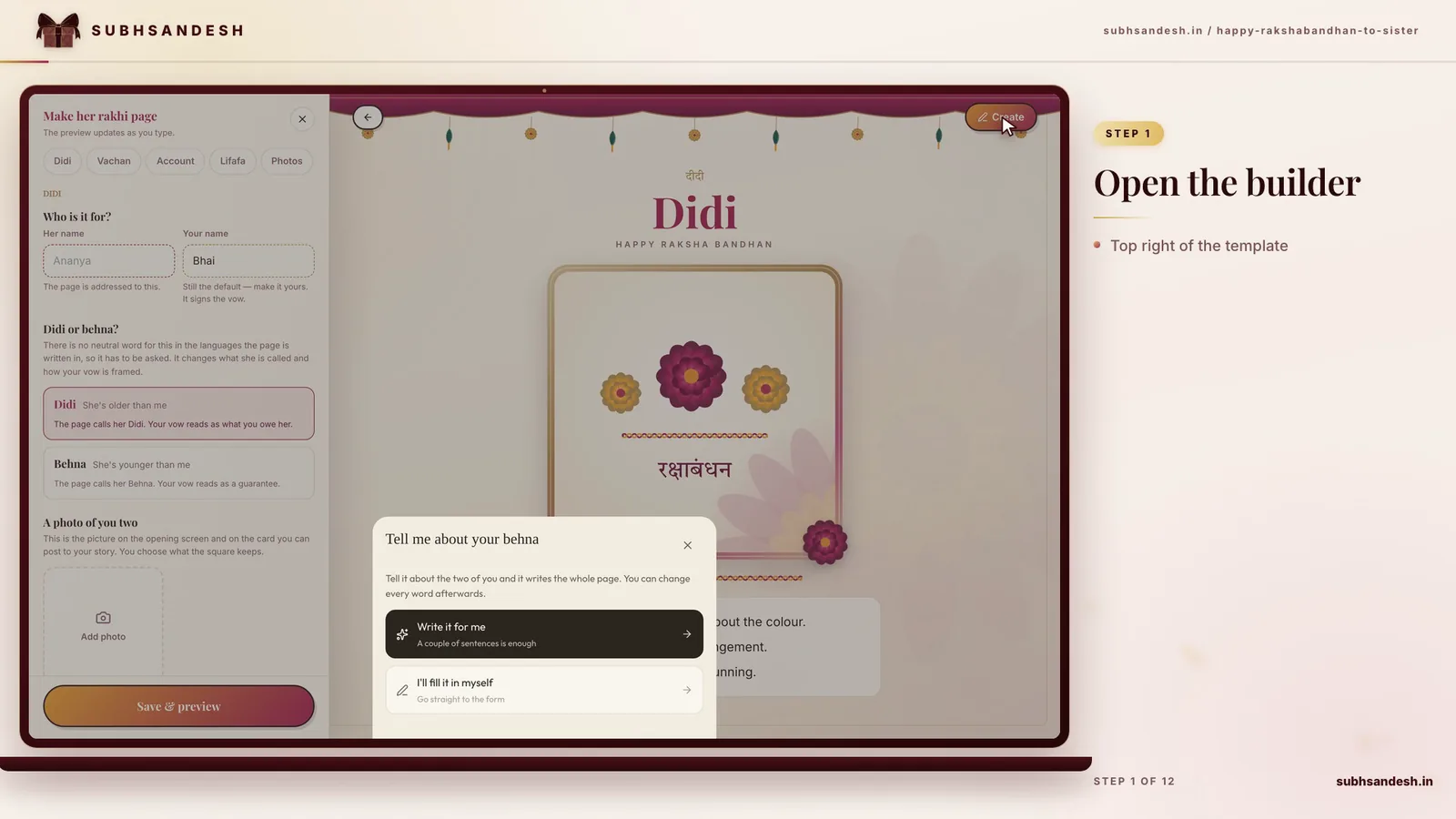
And the honest limit: SubhSandesh's only rakhi template is addressed to a brother — it is what your sister would send you, not a reply you send her. Use a general page type or plain text. If she has no smartphone, call her instead. If she is in the same house, put the phone down and say it.
Sources
- Templeton et al., Fast response times signal social connection in conversation — PNAS 119(4), 18 January 2022
- Visserman et al., Lightening the Load: Perceived Partner Responsiveness and Relational Sacrifices — JPSP 123(4), 2022
- Ireland et al., Language Style Matching Predicts Relationship Initiation and Stability — Psychological Science 22(1), 2011
- Transparent Replications, Report #7: replication of "The Surprise of Reaching Out" — 26 October 2023
- Relationship power attenuated the effects of gratitude on perceived partner responsiveness — Scientific Reports, 10 September 2024
Frequently Asked Questions
Turn this inspiration into an unforgettable surprise
Build a page with photos, a heartfelt message, music and a ready-to-share link.
- Photos, message & music
- Ready-to-share link

Written by
Suyash Agrahari
Founder
Suyash Agrahari is a Software Engineer at HireQuotient and the founder of SubhSandesh and DrawFlow (drawflow.in). He builds AI agents and full-stack products with Next.js, Node.js, and the OpenAI and LangChain ecosystems, having shipped autonomous multi-agent systems, AI copilots, and large-scale outreach platforms — and scaled side projects from a few hundred to millions of users. He writes about AI engineering, web development, and building products that grow through SEO and organic reach.
Stay Connected
Follow SubhSandesh
New templates, festival ideas and step-by-step walkthrough videos — first on our socials.
Product guide
See it built, step by step
Keep reading
Thala Deepavali: A Couple's First Deepavali at the Bride's Home
Thala Deepavali is a Tamil couple's first Deepavali after marriage, at the bride's home. In 2027 it is Thursday 28 October, oil bath 4:40–6:01 AM in C…
 Suyash Agrahari· 9 min
Sugar-Free Diwali Sweets: Swaps, Label Warnings and the Evidence
Five original no-added-sugar Diwali sweets, why jaggery and honey do not count, the warnings FSSAI requires on a sugar-free box, and what an Indian su…
Suyash Agrahari· 9 minShort Diwali Quotes: 34 Original One-Liners Under 10 Words
34 original short Diwali quotes, each under ten words and marked with its word and character count, grouped by mood: lamps, family, friends, gratitude…
Suyash Agrahari· 9 min