
Happy Raksha Bandhan Wishes With Name: Where the Name Goes
Where the name goes in a Raksha Bandhan wish, and which name to use: opening address versus sign-off, bhai versus a full name, the visible mail-merge seam, the Devanagari spelling risk, and two siblings at once. No photo needed.
Make this into a page you can send
Photos, a message, music and a ready-to-share link — in a couple of minutes.
or browse all occasionsKey takeaways
- • Put the name first. The opening address is the "call" position, rated the most natural of three placements by the 56 speakers in a 2023 Linguistic Review study, and it is the only slot a truncated phone preview cannot hide.
- • Use the form you say out loud — bhai, bhaiya, Chintu. A full name where the family uses a nickname reads as distance, not respect.
- • One specific clause closes the mail-merge seam; the name alone never does. 99.4% of the 2,739 pages started on SubhSandesh get published and shared, so wording is the bottleneck, not the tool.
- • A misspelled name is worse than no name. Devanagari is single-case, and many Hindi names double as ordinary nouns.
- • Raksha Bandhan 2026 is Friday 28 August, and 51.8% of our 33,007 recorded page views are phone opens.
On this page
Happy Raksha Bandhan Wishes With Name: Where the Name Goes
Put the name where you would say it out loud — usually first, as a direct address ("Rohit, happy Raksha Bandhan") — then write one line after it that only you could have written. That second line is what separates a wish from a mail merge, and none of it needs a photo, an editor or a download. Of the 2,739 personalised pages SubhSandesh has recorded since 2026-03-12, 99.4% of the pages people start get published and shared (2,722 of 2,739), and 44.3% of creators password-protect the page first (1,213 of 2,739) — the thing people stall on is almost never the tool, it is the wording. Raksha Bandhan 2026 falls on Friday 28 August. Below: where the name sits in the sentence, which name to use, why "Dear {{name}}" is visible from across the room, what changes when the name is written in Devanagari, and when to leave the name out.
What a named Raksha Bandhan wish actually is
A named wish is a greeting whose grammar contains a form of address — a noun phrase pointing at the person spoken to. Linguists call that a vocative, and it can sit at the start, in the middle or at the end of a sentence.
Nothing about it requires an image. The name can go into a WhatsApp message, the inside line of a card, or the headline of a page you send on Friday 28 August 2026.
What makes it read as personal is not the string but its position, and the sentence it keeps company with.
Where the name goes: three positions, three tones
Position carries meaning. An acceptability-judgment study of 56 native Spanish speakers, published in The Linguistic Review in 2023, found the opening slot was rated the most natural of the three, and restates Zwicky's 1974 distinction: an initial vocative attracts attention (a "call"), while middle and final ones maintain contact with the person already listening (an "address").
The same paper notes middle vocatives lean formal and final vocatives lean informal. That maps onto Hindi and English rakhi messages closely enough to use.
1. The opening vocative
"Rohit, happy Raksha Bandhan." The name does the summoning, so everything after it reads as spoken directly at him. In Hindi: रोहित, रक्षाबंधन की ढेरों शुभकामनाएँ। (Rohit, rakṣābandhan kī ḍherõ śubhkāmnāeṁ — "Rohit, heaps of good wishes for Raksha Bandhan.") Use it when the message is short and the relationship is close. It is also what a WhatsApp notification preview shows first, which matters when 51.8% of our 33,007 recorded page views are phone opens.
2. Mid-sentence
"I hope, Rohit, that this one is easier than last year." The name interrupts, so it slows the sentence and adds weight. This is the polite, slightly formal slot — good for a cousin, a brother-in-law, or a brother you are not in daily contact with. It reads badly in a one-line wish, because there is not enough sentence for the interruption to land inside.
3. The sign-off
"Happy Raksha Bandhan, bhai." Here the name confirms who was being spoken to rather than announcing it, which is why it feels warm and slightly casual. Use it when the sentence itself carries the content. It is the weakest slot in a group message, where the reader may never get that far.
Notification previews truncate, so a name in the sign-off can be cut off entirely. What the three placements cost:
| Where the name sits | Function (The Linguistic Review, 2023) | Register | Characters before the name (51.8% of our 33,007 views are phone opens) |
|---|---|---|---|
| Opening — "Rohit, happy Raksha Bandhan." | Call: attracts attention | Direct, spoken | 0 |
| Mid-sentence — "I hope, Rohit, that this year is kinder." | Address: maintains contact | Polite, formal | 8 |
| Sign-off — "Happy Raksha Bandhan, Rohit." | Address: confirms addressee | Warm, informal | 22 |
| No name, one shared memory instead | None | Intimate | not applicable |
The earlier the name, the more the message sounds like speech, and the less a truncated preview can hide.
Which name: Rohit, Chintu, or bhai
The three are not interchangeable. A study of Hindi and Syrian Arabic kinship terms in the Russian Journal of Linguistics (2021), built on questionnaires with 70 Hindi-speaking respondents aged 20 to 85, shows how fine the Hindi system is — eight terms for cousins, separate words for a father's father (dada) and a mother's father (nana).
The same paper reports Yoon's observation of two Korean-Australian brothers: the younger used his brother's first name when he wanted to be treated as an equal, and Korean hyeng ("elder brother") when he wanted to appeal to seniority. The address form was the message.
That is why a full name lands wrong. If your family says bhaiya or a childhood nickname, "Dear Rohit Sharma" does not read as respect. It reads as distance, or as a form letter.
Sometimes the name is not the address term at all. A description of Lambada kinship terms in the International Journal of Humanities and Social Science Invention, April 2014, records that a husband's younger brother is devar in reference but addressed as bhaya or bapu, and that spouses often address each other by their eldest child's name rather than a name at all.
The rule: use the form you would use out loud on an ordinary Tuesday. Bhai, bhaiya, dada, anna, Chintu. That is the correct string.
The mail-merge seam: why "Dear {{name}}" is visible
"Dear {{name}}" and "Happy Raksha Bandhan, [Name]!" are detectable for one structural reason: the name is the only variable in the sentence. Every other word would be identical for any recipient, so the name reads as a slot that was filled rather than a person who was thought about.
Three things give the seam away: punctuation nobody uses in speech ("Dear Rohit," to a brother), a capitalised full name where the family uses a nickname, and remaining content — health, wealth, prosperity, a bond that lasts forever — that could go to anyone.
Closing the seam takes one clause, not a paragraph. Pair the name with something only the two of you know: a date, a place, a running joke, an amount of money one of you still owes. "Rohit, happy Raksha Bandhan — I still have the ₹200 from Nagpur." The name is now load-bearing, because the sentence would make no sense addressed to anyone else.
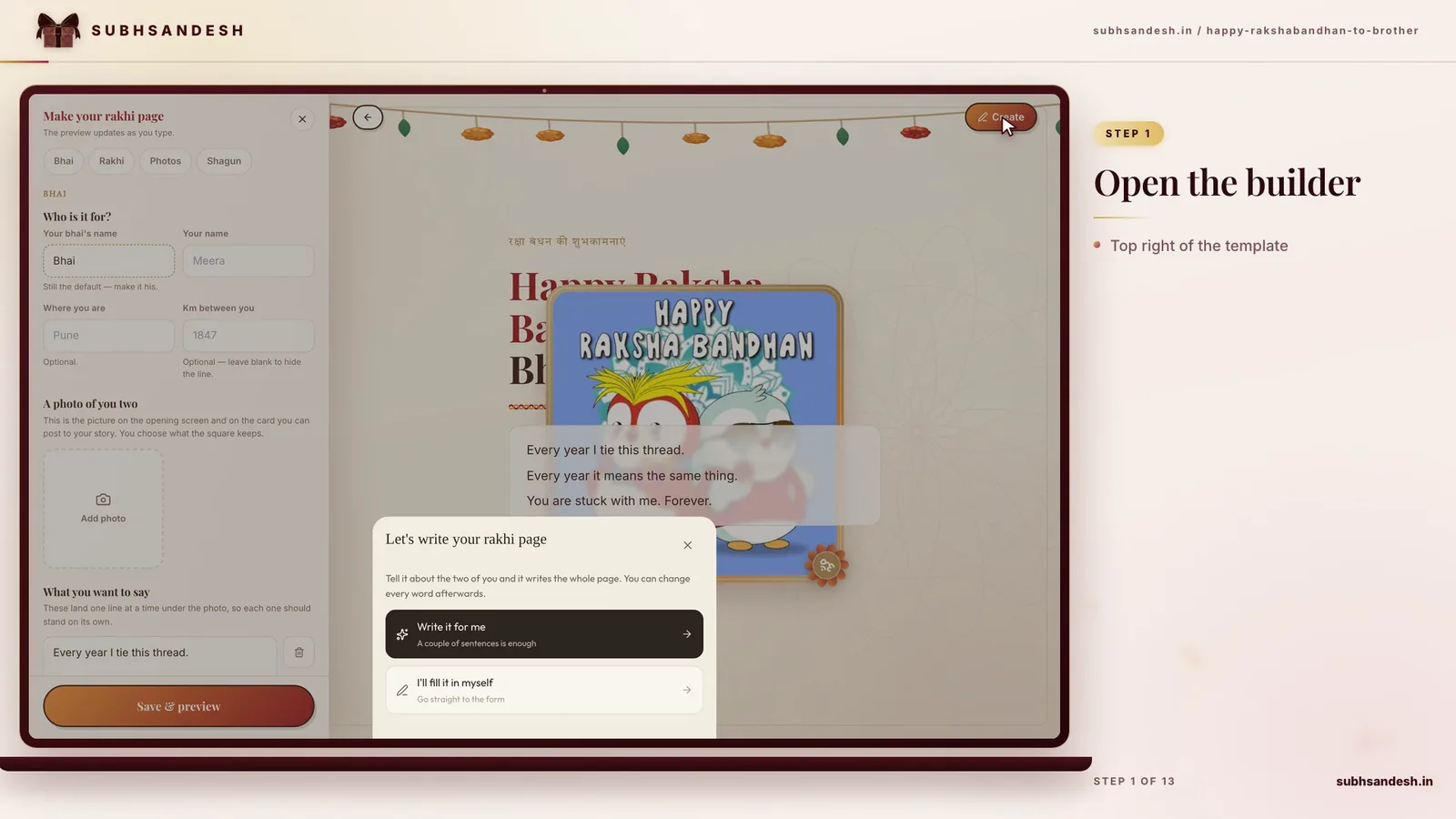
This is also why editing matters more than choosing. On our own pages, the median gap between a page's first save and its last edit is 6.9 hours (sampled on the "I love you" page, n=914) — people write, leave, and come back to fix wording. If you build the wish on a Raksha Bandhan page for a brother, the name stays live text you can correct after the fact; typed into WhatsApp, it is gone the second you press send.
The name in Devanagari, and the mistake worse than no name
Devanagari has no capital letters, so the cue English uses to mark a name is gone. Rupert Snell's guide to transliterating Devanagari opens Premchand's Godān on exactly this: गोबर appears first as a character's name (short for गोवर्धन), then as the ordinary noun for cow-dung. Many Hindi names double as common nouns — आशा (āśā, "hope"), शांति (śānti, "peace"), प्रकाश (prakāś, "light").
Snell also warns that rough-and-ready romanisation "leaves too many ambiguities", and that for a living person you use the spelling that person uses: बच्चन is baccan by scholarly convention and Bachchan on a passport. No rule gets you there. You check.
That check is not optional politeness. A survey in the Journal of Emerging Investigators, February 2024, found non-white students were 2.55 times more likely to experience racial or ethnic microaggressions, name mispronunciation included, and that the commonest reactions were exhaustion, embarrassment and a lost sense of belonging. Only the abstract is readable, so that is all it is cited for.
Getting a name wrong is worse than sending no name. Copy the spelling from a message the person sent you, in the script they used.
Two brothers, one message: naming in a group
Naming one person in a group message excludes everyone else in it, and the exclusion is legible. In a family WhatsApp group, "Happy Raksha Bandhan, Rohit" tells the other three siblings they were an audience.
Two options work. Send separate messages — our pages average 12.1 views each across 33,007 recorded views, so a link gets reopened rather than read once, which makes a separate rakhi page per brother worth the extra minutes. Or name everyone in a deliberate order: eldest first is the safe convention.
If you are naming two brothers in one line, the vocative goes at the front and both names go inside it: "Rohit, Aman — happy Raksha Bandhan." Never "Rohit and family". For an unnamed group, drop the name and use the relation: भाइयों, रक्षाबंधन की शुभकामनाएँ। (bhāiyoṁ, rakṣābandhan kī śubhkāmnāeṁ — "Brothers, best wishes for Raksha Bandhan.")
When to leave the name out
An unnamed message carrying a specific memory beats a named message carrying nothing. If the name is the only personal element you can manage, it is doing work it cannot do.
Leave it out inside a one-to-one chat, where the sentence already identifies the reader and the name turns oddly formal. Leave it out when you are unsure of the spelling and cannot check. Leave it out of a group wish you cannot make specific.
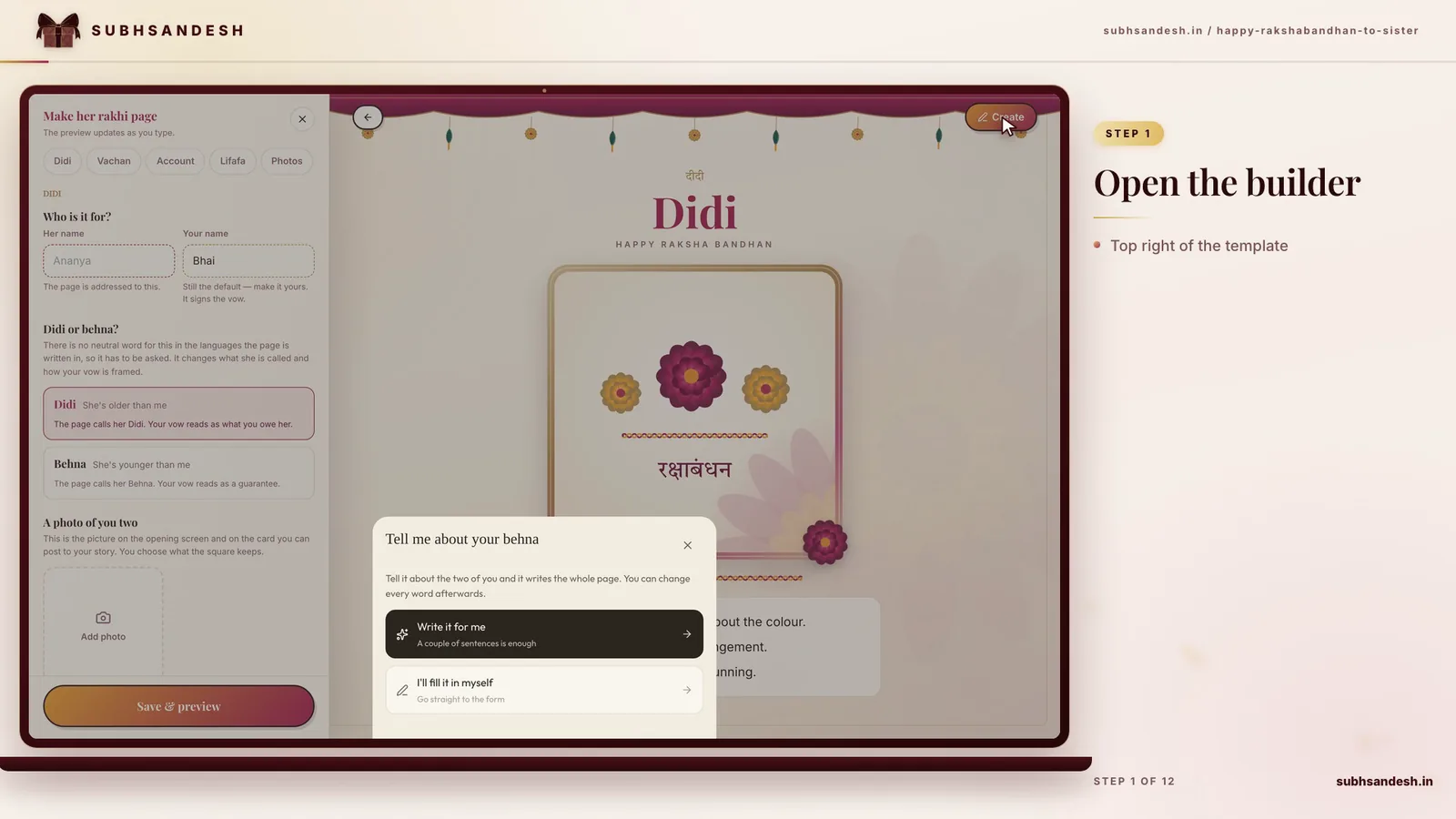
Where we lose: if the whole message is one line, a WhatsApp text beats any page we build, because a link adds a tap for no gain. 51.8% of our 33,007 recorded views are phone opens — but a recipient who never opens links gets nothing at all. A page earns its tap when a photo, a longer letter or a private note sits behind it. If it does, browse the SubhSandesh templates, and note the only Raksha Bandhan template in our public list is written brother-first, so a sister-directed page needs its wording changed by hand.
Sources
- "Vocative, where do you hang out in wh-interrogatives?" — The Linguistic Review 40(1), 77–106, 20 December 2022, CC BY 4.0.
- "Kinship terms as indicators of identity and social reality" — Russian Journal of Linguistics 25(1), 125–146, 2021.
- "Lambada Kinship Terms as Terms of Reference and Address" — IJHSSI 3(4), 7–9, April 2014.
- "Transliterating Devanagari" — Rupert Snell, Hindi Urdu Flagship, University of Texas at Austin; no publication date stated.
- "The frequency and psychological effects of name mispronunciation" — Journal of Emerging Investigators, 19 February 2024; abstract only.
Frequently Asked Questions
Turn this inspiration into an unforgettable surprise
Build a page with photos, a heartfelt message, music and a ready-to-share link.
- Photos, message & music
- Ready-to-share link

Written by
Suyash Agrahari
Founder
Suyash Agrahari is a Software Engineer at HireQuotient and the founder of SubhSandesh and DrawFlow (drawflow.in). He builds AI agents and full-stack products with Next.js, Node.js, and the OpenAI and LangChain ecosystems, having shipped autonomous multi-agent systems, AI copilots, and large-scale outreach platforms — and scaled side projects from a few hundred to millions of users. He writes about AI engineering, web development, and building products that grow through SEO and organic reach.
Stay Connected
Follow SubhSandesh
New templates, festival ideas and step-by-step walkthrough videos — first on our socials.
Product guide
See it built, step by step
Keep reading
Thala Deepavali: A Couple's First Deepavali at the Bride's Home
Thala Deepavali is a Tamil couple's first Deepavali after marriage, at the bride's home. In 2027 it is Thursday 28 October, oil bath 4:40–6:01 AM in C…
 Suyash Agrahari· 9 min
Sugar-Free Diwali Sweets: Swaps, Label Warnings and the Evidence
Five original no-added-sugar Diwali sweets, why jaggery and honey do not count, the warnings FSSAI requires on a sugar-free box, and what an Indian su…
Suyash Agrahari· 9 minShort Diwali Quotes: 34 Original One-Liners Under 10 Words
34 original short Diwali quotes, each under ten words and marked with its word and character count, grouped by mood: lamps, family, friends, gratitude…
Suyash Agrahari· 9 min