
How Much I Love You Messages for a Girlfriend That Aren't Copied
Specific beats superlative: 35 how much I love you messages for a girlfriend, grouped by the five mechanisms that make them land, each with a fill-in slot, plus the lines that backfire and where a message survives past tomorrow.
Make this into a page you can send
Photos, a message, music and a ready-to-share link — in a couple of minutes.
or browse all occasionsKey takeaways
- • A message naming one real detail beats a superlative: "more than all the stars in the sky" is weaker than naming the thing she did on a Tuesday.
- • The "I love you" page is SubhSandesh's most-created template — 975 pages, 29.2% of all 3,335 built since 12 March 2026.
- • Creators spend a median 6.9 hours between first save and last edit on those pages (n=975), which is what writing something specific actually costs.
- • Pages average 12.3 views each, and "I love you" pages have taken 14,396 views (35.2% of the site total), so the message gets reopened rather than scrolled past.
- • Keep a chat message under about 60 words: 50.3% of views on shared pages happen on a phone (20,561 of 40,864).
On this page
How Much I Love You Messages for a Girlfriend That Aren't Copied
The best "how much I love you" messages for a girlfriend name one specific thing about her instead of reaching for scale. "More than all the stars in the sky" is weaker than naming the thing she did on a Tuesday, because the first line could be sent to anyone — and usually was.
Our own numbers say the specific version is real work. The "I love you" page is the most-created thing on SubhSandesh (975 pages, 29.2% of everything built since 12 March 2026), the median creator spends 6.9 hours between first save and last edit, and those pages average 12.3 views each.
Below: 35 messages grouped by the five mechanisms that make them land, the lines that backfire, and where a message goes to survive past tomorrow.
What makes a "how much I love you" message land (Floyd's three channels, r = 0.23)
Affectionate communication is the intentional expression of closeness, care and fondness — Kory Floyd and Mark Morman's 1998 definition. Their tripartite model splits it into three channels: verbal ("I love you"), nonverbal (a hug), and indirect affection, meaning you do something that helps her.
A text can only use the first, and the other two are strong: in two studies of 7,880 people, the first a 37-country survey, love was reliably associated with affectionate touch. Typed words carry what a hug would have.
Floyd's 2023 review in Personal Relationships puts the association between communicating affection and wellness at a weighted mean r = 0.23 — consistent, and modest. His 2025 state-of-the-art review counted 135 empirical projects and 54,784 participants testing affection exchange theory between 2001 and 2024.
30 how much I love you messages for a girlfriend, grouped by five mechanisms
Take the line closest to your relationship and fill the blank with a detail only you two have. Left generic, it is a line she has read before.
1. A specific memory
A memory is verifiable. She checks it against her own recollection, and that check is what makes a line feel addressed rather than forwarded.
- "I still measure good days against the ___ at ___. That is how much."
- "You asked me ___ the second time we met. Still working on my answer."
- "I remember what you wore on ___, and I never remember clothes."
- "I loved you before ___ happened. Proof: I told ___ about you first."
- "The ___ you made me try is still the only thing I order."
- "Ask about ___ and I can give you that whole hour, minute by minute."
2. A habit of hers only you would notice
A habit takes months to spot, so naming one proves sustained interest that vocabulary cannot fake.
- "You ___ before answering anything difficult. I love that more than I like most people."
- "How much I love you is measurable by how much I miss you ___."
- "You always ___ when you are nervous. I notice every single time."
- "I love the way you ___ when you think nobody is watching. Somebody is."
- "Nobody else knows you ___. I would like to keep knowing."
- "You say ___ instead of ___. I have started saying it too."
3. A number that means something
A number is checkable, and checkable is the opposite of a superlative.
- "___ days. ___ real arguments. Zero days I wanted out. Honest arithmetic."
- "___ hours on trains to see you for ___ hours. Worth it."
- "___ messages since ___. I have re-read about ___ of them."
- "It took me ___ weeks to say it. It took ___ minutes to know it."
- "___ months in, and ___ separate plans that all have you in them."
- "Out of everyone at that ___, I found you. I like those odds."
4. A future you describe in detail
A detailed future signals intent without demanding an answer. Vague forever is a claim; a specific Tuesday is a plan.
- "I want to be arguing about ___ in a kitchen we have not bought."
- "In ten years I want to still know you take your ___ like ___."
- "Not forever yet. Just ___ in ___, then we talk about the next bit."
- "One day you will ___ and I will ___. Most ordinary day of my life."
- "I have thought about ___ with you in enough detail that it feels remembered."
- "___ is in my plans without me asking whether it should be."
5. One honest admission
An admission costs you something, and cost cannot be copied off a list.
- "I was ___ before you. You did not fix it. I stopped hiding it."
- "I am scared of ___, and you are who I would rather be scared with."
- "I love you enough to admit I was wrong about ___, which you knew."
- "You saw me at my worst on ___. That you stayed is why I stopped hedging."
- "I do not say this well. I have rewritten it ___ times. That is how much."
- "Some days I love you more than I like myself. Working on the second part."
I love you messages for her to make her cry: why tears follow recognition, not adjectives
An "I love you message for her to make her cry" works when she is recognised, not complimented. Tears answer being seen accurately, so it must carry information only you hold.
Fit beats intensity. In a PLOS ONE study of 100 couples from June 2022, people who expressed affection the way their partner preferred to receive it reported higher relationship and sexual satisfaction. Your favourite way is not hers.
Longer is allowed here, but only if the length carries detail:
- "I have been in love before. I had never stopped performing until ___."
- "You handled ___ alone before me and never used it to be cold."
- "If this ended tomorrow, these ___ months still get read at my funeral."
- "I love you the way you love ___: without needing it noticed."
- "There is a version of me from before ___. I am not going back to him."
Say it out loud before sending. Anything you cannot say out loud is copied.
The five mechanisms side by side, and the failure mode for each
| Mechanism | Why it lands | In the blank | When it backfires |
|---|---|---|---|
| Specific memory | She can verify it | Date, place, object | She remembers it differently |
| Habit only you notice | Proves months of attention | Gesture, phrase, tell | Reads as surveillance |
| Number that means something | Makes a feeling checkable | Count, hours, money | Small number meant to sound large |
| Future in detail | Intent without a demand | Room, city, Tuesday | Arrives as a deadline |
| One honest admission | Costs you something | The fear, the failure | Reassuring you becomes her job |
Four of those five failures are one failure: the message was about you.
Messages that backfire: the ex, the pressure, anything past 60 words
Delete anything mentioning an ex, hers or yours. It converts a love message into a comparison, and comparisons invite an audit nobody wanted.
Delete anything reading as pressure — "I don't know what I'd do without you", "promise you'll never leave". That hands her the job of managing your feelings on a weekday.
Delete anything long enough to need scrolling — roughly 60 words on a phone. Half our traffic is exactly that: 50.3% of views on shared pages are on a phone (20,561 of 40,864).
Context decides whether affection reads as affection. In an April 2019 Frontiers in Psychology experiment, texts carrying an affectionate emoji were rated far less appropriate (M = 3.57) than identical texts with a friendly one (M = 5.50) — in a workplace scenario, not a romantic one. The wrapper does as much work as the words.
Where the message lives after tomorrow: 12.3 views versus one scroll
A message in a WhatsApp thread has a shelf life of about a day. It gets buried under the next forty, and nobody scrolls back.
So put it somewhere with an address. Pages built here average 12.3 views each, and "I love you" pages alone have taken 14,396 views — 35.2% of every view on the site, which only happens when people reopen them.
| Where it goes | Read again later? | Our data | Effort |
|---|---|---|---|
| WhatsApp text | Rarely — buried in a day | Not measurable here | 2 minutes |
| Voice note | Sometimes, if she saves it | 50.3% of views are on a phone, where audio plays | 5 minutes |
| A page with its own link | Yes | 14,396 views on "I love you" pages, 12.3 per page | Median 6.9h editing, n=975 |
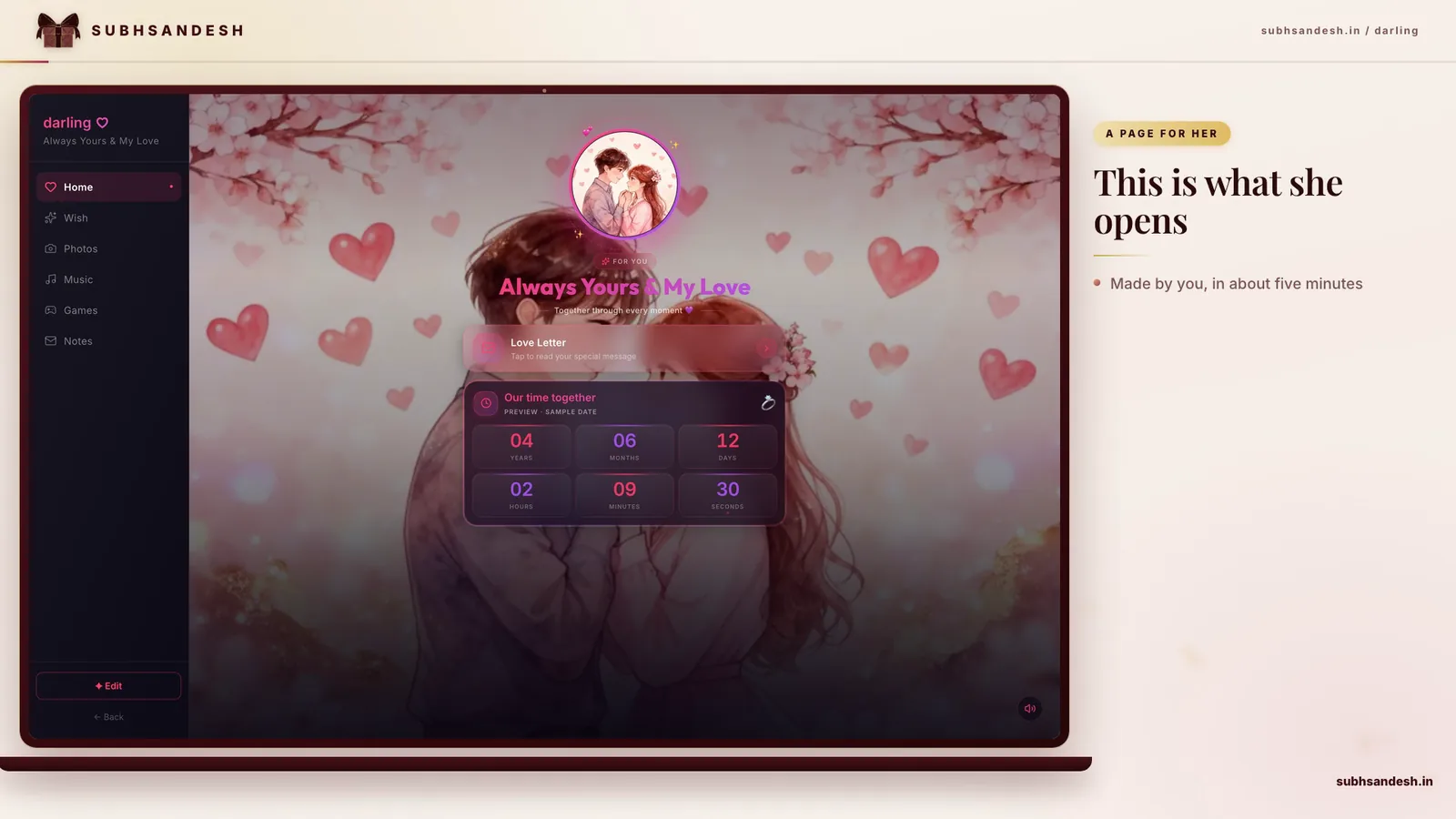
For the letter-plus-photos-plus-her-song version, the romantic "I love you" page for a girlfriend is built for it: a letter, photo gallery, background music, a Love Quiz, Truth-or-Dare, optional password. 42.9% of creators set that password before sharing (1,432 of 3,335).
When a message is the wrong move, and when the moodier page fits better
A message is wrong when the thing needing saying should be said with your face. Same city, and you send forty words instead of showing up? The words are the problem.
It is also wrong as damage control. Sent the morning after a fight, it reads as the argument continued by other means. Apologise first, separately.
Register matters. If your relationship runs intense rather than cute, the sweet version falls flat; the dark, dramatic romantic page for a partner is the moodier option, and the fourth most-created type here (343 pages, 10.3%).
One caveat: none of this survives a relationship that is not working. A good message does not fix a pattern, and 12.3 average views measures interest, not health. To compare formats, browse all SubhSandesh templates.
Sources
- Affectionate communication, health, and relationships — Floyd et al., Personal Relationships 30 (2023).
- Two Decades of Affection Exchange Theory — Floyd, Review of Communication Research 13 (11 August 2025).
- I love the way you love me — Mostova et al., PLOS ONE 17(6) (22 June 2022).
- Sender Gender Influences Emoji Interpretation — Butterworth et al., Frontiers in Psychology 10 (5 April 2019).
- Love and affectionate touch toward romantic partners all over the world — Sorokowska et al., Scientific Reports 13 (4 April 2023), HAL open deposit.
Frequently Asked Questions
Turn this inspiration into an unforgettable surprise
Build a page with photos, a heartfelt message, music and a ready-to-share link.
- Photos, message & music
- Ready-to-share link

Written by
Suyash Agrahari
Founder
Suyash Agrahari is a Software Engineer at HireQuotient and the founder of SubhSandesh and DrawFlow (drawflow.in). He builds AI agents and full-stack products with Next.js, Node.js, and the OpenAI and LangChain ecosystems, having shipped autonomous multi-agent systems, AI copilots, and large-scale outreach platforms — and scaled side projects from a few hundred to millions of users. He writes about AI engineering, web development, and building products that grow through SEO and organic reach.
Stay Connected
Follow SubhSandesh
New templates, festival ideas and step-by-step walkthrough videos — first on our socials.
Product guide
See it built, step by step

Keep reading
Which Day Comes After Propose Day, and What Happens Now
Chocolate Day comes after Propose Day — Tuesday 9 February 2027. That is one sentence, so this page covers the four situations you are actually in on …
 Suyash Agrahari· 9 min
When to Propose a Girl to Be Your Girlfriend, and When Not To
The timing question, answered with conditions instead of a date: what has to be true before you ask, what politeness and fast replies do not prove, wh…
Suyash Agrahari· 9 minRomantic Proposal Room Decoration: What the Room Must Do
Romantic proposal room decoration, sorted by the work each setup takes and what the room allows: 7 setups with set-up and reversal times, lighting evi…
Suyash Agrahari· 9 min