
How Raksha Bandhan Is Celebrated, Step by Step and by Region
The six-step order of the day — thali, aarti, tilak, thread on the right wrist, mithai both ways, gift — then the five regional versions most guides collapse into one: Narali Poornima, Gamha Purnima, Jhulan Purnima, Janai Purnima, and the Upakarma day before.
Make this into a page you can send
Photos, a message, music and a ready-to-share link — in a couple of minutes.
or browse all occasionsKey takeaways
- • The North Indian sequence is six steps: thali, aarti, tilak, rakhi on the right wrist, mithai fed both ways, then the gift.
- • At least five distinct observances share the Shravana full moon — Rakhi, Narali Poornima (Maharashtra), Gamha Purnima (Odisha), Jhulan Purnima (Bengal) and Janai Purnima (Nepal).
- • In three of those five, the thread is not primarily going from a sister to a brother: it goes to cattle, to a chest-worn janai, or into the sea as a coconut.
- • Raksha Bandhan 2027 falls on Tuesday, 17 August 2027; the muhurat is location-specific, so a national headline time is wrong for most readers.
- • 44.2% of SubhSandesh creators password-protect a page before sharing it (1,315 of 2,973) and 51.1% of views land on a phone — privacy and mobile are now part of how the day is observed remotely.
On this page
How Raksha Bandhan Is Celebrated, Step by Step and by Region
Raksha Bandhan is celebrated in six moves: the sister prepares a thali, performs aarti, applies tilak, ties the rakhi on her brother's right wrist, feeds him a sweet, and he feeds her back and hands over a gift. That is the North Indian sequence, and it is not the whole festival. On the same full moon, Koli families in coastal Maharashtra throw coconuts into the sea for Varuna, Odia farmers tie rakhis onto their cattle, and Nepali men change the janai across their chest.
One modern layer belongs in that list too. On SubhSandesh, 44.2% of creators password-protect their page before sharing it — 1,315 of 2,973 pages, and 51.1% of shared pages are opened on a phone (18,497 of 36,202 views). When part of the rite travels as a link, privacy stops being an afterthought and becomes a step.
What the ritual actually is, stripped of the story
Raksha Bandhan falls on the full moon of Shravana. The core act is a protective thread — the word raksha means protection, bandhan means binding — tied around a right wrist and paid for with a return obligation.
The Hindu American Foundation's festival explainer describes the same order: aarti with a small oil lamp offered to the family deity, prayers for the brother's wellbeing, tilak on his forehead, the rakhi tied on his wrist, then a sweet placed in his mouth, which the brother reciprocates along with a gift.
Note what is not fixed there: the sweet, the gift, the thali's contents, the hour, and whether the person tying is a sister at all.
What goes on the thali, and what each item is for
A rakhi thali is not decoration. Every item has a job in the sequence, which is why the same five or six things recur across households that agree on nothing else.
- Roli or kumkum — for the tilak mark on the forehead.
- Akshat (uncooked rice, usually unbroken) — pressed onto the wet tilak so the mark holds.
- A diya or small oil lamp — for the aarti circled in front of the brother.
- The rakhi itself — cotton, silk, zari or a factory-made band.
- Mithai — one piece, fed by hand; the reciprocal feeding is the part people forget.
- Water in a small pot or spoon — poured out after the aarti in many households.
Families add to this freely: a coconut in western India, a chandan paste instead of roli in the south, sometimes a photograph where the brother is absent. There is no scriptural inventory. If a page tells you a thali "must" contain seven items, it is describing one family's habit.
The order of the day, step by step
The sequence below is the one most North Indian households follow. Times are approximate because they are pinned to a muhurat, not a clock.
1. The fast, and the morning bath
In many households the sister does not eat until the rakhi is tied. Both siblings bathe and change before the rite. In some Brahmin families the sacred thread is renewed on Upakarma — traditionally the day before Raksha Bandhan, not the same morning, which is a scheduling detail almost every "how to celebrate" page collapses.
2. Preparing and lighting the thali
The thali is assembled and the diya lit shortly before the chosen muhurat. The brother sits facing east or north in most households; this is convention, not requirement.
3. Aarti and tilak
The sister circles the lamp in front of her brother, then applies tilak and presses akshat onto it. The prayer here is for his wellbeing — the direction of the blessing runs sister to brother, which surprises readers who expect the opposite from the "protection" framing.
4. Tying the rakhi
The thread goes on the right wrist, and the standard Hindi lexicon Hindi Shabd Sagar builds that into its definition of rakhi — a thread tied on the right hand's wrist on the Shravani full moon. The knot is usually tied three times in practice; no text prescribes a number.
5. The mithai, both ways
She feeds him first. He feeds her back. Skipping the second half turns a mutual rite into a one-way ceremony, and it is the single most commonly dropped step in condensed online descriptions.
6. The gift, and touching feet
The brother gives money or a gift. Where there is an age gap, the younger sibling touches the elder's feet. Then the family eats — the sister's fast ends here.
How the day changes by region
This is where almost every ranking page describes one household's practice as if it were the country's. It is not. The same full moon carries at least five distinct observances. The rows below consolidate the regional descriptions the English Wikipedia entry on Raksha Bandhan carries as scattered prose, and set them against each other instead.
| Region | Local name for the day | What is different in practice | Who ties, and to whom |
|---|---|---|---|
| North India (UP, Delhi, Haryana, Rajasthan) | Raksha Bandhan / Rakhi | Kite-flying is common near Raksha Bandhan and Janmashtami; the strong string sold for it is known locally as gattu door | Sister → brother's right wrist |
| Coastal Maharashtra (Koli community) | Narali Poornima ("coconut day") with Rakhi Pournima | Fishermen offer prayers to Varuna, god of the sea, and throw coconuts into the water | Sister → brother, alongside the sea rite |
| Odisha | Rakhi Purnima / Gamha Purnima | Marks Balabhadra's birthday; farmers tie rakhis onto their cattle | Sister → brother, and farmer → animal |
| West Bengal | Jhulan Purnima | Puja of Krishna and Radha; political parties, offices and institutions tie rakhis publicly | Sister → brother, plus civic tying |
| Nepal | Janai Purnima / Rishitarpani (Gunhu Punhi among Newars) | Hindu men change the janai worn across the chest; observed by Hindus and Buddhists | Priest → wearer; in some areas sisters also tie |
The takeaway: the coconut, the cattle and the janai are not decorative regional colour. In three of those five columns the thread is not primarily going from a sister to a brother at all.
Mary M. Anderson's 1971 chapter on Janai Purni in The Festivals of Nepal, reissued by Routledge in 2024, makes the timing point too — the day's festivities "begin the preceding evening, continuing all through the day". A one-morning schedule is a regional assumption, not a rule.
And regional practice is not frozen. Daniela Berti's 2011 study of ritual competition at the Dussehra festival in northern India argues that a festival's passage "from religious festival to cultural programme is the result of a historically complex process" — which is a useful corrective to any page that presents its own regional version as the ancient one.
The timing: muhurat, Bhadra, and why people argue about it
Raksha Bandhan 2027 falls on Tuesday, 17 August 2027. The tying is conventionally avoided during Bhadra, an inauspicious window that can occupy the morning of the tithi, which is why the "right time" shifts year to year and city to city.
Two honest caveats. Bhadra observance is itself regional — plenty of families in Maharashtra, Bengal and the south do not schedule around it. And a muhurat is calculated for a location, so a window published for Delhi is wrong for Chennai or for Toronto. Check a panchang for your own city rather than a national headline time.
Ritual bathing is the other timing anchor. Sanchita Paul's 2022 study of ritualistic bathing fairs in the International Journal of Religious Tourism and Pilgrimage notes that mass congregations gather for a holy dip "during a particular astrological conjunction" — the same logic that puts the Shravana full moon bath before the day's rites.
What changes when the day is celebrated over a link
This is now the common case, not the exception, and it is where our own numbers actually say something. Across 2,973 pages by 2,466 creators, 99.4% of started pages are published and shared (2,956 of 2,973) — people who begin a personal page almost always finish it.
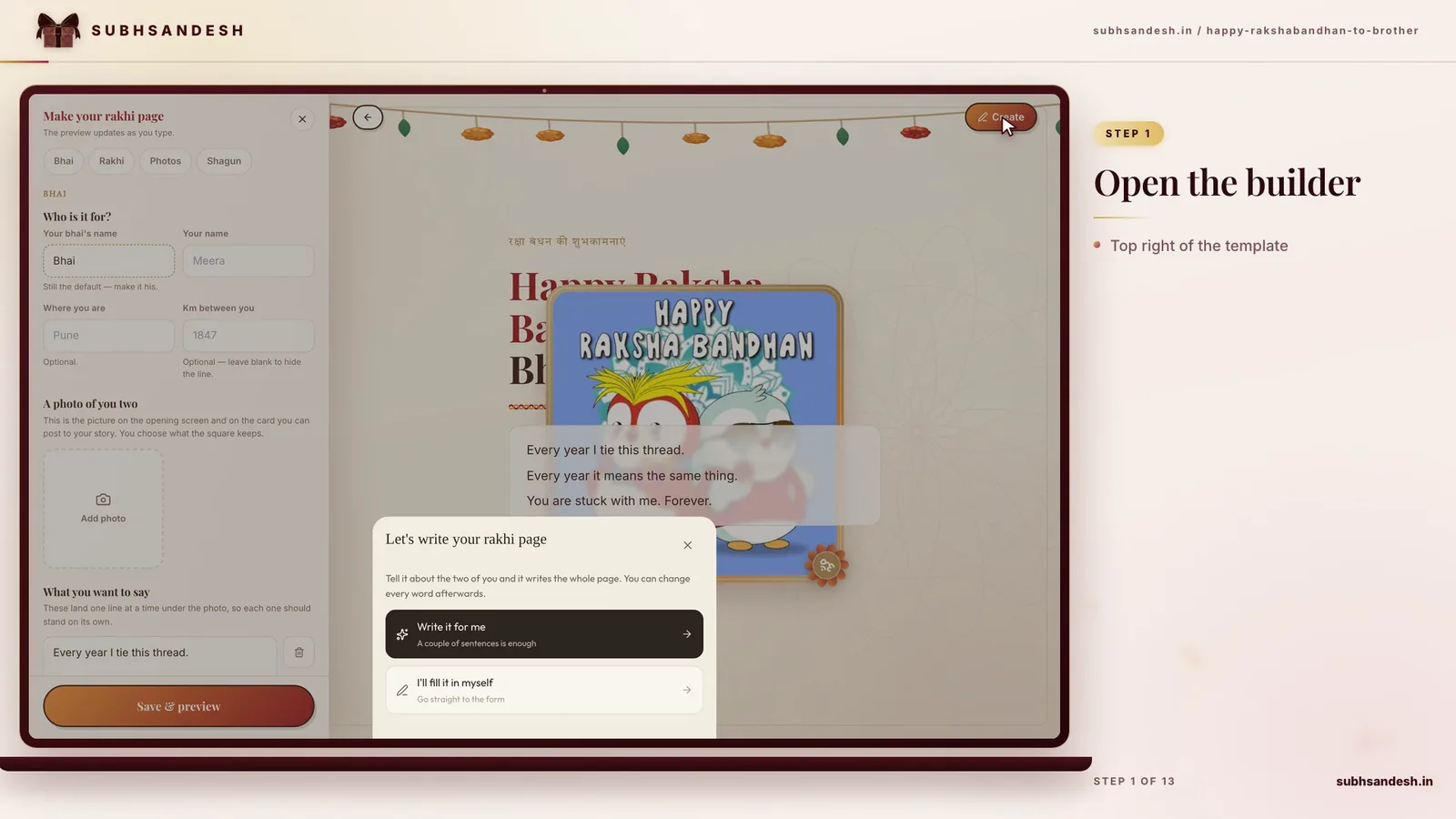
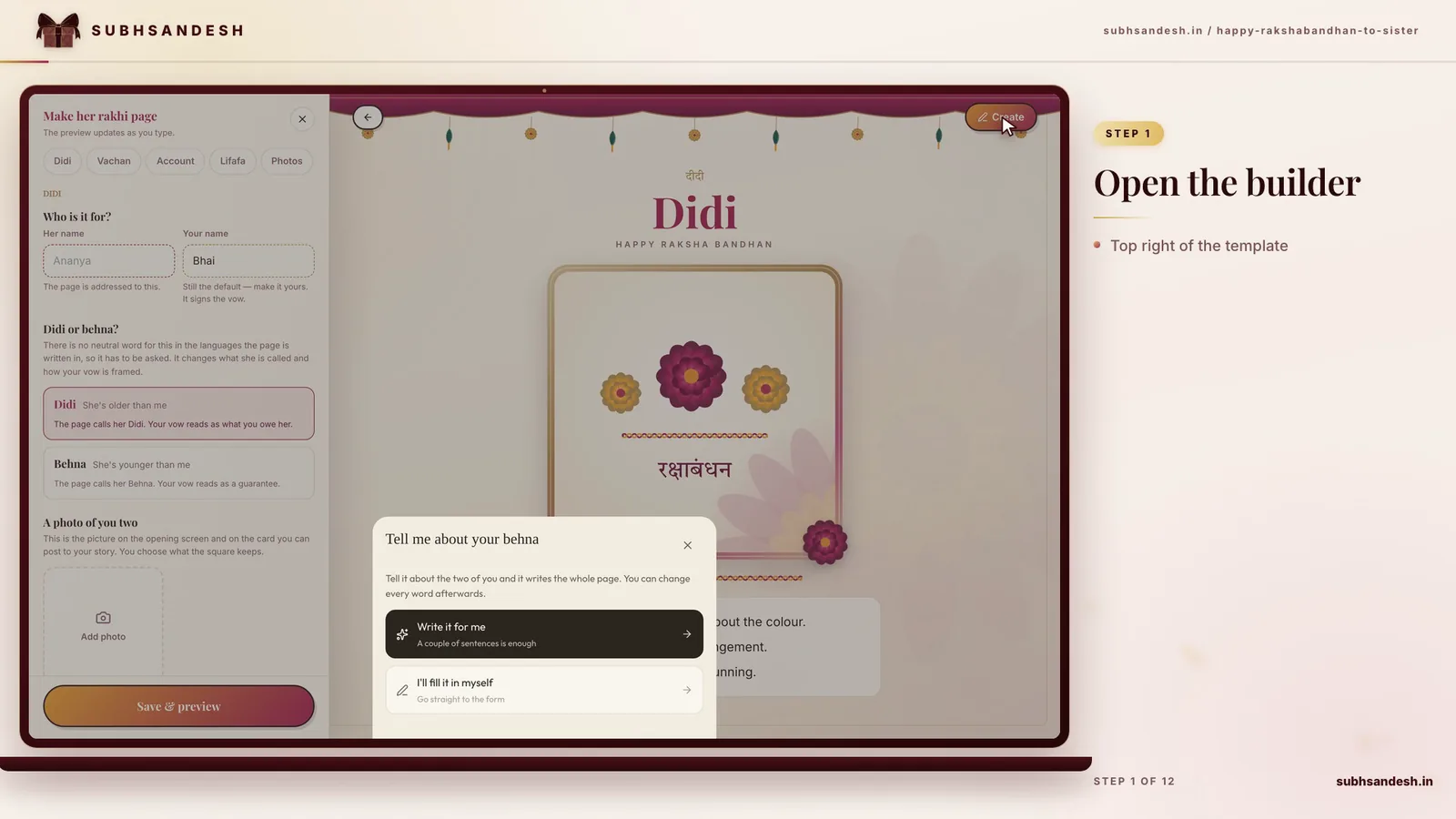
The privacy behaviour is the interesting part. 44.2% lock the page before sending it. A rakhi message is often the most personal thing a person writes all year, and roughly half the people writing one decide it should not be readable by whoever the link reaches next. If you build a Raksha Bandhan page for a brother or a Raksha Bandhan page for a sister, treat the password as part of the rite, not a settings toggle.
With 51.1% of views landing on a phone, the practical order for a remote celebration is: send the link the evening before, call during the muhurat window in the recipient's timezone, and post the physical rakhi early enough to arrive first.
Where a digital rakhi is the wrong answer
A page cannot be tied to a wrist. If your brother is reachable — same city, same country, willing to travel — the physical thread wins on every axis that matters, and a link is a poor substitute for a thali.
The honest limits of our own data belong here too. SubhSandesh's rakhi templates are new and lightly used: 39 views out of 36,202 across the platform. Every percentage on this page is platform-wide behaviour across all page types, not rakhi-specific behaviour, and it should be read as "how people write personal pages", not "how people celebrate Raksha Bandhan". You can browse the full template range if you want to see what that catalogue actually covers.
Sources
- Syama Allard, "5 things to know about Raksha Bandhan", Hindu American Foundation, 31 July 2020 — ritual sequence: aarti, tilak, tying, reciprocal feeding, gift.
- Mary M. Anderson, "Janai Purni or Raksha Bandhan — The Sacred Thread Festival", ch. 12 of The Festivals of Nepal, George Allen & Unwin, 1971; Routledge ebook reissue 2024 — festivities begin the preceding evening. Publisher chapter description only.
- Daniela Berti, "Political Patronage and Ritual Competitions at Dussehra Festival in Northern India", in Ritual, Heritage and Identity, 2011, pp. 126–148; Routledge India ebook 2020 — festival practice as a historically produced process. Chapter abstract only.
- Sanchita Paul, "Holy Baths as Attractions in Religious Tourism: A Study of Ritualistic Bathing Fairs in India", International Journal of Religious Tourism and Pilgrimage 10(2), 2022 — open access; abstract read, full PDF not retrievable.
Frequently Asked Questions
Turn this inspiration into an unforgettable surprise
Build a page with photos, a heartfelt message, music and a ready-to-share link.
- Photos, message & music
- Ready-to-share link

Written by
Suyash Agrahari
Founder
Suyash Agrahari is a Software Engineer at HireQuotient and the founder of SubhSandesh and DrawFlow (drawflow.in). He builds AI agents and full-stack products with Next.js, Node.js, and the OpenAI and LangChain ecosystems, having shipped autonomous multi-agent systems, AI copilots, and large-scale outreach platforms — and scaled side projects from a few hundred to millions of users. He writes about AI engineering, web development, and building products that grow through SEO and organic reach.
Stay Connected
Follow SubhSandesh
New templates, festival ideas and step-by-step walkthrough videos — first on our socials.
Product guide
See it built, step by step
Keep reading
Thala Deepavali: A Couple's First Deepavali at the Bride's Home
Thala Deepavali is a Tamil couple's first Deepavali after marriage, at the bride's home. In 2027 it is Thursday 28 October, oil bath 4:40–6:01 AM in C…
 Suyash Agrahari· 9 min
Sugar-Free Diwali Sweets: Swaps, Label Warnings and the Evidence
Five original no-added-sugar Diwali sweets, why jaggery and honey do not count, the warnings FSSAI requires on a sugar-free box, and what an Indian su…
Suyash Agrahari· 9 minShort Diwali Quotes: 34 Original One-Liners Under 10 Words
34 original short Diwali quotes, each under ten words and marked with its word and character count, grouped by mood: lamps, family, friends, gratitude…
Suyash Agrahari· 9 min