
How Raksha Bandhan Started: What the Records Actually Show
The oldest dated records of Raksha Bandhan describe a priest's protective charm tied on a paying patron, not a sister's thread. Tod (1829), Molesworth (1857), Platts (1884) and Marriott (1950-52), read against SubhSandesh's 36,202 recorded page views.
Make this into a page you can send
Photos, a message, music and a ready-to-share link — in a couple of minutes.
or browse all occasionsKey takeaways
- • In the oldest dated records the rakhi is a priest's protective charm tied on a paying patron, not a sister's thread — Tod (1829), Molesworth (1857) and Platts (1884) all describe it that way.
- • Neither nineteenth-century dictionary carries "raksha bandhan" as a headword; Platts files the day at page 670 under Saluno and treats the modern name as a cross-reference.
- • McKim Marriott's 1950-52 fieldwork in Kishan Garhi caught the sister-to-brother form still spreading, partly because a factory string was "more convenient for mailing" to a brother in the city.
- • The Rani Karnavati story's earliest wide circulation is Tod in 1829; "Karnavati", "Chittor", "rakhi" and "bracelet" each occur 0 times in the 745,672-byte text of Gulbadan Begum's contemporary Humayun-nama.
- • The delivery medium keeps changing and the rite follows it: SubhSandesh has recorded 36,202 views of shared pages, 12.2 per page created, 51.1% of them on a phone.
On this page
How Raksha Bandhan Started: What the Records Actually Show
How Raksha Bandhan started is answerable from dated records, and those records do not begin with a sister tying a thread to a brother. In the oldest datable descriptions the rakhi is a protective charm — tied by Brahman priests onto paying patrons, or sent by Rajput women to unrelated men they adopted as brothers — and the festival's headword in nineteenth-century Marathi and Hindi-Urdu dictionaries is Salūno, not Raksha Bandhan. The sister-ties-brother form is documented still spreading in 1950–52, in a village where the new factory-made thread was easier to post to a brother working in a city. The rite travels on whatever can carry it, which is why today's version is a link: SubhSandesh has recorded 36,202 views of shared personalised pages, an average of 12.2 views for every page created. Below are four dated records and the page-one claims no source supports.
What the festival was called before it was called Raksha Bandhan
Rakṣā-bandhana is a Sanskrit compound meaning "protection binding", and for most of its documented history it named a protective amulet rather than a sibling rite. The vernacular word rākhī is traced by John T. Platts in 1884 not to rakṣā directly but to Sanskrit rakṣikā — a guard, a protector.
Neither great nineteenth-century dictionary of the region carries "raksha bandhan" as a headword: not Molesworth's Marathi one, not Platts's Hindi-Urdu one. What both carry is the day's popular name instead.
Platts files it at page 670 under salūno: "The day of full moon in the month Sāwan (July-August), the festival of rakshā-ban-dhan (see rākhī)." The phrase everyone now uses was, in 1884, a gloss on a different word — thin support for an unbroken 6,000-year tradition under that name.
Four dated records of how Raksha Bandhan started
Each can be read in full today. They run oldest first, and each gives the year, who tied the thread, who received it, and what it was for.
1. James Tod, 1829 — a bracelet for adopted brothers
Tod's Annals and Antiquities of Rajast'han, Volume I is the earliest widely circulated English description, and it contradicts itself on the date: at page 250 "the festival of the bracelet (Rakhi) is in spring", while his Mewar festival calendar at page 463 places it "on the last day of Sawun".
Who could tie it is unambiguous: "The ministers of religion and females alone are privileged to bestow these charmed wrist-bands." Rajput women sent the bracelet "either by their handmaids or the family priests" to men "they adopt as brothers", and Tod notes that "the claims thus acquired by the fair are far stronger than those of consanguinity".
The sister's part of the day is a separate transaction, and it is not the thread: "Sisters also present their brothers with clothes on this day, who make an offering of gold in return." Tod himself received rakhis from women he had never met, and returned "from three to five pieces of gold" for each.
2. Molesworth, 1857 — a charm against evil spirits
Molesworth's Marathi dictionary defines rākhī at page 687 as "A piece of silk, a bit of tinsel, or a cotton string tied around the arm on the day of full moon of Shráwan̤, as a preservative against evil spirits." No brother appears in the entry. No sister does either.
The full-moon day is rākhīpūrṇimā, "Because on this day राखी is worn". The entry is about the wearer and the danger, not a relationship.
The day after, rākhīpāḍavā, is listed as "one of the three great begging days of Bráhmans". In 1857 Marathi usage, the days around the Shravan full moon are a priest's earning season.
3. Platts, 1884 — a protection fee, and no sibling in the entry
The Hindi-Urdu entry at page 582 of Platts's dictionary gives rākhī as "A piece of thread or silk bound round the wrist on the festival of Salūno or the full moon of Sāvan, either as an amulet and preservative against misfortune, or as a symbol of mutual dependence, or as a mark of respect".
The part nobody quotes comes next. The same headword also means "fee paid for protection"; locally, "the portion of the land of a village which is assigned for the maintenance of a watchman"; and "the black mail formerly levied by the Sikhs in the parganas on the Jamnā".
In 1884 the word covered a wrist amulet, a watchman's land grant and a protection levy — one semantic field, protection paid for. There is no brother and no sister anywhere in it.
4. McKim Marriott, 1950–52 — the sister's form caught mid-spread
Marriott's field study of Kishan Garhi, Aligarh district, published in Village India in 1955, records two things on the same day. At Salūno, wives and unmarried village sisters place "young shoots of barley, the locally sacred grain, on the heads and ears of their brothers", and brothers reciprocate with small coins, "since brothers should accept nothing from their sisters as a free gift".
Separately, at what Marriott calls Charm Tying, "the Brahman domestic priests of Kishan Garhi go to each patron and tie upon his wrist a charm in the form of a polychrome thread, bearing tassel 'plums'", and are paid cash for it. Priest to patron, for money, in 1952.
Then, at page 204, the change: the priests' threads "are now factory-made in more attractive form" and hawked in the village, and "A few sisters in Kishan Garhi have taken to tying these heterogenetic charms of priestly type onto their brothers' wrists. The new string charms are also more convenient for mailing in letters to distant, city-dwelling brothers whom sisters cannot visit on the auspicious day."
How a rakhi reached a brother who was not in the room
The four records line up into a story about delivery, not devotion. Each row states how the thread reached its recipient, and what reach can be measured.
| Period | How it reached someone elsewhere | Who tied it | Source | Measured reach |
|---|---|---|---|---|
| 1829, Mewar | carried by a handmaid or family priest | priests and women, to adopted brothers | Tod, Annals, Vol. I | not recorded |
| 1857, Maharashtra | in person; priests toured patrons | priest, or the wearer | Molesworth, page 687 | not recorded |
| 1884, Hindi-Urdu belt | in person | unspecified — no sibling in the entry | Platts, page 582 | not recorded |
| 1950–52, Kishan Garhi | posted inside a letter | priests to patrons; "a few sisters" | Marriott, page 204 | not recorded |
| 2026, SubhSandesh | a link opened on a phone | the sender, on a page | SubhSandesh database, 25 Aug 2026 | 36,202 views; 12.2 per page; 51.1% on a phone |
The rite adopts whatever medium reaches an absent brother. A factory string did in 1952 what a link does now, and 18,497 of our 36,202 recorded views were on a phone.
The Rani Karnavati story, and why it keeps getting corrected
The Karnavati–Humayun episode is the origin story most often given, and its earliest wide circulation is Tod in 1829 — where he flags his own source as bardic, "According to the annals", and where the relief arrives too late and Chittor falls with "thirty-two thousand Rajpoots" slain.
The obvious check is the contemporary Mughal memoir. Gulbadan Begum, Humayun's own half-sister, wrote the Humayun-nama; in Annette Beveridge's 1902 translation, the full 745,672-byte text contains "rakhi", "Karnavati", "Karmavati", "Chitor", "Chittor" and "bracelet" zero times each. "Bahadur", the Gujarat sultan whose army took Chittor, appears 21 times, so the period is covered. The episode is not.
This is a live argument, not an antiquarian one. In August 2024 the Rajya Sabha MP Sudha Murty posted that Karnavati "sent a thread to King Humayun as a symbol of sibling-hood... This is where the tradition of the thread began", was widely criticised, and corrected herself within days: the story "is just one of many tales associated with the festival and certainly not its origin". Deccan Herald reported the exchange on 20 August 2024.
What these records do not settle
Marriott himself refused to say which way the borrowing ran, writing that "the priestly charms of the Charm Tying festival may be universalizations of sisterly barley shoots, or the barley shoots may be parochializations of the priestly charms". The direction is undecidable from the evidence he had.
Gulbadan's silence is not a disproof either. She was a child in 1535 and her memoir is selective, so the honest claim is that the one contemporary source does not corroborate the story.
Dictionaries record the senses a lexicographer met, not every practice in every district, and Tod contradicts himself on the season inside one volume. Still, the two claims currently on page one for this query — that the festival is 6,000 years old and descends from the Indus Valley Civilisation, and that it dates to 326 BCE and Alexander's campaign — are asserted on pages that name no text, no manuscript and no excavation. A dated dictionary entry is thin evidence; an undated assertion is none.
Where a shareable link is the wrong way to send a rakhi
If you are in the same room, tie the thread. A physical rakhi does something a page cannot, and Marriott's sisters used barley shoots precisely because they were standing beside their brothers.
A link is also wrong for a recipient who does not use a smartphone. Of the 36,202 views recorded, 18,497 — 51.1% — were on a phone, and the format assumes one.
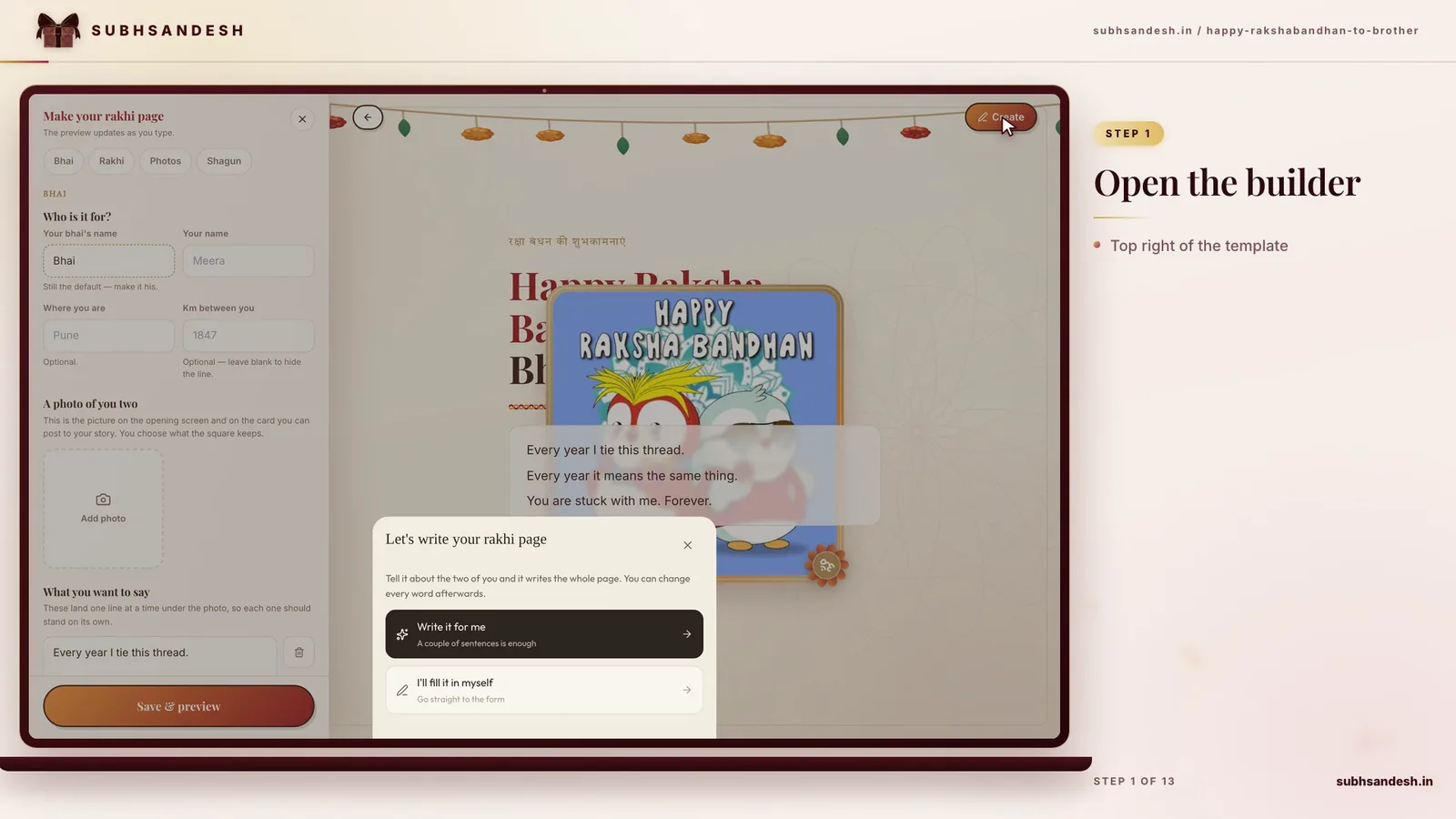
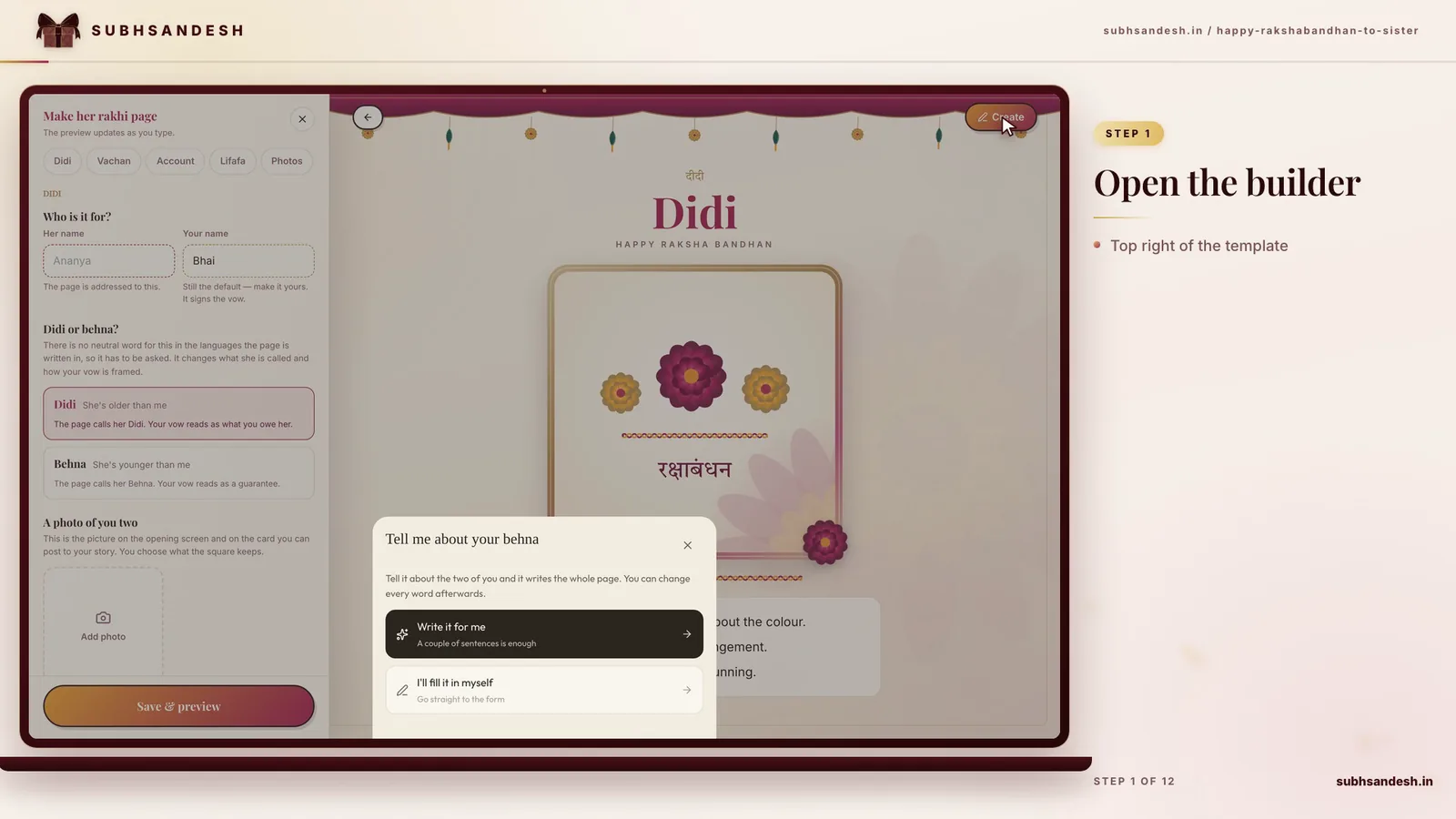
One more honest number: our two Raksha Bandhan templates have three pages made between them and 39 views out of 36,202, or 0.1%. They are new and lightly used, so every platform figure here is platform-wide behaviour, not rakhi-specific evidence. If a link genuinely is the best route to a brother in another city, the Raksha Bandhan page for a brother and the Raksha Bandhan page for a sister each take a photo and a name, and the wider SubhSandesh template library covers the occasions around it.
Sources
- James Tod, Annals and Antiquities of Rajast'han, Vol. I, 1829 — pages 250 and 463.
- J. T. Molesworth, A Dictionary, Marathi and English, 1857 — page 687, via the Digital Dictionaries of South Asia.
- John T. Platts, A Dictionary of Urdu, Classical Hindi, and English, 1884 — pages 582 and 670.
- Gulbadan Begum, Humayun-nama, trans. Annette S. Beveridge, Royal Asiatic Society, 1902.
- McKim Marriott, in Village India, 1955 — pages 197–204.
- Deccan Herald, "Sudha Murty shares history of Raksha Bandhan, gets trolled", 20 August 2024.
Frequently Asked Questions
Turn this inspiration into an unforgettable surprise
Build a page with photos, a heartfelt message, music and a ready-to-share link.
- Photos, message & music
- Ready-to-share link

Written by
Suyash Agrahari
Founder
Suyash Agrahari is a Software Engineer at HireQuotient and the founder of SubhSandesh and DrawFlow (drawflow.in). He builds AI agents and full-stack products with Next.js, Node.js, and the OpenAI and LangChain ecosystems, having shipped autonomous multi-agent systems, AI copilots, and large-scale outreach platforms — and scaled side projects from a few hundred to millions of users. He writes about AI engineering, web development, and building products that grow through SEO and organic reach.
Stay Connected
Follow SubhSandesh
New templates, festival ideas and step-by-step walkthrough videos — first on our socials.
Product guide
See it built, step by step
Keep reading
Thala Deepavali: A Couple's First Deepavali at the Bride's Home
Thala Deepavali is a Tamil couple's first Deepavali after marriage, at the bride's home. In 2027 it is Thursday 28 October, oil bath 4:40–6:01 AM in C…
 Suyash Agrahari· 9 min
Sugar-Free Diwali Sweets: Swaps, Label Warnings and the Evidence
Five original no-added-sugar Diwali sweets, why jaggery and honey do not count, the warnings FSSAI requires on a sugar-free box, and what an Indian su…
Suyash Agrahari· 9 minShort Diwali Quotes: 34 Original One-Liners Under 10 Words
34 original short Diwali quotes, each under ten words and marked with its word and character count, grouped by mood: lamps, family, friends, gratitude…
Suyash Agrahari· 9 min