
How to Make Your Girlfriend Feel Special Online, Week by Week
Six gestures that make a girlfriend feel special online, ordered by how often each one holds up — with the cadence each needs, what it costs you in time, and first-party numbers from 3,377 SubhSandesh pages.
Make this into a page you can send
Photos, a message, music and a ready-to-share link — in a couple of minutes.
or browse all occasionsKey takeaways
- • Treat it as a habit with a cadence, not one surprise: the median SubhSandesh page takes 7.2 hours from first save to last edit (n=987), spread over an evening and a morning rather than one sitting.
- • Effort only counts if she can see it — in a 2023 experiment with 208 participants, a gesture known to be AI-assisted was judged lower-effort and lowered relationship satisfaction.
- • Build it phone-first: 50.3% of the 41,486 recorded views of shared pages happen on a phone (20,853 of them).
- • If her phone gets borrowed at home, password-protect the page — 42.8% of creators already do (1,444 of 3,377).
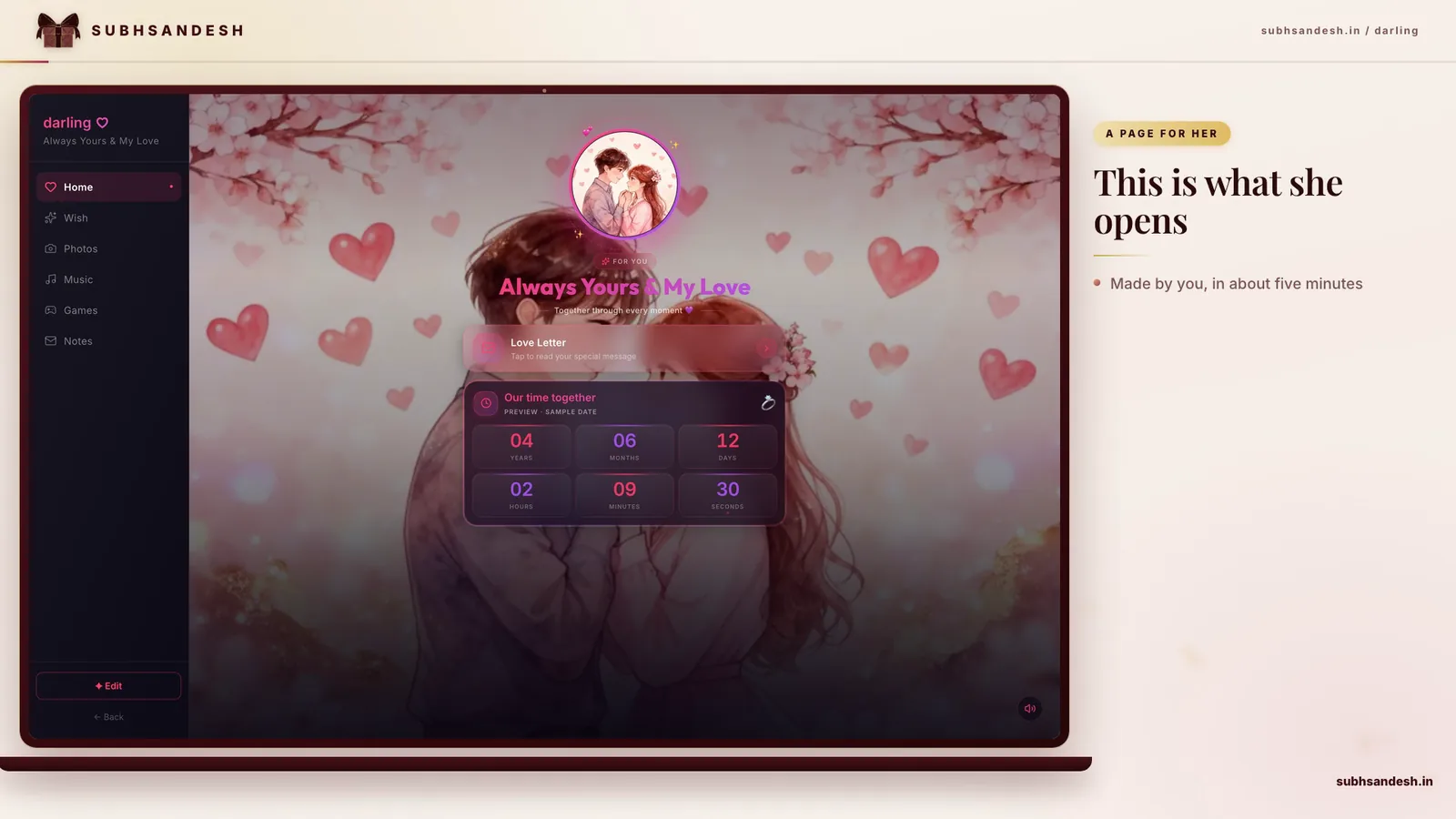
- • Rotate the format before it goes stale: /love-gf is the most-built template at 987 pages (29.2%) and /darling is fourth at 349 (10.3%), and they read as different registers.
On this page
How to Make Your Girlfriend Feel Special Online, Week by Week
To make your girlfriend feel special online, run it as a habit with a cadence — daily, weekly, monthly — instead of staking everything on one surprise. The most useful number we hold on this is a median of 7.2 hours between a page's first save and its last edit, sampled across the 987 "I love you" pages built on SubhSandesh (n=987). Nobody spends 7.2 hours in one sitting; that gap is people coming back across an evening and a morning.
Two more numbers decide what you should send: 50.3% of the 41,486 recorded views of shared pages happen on a phone (20,853 of them), so it has to open in one tap, and 42.8% of creators password-protect the page before sharing it (1,444 of 3,377).
Below: what belongs in the daily slot, what belongs in the monthly one, and when a link is the wrong answer.
What "making her feel special online" actually means
It means she can tell, from the thing itself, that you spent attention on her that you could have spent elsewhere. Online, the only evidence of attention available to her is specificity, timing and format — she cannot see you queuing at a florist, so the gesture has to carry its own proof.
That is why the two halves of this split cleanly. An event is one page, one video call, one big reveal, and it works once. A habit is a small, specific, recurring signal that she stops having to wonder about.
Most advice here answers for couples in the same room — hugs, breakfast in bed, a booked dinner. None of that is available to you, and the substitutions are not one-to-one. Across the 3,377 pages built on SubhSandesh since 12 March 2026, spread over 15 page types, what varies is not the format people choose but how much of themselves they put into it.
Why effort has to be visible, not just spent
The trap online is spending real effort in a way she cannot detect. In a 2023 online experiment with 208 participants, Bingjie Liu, Jin Kang and Lewen Wei found that when people were told a close friend had used AI to help with a relational task — support, advice, a birthday celebration — they judged that friend to have put in less effort, and reported lower relationship satisfaction and more uncertainty about the friendship. Getting help from another human scored no better.
Read that as a warning about legibility, not about tools. The same page can read as devotion or as a template depending on whether it contains anything only you could have written. That 7.2-hour median edit window is the useful shape here: the version she opens is usually the fourth or fifth draft, and the specifics that survived those drafts are what she notices.
Six things that work when you cannot be in the same room
Six gestures, in the order I would add them. Each entry states what it is, why it lands online, what it costs you, and the number behind it.
1. Send one specific thing you noticed, every day
One line about something real — the way she handled her manager, the song she had on repeat. Specificity is the whole payload, because a generic compliment is indistinguishable from a forwarded one.
It costs two to five minutes and no planning. At a fixed time it becomes the thing she checks for, in the same lock-screen slot where 50.3% of views on shared pages happen.
2. Hang out on video instead of scheduling a call
Leave the call open while you both do ordinary things — she studies, you cook. In interviews with 14 people in long-distance relationships, Carman Neustaedter and Saul Greenberg reported that "hanging out" over video gave couples shared presence and, with it, intimacy and less idealisation of each other. It costs overlapping free time — the same paper notes same-time-zone couples often had three or four hours in an evening, while a couple split across two coasts had about one.
3. Build one page she can reopen, and let the drafts show
A page with your letter, your photos and a quiz about your own relationship survives the moment it was sent, which a message does not. The romantic "I love you" page for a girlfriend is the most-built template on SubhSandesh — 987 pages, 29.2% of all 3,377 created since 12 March 2026 — and pages average 12.3 views each. Cost: an evening, spread out.
4. Say thank you for something ordinary she does
Name a specific unglamorous thing — she remembers your deadlines, she calls your mother. Gratitude aimed at routine behaviour is the version she cannot pre-empt, and it is the half of "special" that no page can manufacture for you.
One or two lines, once or twice a week. Sent as a voice note it survives being scrolled past, which a text at 2am does not.
5. Change the format before the gesture goes stale
Repetition is the failure mode nobody warns about. Rotate: voice note, then a page, then a call with nothing scheduled in it.
When the "I love you" format has run its course, the dark, dramatic Darling page is a genuinely different register — it is the fourth most-built template at 349 pages, 10.3% of everything created. Cost: the same build effort, in a new shape.
6. Lock the page if her phone is not private
If her phone gets borrowed by siblings or parents — routine in most Indian households — a surprise that opens in front of everyone stops being a surprise. Set a password she will guess in one try and send the hint separately. 42.8% of creators already do this (1,444 of 3,377), which is a much higher share than most people expect, and it costs one extra step at share time.
Six gestures compared: cadence, cost and what our own data shows
This table compares the gestures above on how often each one holds up, what it actually costs you, and the first-party number behind it, measured on 2 September 2026.
| Gesture | Cadence that holds up | What it costs you | SubhSandesh first-party data |
|---|---|---|---|
| Specific daily note | Daily | 2–5 minutes | 50.3% of 41,486 views are on a phone (20,853) |
| Video "hanging out" | 2–4 times a week | 1–4 hours of overlapping free time | Not measured in our data — see the 2012 interview study |
| A built page | Every 2–3 months | 7.2 hours median, first save to last edit (n=987) | 987 /love-gf pages, 29.2% of 3,377 |
| Switching template | When the format goes stale | Same build effort, new format | /darling is #4 at 349 pages, 10.3% |
| Password-gated share | Every share to a shared phone | One extra step | 42.8% of creators do it (1,444 of 3,377) |
The pattern: the small gestures have to be frequent to mean anything, and the effortful ones have to be rare or they stop reading as effortful.
How often is too often, and why the same gesture stops landing
More is not the lever; consistency is. In a study of 73 Romanian couples (146 individuals), Octav-Sorin Candel and colleagues found that both the quality and the frequency of a couple's social-network communication changed how attachment insecurity related to relationship satisfaction — and specifically that when communication was frequent, a woman's own anxiety made no difference to her satisfaction, while infrequent communication let that anxiety count against it.
The other half is decay. Reviewing hedonic adaptation in relationships, Katherine Jacobs Bao and Sonja Lyubomirsky argue that variety and appreciation are what slow it: a couple doing something different each time they connect should adapt more slowly than a couple repeating the same routine. Their long-distance section is a proposal for future testing, not a finding, but the practical read is unambiguous — the eleventh identical good-morning message is not doing the work the first one did.
Format choice carries meaning of its own. A 2012 nationwide Swedish survey of what André Jansson calls "polymedia couples" — 39% of couples in that sample — found that asynchronous, longer-form text held a higher sociocultural standing than chat and social media. It is Swedish survey data from 2012, so treat it as a hypothesis about your own relationship: a long letter is not just a long chat message.
Her phone, her audience, and the two settings that matter
Two settings do most of the work. Password-protect anything you would not want read aloud, and open the thing on a phone before she does, because half your audience is on one.
If an "I miss you" page for a partner renders badly on a 6-inch screen, that is what she will remember about it.
The wider point: "online" is not private by default. Screenshots travel, group chats leak, and 99.5% of pages started on SubhSandesh get published and shared (3,359 of 3,377) — the thing you build is almost always seen by someone. Decide who that someone is before you write the intimate part.
When a page or a message is the wrong answer
Three cases where this approach loses. First, physicality: the 2012 video-chat study named the lack of real physical contact as the limit its participants could not work around, and no page fixes that. If she is asking to be held, a link is a substitute she did not ask for.
Second, same city. If you are twenty minutes away and you send a link, the link reads as the lazier option, because it was. Third, after a fight, or when she has asked for space — a designed surprise arriving mid-argument is pressure dressed as affection.
And if she is on a laptop-only setup or a slow connection, a heavy animated page is worse than a plain letter.
Sources
- Bingjie Liu, Jin Kang and Lewen Wei, "Artificial intelligence and perceived effort in relationship maintenance: Effects on relationship satisfaction and uncertainty", Journal of Social and Personal Relationships, 18 July 2023.
- Carman Neustaedter and Saul Greenberg, "Intimacy in Long-Distance Relationships over Video Chat", CHI 2012, May 2012.
- Octav-Sorin Candel, Roxana Maria Carciuc, Daniela Cracan, Manuela Mînzat and Andreea Loredana Lungu, "Is the quality or the frequency of communication?", Psihologija 54(1), 2021.
- Katherine Jacobs Bao and Sonja Lyubomirsky, "Making it last: Combating hedonic adaptation in romantic relationships", The Journal of Positive Psychology 8(3), May 2013.
- André Jansson, "Polymedia Distinctions: The Sociocultural Stratification of Interpersonal Media Practices in Couple Relationships", Nordicom Review 36(2), 2015.
Frequently Asked Questions
Turn this inspiration into an unforgettable surprise
Build a page with photos, a heartfelt message, music and a ready-to-share link.
- Photos, message & music
- Ready-to-share link

Written by
Suyash Agrahari
Founder
Suyash Agrahari is a Software Engineer at HireQuotient and the founder of SubhSandesh and DrawFlow (drawflow.in). He builds AI agents and full-stack products with Next.js, Node.js, and the OpenAI and LangChain ecosystems, having shipped autonomous multi-agent systems, AI copilots, and large-scale outreach platforms — and scaled side projects from a few hundred to millions of users. He writes about AI engineering, web development, and building products that grow through SEO and organic reach.
Stay Connected
Follow SubhSandesh
New templates, festival ideas and step-by-step walkthrough videos — first on our socials.
Product guide
See it built, step by step

Keep reading
Which Day Comes After Propose Day, and What Happens Now
Chocolate Day comes after Propose Day — Tuesday 9 February 2027. That is one sentence, so this page covers the four situations you are actually in on …
 Suyash Agrahari· 9 min
When to Propose a Girl to Be Your Girlfriend, and When Not To
The timing question, answered with conditions instead of a date: what has to be true before you ask, what politeness and fast replies do not prove, wh…
Suyash Agrahari· 9 minRomantic Proposal Room Decoration: What the Room Must Do
Romantic proposal room decoration, sorted by the work each setup takes and what the room allows: 7 setups with set-up and reversal times, lighting evi…
Suyash Agrahari· 9 min