
How to Send Rakhi Wishes on WhatsApp That Get Opened
Every other guide answers this with more text to paste. WhatsApp has labelled forwarded messages since 2018, so the format matters more than the wording — five ways to send a rakhi wish, compared by how long each one survives, using data from 31,081 shared-page views.
Make this into a page you can send
Photos, a message, music and a ready-to-share link — in a couple of minutes.
or browse all occasionsKey takeaways
- • Format beats wording: WhatsApp has labelled forwarded messages since 10 July 2018 so recipients can tell whether you wrote it yourself.
- • A shared SubhSandesh page averages 11.8 views, because links get reopened to show someone else — pasted text never is.
- • 52.5% of 31,081 recorded views of shared pages happen on a phone, so anything you send on 28 August has to work phone-first.
- • A WhatsApp Status with his name expires after 24 hours; a voice note and a page link both stay reachable permanently.
- • 44.7% of SubhSandesh creators password-protect a page before sharing it (1,177 of 2,632), which stops a family link being forwarded onward.
On this page
How to Send Rakhi Wishes on WhatsApp That Get Opened
Send the wish as its own object — a voice note, a Status with his name in it, or a link that unfurls into a preview card — rather than a paragraph of text pasted into the chat. Pasted text is the one format WhatsApp gives your brother no way to tell apart from the forwards already stacked up in his morning.
SubhSandesh's own delivery numbers argue for the link: 52.5% of 31,081 recorded views of shared pages happen on a phone, each shared page averages 11.8 views, and 99.4% of the pages people start get published and shared. Raksha Bandhan 2026 falls on Friday 28 August.
This page covers the five formats WhatsApp actually supports, how long each survives in a chat, how to make a link preview look right before you send it, and the cases where WhatsApp is the wrong channel entirely.
What sending a rakhi wish on WhatsApp actually involves
Sending a rakhi wish on WhatsApp means delivering a Raksha Bandhan greeting through one of five surfaces: a chat message, an image or video, a Status update, a voice note, or a link. The surface decides how long the wish stays reachable and whether anyone opens it twice.
Raksha Bandhan has a narrow ritual window — the tying happens in the morning — so the messages arrive in a burst rather than across the day. Your brother is not reading one wish on 28 August. He is clearing a queue of them before breakfast.
That queue is the real constraint, and it is a delivery problem rather than a wording problem. Every page that answers this question with more text to copy is solving the wrong half.
What you send matters as much as that you send. A survey of 4,891 Hong Kong adults in Frontiers in Psychiatry (2022) found family wellbeing and personal happiness were higher where family messages carried positive, supportive content rather than neutral content, and that messaging-only contact beat face-to-face-only on both measures.
Why a pasted rakhi message reads like a forward
WhatsApp has spent years making forwarded content visible. Since 10 July 2018 it has labelled forwarded messages, for the stated reason that it "helps you determine if your friend or relative wrote the message they sent or if it originally came from someone else."
Copying a wish out of a listicle technically dodges that label, because you typed it. It does not dodge the pattern. A four-line rhyming couplet about the sacred thread has the same shape as the eleven he already swiped away, and shape is what gets recognised at speed.
The volume behind that is not imagined. WhatsApp singled out India as the country where people forward more messages, photos and videos than any other in the world when it capped forwarding at five chats at a time. Meta tightened it again in April 2020, limiting messages already marked "forwarded many times" to one chat at a time, a change that followed an earlier 25% drop in total message forwards globally.
The platform's own product decisions treat high-forward content as less personal, and your brother has been trained by six years of interface design to read a block of festival prose as something that came from a chain.
Researchers have measured what those caps achieve. A 2019 open-access study modelled the five-chat limit against real WhatsApp data from Brazil, India and Indonesia and found it delays how fast content spreads without blocking highly viral material. It studied misinformation rather than greetings, but the mechanism is the same: caps slow recycled text, they do not stop it.
Five ways to send rakhi wishes on WhatsApp, ranked by what survives
Each option below covers the same four things in the same order: what it is, who it suits, how long it takes to make, and how long it stays reachable.
1. A plain text message
A wish typed straight into the chat. It suits a brother you already speak to daily, where the wish reads as a continuation rather than an announcement.
It takes about ten seconds. It stays reachable only until the conversation scrolls past it, which on the morning of 28 August means roughly until lunchtime — text is the one format nobody scrolls back up to find.
2. A rakhi image with a caption
A photograph, a graphic, or a picture of the rakhi you actually posted to him. It suits siblings who trade pictures anyway, and a real photo beats a downloaded design every time.
Budget one to two minutes. It survives in his gallery until he clears it, which is a longer half-life than text but still gives him no reason to return to it.
3. A WhatsApp Status with his name in it
A Status update naming your brother, visible to contacts who have your number saved. It suits a public gesture, because cousins and family see it too — which is exactly why "raksha bandhan status with name" is searched so heavily in the week before the festival.
Three to four minutes if you are laying text over a photo. It expires after 24 hours by design, so it is a broadcast rather than a keepsake, and he has to open the Status tab to see it at all.
4. A voice note
Thirty seconds of you saying it out loud. This is the highest-return option on the list and the least used: it cannot be lifted from a wishes listicle, and it carries the one thing text strips out. It suits any sibling, including the one you argue with.
Under a minute to record, and it stays in the chat permanently. The trade-off is that it is private to the point of being unshareable — he cannot show it to anyone without playing it aloud.
5. A link to a personalised page
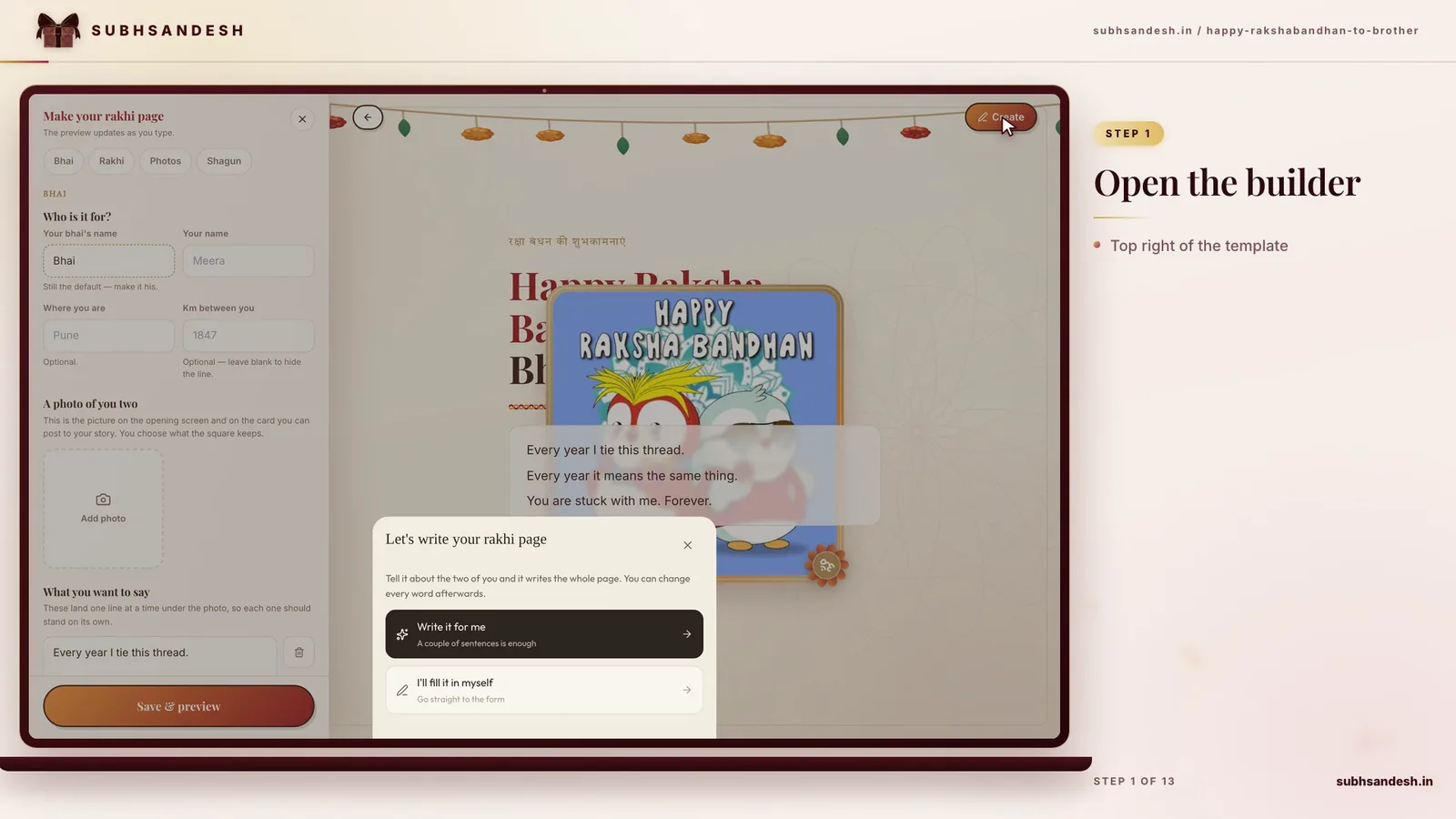
A URL that opens a page built around his name and your photographs — a Raksha Bandhan page for a brother with animated tilak, aarti and rakhi-tying scenes. It suits long-distance siblings and anyone who wants the wish to outlast the day.
Four to six minutes to build, and 99.4% of the pages people start on SubhSandesh get finished and shared. It stays reachable permanently, and shared pages average 11.8 views each — they get reopened, usually because someone is showing it to a third person.
Which format to pick
The table compares the five formats on the two things that decide whether a rakhi wish lands: effort at your end, and lifespan at his.
| Format | Time to make | How long it stays reachable | What the recipient has to do |
|---|---|---|---|
| Pasted text wish | ~10 seconds | Until the chat scrolls past it | Nothing — which is the problem |
| Rakhi image + caption | 1–2 minutes | Until he clears his gallery | Tap to open |
| Status with his name | 3–4 minutes | 24 hours, then gone | Open the Status tab |
| Voice note | Under 1 minute | Permanent, in the chat | Tap play, with sound on |
| Personalised page link | 4–6 minutes | Permanent URL; 11.8 average views per page | One tap; 52.5% open it on a phone |
The honest reading: the voice note wins on effort-to-impact, and the link wins on lifespan. Both of those first-party figures are platform-wide across 2,632 SubhSandesh pages and 13 page types, not rakhi-specific — the rakhi template is too new to segment, and this post will say so rather than imply a number it does not have.
How to make the WhatsApp link preview look right
A link in a WhatsApp chat does not stay a link. WhatsApp fetches the page and renders a preview card, and whether that card looks like a greeting or like a broken URL depends on four tags in the page's <head>. The Open Graph protocol specifies them: og:title, og:type, og:image and og:url are all required for a page to render as a rich object.
Three practical consequences follow. Send the link on its own line, because a URL buried mid-sentence is easier to miss than a card, and send it once — the preview is generated on first paste and re-pasting does not refresh it.
Then check the preview image before you hit send. The card is what he sees in the notification, so it is doing the job the opening sentence used to do.
When WhatsApp is the wrong place to send a rakhi wish
If your brother is in the same house, put the phone down. A rakhi is a physical ritual, and a message sent across a room is worse than the room.
If he does not use WhatsApp — and a meaningful number of older relatives do not — a link is a dead end no matter how well built. The same goes for a brother who reads on a desktop at work: SubhSandesh's pages are phone-first, and 47.5% of views do not arrive on a phone.
And if the wish is going to a group of cousins rather than one person, a link is the wrong shape. Group chats reward something that renders inline, which is where a photo or a Status genuinely beats a URL. A shared page is built for one recipient with a name on it; used as a broadcast, it loses the thing that makes it work.
One more limit worth stating: a link is public unless you make it private. 44.7% of SubhSandesh creators password-protect their page before sharing it — 1,177 of 2,632 — which tells you how often people want a family page not to be forwardable. If that matters to you, set the password before you send, not after.
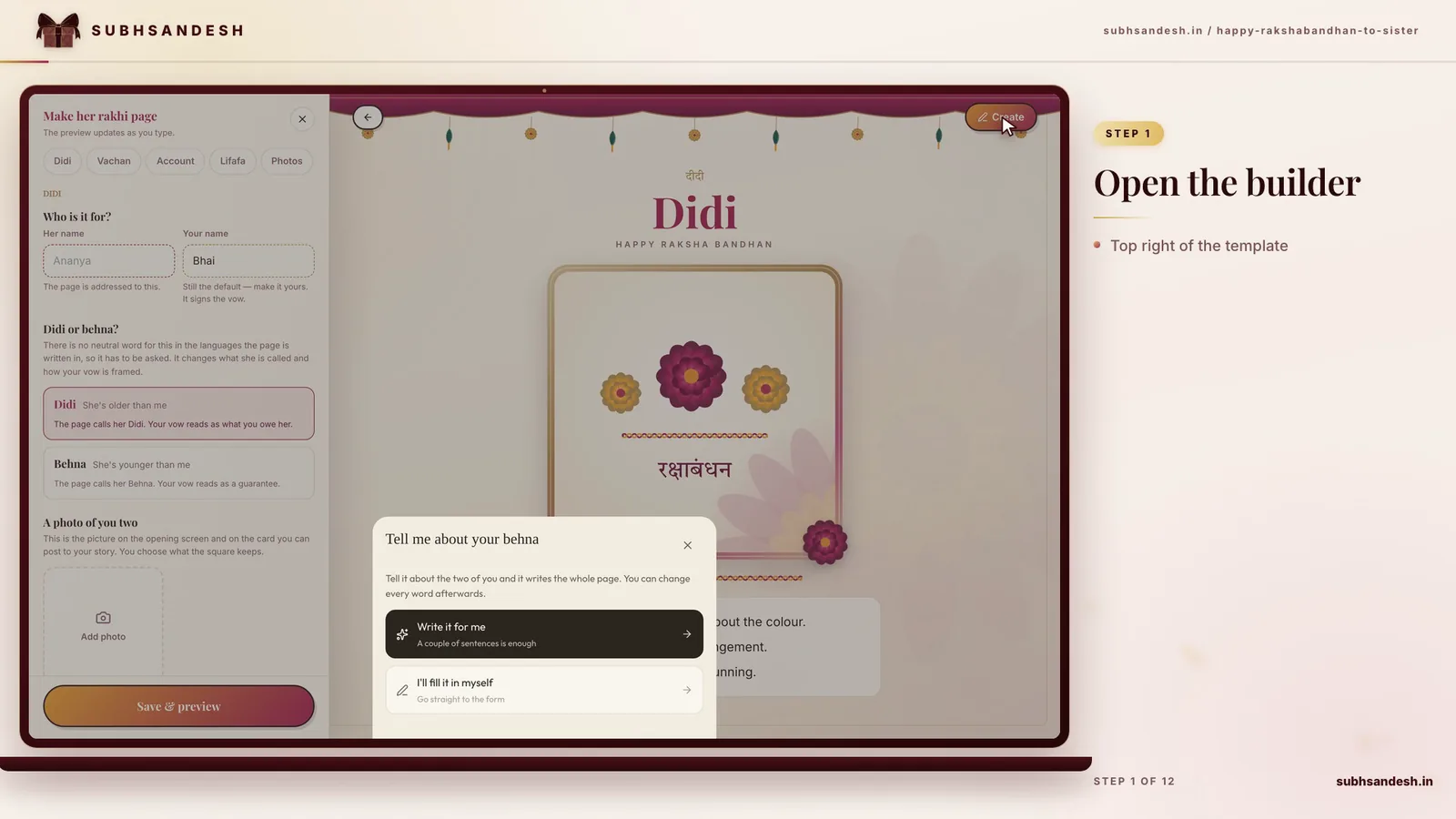
If a link is the right shape for your brother, the rakhi page for a brother takes four to six minutes end to end. You can also browse every SubhSandesh template first if you want to see the format before committing to it.
Sources
- WhatsApp Blog — Labeling Forwarded Messages, 10 July 2018
- WhatsApp Blog — More changes to forwarding, 19 July 2018, updated 21 January 2019
- Meta Newsroom — Keeping WhatsApp Personal and Private, 8 April 2020
- The Open Graph protocol — required properties specification
- Frontiers in Psychiatry — instant messaging family communication and wellbeing, 29 March 2022, open access
- arXiv:1909.08740 — Can WhatsApp Counter Misinformation by Limiting Message Forwarding?, 18 September 2019, open access
First-party figures are from SubhSandesh's own database, measured 13 August 2026 across 2,632 created pages and 31,081 recorded views.
Frequently Asked Questions
Turn this inspiration into an unforgettable surprise
Build a page with photos, a heartfelt message, music and a ready-to-share link.
- Photos, message & music
- Ready-to-share link

Written by
Suyash Agrahari
Founder
Suyash Agrahari is a Software Engineer at HireQuotient and the founder of SubhSandesh and DrawFlow (drawflow.in). He builds AI agents and full-stack products with Next.js, Node.js, and the OpenAI and LangChain ecosystems, having shipped autonomous multi-agent systems, AI copilots, and large-scale outreach platforms — and scaled side projects from a few hundred to millions of users. He writes about AI engineering, web development, and building products that grow through SEO and organic reach.
Stay Connected
Follow SubhSandesh
New templates, festival ideas and step-by-step walkthrough videos — first on our socials.
Product guide
See it built, step by step
Keep reading
Thala Deepavali: A Couple's First Deepavali at the Bride's Home
Thala Deepavali is a Tamil couple's first Deepavali after marriage, at the bride's home. In 2027 it is Thursday 28 October, oil bath 4:40–6:01 AM in C…
 Suyash Agrahari· 9 min
Sugar-Free Diwali Sweets: Swaps, Label Warnings and the Evidence
Five original no-added-sugar Diwali sweets, why jaggery and honey do not count, the warnings FSSAI requires on a sugar-free box, and what an Indian su…
Suyash Agrahari· 9 minShort Diwali Quotes: 34 Original One-Liners Under 10 Words
34 original short Diwali quotes, each under ten words and marked with its word and character count, grouped by mood: lamps, family, friends, gratitude…
Suyash Agrahari· 9 min