
How to Surprise My Boyfriend for No Reason and Be Believed
An unprompted gift is read with the grammar of debt: indebtedness was the only emotion that predicted gift-giving across three studies. Here is what 'no reason' signals, why 'what did you do?' comes first, and how to make affection the easiest reading.
Make this into a page you can send
Photos, a message, music and a ready-to-share link — in a couple of minutes.
or browse all occasionsKey takeaways
- • Indebtedness, not fondness or respect, was the only emotion that uniquely predicted thank-you gift-giving across three studies (N = 120, 327 and 561) — which is why an unprompted gift can read as a bill.
- • A 759-person registered report found a giver's intention shapes gratitude but not indebtedness; what tracked indebtedness was how much reciprocity the recipient thought was expected (r = 0.17).
- • Partners underestimate each other's gratitude (205 and 309 couples studied), so an unprompted gesture has to state its reason rather than imply it.
- • 99.4% of started SubhSandesh pages are published and shared (3,405 of 3,425), so with a no-occasion surprise the hesitation happens before you begin, not halfway through.
- • 42.7% of creators password-protect before sharing (1,462 of 3,425) — sensible, but a password plus no occasion is the combination most likely to read as bad news.
On this page
How to Surprise My Boyfriend for No Reason and Be Believed
Supply the reason the calendar is not supplying, out loud, inside the gesture itself. People asking how to surprise my boyfriend for no reason are usually worried about one specific failure: with no date behind it, an unprompted gesture makes him hunt for a cause, and the two he reaches first are "she wants something" and "she did something." On SubhSandesh, 99.4% of started pages are actually published and shared (3,405 of 3,425), so with a no-occasion surprise the hesitation happens before you begin, not halfway through. Another 42.7% of creators password-protect their page before sharing it (1,462 of 3,425) — sensible privacy that, on a day with nothing attached to it, also deepens the mystery. Below: what "no reason" actually signals, why "what did you do?" is the default reaction, and how to make affection the easiest available reading.
What a gift with no occasion actually signals
A no-occasion surprise is any gesture whose only stated cause is the giver's feeling — no birthday, no anniversary, no argument to repair. Because the reason lives entirely in your head, he has to reconstruct it, and the reconstruction is where it goes wrong.
The grammar he reconstructs it with is not romantic. In three studies of thank-you gifts published in Applied Psychology: Health and Well-Being in 2025 (N = 120, 327 and 561), indebtedness was the only emotion that uniquely predicted whether someone actually gave a gift. Gratitude, fondness and respect did not.
That is the whole problem in one finding. A gift is the standard instrument people reach for when they owe something, so a gift with no occasion arrives pre-loaded with the question of what is owed — and by whom.
An occasion is not decoration, then. It is the label that stops the recipient from having to guess, and removing it is the single change that makes this hard. Everything below is about replacing that label with words rather than hoping he supplies it himself.
Why "what did you do?" is the default reaction, not delight
Because receiving a benefit is a mixed emotional event, not a purely pleasant one. Layous and colleagues, writing in PLOS ONE in 2017, ran three studies on the emotions people feel immediately after a gratitude exercise and found elevation and connectedness alongside indebtedness — and, in a third study run in both the United States and South Korea, guilt as well.
Their meta-analysis of the three studies described the result as feeling "uplifted and indebted" at once. So a flat or suspicious first reaction is not evidence that he disliked it, and it is not evidence you did it badly.
He is doing arithmetic. Your job is to finish the sum for him before he starts, which is a writing problem more than a gifting one.
It is also worth saying plainly that "what did you do?" is often affectionate teasing rather than real suspicion. The mistake is answering it defensively, because a defensive answer confirms that there was something to defend.
The reciprocity trap, and where it stops being a gift
Being close to him does not protect you from this. In a 2022 study of 275 adolescents assigned to three conditions, writing gratitude to significant others produced felt indebtedness regardless of how socially close the writer felt, while the other two conditions felt less indebted the closer people felt to those around them.
And the thing that actually drives the debt is not your reason. A 2025 registered report in Royal Society Open Science (n = 759) replicated a 2006 finding that a helper's perceived intention strongly shapes gratitude but has essentially no effect on indebtedness, then extended it: perceived intention did move how much reciprocity the recipient thought was expected of him (d = 1.51), and that expectation correlated negatively with gratitude (r = −0.28) and positively with indebtedness (r = 0.17).
Read that as the operating instruction for the whole post. Being warm about why raises gratitude; only removing the expectation of something back lowers the debt.
There is one case where none of this applies, and it is the one people get wrong most often: if you are actually repairing something, an unprompted gift is evasion, not romance. He gets the debt and no admission, which is worse than saying nothing. Name it instead — the all-in-one apology page built for making up properly exists for that job, and it is the third most-created page type here at 753 created, 22.0% of all pages. A no-reason surprise is for when there is genuinely nothing to fix.
Five ways to make an unprompted surprise legible as affection
Each of these attacks the reading problem rather than the gift problem.
1. Name the absence in the first line
Say that there is no occasion, before he asks. One sentence — "nothing happened, nothing's wrong, I just wanted to" — removes both wrong readings at once. It fails if you bury it below three paragraphs of build-up, because he will have finished guessing by then.
Implying it is not enough. Across 205 and 309 couples, partners generally underestimated each other's gratitude in a 2023 study using the Truth and Bias Model of Judgment — and partners were less satisfied when their expression was underestimated.
Be clear about what this step does and does not do, though. Naming the reason raises how grateful he feels; it does not by itself lower what he feels he owes. Step 4 is the one that does that.
2. Keep it below his debt line
Match the scale to what he could comfortably match. A modest, specific gesture reads as affection; an elaborate one reads as a claim, and the indebtedness research says the claim is what he will respond to. This one fails if "modest" turns into forgettable — small is not the same as vague.
3. Build it from something he said, not something he needs
Use a line he repeated, a photo he asked you to send, a running joke with a date attached. Evidence that you were paying attention cannot be read as a transaction, because attention is not the kind of thing anyone can hand back. It fails when the detail is one he does not remember giving you.
4. Ask for nothing back, in writing
State it: no reply needed, nothing expected. Of everything on this list, this is the one with the strongest evidence behind it — the reciprocity expectation is what the 759-person replication found tracking indebtedness, not the sweetness of your reason. It fails if you then check whether he responded within the hour.
5. Make it something he can reread, not an event he must attend
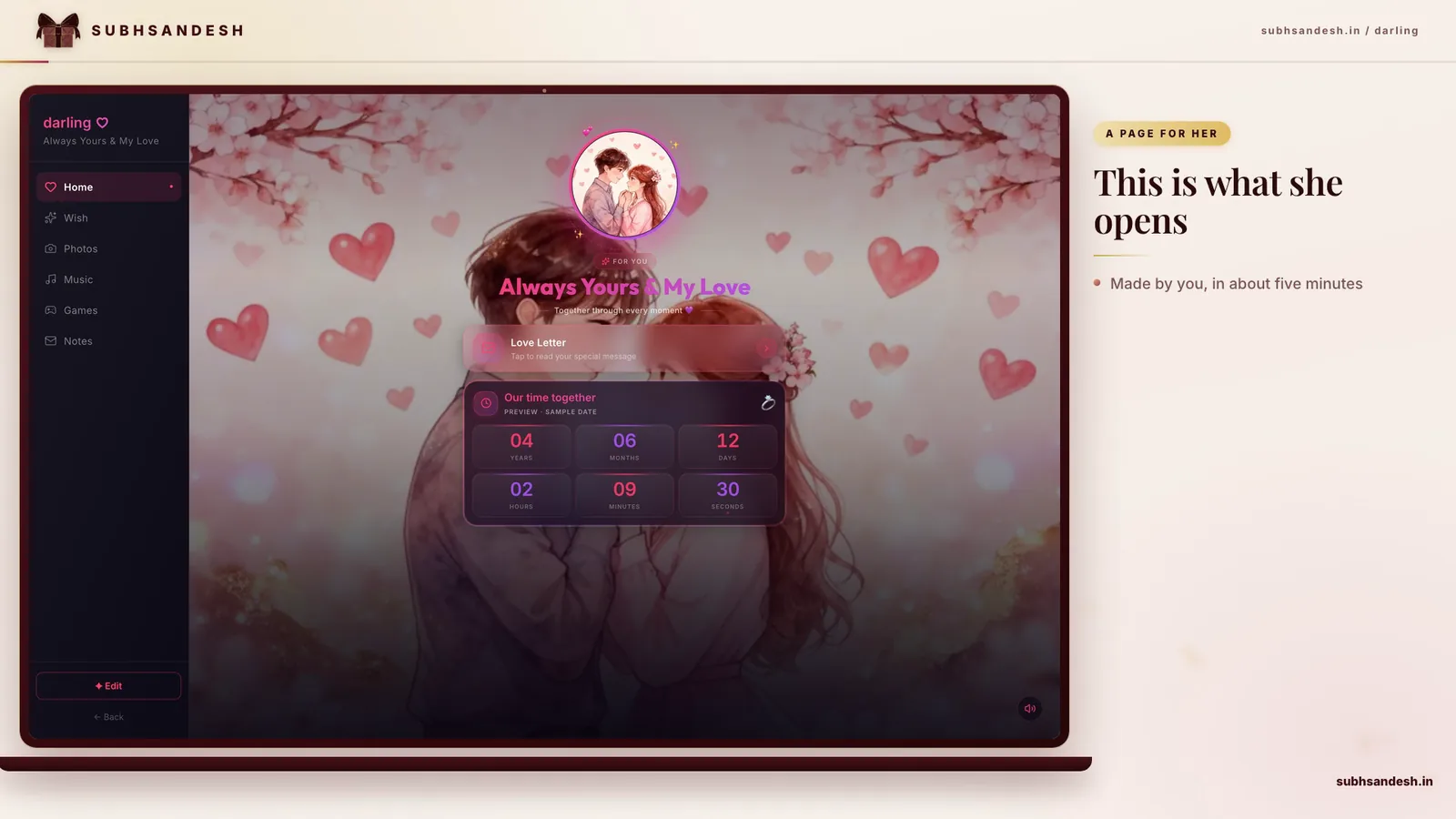
A page he can reopen alone puts no performance on him — no reaction to produce in front of you. The animated "I love you" page is the most-created template here at 1,001 pages, 29.2% of everything made, and the darker, more dramatic Darling page sits fourth at 349 created, 10.2%. Neither carries a date, which is exactly the point — and exactly the risk covered below.
Occasion-bound versus unprompted: what he has to decode
This compares what the recipient has to work out for himself, alongside how often each page type actually gets made here.
| Gesture | What the calendar supplies | Pages created on SubhSandesh | Most likely misreading |
|---|---|---|---|
| Birthday page (/birthday-gf) | The date explains everything | 258, 7.5% of all pages | Almost none — the reason is public |
| Apology page (/apology-dashboard) | The argument explains it | 753, 22.0% | Read as closing a subject early |
| "I love you" page (/love-gf) | Nothing; you supply the reason | 1,001, 29.2% | Read as a debt, or as an unnamed apology |
| Darling page (/darling) | Nothing; the tone supplies it | 349, 10.2% | Read as heavier than you meant |
The two most-made page types here are the two with no date attached, and they are also the two that need their reason written into them.
When a no-reason surprise is the wrong call
When he is in the same room. A link is a worse delivery mechanism than a sentence said out loud, and sending one to someone three feet away is its own kind of odd.
When the surprise has to be private and instant. Password-protecting is the norm — 42.7% of creators do it — but a password plus no occasion is the single combination most likely to read as bad news before he has opened anything.
When you have five minutes. The median gap between a page's first save and its last edit is 7.2 hours, sampled on the "I love you" page with n = 1,001. That is not a rule, but it tells you what people actually do: they draft, leave it, and come back. If you need something in the next five minutes, write him a message instead.
And when he has told you he dislikes surprises. Believe him. Unprompted attention and unprompted spectacle are different things, and only one of them is being asked for here.
Sources
- The psychology of a thank-you gift: Who gives it and why? — Applied Psychology: Health and Well-Being, 7 May 2025
- The proximal experience of gratitude — PLOS ONE, 7 July 2017
- Gratitude Intervention Evokes Indebtedness: Moderated by Perceived Social Distance — Frontiers in Psychology, 16 March 2022
- Understanding the Links Between Perceiving Gratitude and Romantic Relationship Satisfaction Using an Accuracy and Bias Framework — Social Psychological and Personality Science, 2 December 2022
- Revisiting the effects of helper intentions on gratitude and indebtedness: Replication and extensions Registered Report of Tsang (2006) — Royal Society Open Science, 30 April 2025
Frequently Asked Questions
Turn this inspiration into an unforgettable surprise
Build a page with photos, a heartfelt message, music and a ready-to-share link.
- Photos, message & music
- Ready-to-share link

Written by
Suyash Agrahari
Founder
Suyash Agrahari is a Software Engineer at HireQuotient and the founder of SubhSandesh and DrawFlow (drawflow.in). He builds AI agents and full-stack products with Next.js, Node.js, and the OpenAI and LangChain ecosystems, having shipped autonomous multi-agent systems, AI copilots, and large-scale outreach platforms — and scaled side projects from a few hundred to millions of users. He writes about AI engineering, web development, and building products that grow through SEO and organic reach.
Stay Connected
Follow SubhSandesh
New templates, festival ideas and step-by-step walkthrough videos — first on our socials.
Product guide
See it built, step by step

Keep reading
Which Day Comes After Propose Day, and What Happens Now
Chocolate Day comes after Propose Day — Tuesday 9 February 2027. That is one sentence, so this page covers the four situations you are actually in on …
 Suyash Agrahari· 9 min
When to Propose a Girl to Be Your Girlfriend, and When Not To
The timing question, answered with conditions instead of a date: what has to be true before you ask, what politeness and fast replies do not prove, wh…
Suyash Agrahari· 9 minRomantic Proposal Room Decoration: What the Room Must Do
Romantic proposal room decoration, sorted by the work each setup takes and what the room allows: 7 setups with set-up and reversal times, lighting evi…
Suyash Agrahari· 9 min