
How to Surprise My Boyfriend on Our Anniversary Without a Gift
An anniversary is a date he already knows, so the surprise lives in the hour and the form, not the object. What ritual and capitalisation research says about the reveal, five moves for the day itself, and how the same plan runs in either direction.
Make this into a page you can send
Photos, a message, music and a ready-to-share link — in a couple of minutes.
or browse all occasionsKey takeaways
- • Plan the hour of the reveal, not the object: an anniversary is a date he already knows, so timing and form are the only variables you control.
- • Be present when he opens it. In a survey of 139 dating adults, the active-constructive response to good news carried the strongest influence on relationship satisfaction, above and beyond every other response type.
- • In 174 dating couples, inadequate support when a partner shared good news predicted both breakup and declining relationship quality six months later.
- • Holding the secret is not the hard part: five experiments with 2,800 participants found positive secrets increase felt energy rather than draining it.
- • 42.7% of SubhSandesh creators password-protect their page before sharing it (1,462 of 3,425), and the median build spans 7.2 hours on the /love-gf page (n=1,001).
On this page
How to Surprise My Boyfriend on Our Anniversary Without a Gift
Plan the reveal, not the object. Decide the exact hour he finds out, be in the room or on the call when he does, and build him a part to play instead of only something to receive — anniversary surprises fail at the reveal far more often than at the choosing. SubhSandesh's own numbers point the same way: the median gap between a page's first save and its last edit is 7.2 hours, sampled on the "I love you" page (/love-gf), n=1,001, so people assemble these across an evening rather than in a panic, and 42.7% of creators password-protect their page before sharing it (1,462 of 3,425), which makes the secret-keeping part of the gesture rather than an accident. Below: why the date is not the variable you control, why the first thirty seconds belong to him, five moves for the day itself, and how the same plan runs when the surprise is going the other way.
An anniversary is a ritual the two of you enact, not an object one of you hands over
A birthday belongs to one person; an anniversary belongs to both, and that changes what a surprise has to do on it. The closest hard evidence comes from Ovul Sezer, Michael Norton, Francesca Gino and Kathleen Vohs, whose three studies of holiday rituals (N = 1,098, published in the Journal of the Association for Consumer Research on 2 September 2016) found that enacting a ritual while with family added significantly to enjoyment beyond simply being with family.
The finding that matters most here is the negative one: participants rarely performed rituals alone, and when they did, those individual rituals were not associated with holiday enjoyment. Scope it honestly — that paper studied Christmas and New Year's Eve with families, not couples on a dating anniversary, though it names anniversaries among annual rituals. Its mechanism is closeness plus involvement, which is what a one-way handover skips.
The first thirty seconds after the reveal are his, and they decide the whole thing
Whatever you plan, the surprise is graded by his response, and that response is a measured variable in relationship research rather than a mood. Priscilla De Netto, Kia Fatt Quek and Karen Golden surveyed 139 Malaysians in dating relationships aged 18–30 (46 men, 93 women; Frontiers in Psychology, 13 December 2021) and found the active-constructive response to good news — visible enthusiasm plus elaboration, asking about it — carried the strongest influence on relationship satisfaction, above and beyond every other response type. The most damaging pattern was passive-destructive: no interest, subject changed.
The stakes are not abstract. In a study of 174 heterosexual dating couples by Todd Kashdan and colleagues (Behaviour Research and Therapy, October 2013), people whose partners gave inadequate support when they shared good news were more likely to have ended the relationship, and reported declining relationship quality, six months later.
So give him something to be enthusiastic about out loud — a question, a photo he has to identify, a plan with a date in it — because "here you go" invites a nod. Read it in reverse too: he is also the discloser, and your thirty seconds count identically.
The date is fixed and he knows it, so the hour is your only real variable
He knows the date, so nothing about a shared anniversary hides the way a birthday can. The surprise lives entirely in when inside the day and what form it takes — before he wakes, mid-shift, or after the evening you already agreed on.
Holding it is easier than people expect. Michael Slepian, Katharine Greenaway, Nicholas Camp and Adam Galinsky ran five experiments on positive secrets (N = 2,800; Journal of Personality and Social Psychology, volume 125, 2023) and found positive secrets increase feelings of energy relative to content-matched positive information that was not secret — an effect independent of positive affect and driven by intrinsic motivation, because people keep good secrets by choice. One of their own vignettes is literally keeping good news to surprise your partner when you get home from work.
Scope that too: those were single pieces of good news held for days, not a three-week operation with a booking and four accomplices. Once a plan has accomplices the failure mode is leakage, not fatigue — one reason 42.7% of SubhSandesh creators password-protect their page before sending the link (1,462 of 3,425).
Five moves for the day, ordered by how much he has to do
None of these is a gift. Each is a move in the day itself, chosen so he ends up doing something rather than only receiving.
1. Reveal it where you can see or hear him
Hand it over in person, or open it together on a live call — not by leaving it to be found. The active-constructive finding above depends on a responder being present; a link he opens alone at 11 p.m. turns a shared ritual into a solo one, the condition Sezer and colleagues found was not associated with enjoyment.
2. Repeat exactly one thing from last year
Repetition is what separates a ritual from a nice evening, and it is cheap to start: the same first-date order, the same route, the same one-line message at the same hour. In year one it reads as coincidence; by year three it is the thing he names when someone asks what you two do.
3. Hand him one hour of the day to run
Tell him one hour is his to plan and you will not ask what it is. It is the fastest way to convert a surprise into a two-person ritual, it removes the "what did you do for me?" imbalance a one-way gesture creates, and it lets the day survive one bad idea.
4. Put the surprise somewhere he cannot skim
A surprise consumed in four seconds gets four seconds of response. A password, a sequence, or a question he has to answer forces a pause — and 99.4% of pages started on SubhSandesh are published and shared (3,405 of 3,425), so the format is not where people give up.
5. Leave the second half of the day deliberately empty
Book nothing after the reveal. The elaboration half of an active-constructive response needs somewhere to go, and a packed itinerary is the commonest way a good surprise gets cut off mid-sentence.
The five reveal formats, compared on what each one asks of him
The choice that changes the outcome is not what you give but how it reaches him. Here are the five realistic channels against what each asks of him.
| Reveal format | Soonest you can do it | What it asks of him | First-party figure |
|---|---|---|---|
| Handed over in person | Same evening | Respond in front of you | Not recorded |
| Opened together on a video call | Same evening | Respond in front of you | 50.2% of views are on a phone (21,130 of 42,099) |
| A link he opens alone | Minutes | Reply later, in text | 99.4% published and shared (3,405 of 3,425) |
| A password-protected link | Minutes | Ask you for the password first | 42.7% password-protect first (1,462 of 3,425) |
| Left somewhere to be found | A day of setup | Nothing — you are not there | Not recorded |
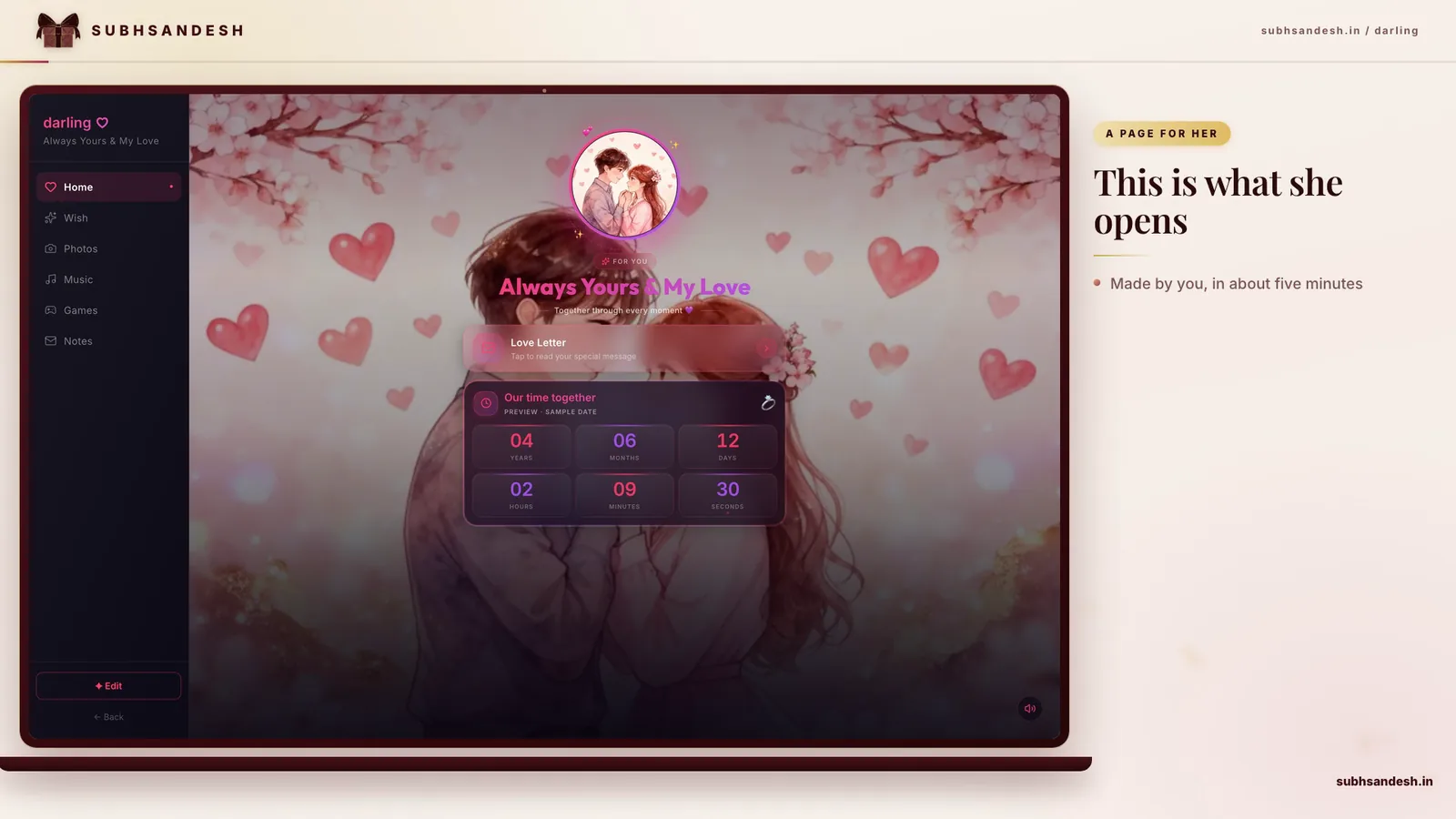
The two formats that put you in front of him demand the most planning and return the most response; the last row returns the least. For the middle option, the "I love you" page is the most-created page type at 1,001 pages, 29.2% of everything made, and the dark, dramatic Darling page is fourth of fifteen at 349 created, 10.2% — that one suits a couple whose anniversary humour runs closer to obsession than pastel.
How to surprise my girlfriend on our anniversary: the same plan, reversed
Search demand for the girlfriend version of this question runs higher than for the boyfriend version — a useful hint that anniversary advice gets written one-way when the occasion is not. The mechanism above is symmetric by construction: De Netto's sample was 46 men and 93 women, Kashdan's design was dyadic across 174 couples, and both measured each partner as discloser and responder.
The honest answer is that the research licenses no different plan for her. Interdependent self-construal — tested by De Netto and colleagues precisely because this literature has been dominated by Western samples — did not moderate the effect, which is modest evidence that the same response pattern holds in an Asian dating sample.
What differs is the market, not the person: the default anniversary shelf aimed at women is deeper and more predictable, so a surprise aimed at her works harder to avoid landing as a category rather than a gesture. Note also what we cannot tell you — SubhSandesh records no recipient gender on any of the 3,425 pages, so no split by direction exists in our data.
Where this goes wrong, and when a SubhSandesh page is the wrong surprise
Three failure modes, in the order they happen. You plan the object and not the hour, so it lands mid-call. You plan something he must react to in front of other people, turning a private ritual into a performance. Or you plan the whole day and leave him nothing to do in it — the individual-ritual condition Sezer and colleagues found was not associated with enjoyment.
A page is the wrong choice in three situations. If you are together on the day, a link is worse than the same words said out loud, because the reveal carries the effect. If he keeps his phone on do-not-disturb through the evening you picked, a delivery you cannot control decides your timing. And if the anniversary lands on a rough patch, a celebratory page is the wrong register — a repair conversation is not a surprise.
If you are apart and a live reveal is genuinely impossible, an "I miss you" page is the honest version of that constraint rather than a substitute for being there.
Sources
- Sezer, Norton, Gino and Vohs, "Family Rituals Improve the Holidays", Journal of the Association for Consumer Research, 2 September 2016.
- De Netto, Quek and Golden, "Communication, the Heart of a Relationship", Frontiers in Psychology, 13 December 2021.
- Kashdan et al., "Failure to capitalize on sharing good news with romantic partners", Behaviour Research and Therapy, October 2013.
- Slepian, Greenaway, Camp and Galinsky, "The Bright Side of Secrecy", Journal of Personality and Social Psychology, 2023.
- Usage figures: SubhSandesh's own database, measured 2026-09-03.
Frequently Asked Questions
Turn this inspiration into an unforgettable surprise
Build a page with photos, a heartfelt message, music and a ready-to-share link.
- Photos, message & music
- Ready-to-share link

Written by
Suyash Agrahari
Founder
Suyash Agrahari is a Software Engineer at HireQuotient and the founder of SubhSandesh and DrawFlow (drawflow.in). He builds AI agents and full-stack products with Next.js, Node.js, and the OpenAI and LangChain ecosystems, having shipped autonomous multi-agent systems, AI copilots, and large-scale outreach platforms — and scaled side projects from a few hundred to millions of users. He writes about AI engineering, web development, and building products that grow through SEO and organic reach.
Stay Connected
Follow SubhSandesh
New templates, festival ideas and step-by-step walkthrough videos — first on our socials.
Product guide
See it built, step by step

Keep reading
Which Day Comes After Propose Day, and What Happens Now
Chocolate Day comes after Propose Day — Tuesday 9 February 2027. That is one sentence, so this page covers the four situations you are actually in on …
 Suyash Agrahari· 9 min
When to Propose a Girl to Be Your Girlfriend, and When Not To
The timing question, answered with conditions instead of a date: what has to be true before you ask, what politeness and fast replies do not prove, wh…
Suyash Agrahari· 9 minRomantic Proposal Room Decoration: What the Room Must Do
Romantic proposal room decoration, sorted by the work each setup takes and what the room allows: 7 setups with set-up and reversal times, lighting evi…
Suyash Agrahari· 9 min