
How to Surprise My Girlfriend for No Reason on an Ordinary Day
An unprompted surprise has to prove you were paying attention, not that you planned something big. What changes when the recipient is a woman (less than you would think), why the end of the workday is the slot to aim for, and five gestures that ask nothing of her.
Make this into a page you can send
Photos, a message, music and a ready-to-share link — in a couple of minutes.
or browse all occasionsKey takeaways
- • Perceived partner responsiveness is the pathway an unprompted gesture travels: in 825 adults, gratitude reached relationship satisfaction through it, at β = 0.27 for people low in relationship power against β = 0.11 for those high in it.
- • The recipient's gender changes less than the search results imply — a 27-study meta-analysis (N = 4,045, δ = 0.28) found the wellbeing effect of performing kind acts was not moderated by sex.
- • The end of the workday is the slot to aim for, and it should ask nothing: 87 employees surveyed across three working days detached less from work in the evening after heavier days.
- • Shared pages here average 12.3 views each across 42,099 recorded views, so an unprompted page is reopened rather than consumed once.
- • Registered creators average 1.21 pages each, which is the honest limit of treating a page as a habit rather than a one-off.
On this page
How to Surprise My Girlfriend for No Reason on an Ordinary Day
Aim at the end of an ordinary weekday, and make the gesture prove you were paying attention rather than that you organised something big. Most people asking how to surprise my girlfriend for no reason have the idea right and the timing wrong: with no occasion carrying it, the surprise has to survive whatever kind of day she has just had, so it should ask nothing of her in the moment — no travelling, no audience, no immediate reply. On SubhSandesh, shared pages average 12.3 views each across 42,099 recorded views, which is the part that pays off: an unprompted page gets reopened on days nobody planned. Below: what it has to prove, whether the recipient's gender changes any of it, the slot in the week to aim for, five gestures for an ordinary Tuesday, and when a link is the wrong answer.
What an unprompted surprise has to prove
An unprompted surprise is any gesture with no date, no argument and no request behind it, where the only cause is that you noticed something. That makes noticing the thing it has to demonstrate, because attention is the only claim a gesture like this can honestly make.
There is a name for what she is reading it for. In a study of 825 adults in romantic relationships of at least six months (438 men, 387 women), published in Scientific Reports on 10 September 2024, gratitude reached relationship satisfaction through perceived partner responsiveness — the sense that a partner notices you, understands you and values you.
The same paper found the pathway is not equally strong for everyone. The indirect effect ran at β = 0.27 for people low in relationship power and β = 0.11 for people high in it, which reads as: the gesture does more work for whoever has less say in the relationship.
Two caveats: it measured expressed gratitude rather than gifts, so I am borrowing the mechanism and not the finding, and the sample was recruited online in China.
Does the advice change because the recipient is a woman?
Mostly not, and inventing a difference would be worse than saying so. The largest open evidence I could read is a 2018 meta-analysis in the Journal of Experimental Social Psychology covering 27 studies (total N = 4,045, 52 effect sizes), which put the effect of performing acts of kindness on the actor's own wellbeing at δ = 0.28 and reported that the effect was not moderated by sex. That is about the giver rather than the receiver, and I am not stretching it past that.
The one measured sex difference I could find is not about gifts at all. Among 772 Chinese young adults surveyed for BMC Psychology in June 2025 (270 men, 502 women), perceived partner responsiveness mediated the link between partner phubbing and relationship quality for women but not for men — an indirect effect of −0.17, 95% CI [−0.24, −0.10], carrying 70.8% of the total effect. Where a difference showed up, it was about attention being withdrawn by a phone, not about what to hand over.
What is genuinely different is the selling, not the receiving. Of the eight hosts ranking for this exact search in India, three are forum or pin boards and one is a craft shop; the two editorial pages I could open are a 29-item activity list and a Valentine's Day round-up, which is occasion content answering a query that states it has no occasion. The "for her" framing lives in that catalogue rather than in how she reads your gesture.
Our own numbers cannot settle it either way. The database records no recipient gender on any of the 3,425 personalised pages created since 2026-03-12, so no figure on this site — including mine — can tell you what women prefer. I searched for unsolicited gift reciprocity, gratitude expression in relationship maintenance, small acts of kindness, felt understanding and everyday relational maintenance, and found no India-specific study of unprompted romantic gestures at all.
Why the end of an ordinary workday is the slot to aim for
Because that is when she has the least spare capacity to take on something new. Sabine Sonnentag and Ute-Vera Bayer surveyed 87 employees daily across three working days and found that a heavy workload during the day was followed by less psychological detachment from work in the evening, while detachment itself went with better mood and lower fatigue (Journal of Occupational Health Psychology, 2005).
That is the argument against the standard answer to how to surprise my girlfriend after work, which is almost always a plan: dinner somewhere, an outing, people. A plan is a second shift at the end of the first one.
The version that survives 7pm is one she can receive lying down. Build it earlier — the median gap between a page's first save and its last edit here is 7.2 hours, sampled on the "I love you" page across 1,001 pages, so most people draft, leave it, and come back before sending.
Five unprompted surprises that survive an ordinary Tuesday
Each one below follows the same order: what it is, what it proves, what it asks of her, and where it fails.
1. Send it before she leaves work, not after
A message or a page timed to land in the last half hour of her working day. It proves you know her schedule well enough to know when it ends. It asks nothing but a glance, because she is not home yet and has no reaction to produce in front of you. It fails on a day she is already running late: the detachment research above says a heavy day makes switching off harder, and your surprise is one more thing to switch to.
2. Take one thing off tonight instead of adding one
A subtractive surprise: the chore she was dreading, already done, and mentioned rather than left to be discovered. It proves you tracked what her week actually contained. It asks nothing at all, which is the whole point. It fails when the task is one she has asked you to do before, because then it reads as overdue rather than unprompted.
3. Make it something she can open alone
A private page or note rather than a public delivery. It proves you thought about who else would be in the room when it landed. It asks one tap, at a time she chooses. It fails only in one way: 42.7% of creators here password-protect their page before sharing it (1,462 of 3,425), and a password arriving on a day with nothing attached to it can read as bad news — so say what it is in the message that carries the link.
4. Use a detail with a date on it
One specific thing she said or did, named along with when it happened. It proves attention in the only form nobody else could have produced. It asks nothing, because it is evidence rather than a request. It fails when the detail is one she does not remember giving you, which lands as surveillance rather than fondness.
5. Keep it small enough that you could do it again next month
A gesture at a scale you could repeat without it turning into an event. It proves the attention is ongoing rather than a one-off. It asks for no matching production in return. It fails in the way this site's own data suggests it usually does: registered creators average 1.21 pages each, so most people do this exactly once.
What each delivery asks of her, not of you
This compares the four common ways an unprompted surprise arrives, judged by what the recipient has to do at the moment it lands.
| Delivery | Audience when it lands | What she does right then | Measured on SubhSandesh |
|---|---|---|---|
| A link on her phone | One person, or none if it is password-protected | Taps once, or leaves it until later | 12.3 views per created page; 50.2% of views arrive on a phone |
| A parcel to her home | Whoever is at home | Answers the door and explains it | No first-party data — this site ships nothing |
| A delivery to her desk | Colleagues, reception, the floor | Accepts it publicly, carries it home | No first-party data |
| An evening you planned | Everyone at the venue | Changes clothes, travels, performs | No first-party data |
Only the first row is something this site can measure, which is worth remembering when you read any gifting page, this one included.
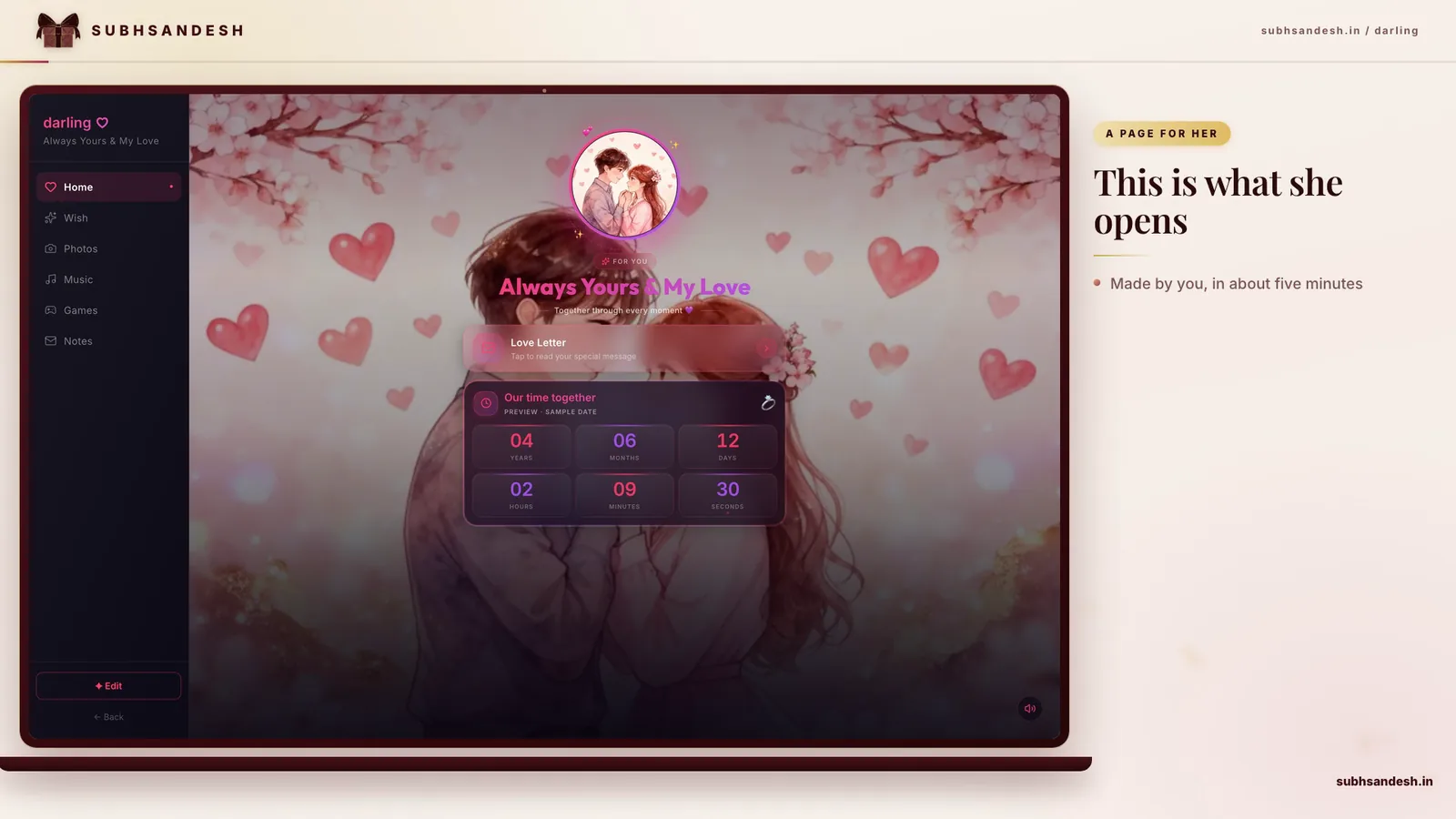
The template matters less than the words in it, but it does matter. The animated "I love you" page is the most-created template here at 1,001 created, 29.2% of all pages; the darker, more dramatic Darling page sits fourth at 349 created, 10.2%; and the "I miss you" page for a partner is the one to reach for when the reason is distance rather than a date.
When a page is the wrong surprise
When she is in the same room. A sentence said out loud beats a link, and sending one across a sofa is its own kind of strange.
When she will open it on a laptop. 50.2% of shared pages here are opened on a phone (21,130 of 42,099 views), which means close to half are not — so if it will be read at a work machine, anything with sound or a slow animation is a poor bet.
When you want this to become a habit. Registered creators average 1.21 pages each, and that number is not climbing on its own. A page is a good instrument for a moment you want to be reopenable; a plain message is the better instrument for a Tuesday you want to repeat.
And when she has told you she does not like surprises. That is information, not an obstacle. Unprompted attention and unprompted spectacle are different things, and only one of them was ever being asked for.
Sources
- Relationship power attenuated the effects of gratitude on perceived partner responsiveness and satisfaction in romantic relationships — Scientific Reports, 10 September 2024
- Partner phubbing and quality of romantic relationship in emerging adults — BMC Psychology, 5 June 2025
- Happy to help? A systematic review and meta-analysis of the effects of performing acts of kindness on the well-being of the actor — Journal of Experimental Social Psychology, 21 March 2018
- Switching off mentally: predictors and consequences of psychological detachment from work during off-job time — Journal of Occupational Health Psychology, 2005
Frequently Asked Questions
Turn this inspiration into an unforgettable surprise
Build a page with photos, a heartfelt message, music and a ready-to-share link.
- Photos, message & music
- Ready-to-share link

Written by
Suyash Agrahari
Founder
Suyash Agrahari is a Software Engineer at HireQuotient and the founder of SubhSandesh and DrawFlow (drawflow.in). He builds AI agents and full-stack products with Next.js, Node.js, and the OpenAI and LangChain ecosystems, having shipped autonomous multi-agent systems, AI copilots, and large-scale outreach platforms — and scaled side projects from a few hundred to millions of users. He writes about AI engineering, web development, and building products that grow through SEO and organic reach.
Stay Connected
Follow SubhSandesh
New templates, festival ideas and step-by-step walkthrough videos — first on our socials.
Product guide
See it built, step by step

Keep reading
Which Day Comes After Propose Day, and What Happens Now
Chocolate Day comes after Propose Day — Tuesday 9 February 2027. That is one sentence, so this page covers the four situations you are actually in on …
 Suyash Agrahari· 9 min
When to Propose a Girl to Be Your Girlfriend, and When Not To
The timing question, answered with conditions instead of a date: what has to be true before you ask, what politeness and fast replies do not prove, wh…
Suyash Agrahari· 9 minRomantic Proposal Room Decoration: What the Room Must Do
Romantic proposal room decoration, sorted by the work each setup takes and what the room allows: 7 setups with set-up and reversal times, lighting evi…
Suyash Agrahari· 9 min