
How to Surprise Your Boyfriend Randomly Without a Pattern
A predictable gesture stops registering: dopamine neurons stay at baseline for a fully predicted reward. Five ways to randomise timing when you both keep routines, plus a comparison table and the cases where random timing is the wrong call.
Make this into a page you can send
Photos, a message, music and a ready-to-share link — in a couple of minutes.
or browse all occasionsKey takeaways
- • Dopamine neurons stay at baseline activity for a fully predicted reward, so a gesture he can name in advance produces almost no reward response (Schultz, 2016).
- • In a 25-person fMRI study, reward-region activity was greatest when delivery was unpredictable, and stated preference between the two treats did not correlate with it at all.
- • Variety, not scale, is the counterweight: four studies with 2,920 participants found variety uniquely associated with well-being, though the experimental effect was slight.
- • SubhSandesh's 2,829 registered creators average 1.21 pages each, so a second gesture is usually a copy of the first - change the register, not the size.
- • Half of all page views, 21,130 of 42,099, open on a phone, which is why timing a surprise into his dead time works and a no-signal shift breaks it.
On this page
How to Surprise Your Boyfriend Randomly Without a Pattern
To surprise your boyfriend randomly, change when the gesture lands rather than what it is: vary the hour, the medium and the tone, and never let two gestures fall into the same slot twice. The neuroscience is blunt about why. Dopamine neurons sit at baseline activity for a fully predicted reward, so a Friday-evening gesture he can see coming produces close to nothing. SubhSandesh's own numbers say the same from the other side: across 3,425 personalised pages created since 2026-03-12, across 15 page types, registered creators average 1.21 pages each, so repeat use of the same gesture is rare — and the pages that do get made keep getting reopened, at an average of 12.3 views per created page. Below: why predictability kills a gesture, how fast one decays, five ways to randomise timing when you both keep routines, and when random timing is the wrong idea.
What "randomly" actually means here
A random surprise is one whose timing he cannot forecast. The gesture itself can be small and familiar — the slot it arrives in is what has to be unfamiliar.
That distinction does the work. You are not generating statistical randomness; you are staying outside his forecast, which is a much lower bar. He forecasts from three things — the day, the hour, the form. Break one and the prediction fails.
It also means you do not need a bigger idea. Across 2,829 registered creators on SubhSandesh the average is 1.21 pages each: this is a thing people do once and then struggle to repeat, because the second attempt is usually a copy of the first, in a slot he now expects.
Why the Friday-evening gesture stops registering
Because his brain has already accounted for it. In Wolfram Schultz's 2016 review of dopamine reward prediction error coding, most dopamine neurons are activated by more reward than predicted and "remain at baseline activity for fully predicted rewards". A gesture he can name in advance is a fully predicted reward.
The more useful finding for a timing question is older. Berns and colleagues scanned 25 adults at Emory University while delivering small amounts of fruit juice or water, and reported in the Journal of Neuroscience in 2001 that activity in the nucleus accumbens and medial orbitofrontal cortex was greatest when delivery was unpredictable. More striking: each person's stated preference between juice and water was not correlated with reward-region activity at all.
How it arrived mattered more to the reward system than which one they said they liked. That is the case for randomising timing instead of upgrading the gift.
How fast a repeated gesture decays, and what puts it back
Slower than you fear, but it decays. Hedonic adaptation is the plain name for it: after some time with a thing, you feel less pleasure from it. Kieling, Brei and Vieira tested surprise as a moderator of that process across two experiments in Brazilian Business Review in 2016 and found that a negative surprise makes adaptation happen more intensively and faster. A gesture that lands badly does not merely fail; it accelerates the decline of everything after it.
Variety is the documented counterweight. Gladstone, Ruberton, Margolis and Lyubomirsky ran four studies with a combined 2,920 participants, published in BMC Psychology in February 2024, and found that variety in enjoyable purchases was uniquely associated with well-being even after controlling for how much was spent in total. I will not overstate it: their own experiment found the varied-versus-uniform gap slight, and not reliably larger than the same effect for varied practical purchases. Variety helps. It is not magic.
The relationship version of this is Arthur Aron's self-expansion model. In a 2026 review in Behavioral Sciences, Aron and Tomlinson describe how the excitement of a new relationship slows over time so that relationships can become dull, and argue that novel, challenging shared activities are the main way to reinvigorate them. Novelty is not decoration; it is the mechanism.
Five ways to randomise the timing when you both keep routines
Routines are the problem and also the solution: a shared routine tells you which slots he is watching, so you know which to avoid.
1. Move the hour, not the day
What it varies: the time of day, keeping everything else identical. When it lands: 11:40 a.m. on a Tuesday, or 6 a.m. before his alarm. Why he cannot forecast it: most people schedule romance in the evening, so a mid-morning arrival has no template to match against. What it takes from you: under five minutes, and no planning. It is the smallest variation available and the one people skip.
2. Aim at his dead time, not his evening
What it varies: where he physically is when it lands. When it lands: the commute, the queue, the fifteen minutes before a meeting he is dreading. Why he cannot forecast it: he is not braced for anything in dead time, so the contrast is at its widest. What it takes from you: knowing his week. Half of SubhSandesh views — 50.2%, or 21,130 of 42,099 — open on a phone, which is the only device present in those gaps.
3. Let a die pick the date
What it varies: the date itself, taken out of your hands. When it lands: roll a die on the 1st; that is the day in the next six. Why he cannot forecast it: you genuinely do not know either, so nothing leaks in your behaviour beforehand. What it takes from you: one evening to build the thing in advance and then leave it alone until the rolled day.
4. Change the register, not the size
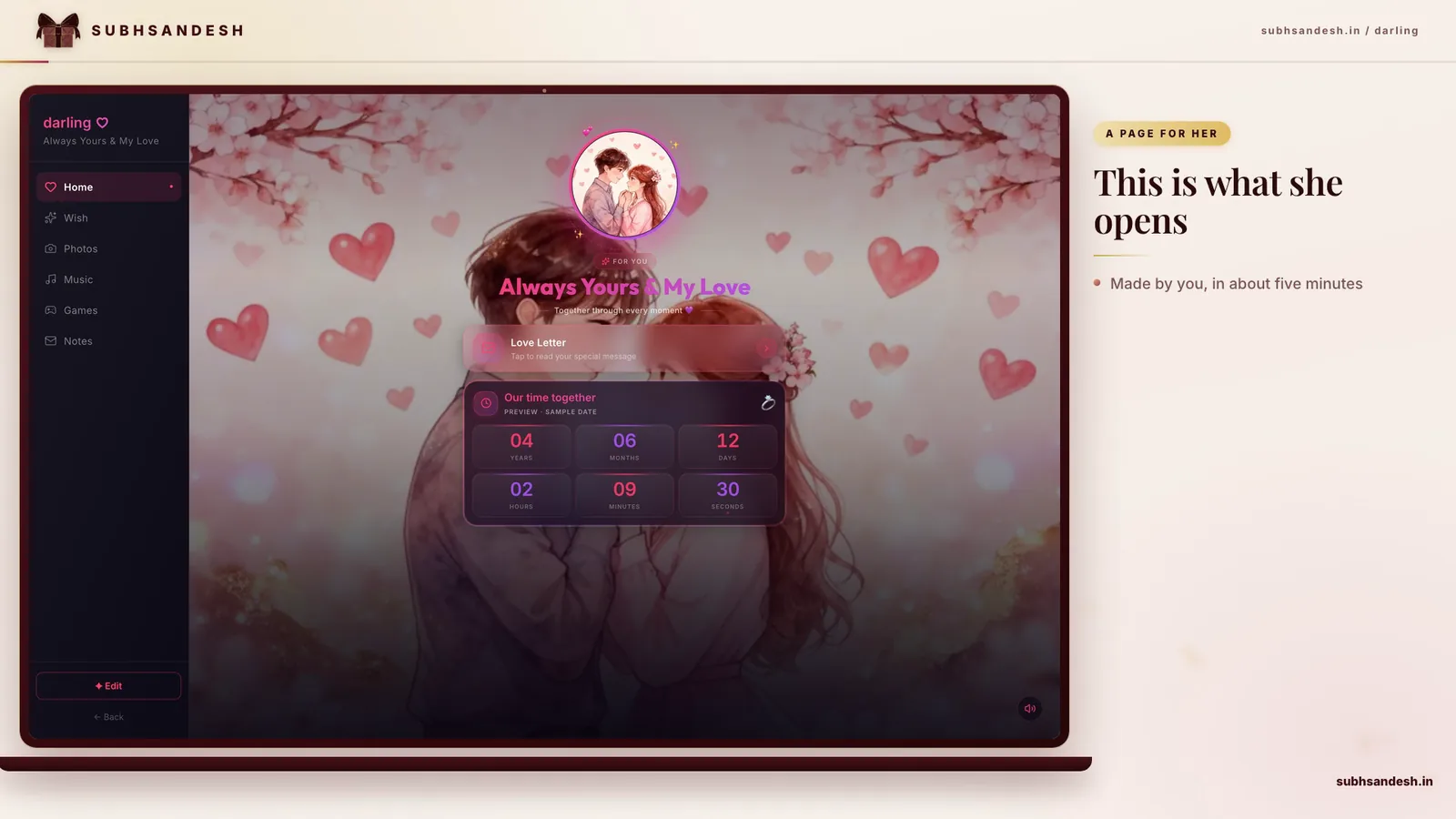
What it varies: the emotional tone. When it lands: whenever, because the register is doing the surprising. Why he cannot forecast it: he can predict a repeat of your last gesture; he cannot predict a swerve into a different mood. A plain animated "I love you" page is the most-made thing on SubhSandesh at 1,001 pages, 29.2% of everything created. The dark, dramatic Darling page sits at 349 pages, 10.2% — a deliberately different register. What it takes from you: the median gap between first save and last edit on a love page is 7.2 hours, sampled on 1,001 of them, so give yourself an evening rather than ten minutes.
5. Plant it on a delay
What it varies: the moment of discovery, which you hand over to him. When it lands: whenever he next opens his laptop, his gym bag, or the notes app. Why he cannot forecast it: you have decoupled sending from finding, so even you cannot say when it fires. What it takes from you: one to two days of not asking whether he has seen it.
The five tactics compared
Real numbers, and one column no competing page can print: how many pages of each type have been made on SubhSandesh since 12 March 2026.
| Tactic | What it varies | Lead time it needs | Page type that fits (created since 12 Mar 2026) |
|---|---|---|---|
| Move the hour | time of day | under 5 minutes | "I love you" page — 1,001 created, 29.2% |
| Aim at dead time | his location | under 5 minutes | "I love you" page — 1,001 created, 29.2% |
| Let a die pick | the date | one evening, built in advance | Darling page — 349 created, 10.2% |
| Change the register | emotional tone | 7.2 h median build gap (n=1,001) | Darling page — 349 created, 10.2% |
| Plant it on a delay | moment of discovery | 1–2 days | "I miss you" page — no created count published |
The pattern in that table: the two tactics needing almost no lead time are the two that vary timing rather than content. Effort is not the lever.
Varying intensity without starting an escalation
The trap is arithmetic. If each gesture must beat the last, you are on a curve that ends somewhere you cannot sustain, and the day you cannot top yourself reads as a downgrade rather than a normal Tuesday.
So vary along the axes that move easily — hour, medium, register, who finds it first — and hold magnitude flat. Kieling and colleagues' 2016 result is the reason to be careful rather than bold: an over-reached surprise that misses does not land at zero, it speeds up the adaptation of everything after it.
One concrete way to change choreography without changing scale: 42.7% of SubhSandesh creators password-protect a page before sharing it — 1,462 of 3,425. A locked page means you have to hand him a passphrase, which turns a single notification into a two-step exchange. Same size, different shape. The animated "I miss you" page is a third register again, for the weeks he is away.
When random timing is the wrong choice
Random is a tactic, not a virtue. Four cases where it is the wrong one.
If he is in the same room, send nothing. A link is a bad object at conversational distance — hand him the thing, or say it.
If he reads unpredictability as instability, stop. Some people experience an unscheduled gesture as a question they have to answer, and for them a reliable Sunday call is the gift. The pattern is the point, and randomising it takes something away.
If his day has no phone in it — a shift with lockers, a site with no signal, long stretches driving — the timing you chose is not the timing he experiences. Half of all views arrive on a phone, 21,130 of 42,099, and a page he cannot open on time is not a surprise.
And SubhSandesh is the wrong choice outright when he wants an object he can keep on a shelf, or when the thing you need to say deserves your handwriting. A shared page is good at arriving instantly, at any hour, from anywhere. It is bad at being held.
Sources
- Wolfram Schultz, "Dopamine reward prediction error coding", Dialogues in Clinical Neuroscience, March 2016.
- Gregory S. Berns, Samuel M. McClure, Giuseppe Pagnoni and P. Read Montague, "Predictability Modulates Human Brain Response to Reward", Journal of Neuroscience, 15 April 2001.
- Ana Paula Kieling, Vinicius Brei and Valter Afonso Vieira, "The Influence of Negative Surprise on Hedonic Adaptation", Brazilian Business Review, 1 May 2016.
- Joe J. Gladstone, Peter M. Ruberton, Seth Margolis and Sonja Lyubomirsky, "Does variety in hedonic spending improve happiness?", BMC Psychology, 26 February 2024.
- Arthur Aron and Jennifer M. Tomlinson, "Self-Expansion Activities with a Partner as One Path to Well-Being", Behavioral Sciences, 4 May 2026.
Frequently Asked Questions
Turn this inspiration into an unforgettable surprise
Build a page with photos, a heartfelt message, music and a ready-to-share link.
- Photos, message & music
- Ready-to-share link

Written by
Suyash Agrahari
Founder
Suyash Agrahari is a Software Engineer at HireQuotient and the founder of SubhSandesh and DrawFlow (drawflow.in). He builds AI agents and full-stack products with Next.js, Node.js, and the OpenAI and LangChain ecosystems, having shipped autonomous multi-agent systems, AI copilots, and large-scale outreach platforms — and scaled side projects from a few hundred to millions of users. He writes about AI engineering, web development, and building products that grow through SEO and organic reach.
Stay Connected
Follow SubhSandesh
New templates, festival ideas and step-by-step walkthrough videos — first on our socials.
Product guide
See it built, step by step

Keep reading
Which Day Comes After Propose Day, and What Happens Now
Chocolate Day comes after Propose Day — Tuesday 9 February 2027. That is one sentence, so this page covers the four situations you are actually in on …
 Suyash Agrahari· 9 min
When to Propose a Girl to Be Your Girlfriend, and When Not To
The timing question, answered with conditions instead of a date: what has to be true before you ask, what politeness and fast replies do not prove, wh…
Suyash Agrahari· 9 minRomantic Proposal Room Decoration: What the Room Must Do
Romantic proposal room decoration, sorted by the work each setup takes and what the room allows: 7 setups with set-up and reversal times, lighting evi…
Suyash Agrahari· 9 min