
How to Tie Rakhi Virtually on a Video Call, Step by Step
The video-call rakhi as a procedure, not an idea list: nine steps in order, a 22-minute timing table, who holds what when only one side has a thali, the IST offset maths for a sibling abroad, and what to do when the call drops mid-tie.
Make this into a page you can send
Photos, a message, music and a ready-to-share link — in a couple of minutes.
or browse all occasionsKey takeaways
- • A video-call rakhi runs about 22 minutes: 6 to set up and light the diya, 5 for tilak and aarti, 4 for the tie, 3 for the sweet and gift, 4 for the blessing and photo.
- • Name one sequence owner before the call. Face-to-face gaps between speakers average 135 ms against 487 ms over Zoom, so improvised turn-taking is what breaks the ritual.
- • Frame waist-up, landscape, at chest height. 51.9% of the 32,683 views on pages shared through SubhSandesh happen on a phone, so assume one-handed camera work at the far end.
- • If the call drops, whoever dropped redials and the interrupted step restarts from its beginning; nobody touches the thali in the meantime.
- • Video beats text for felt closeness and still loses to being there: in a study of 2,099 adults aged 65+, video contact showed no significant moderating effect on isolation or loneliness.
On this page
- 1. Lock the slot and name the sequence owner
- 2. Set both frames before anyone dresses up
- 3. Light the diya on camera, not before
- 4. Tilak: she mimes it, the far side applies it
- 5. Akshat and aarti, deliberately slow
- 6. The tie, with one wrist filling the frame
- 7. The sweet, on a shared count
- 8. The gift, the shagun, and something that survives the call
- 9. Say the blessing aloud, then close
How to Tie Rakhi Virtually on a Video Call, Step by Step
You can tie a rakhi on a video call, and what decides whether it lands as a ritual rather than a phone call is sequence ownership: one household runs the thali, the other holds a wrist to the lens, and every step is named out loud because a camera drops the cues a shared room carries for free. Raksha Bandhan falls on Friday 28 August 2026, and the call wants roughly 22 minutes, not five. Of the 32,683 recorded views on pages shared through SubhSandesh, 51.9% were opened on a phone — so assume the far side is holding a handset in one hand while a rakhi goes onto the other wrist, and frame for that.
Below: the nine-step order, a minute-by-minute table, the four ways to split the ritual when only one side has a thali, the offset arithmetic for a sibling abroad, and the drop protocol.
What tying rakhi virtually on a video call actually means
A virtual rakhi tie is the same ritual with the thread and the wrist in two different rooms: the sister performs tilak and aarti to her sibling's face on screen, and the rakhi is then tied in one of three ways — by someone physically present with him, by him on his own wrist while she watches, or to a printed photo at her end.
The three arrangements all keep the same 5 objects — rakhi, roli, akshat, diya, sweet — and the same order. What changes is who may touch them, and that is agreed before the call connects, not negotiated on it.
The nine-step order for a video-call rakhi, timed to 22 minutes
The timing assumes one thali, two households and one phone on each side.
| Minute | Step | Who acts | What has to be in frame |
|---|---|---|---|
| 0–6 | Connect, prop the phones, confirm who ties, light the diya | Both | Faces waist-up, then the thali |
| 6–11 | Tilak, akshat, aarti | Sister | Her hands and his face |
| 11–15 | The tie | Whoever is with him | His right wrist and the hands tying |
| 15–18 | Sweet, then the gift or the shagun | Both | Faces |
| 18–22 | Photo, blessing said aloud, close | Both | Both wrists |
Twenty-two minutes is the whole ritual with no rush in it.
1. Lock the slot and name the sequence owner
Do this 48 hours ahead, in writing. Pick the exact minute the call starts and name one sequence owner — the person who says "tilak now", "tie now". Two people improvising over a laggy connection is how the tie happens while nobody is looking at it.
2. Set both frames before anyone dresses up
Prop each phone at chest height, landscape, and check a hand reaching forward stays in frame. Waist-up beats head-and-shoulders, because every object here travels between a plate and a wrist.
3. Light the diya on camera, not before
The lamp marks the start, so the far side should watch it being lit rather than arrive to one already burning. Hold the thali to the lens for a few seconds afterwards — rakhi, roli, rice, sweet — so he can see what is about to be used on him.
4. Tilak: she mimes it, the far side applies it
The sister dips her finger and moves it toward the screen; whoever is with him applies the tilak at the same moment, or he applies it himself if nobody is there. Say "now" out loud. The gesture and the touch will not land in the same instant, and that is fine.
5. Akshat and aarti, deliberately slow
Press a few grains of rice onto the tilak, then circle the lit diya three times in front of the screen, at roughly half your usual speed. Fast circular motion is what video compression smears into a blur, and the aarti is the one step whose meaning is entirely the movement.
6. The tie, with one wrist filling the frame
The brother extends his right wrist toward the camera, close enough to fill most of the frame, and holds still. The person tying works inside that frame. If he is alone, he ties it himself with the knot facing the lens.
7. The sweet, on a shared count
Both sides hold a sweet up, count to three aloud, and eat together. This is the only genuinely simultaneous step over a call, so protect it — do not let it become "you eat, I'll watch".
8. The gift, the shagun, and something that survives the call
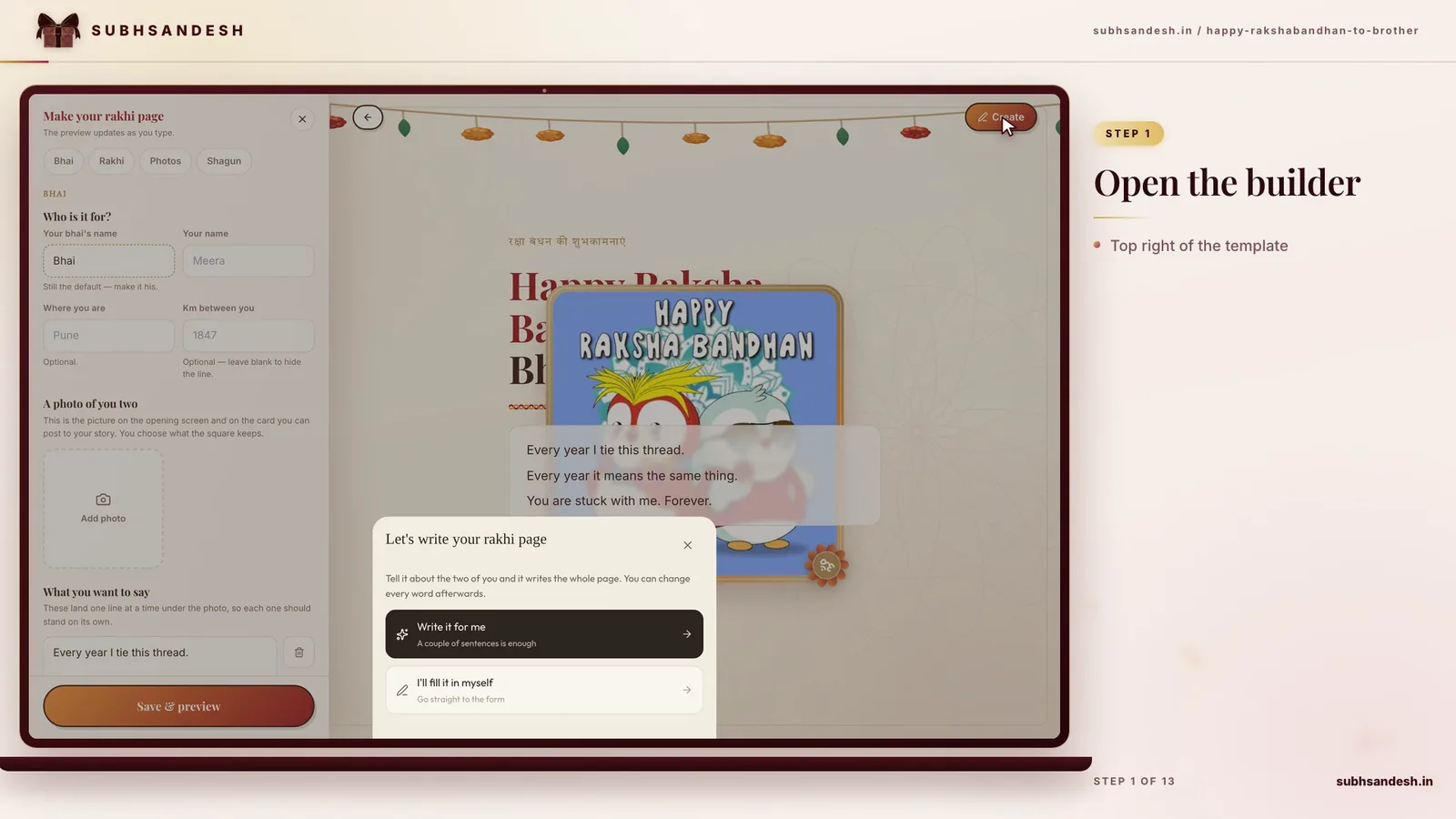
The brother gives his gift now. If it is money, send it during the call, so the transfer sits inside the ritual rather than beside it. If there is nothing physical to hand over, an animated Raksha Bandhan page for a brother opens on the same phone he is already holding.
9. Say the blessing aloud, then close
Screenshots are silent. Say the promise and the blessing in words, both directions, before anyone reaches for the end-call button. Then photograph both wrists — hers with the thread she kept, his with the one now tied.
Only one side has a thali: four ways to split the ritual
Most long-distance ties fall into one of four arrangements. Pick one before the call.
| Arrangement | Who ties the thread | Call minutes needed | SubhSandesh data point |
|---|---|---|---|
| Rakhi posted ahead, family member ties it | A parent, bhabhi or friend with him | 22 | 99.4% of pages started on our site get published and shared (2,701 of 2,718) |
| Rakhi posted ahead, he ties it himself | The brother, on camera | 18 | 51.9% of all page opens happen on a phone (16,952 of 32,683) |
| No rakhi arrived; tied to his photo at her end | The sister, to a printout | 15 | 2,718 pages created since 12 March 2026 across 13 page types |
| Thread kept for a later visit; call carries the ritual | Nobody, yet | 12 | Pages average 12.0 views each, so the record gets reopened |
The takeaway: only the first two put a thread on a wrist on the day, and both depend on something posted a fortnight earlier.
What to post ahead, and how to fit the call into the muhurat from abroad
Post the rakhi, a sachet of roli, a pinch of rice and a sweet that survives transit — the thread alone leaves the far side with nothing to perform the rest with. Take the transit time your courier quotes, count backwards from 28 August 2026 and add a week of slack; a parcel arriving on the 29th missed.
Then do the offset arithmetic, because the family's muhurat window is set in Indian Standard Time, and IST sits at UTC+5:30. Dubai runs 1 hour 30 minutes behind IST, London 4 hours 30 minutes behind, New York and Toronto 9 hours 30 minutes behind, Sydney 4 hours 30 minutes ahead.
A morning window in India is the small hours in North America, so either the Indian side takes a late-evening slot or the sibling abroad wakes early. Take the window from whoever in your family sets it; this page will not invent a muhurat time.
Camera placement: the tie is invisible unless a wrist and two hands share the frame
Video is measurably better than text for this and measurably worse than being there. In a study of 58 young women in close-friend pairs, each holding four five-minute conversations, self-reported bonding was significantly higher over video chat than over instant messaging (Sherman, Michikyan and Greenfield, 2013), and higher still in person.
So spend the frame on what the ritual needs: the wrist during step 6, faces during the sweet and the blessing.
Research on worship moved onto Zoom found participants leaning on explicit digital signals such as the chat box and emoji to communicate affective moments the sensory environment would otherwise have carried (Addo, 2021, Approaching Religion). The offline equivalent: name each step out loud as you do it.
What to do when the call drops mid-ritual
Agree the rule before you start: whoever dropped redials, the other side waits and touches nothing on the thali. Resume from the start of the interrupted step, not from the freeze — a half-applied tilak is worse to watch than a repeated one.
Expect the conversation to feel slightly off even when the connection holds. Measured face-to-face, gaps between speakers averaged 135 milliseconds; the same pairs over Zoom averaged 487 milliseconds (Boland et al., 2021, Journal of Experimental Psychology: General). That is why "you go" — "no, you go" happens so often on a ritual call, and why one named sequence owner fixes more than a better camera does.
When a video-call rakhi is the wrong choice
If your brother is on a low-signal connection, a 22-minute video call is the wrong instrument — run the ritual on a voice call and send the visual part as a link he opens later. Around 44.3% of people who make a page on SubhSandesh password-protect it before sharing (1,205 of 2,718), worth knowing if that link will sit in a family group.
And the honest limit: video is not a substitute for presence. In a study of 2,099 adults aged 65 and over, video contact showed no significant moderating effect on isolation or loneliness, and the authors concluded that no form of technology-mediated communication has emotional equivalence to embodied presence (Burholt, Windle, Gott and Morgan, 2020, The Gerontologist).
If you can be in the room this year, be in the room. If a call and something from the SubhSandesh template gallery is what is available, use it knowing it is second best — and say so on the call.
Sources
- Sherman, L. E., Michikyan, M., & Greenfield, P. M. (2013). The effects of text, audio, video, and in-person communication on bonding between friends. Cyberpsychology, 7(2), Article 3.
- Boland, J. E., Fonseca, P., Mermelstein, I., & Williamson, M. (2021, 8 November). Zoom disrupts the rhythm of conversation. Journal of Experimental Psychology: General (abstract consulted).
- Addo, G. (2021, November). Join the Holy Spirit on Zoom. Approaching Religion, 11(2) (abstract consulted).
- Burholt, V., Windle, G., Gott, M., & Morgan, D. J. (2020, 5 May). Technology-mediated communication in familial relationships. The Gerontologist.
- Raksha Bandhan date checked against the Georgia Tech campus calendar entry for Friday 28 August 2026 (no publication date given).
Frequently Asked Questions
Turn this inspiration into an unforgettable surprise
Build a page with photos, a heartfelt message, music and a ready-to-share link.
- Photos, message & music
- Ready-to-share link

Written by
Suyash Agrahari
Founder
Suyash Agrahari is a Software Engineer at HireQuotient and the founder of SubhSandesh and DrawFlow (drawflow.in). He builds AI agents and full-stack products with Next.js, Node.js, and the OpenAI and LangChain ecosystems, having shipped autonomous multi-agent systems, AI copilots, and large-scale outreach platforms — and scaled side projects from a few hundred to millions of users. He writes about AI engineering, web development, and building products that grow through SEO and organic reach.
Stay Connected
Follow SubhSandesh
New templates, festival ideas and step-by-step walkthrough videos — first on our socials.
Product guide
See it built, step by step
Keep reading
Thala Deepavali: A Couple's First Deepavali at the Bride's Home
Thala Deepavali is a Tamil couple's first Deepavali after marriage, at the bride's home. In 2027 it is Thursday 28 October, oil bath 4:40–6:01 AM in C…
 Suyash Agrahari· 9 min
Sugar-Free Diwali Sweets: Swaps, Label Warnings and the Evidence
Five original no-added-sugar Diwali sweets, why jaggery and honey do not count, the warnings FSSAI requires on a sugar-free box, and what an Indian su…
Suyash Agrahari· 9 minShort Diwali Quotes: 34 Original One-Liners Under 10 Words
34 original short Diwali quotes, each under ten words and marked with its word and character count, grouped by mood: lamps, family, friends, gratitude…
Suyash Agrahari· 9 min