
How to Write a Love Letter to Your Girlfriend That Sounds Like You
To write a love letter to your girlfriend, collect six specific moments before you write a sentence, then build the letter from those instead of adjectives. Across all 975 SubhSandesh “I love you” pages the median gap between first save and last edit is 6.9 hours.
Make this into a page you can send
Photos, a message, music and a ready-to-share link — in a couple of minutes.
or browse all occasionsKey takeaways
- • Collect six specific moments — each with a place and a time — before writing a single sentence; the letter is assembled from those, never from adjectives.
- • Expect most of a day, not five minutes: the median gap between first save and last edit on a SubhSandesh “I love you” page is 6.9 hours across all 975 of them.
- • Those 975 pages are 29.2% of the 3,335 built since 12 March 2026 and the most-read at 14,396 views, so this is the most common version of the task on the platform.
- • A preregistered replication in Collabra: Psychology (30 April 2019) failed to reproduce the finding that concrete wording makes statements seem truer, dz = 0.08 and 0.11 — specificity works because only you could have written it, not as a persuasion trick.
- • 42.9% of creators password-protect the page before sharing it, 1,432 of 3,335.
On this page
How to Write a Love Letter to Your Girlfriend That Sounds Like You
To write a love letter to your girlfriend, collect six specific moments before you write a single sentence, then build the letter out of those moments instead of adjectives. That is the method, and it takes longer than any page on this subject admits: the median gap between a creator's first save and their last edit on a SubhSandesh "I love you" page is 6.9 hours, sampled across all 975 of them.
Those 975 pages are the most-created thing on the platform, 29.2% of the 3,335 pages built since 12 March 2026, and the most-read, at 14,396 views. So the honest answer to "how long will this take" is most of a day across several sittings, not five minutes at your desk.
Below: six steps, one worked letter, the clichés to drop, and when not to send one.
What actually makes a love letter land
A love letter lands when it contains information only you two have. Everything else in it, however warmly phrased, is a greeting card with a longer runtime.
Concreteness is a measured property of words, not a matter of taste: Brysbaert, Warriner and Kuperman published concreteness ratings for 37,058 English words and 2,896 two-word expressions, from over 4,000 raters, in Behavior Research Methods in October 2013.
Abstraction reads badly in a letter because it is what we use for people who are far away. Snefjella and Kuperman, analysing millions of social-media posts in Psychological Science in August 2015, found that people describe more socially, geographically and temporally distant referents in more abstract language.
Write her in adjectives and you have used the register reserved for strangers. She will not be able to name what is wrong, but she will feel it.
The six steps, in order
Do these in sequence. Step 1 is the one most people skip, which is why their letter sounds like every other letter.
1. Collect six moments, before any writing
Open a notes app and list six things that actually happened, each with a place and a time. Not "you are always there for me" but "the night the geyser broke, you boiled water in the pressure cooker at 1 a.m."
Six is the working number because two or three will be unusable. Expect a couple of days of noticing, which is most of that 6.9-hour median.
2. Convert every adjective into an action
Go through your six and delete every trait word. "Kind" becomes the thing she did; "funny" becomes the sentence she actually said.
Packard and Berger, in the Journal of Consumer Research in July 2020, ran five studies including text analysis of over 1,000 real conversations and found that concrete language makes the speaker seem to be listening — attending to and understanding the other person. Specificity is evidence of attention, which is what a letter is trying to prove.
3. Pick one thing you have never said out loud
Every letter needs exactly 1 sentence that is new information: something you noticed and kept, an old fear she fixed without knowing, a decision she changed.
If nothing in the draft is new to her, the letter is a summary of your relationship rather than a contribution to it.
4. Write the middle first, the opening last
Start with your strongest moment and write it out in full detail, then add two more. The greeting and the closing come last, because openings written first turn into throat-clearing.
Aim for 200 to 400 words. Longer and the specific parts get diluted by connective tissue.
5. Cut every line that would work for anyone else
Read each sentence and ask whether you could send it, unchanged, to a different person. If yes, delete it — this usually removes a third of a first draft.
Do the cut cold, a day after writing, which is part of why that median edit window runs to 6.9 hours.
6. End on a promise you can keep this week
Close with something specific and near, not eternal. "Sunday, I am cooking and you are not allowed in the kitchen" outperforms "forever and always" because it is checkable.
An eternal promise costs nothing to write. A dated one is evidence, which is what the letter runs on.
The abstraction trap: why "you are amazing" fails
Abstract praise feels safer to write. It is unfalsifiable, it cannot be argued with, and it lets you avoid choosing which specific thing you mean.
The conversion, in five pairs:
-
"You are always there for me" becomes "You took the 6 a.m. bus to Pune for a hospital appointment that was not yours."
-
"You make me a better person" becomes "You told me to call my father back. I had been putting it off for eleven days."
-
"You are beautiful" becomes "You do that thing with your hair when you are about to disagree with someone."
-
"I cannot imagine life without you" becomes "I buy the coriander you like even in the weeks you are not here."
-
"You complete me" becomes "You re-tied my shoelace in the Bangalore airport queue at 5:40 in the morning, both my hands full."
One honest caveat. Being specific does not make a sentence more believable in general: Henderson, Vallée-Tourangeau and Simons, in a preregistered replication in Collabra: Psychology on 30 April 2019, failed to reproduce the finding that concretely worded statements are judged more likely to be true, getting effect sizes of Cohen's dz = 0.08 and 0.11 with confidence intervals crossing zero.
Specificity is not a truth trick, then. It works in a love letter for the narrower reason that only you could have written those sentences — a different claim, and a stronger one.
One letter, built by the method
Short on purpose: 1 collected moment, 1 thing never said aloud, 1 dated promise.
Rhea —
The shoelace. Bangalore airport, the security queue, 5:40 in the morning, my lace undone and a bag in each hand. You knelt down in front of forty strangers, tied it, stood up and said "walk" like nothing had happened.
I have told that story to four people and none of them understood why it matters. It matters because you did not ask first. You saw the thing, you fixed the thing, and you did not make me thank you for it.
Here is the part I have never said. There is a version of me that would have stood there until someone offered. You have been quietly deleting that version of me for three years and I have never once told you I noticed.
Sunday, at the Kammanahalli house: I am cooking and you are not allowed in the kitchen.
— Arjun
That is 144 words, 4 sentences that could not be sent to anyone else, and no cliché.
Where the finished letter goes
The format changes what she does with it. Paper gets kept and photographed; a WhatsApp message gets scrolled past by Thursday; a page holds the letter next to the photos and the song.
| Route | What she receives | SubhSandesh first-party numbers | Best when |
|---|---|---|---|
| Handwritten paper | One object, no backup | Not measurable — no data | You hand it over in person |
| WhatsApp message | Text buried in a thread | 50.3% of views are on a phone | The letter is under 100 words |
| An "I love you" page | Letter, photos, music, notes, password | 975 built, 14,396 views, 12.3 per page | It needs a place to live |
| A dark, dramatic page | The same letter, cinematic register | 343 built, 10.3% of all pages | The letter is intense, not sweet |
The number that matters is 14,396 reopenings across 975 pages, which paper cannot report and a chat thread does not encourage.
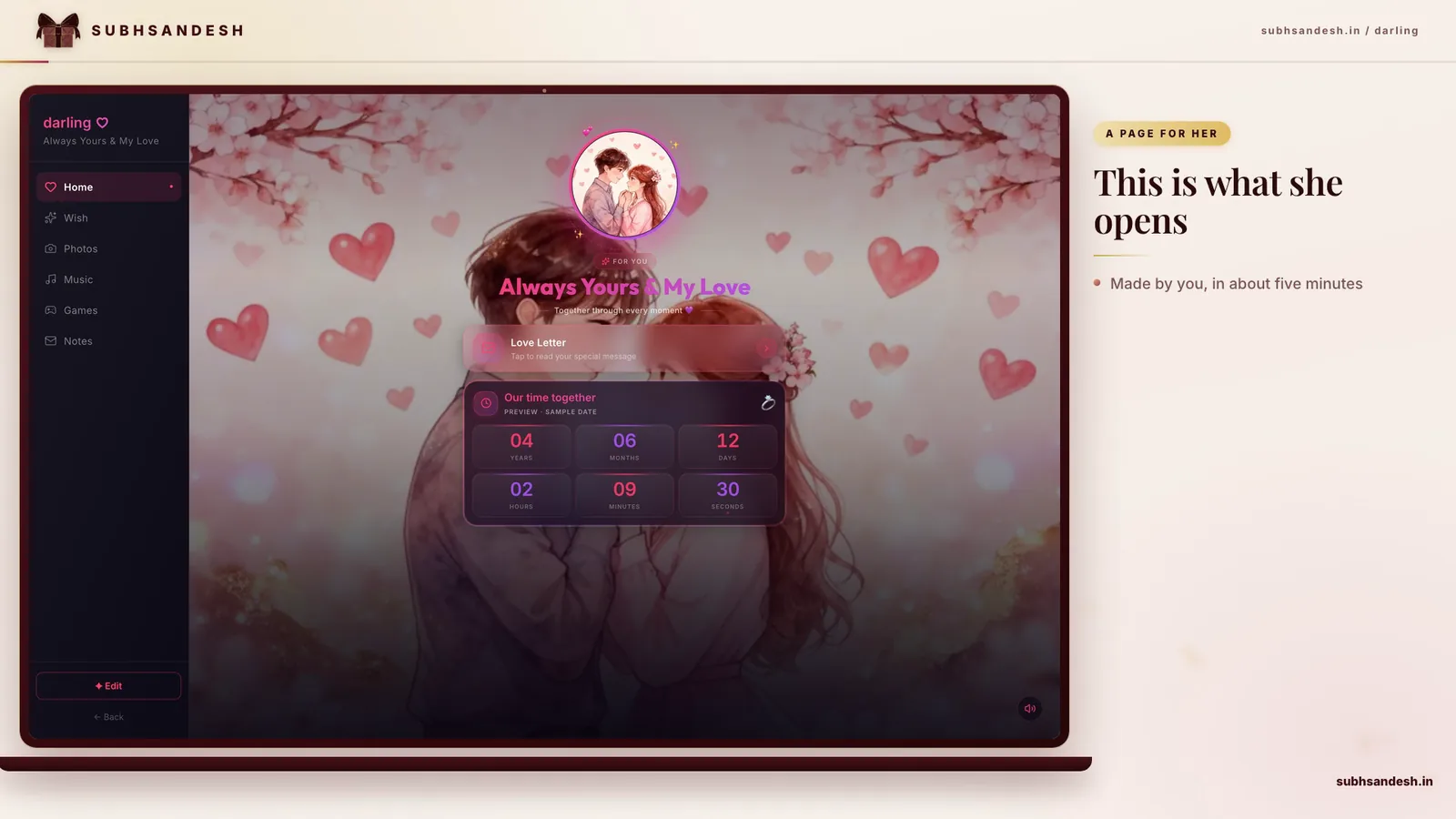
If the letter should sit inside something, the romantic "I love you" page for a girlfriend is what most people pick: the letter, a photo gallery, background music, notes, small games, optional password. For a heavier register, the dark, dramatic romantic page for a partner carries the same words in a cinematic frame.
On privacy: 42.9% of creators password-protect the page before sharing, 1,432 of 3,335 — what you would expect of something this specific.
Clichés that are dead on arrival
These 8 fail because they are borrowed, and a borrowed sentence in a love letter is a tell. She has read all of them before, on cards and captions and other people's stories.
Drop outright: "you complete me", "you are my everything", "my better half", "I love you to the moon and back", "words cannot describe how I feel", "you had me at hello", "I cannot imagine life without you", "you are my world".
The replacement rule is mechanical, not creative: take the cliché, ask which single event made you reach for it, write the event instead.
Also drop the apology for your own writing. "I am not good with words" spends your opening line telling her the letter is not worth much — and 99.5% of pages started here get published anyway, 3,317 of 3,335.
When a love letter is the wrong move
A letter is the wrong instrument in four situations, and sending one anyway usually makes things worse.
It is wrong immediately after a fight. A letter is a closing argument she cannot interrupt, which is the opposite of what an unresolved argument needs.
It is wrong when the real purpose is to extract a decision. "So where do we stand?" is a conversation with two people in it, and a letter makes her answer a question she did not choose.
It is wrong when she has asked for space, and wrong when you are in the same room and could simply say it. A letter's advantage is that it survives the moment, which is worth nothing when the moment is available.
It is also wrong as a substitute for showing up. Average pages per creator here is 1.21: this is a once-or-twice act, a marker rather than a maintenance plan. The full SubhSandesh template gallery shows what a letter can be built into.
Sources
- Brysbaert, Warriner and Kuperman, concreteness ratings for 37,058 English words, Behavior Research Methods, 19 October 2013.
- Snefjella and Kuperman, concreteness and psychological distance, Psychological Science, 3 August 2015.
- Packard and Berger, how concrete language shapes satisfaction, Journal of Consumer Research, 18 July 2020.
- Henderson, Vallée-Tourangeau and Simons, replication of the concrete-wording truth effect, Collabra: Psychology, 30 April 2019.
- SubhSandesh platform data, 1 September 2026.
Frequently Asked Questions
Turn this inspiration into an unforgettable surprise
Build a page with photos, a heartfelt message, music and a ready-to-share link.
- Photos, message & music
- Ready-to-share link

Written by
Suyash Agrahari
Founder
Suyash Agrahari is a Software Engineer at HireQuotient and the founder of SubhSandesh and DrawFlow (drawflow.in). He builds AI agents and full-stack products with Next.js, Node.js, and the OpenAI and LangChain ecosystems, having shipped autonomous multi-agent systems, AI copilots, and large-scale outreach platforms — and scaled side projects from a few hundred to millions of users. He writes about AI engineering, web development, and building products that grow through SEO and organic reach.
Stay Connected
Follow SubhSandesh
New templates, festival ideas and step-by-step walkthrough videos — first on our socials.
Product guide
See it built, step by step

Keep reading
Which Day Comes After Propose Day, and What Happens Now
Chocolate Day comes after Propose Day — Tuesday 9 February 2027. That is one sentence, so this page covers the four situations you are actually in on …
 Suyash Agrahari· 9 min
When to Propose a Girl to Be Your Girlfriend, and When Not To
The timing question, answered with conditions instead of a date: what has to be true before you ask, what politeness and fast replies do not prove, wh…
Suyash Agrahari· 9 minRomantic Proposal Room Decoration: What the Room Must Do
Romantic proposal room decoration, sorted by the work each setup takes and what the room allows: 7 setups with set-up and reversal times, lighting evi…
Suyash Agrahari· 9 min