
I Love You Message for Her Long Distance Relationship: 30 Lines
30 long-distance "I love you" messages for her, grouped by the job each one does — reassure, name a shared detail, mark her time zone, count down, admit it is hard — with the four that backfire named, and first-party data from 975 pages and 14,396 views.
Make this into a page you can send
Photos, a message, music and a ready-to-share link — in a couple of minutes.
or browse all occasionsKey takeaways
- • Sort the message by its job: 30 lines here split into reassurance, a specific shared detail, a time-zone marker, a countdown to a booked date, and the honest admission.
- • A message that asks for reassurance while pretending to give it is the most common long-distance failure; a 2022 daily diary of 110 couples tied excessive reassurance seeking to lower next-day trust.
- • Volume is not the fix: a 2025 systematic review of 151 analyses found partner support buffered attachment insecurity's effect on emotions in only 9% of them.
- • A chat message is buried by tomorrow; SubhSandesh pages average 12.3 views each and the 975 "I love you" pages hold 14,396 views between them.
On this page
I Love You Message for Her Long Distance Relationship: 30 Lines
The best i love you message for her long distance relationship reassures her without asking her to reassure you back; the fastest way to get it wrong is a line that is secretly a question. Sort the message by the job it does: reassure, name a shared detail, mark her time zone, count down to a real date, or admit the distance is hard.
SubhSandesh's own data says why that sorting matters: the "I love you" page is the most-created template on the platform, 975 pages and 29.2% of everything built since 2026-03-12, and those pages have taken 14,396 views, 35.2% of all 40,864 recorded. Below are 30 lines by job, plus the four that backfire.
What makes a long distance "I love you" land differently
A long-distance message carries a load a same-city one never has to: it arrives with no face, no tone and no room, so she fills in the context from her own day, not yours.
That guesswork is measurable. A 2021 Frontiers in Psychology study of 84 people in dating relationships notes that online communication is ambiguous and open to interpretation, making it easier for people high in attachment anxiety to read it as threatening.
So a long-distance relationship message has three jobs a same-city text lacks: survive being read cold, survive a time-zone gap, survive your own anxiety.
30 "I love you" messages for her, sorted by the job each one does
Send one, not six. Each line notes when it lands, because the same sentence is a gift at 9 a.m. and a demand at 2 a.m.
1. Reassurance that asks for nothing back
In Collins and Feeney's 2000 study of 93 dating couples, more direct support-seeking drew more helpful caregiving, and that responsive care was what made seekers feel cared for. Asking sideways worked worse than asking plainly.
- "No reply needed. I just wanted this here when you wake up." Safe at any hour; wrong if you need an answer.
- "I love you. Nothing is wrong, I just thought it and sent it." Good after a quiet day; not if something is wrong.
- "You are not something I'm waiting out. You are the plan." For when she doubts the timeline; too heavy on a Tuesday.
- "I chose this today too, and I'll choose it tomorrow." Good in a hard week; not straight after a fight.
- "I don't need proof from you. I already know." After she apologises for being busy; wrong if you keep score.
- "You're allowed to be tired. I'm not going anywhere." Best when work is eating her; not if you need holding tonight.
- "Nothing about how I feel depends on how fast you text back." Useful if reply speed has been an issue; only if true.
2. One specific shared detail
Specificity is the cheapest proof of attention there is, and a copied line cannot fake it. Felt-security research rewards the same thing: responsiveness she can perceive.
- "Someone on the metro wore your exact yellow kurta and I stared like a fool." Unfakeable, lands anywhere; needs a real memory.
- "Your voice note from Tuesday is still in my starred messages." For when she feels forgettable; not if it was a fight.
- "Made the dal with too much haldi again. You'd have caught it." Domestic and low-stakes; wrong as a reply to bad news.
- "Walked past the bench outside your old PG. Still crooked. I love you." Good on a nostalgic evening; not if it stings.
- "I love you the way you say 'accha' when you're only half-listening." Only you have it; too intimate after a silent day.
- "The song you sent in March came on shuffle and I let it finish twice." Works any time; useless if you can't name it.
3. Marking her clock, not yours
A time-zone gap turns an ordinary text into an ambush; these lines say the hour out loud, so she reads the message, not the delay.
- "It's 11:40 here and your morning hasn't started. Loving you into it anyway." Send at your night; pointless in one zone.
- "Good morning to your side. I'm going to sleep on mine. I love you." A handover; skip it if you want to talk tonight.
- "You're four hours behind me today, so this is a letter, not a question." Good when she is asleep; not if a decision is pending.
- "By the time you read this you'll have had chai. I love you either way." Warm and reply-free; weak if her routine changed.
- "I set your 9 a.m. as my reminder to say it before my day eats me." Evidence of planning; not if you then miss two days.
- "Sleep. I'll still love you in your morning, and I'll still be asleep in it." Best as your last message; not if she is upset.
4. Counting down to a real date
A countdown reassures only if the date is real; an invented one does more damage than silence.
- "Nineteen days. I love you, and I've already picked what I'm wearing." Once travel is booked; never guess the number.
- "The ticket is booked. Read that again, then read that I love you." The strongest line here; available once, so spend it well.
- "Three weekends. That's all that's left of this. I love you." For the final stretch; not if a trip is unconfirmed.
- "I love you, and on the 14th I'm not letting go for the first ten minutes." Lands close to the date; too much a month out.
- "Countdown says 26 days. My plan for day one is nothing at all, with you." When logistics have exhausted her; not if she wants detail.
- "Next month this is a memory we tell badly at parties. I love you." Lands as perspective; weak if the reunion is unbooked.
5. The honest admission that this is hard
Most lists refuse this register, which is why it works: name your own state and close the sentence, instead of leaving it open for her to fix.
- "I love you, and today the distance was heavy. Both things are true." After a normal bad day; not at 2 a.m.
- "I'm not okay tonight, and I'm not asking you to fix it. I love you." Honest without a demand, if clause two is real.
- "I miss you in a boring, daily way that has nothing to do with drama." Good any time; not three days running.
- "I cried at an ad for a phone plan. I love you. That's the whole update." Disarming; not if she is mid-crisis herself.
- "Some days I hate this setup and never once you. I love you." When she apologises for the distance; never mid-argument.
The four that backfire
A message that asks for reassurance while pretending to give it is the most common failure in long-distance texting. "I love you so much, do you still feel the same?" is two messages stapled together, and she will only answer the second one.
The other three are the test ("you'd have replied by now if you cared"), the guilt shape ("I waited up till 2 a.m."), and the demand ("call me right now"), which wants an instant reply from someone asleep. A daily diary study of 110 couples in Europe's Journal of Psychology (2022) found anxious attachment went with more excessive reassurance seeking, and for anxiously attached women that predicted lower next-day trust.
Volume does not rescue a weak message. A 2025 systematic review in Collabra: Psychology pooled 151 analyses across 31 studies and found partner support buffered attachment insecurity's effect on emotions in 9% of them.
Which job to send when
Each group against the hour on her clock and the SubhSandesh figure behind it, 2026-09-01.
| Message job | Lines above | Best send window on her clock | First-party signal it leans on |
|---|---|---|---|
| Reassurance, nothing asked back | 7 | any hour, even while she sleeps | 975 /love-gf pages, 29.2% of 3,335 created |
| One specific shared detail | 6 | 09:00–21:00 her time | 14,396 /love-gf views, 35.2% of 40,864 |
| Marking her clock | 6 | her 07:00 or her 23:00 | 50.3% of views opened on a phone |
| Counting down to a real date | 6 | 7–30 days before the date | 12.3 average views per created page |
| The honest admission | 5 | after a call, never before her sleep | 343 /darling pages, 10.3% of all created |
Only the reassurance group is safe to send blind; only the honest admission needs a call.
Why the message is gone by tomorrow
A chat thread is a bad container for what you most want her to keep. Tomorrow's forwards push it out of reach, and neither of you scrolls back to March.
A page behaves differently. SubhSandesh pages average 12.3 views each, and the 975 "I love you" pages hold 14,396 views between them — roughly 14.8 opens each, not one read and a scroll. Creators treat them as drafts, too: a median 6.9 hours passes between first save and last edit across those 975 pages.
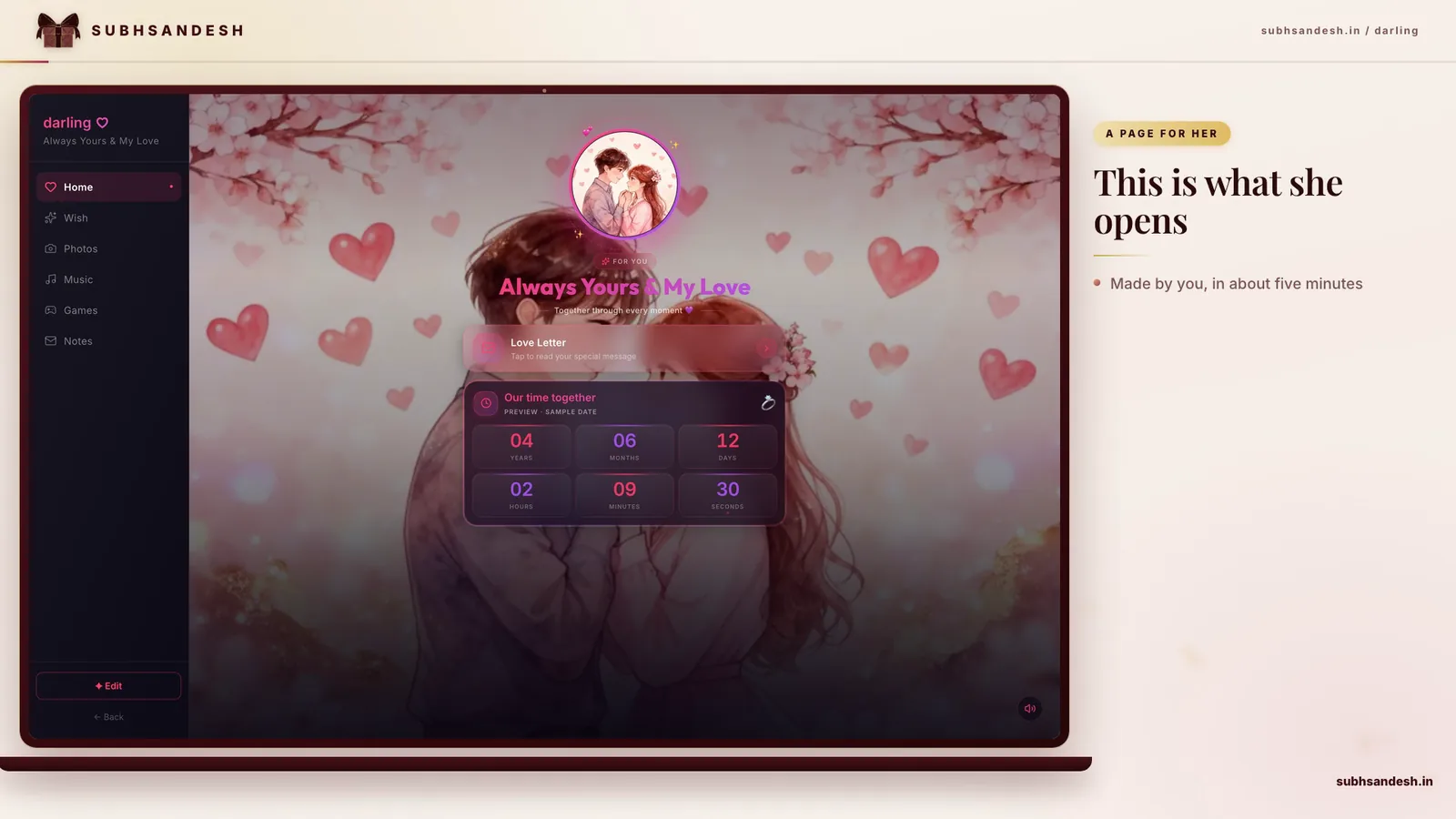
So if a line deserves to outlive tomorrow, put it on an "I love you" page she can reopen, where letter, gallery, music and notes sit behind one link with an optional password that 42.9% of creators switch on. When the message is heavy rather than sweet, the darker, more dramatic Darling page holds the tone better; when missing her is the real subject, an "I miss you" page fits closer.
When a page is the wrong choice
If she is upset right now, a page is a project and she needs a sentence: send the plain line, build nothing. If you meet next week, say it in person.
And if she reads on a work laptop, note 50.3% of views land on a phone, which is what these layouts are tuned for. A 2020 study of 472 people in 236 couples found perceived responsiveness predicted lower partner-specific attachment anxiety, most of all for people who were generally insecure. Responsiveness, not production value.
Sources
- Collins & Feeney, "A Safe Haven", 2000 — 93 couples.
- Rice, Kumashiro & Arriaga, IJERPH, 30 September 2020 — 472 people.
- Evraire, Dozois & Wilde, Europe's Journal of Psychology, 25 February 2022 — 110 couples.
- Mosannenzadeh et al., Collabra: Psychology, 17 March 2025 — 151 analyses.
- Sullivan, Frontiers in Psychology, 16 July 2021 — 84 people.
- SubhSandesh platform data, 2026-09-01.
Frequently Asked Questions
Turn this inspiration into an unforgettable surprise
Build a page with photos, a heartfelt message, music and a ready-to-share link.
- Photos, message & music
- Ready-to-share link

Written by
Suyash Agrahari
Founder
Suyash Agrahari is a Software Engineer at HireQuotient and the founder of SubhSandesh and DrawFlow (drawflow.in). He builds AI agents and full-stack products with Next.js, Node.js, and the OpenAI and LangChain ecosystems, having shipped autonomous multi-agent systems, AI copilots, and large-scale outreach platforms — and scaled side projects from a few hundred to millions of users. He writes about AI engineering, web development, and building products that grow through SEO and organic reach.
Stay Connected
Follow SubhSandesh
New templates, festival ideas and step-by-step walkthrough videos — first on our socials.
Product guide
See it built, step by step

Keep reading
Te extraño, papá: frases para un padre que ya no está y para uno que vive lejos
Ocho de ocho resultados en México y en España escriben para un padre fallecido; ninguno para un padre vivo que vive lejos. Aquí las dos mitades están …
 Suyash Agrahari· 9 min
Te extraño mucho: frases para él, y por qué casi ninguna lo es de verdad
«Te extraño mucho» no lleva género: en 103 frases atestiguadas no hay ni una marca masculina o femenina. Qué cambia de verdad al escribirle a un hombr…
Suyash Agrahari· 9 minTe extraño en silencio: significado, y la decisión que hay detrás
«Te extraño en silencio» no describe a alguien callado: el DLE define la locución adverbial «en silencio» como «sin protestar, sin quejarse». En 100 o…
Suyash Agrahari· 8 min