
Long Distance Rakhi Celebration Ideas Without a Video Call
The long-distance rakhi that works is two houses holding the same objects and running the same sequence at the same agreed minute - no camera. Real postal lead times, a five-step parallel ritual, the food problem, and what to do when there is no call at all.
Make this into a page you can send
Photos, a message, music and a ready-to-share link — in a couple of minutes.
or browse all occasionsKey takeaways
- • A synchronised rakhi needs no bandwidth: both houses run the same fixed sequence at one agreed minute, roughly eight minutes end to end, with the camera off.
- • Post duplicates, not a single gift - two rakhis, two identical sweets, a spare thread - so both wrists get a thread at the same moment.
- • India Post's 24 Speed Post is next-day across six metro cities, seven days a week, capped at 5 kg; USPS Priority Mail International is 6-10 business days, so international wanted weeks, not days.
- • Only one of the four coordination modes compared here requires a shared waking hour, and it is the one every competing article leads with.
- • Raksha Bandhan 2026 is Friday 28 August, with 29-30 August falling on the weekend - which makes celebrating remotely and then again in person a plan rather than a consolation.
On this page
Long Distance Rakhi Celebration Ideas Without a Video Call
The best long distance rakhi celebration ideas are not screen ideas. They are two households holding the same objects and running the same short sequence at the same agreed minute — no camera, no bandwidth, nothing to drop mid-ritual. Post a second thali and a second rakhi weeks ahead, agree one minute on Friday 28 August 2026, and both sides light, tilak, tie and eat in parallel.
Across 2,739 personalised pages SubhSandesh has recorded 33,007 views, and the median gap between a page's first save and its last edit is 6.9 hours — evidence that a shared artefact stays open across a whole day instead of ending when a call ends. Below: what to post and by when, the five-step parallel sequence, the food problem nobody addresses, why 2026 makes celebrating twice practical, and what to do when there is no call at all.
What is a synchronised long-distance rakhi?
A synchronised long-distance rakhi is one ceremony performed twice, in two places, at one agreed clock time, using duplicate materials posted in advance. Nobody watches anybody perform. The coordination sits in the clock and the objects, not in a video feed.
A 2018 review in Personality and Social Psychology Review defines ritual as predefined sequences characterised by rigidity, formality and repetition, embedded in symbolism. A predefined sequence is portable by definition: if the order is fixed, two people can run it apart and still have run the same thing.
The same review describes ritual regulating social connection through behaviour "similar in form and matched in time with others", and notes synchrony raises affiliation and cooperation "especially when synchrony is part of the goal".
The parallel ritual: five steps both houses run at the same minute
Five steps, roughly eight minutes end to end, camera off, in this order in both houses.
1. Lock one minute and write it in both clocks
Agree a single minute a week ahead and write it twice — "7:40 pm IST / 10:10 am ET" — in the same message. Whoever proposes it does the conversion; never leave arithmetic to the person who is tired.
A week of notice matters because Raksha Bandhan 2026 falls on Friday 28 August, a working day at both ends. Put it in both calendars with a 15-minute alert, not a same-day reminder.
2. Lay both thalis before the minute, not during
Each house sets out its own thali: diya, roli, rice, a thread, one sweet. Ten minutes of setting up beforehand is what stops the ritual becoming a hunt for matchsticks at 7:41.
If only one house has the traditional items, decide a week earlier what the second is substituting — a tea light, a pinch of turmeric, a plain red thread — instead of improvising in silence.
3. Tie at the minute — each on their own wrist
At the agreed minute she ties the rakhi she kept for herself onto her own wrist, and he ties the one she posted onto his. No proxy, no photo-tying, nobody holding a phone.
Two wrists get a thread at the same moment in two cities. This is why the second rakhi in the parcel matters more than the first.
4. Eat the same sweet on the same count
Both sides open the same sweet and eat it together, counting to three out loud in an empty room if that is what it takes. Researchers studying remote dining found describing your own food and how you made it was the first thing people reached for, and that remarks about food preparation were "always followed by laughter".
5. Send one line the moment you finish, then stop
Straight after, each side sends one sentence — not a paragraph, not a photo dump. "Done, 7:48, the diya went out twice."
The point is a timestamped acknowledgement that both halves happened. A twenty-minute post-mortem call is a different activity, and folding it in is how a ritual starts feeling like admin.
What to post ahead, and the lead times that actually apply
The design depends on both houses holding the same things, which makes postage the real deadline. India Post's 24 Speed Post service delivers next-day, seven days a week including Sundays, across all pin codes of six metro cities — New Delhi, Mumbai, Bengaluru, Chennai, Kolkata and Hyderabad — with a full postage refund if the D+1 commitment is missed, claimable online within seven days.
Parcels on that service cap at 5 kg, which a thali set with sweets comfortably clears. Metro to metro you can be honest with yourself until roughly 26 August; outside those six cities, give it a week.
International is a different order of magnitude. USPS rates Priority Mail International at 6–10 business days — before customs, before a holiday at either end, before a weekend at a sorting facility.
That is two calendar weeks in practice, so an India-bound parcel from the United States wanted posting in the first week of August. International needed weeks, not days. Pack duplicates deliberately: two rakhis, two identical sweets, a spare thread, and a sealed note nobody opens until the minute.
Four ways to coordinate a rakhi apart, compared
What each coordination mode actually demands of both sides.
| Mode | Needs a shared waking hour? | Lead time before the day | Cost | SubhSandesh evidence |
|---|---|---|---|---|
| Parallel ritual, posted duplicates | No | 1–3 days metro India; 2–3 weeks international | Postage plus a second set of materials | — |
| Shared album both sides add to | No | None | Free | Median 6.9 hours between first save and last edit (n=914) |
| A shareable rakhi page | No | Minutes | Free tier | 12.1 average views per page; 44.3% password-protected |
| Video call | Yes | None | Free | 51.8% of 33,007 views open on a phone |
Only one of the four needs a shared waking hour, and it is the one every competing article leads with.
The asynchronous artefacts do the heavy lifting: an album both sides drop into across the day, a playlist you each add five songs to, a note written in turns. These accept contributions at 6 am and at 11 pm without anyone waiting up.
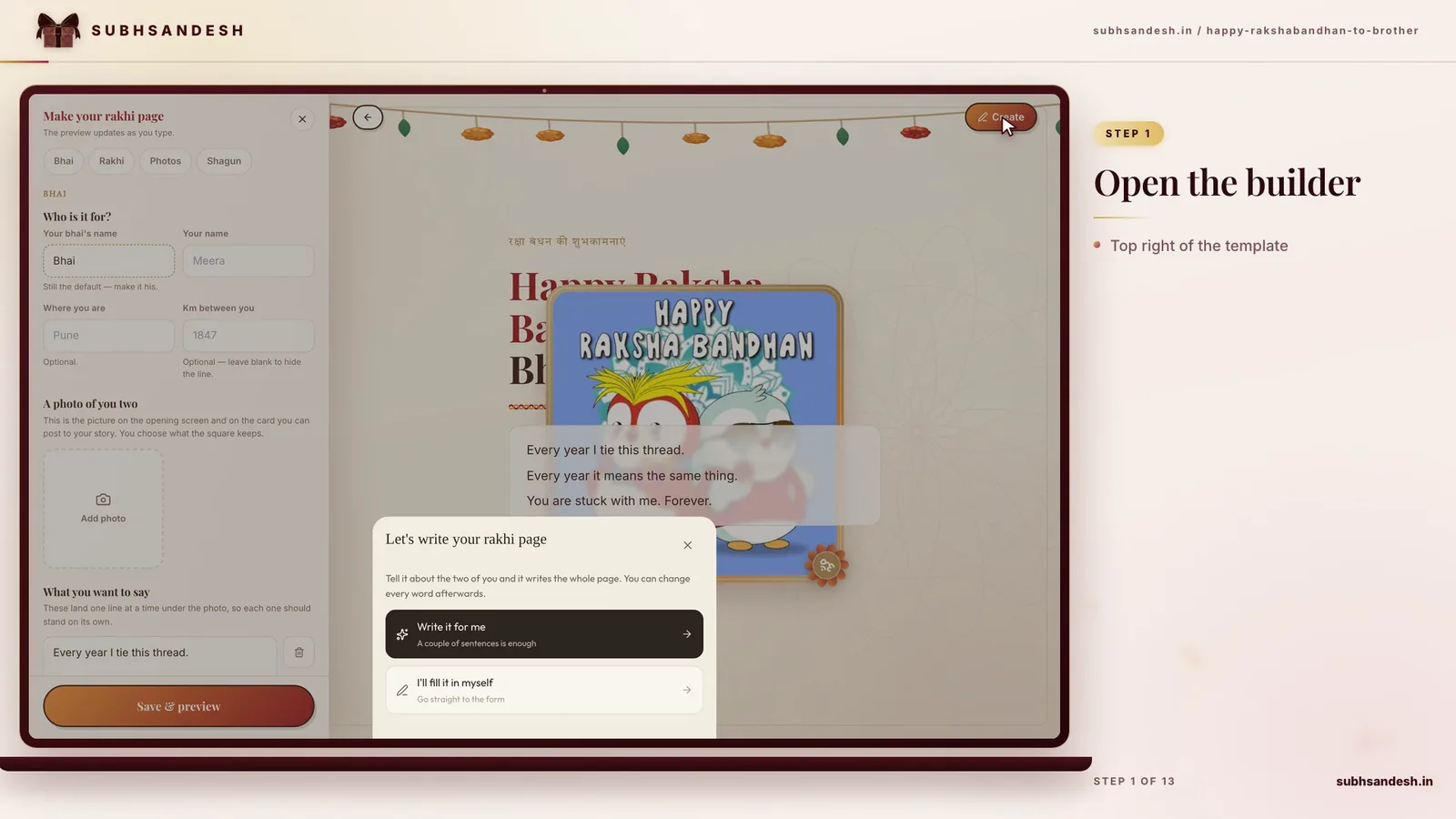
If you want one object rather than three apps, the Raksha Bandhan page for a brother holds a photo, a name and a message behind a single link. It is written brother-first, so a sister-directed version means adapting something from the wider template gallery.
Food: sweets that survive the post, and one dish cooked in two kitchens
Almost nobody writing about long-distance rakhi treats food seriously, and it is the part most likely to fail. Milk-based mithai — barfi, rasgulla, anything with khoya or syrup — does not survive four days in a parcel, let alone ten, and dairy is routinely stopped at international borders. What travels: dry besan or coconut ladoo, sohan papdi, chikki, roasted dry fruit, sealed and boxed rigid.
For international distance the better move is not to post food at all. Researchers who interviewed 29 migrating mothers living in London for between one and twenty-two years class cooking and commensality as a malleable resource — something you act on and reshape, unlike merely referring to a recipe. Send the exact quantities from your mother's recipe and both of you make it badly on the same night.
Celebrate twice on purpose: Friday 28 August, then the weekend
Raksha Bandhan 2026 is Friday 28 August. Both siblings are likely working, and the parallel ritual is built for that: eight minutes, no scheduling negotiation, done before dinner.
Then do it again in person on the next visit, and treat that as the second half rather than a consolation. The Friday helps — 29 and 30 August are a Saturday and Sunday, so anyone within a night train or short flight can hold the in-person version 48 hours later without taking leave.
Say it out loud in advance. "We'll do the thread on Friday at 7:40 and the proper one when I'm home in October" removes the low-grade guilt that otherwise sits over the day. Two celebrations is not half a celebration each.
When there is no call at all
Sometimes there is no shared minute either — a night shift starting at 8 pm, a hospital ward with no phones after visiting hours, a prison with scheduled calls once a fortnight, or a relationship where contact has stopped.
Do the sequence alone at the agreed minute anyway, and post the thread. A ritual whose order is fixed does not require an audience to have been performed.
Where a letter is the only channel, write the minute into it — "I tied yours at 7:40 on Friday" — so the other person can place it. Where contact has stopped entirely, tie the rakhi, keep the sweet, and leave it there: no text, no explanation, nothing requiring a reply.
One practical note: 44.3% of SubhSandesh creators password-protect a page before sharing it, which matters when a message may be read by someone other than its intended recipient.
When a parallel rakhi is the wrong choice
If you are in the same city, close this tab and go. Two people ninety minutes apart running a synchronised ritual on separate sofas is a self-inflicted wound.
It is also wrong when one side has not agreed. This works only on an exact minute; if a sibling is going to be "around 8-ish", a recorded voice note and a posted parcel land better than a coordination they never signed up to.
A digital artefact is the wrong medium for a grandparent with no smartphone. 51.8% of shared page views are on a phone, a strong number until the recipient has none — in which case a printed photograph in the parcel beats any link, and a landline call at the agreed minute beats both.
Sources
- Hobson, Schroeder, Risen, Xygalatas & Inzlicht, "The Psychology of Rituals: An Integrative Review and Process-Based Framework", Personality and Social Psychology Review 22(3), published 1 August 2018.
- Alhasan, Ceccaldi, Covaci, Mancini, Altarriba Bertran, Huisman, Lemke & Ang, "The Playful Potential of Digital Commensality", Proceedings of the ACM on Human-Computer Interaction 6 (CHI PLAY), published 25 October 2022.
- Greco Morasso & Zittoun, "The trajectory of food as a symbolic resource for international migrants", Outlines: Critical Practice Studies 15(1), 2014.
- India Post, Department of Posts, 24/48 Speed Post FAQs, page last reviewed 12 August 2026.
- United States Postal Service, Priority Mail International service page (no publication date stated).
Frequently Asked Questions
Turn this inspiration into an unforgettable surprise
Build a page with photos, a heartfelt message, music and a ready-to-share link.
- Photos, message & music
- Ready-to-share link

Written by
Suyash Agrahari
Founder
Suyash Agrahari is a Software Engineer at HireQuotient and the founder of SubhSandesh and DrawFlow (drawflow.in). He builds AI agents and full-stack products with Next.js, Node.js, and the OpenAI and LangChain ecosystems, having shipped autonomous multi-agent systems, AI copilots, and large-scale outreach platforms — and scaled side projects from a few hundred to millions of users. He writes about AI engineering, web development, and building products that grow through SEO and organic reach.
Stay Connected
Follow SubhSandesh
New templates, festival ideas and step-by-step walkthrough videos — first on our socials.
Product guide
See it built, step by step
Keep reading
Thala Deepavali: A Couple's First Deepavali at the Bride's Home
Thala Deepavali is a Tamil couple's first Deepavali after marriage, at the bride's home. In 2027 it is Thursday 28 October, oil bath 4:40–6:01 AM in C…
 Suyash Agrahari· 9 min
Sugar-Free Diwali Sweets: Swaps, Label Warnings and the Evidence
Five original no-added-sugar Diwali sweets, why jaggery and honey do not count, the warnings FSSAI requires on a sugar-free box, and what an Indian su…
Suyash Agrahari· 9 minShort Diwali Quotes: 34 Original One-Liners Under 10 Words
34 original short Diwali quotes, each under ten words and marked with its word and character count, grouped by mood: lamps, family, friends, gratitude…
Suyash Agrahari· 9 min