
13 Long Distance Relationship Surprise Ideas On a Phone
The long distance surprise ideas that work on a phone need no address and no courier. 13 ideas sorted by what you need - ten minutes, a small spend, her address, or someone next to her - with a time-zone column and figures from 3,335 pages we host.
Make this into a page you can send
Photos, a message, music and a ready-to-share link — in a couple of minutes.
or browse all occasionsKey takeaways
- • Nine of the 13 ideas need no address at all — only her number or a link — and 50.3% of our 40,864 recorded page views arrive on a phone.
- • The "I love you" page is 29.2% of the 3,335 pages created on SubhSandesh since 12 March 2026, and it takes 35.2% of all views.
- • Building a page is not a one-sitting job: the median gap from first save to last edit is 6.9 hours across all 975 of them.
- • Once you need her address or a third party, the surprise stops being time-zone-proof — that is the dividing line in the comparison table.
- • 42.9% of creators password-protect their page before sharing it (1,432 of 3,335), which is what makes a link safe to open beside a colleague.
On this page
13 Long Distance Relationship Surprise Ideas On a Phone
The long distance relationship surprise ideas on a phone that actually land share one trait: they need no address and no courier, only her number or a link. The 13 below are sorted by what you need — ten spare minutes, a small spend, her address, or someone standing next to her.
We can be specific about the phone-only route because we watch it happen. Of 3,335 pages created on SubhSandesh since 12 March 2026, 975 were the "I love you" page for a girlfriend, 29.2% of everything built, and that one template has taken 14,396 views — 35.2% of all 40,864 recorded views. Half of those views, 50.3%, happen on a phone.
What counts as a surprise you can run entirely from a phone?
A phone-only surprise is one where making it, timing it and delivering it all happen on a device you are holding, and she needs nothing but her own phone to receive it. No address, no signature, no third party in the middle.
That changes what "works" means. 50.3% of our 40,864 recorded views arrive on a phone (20,561 of them), so your surprise competes on a screen already carrying her whole day: a 2014 MobileHCI logging study of 15 Android users found they handled 63.5 notifications a day, typically viewed within minutes.
5 surprises that need nothing but ten minutes
These cost nothing, depend on nobody else, and take under ten minutes each — the ideas people abandon are the ones that need a whole evening.
1. A voice note recorded while you walk home
Record 45 to 90 seconds of unedited talking — where you are, what you saw, what you thought about. Voice survives a bad moment better than text, because she can replay it.
Keep it under 90 seconds: a short note gets replayed, a five-minute one gets postponed.
2. A 60-second video of a place she has never seen
Film the walk from your gate to the main road, or the view from your desk at 6pm. Say nothing, or narrate one sentence.
It gives her the ordinary version of your day, and nothing about it is live.
3. One camera-roll photo plus the date she has forgotten
Find a photo from a day you would both remember and send it with the date and nothing else.
The restraint is the point: a dated photo asks her to do the remembering.
4. A shared note she wakes up to
Open a shared note or doc, write one line in it, and share it once. Then add a line a day without announcing any of them.
The surprise is cumulative rather than instant, so it survives opposite halves of the clock.
5. A calendar invite for a call she did not ask for
Send a 20-minute invite titled with something only she would understand, at a time checked against her clock. It reads as a plan rather than a demand.
The least romantic idea here, and the one most likely to be used twice.
Long distance relationship surprise gifts you can buy and send in one sitting
These need a payment method and nothing else, and each is delivered inside ten minutes.
6. A month of the music service she already uses
Spotify's Premium Individual plan in India is ₹139 a month; Netflix's cheapest India plan is ₹149. One month is a small, unembarrassing amount that removes a real irritation.
Pair it with a playlist and a line under each track saying why you picked it — the gift is the excuse, the annotation is the surprise.
7. A private page with a letter, a gallery and background music
A page collects a letter, photos, a soundtrack and a few notes behind one link, which is why the "I love you" page is 29.2% of everything created here. The median gap between first save and last edit on it is 6.9 hours across all 975 — people start, leave it, and come back, so do not promise one tonight.
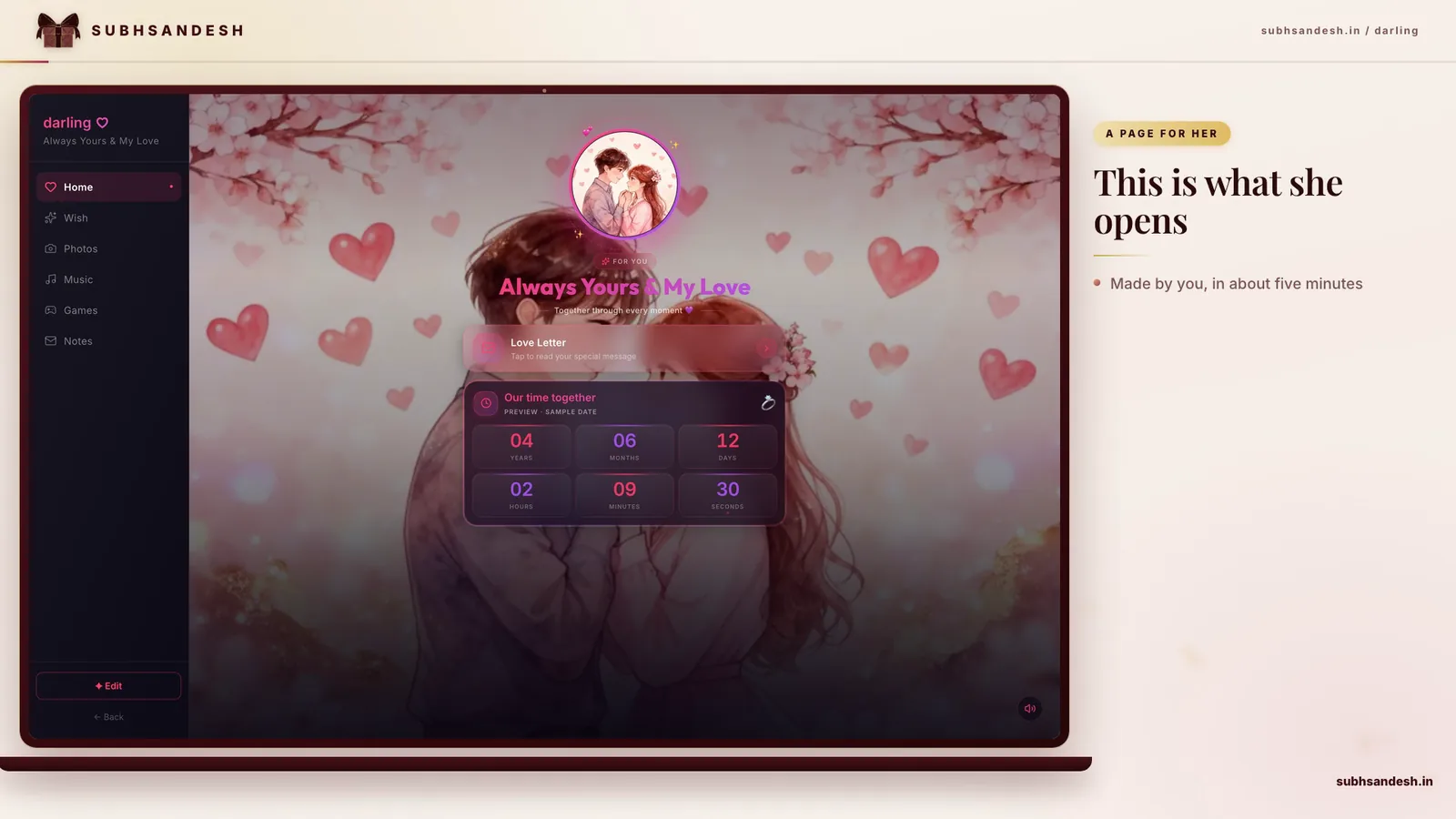
The romantic "I love you" page for a girlfriend carries the letter, gallery, background music, Love Quiz and Truth-or-Dare together; for something moodier, the dark, cinematic Darling page is our fourth most-built template at 343 pages, 10.3% of the total.
8. A quiz or a game about the two of you
A ten-question quiz — how you met, the argument you still laugh about, her order at her local place — turns a one-way message into something she does.
It fails when it is too easy: write three questions you are unsure she will get right.
9. An ebook or audiobook she mentioned once
Buy the specific title she referenced three weeks ago and send it with the sentence she said. Delivery is instant and needs no address.
The recall does the work, not the money: a ₹200 book she mentioned beats a ₹2,000 one she did not.
4 surprises that need her address or someone standing next to her
These break the phone-only rule at the receiving end, though you still arrange all four from your phone. The dependency is hers, not yours.
10. Food to her desk, ordered from your phone
Order from a delivery app using her address, timed to land at a meal she would otherwise skip. Needs a saved address and a guess at where she is.
If she is not where you think, she has to deal with the wasted food.
11. Flowers from a florist near her, not near you
Find a shop in her locality rather than a national chain and ask for delivery on a named day. Local shops are cheaper and faster.
You need her full address including the flat number, the usual reason this collapses at 11pm.
12. Her flatmate or colleague as the delivery hand
Send the thing to somebody near her and ask them to hand it over at a set time. It is the only way to make a phone-arranged surprise land at an exact minute.
It costs a favour and your control over the moment, so use it once.
13. Three people sending one line each, an hour apart
Ask her sister, her closest friend and one colleague to each send a single sentence at 10am, 2pm and 6pm. She spends a day being told the same thing by different people.
It fails loudly if one forgets, so give each a time and a sentence.
Idea, cost, setup time and whether it survives a time-zone gap
One representative row per tier, with the constraint stated.
| Idea | What it costs you | Setup time | Needs her address? | Survives a 5-hour time-zone gap? |
|---|---|---|---|---|
| Voice note, 45–90 seconds | ₹0 | 3 minutes | No | Yes, replays anytime |
| Spotify Premium Individual, India, one month | ₹139 | 5 minutes | No | Yes |
| Private page with letter, gallery, music | 6.9h median build (n=975) | 10 minutes once written | No | Yes |
| Food delivered to her desk | the restaurant's bill | 6 minutes | Yes | No, must hit her mealtime |
| Flatmate hands it over, 8pm her time | a favour plus the item | 15 minutes, one call | Yes | No, tied to her clock |
The pattern holds: the moment you need her address or another person, the surprise stops being time-zone-proof.
Timing it across a time zone, and why the waiting is the material
Send anything live — a call, a countdown, a "look now" — inside her evening, not yours. Compute the gap once into your phone's world clock, because that arithmetic done at midnight is where everyone loses an hour.
Send anything asynchronous so it is the first thing she sees. A page or voice note at her 7am gets a day of re-opening; the same thing at 11:40pm gets one tired look.
Check it renders first. Open the link on your own phone at your worst network speed and confirm the photos load — mobile browsers block autoplay by default, so a page built around a song may open silent.
Assume she opens it at a bad moment anyway — 63.5 notifications a day. Make it re-openable rather than live: send it with "no rush, it keeps", and do not ask what she thought within the hour.
Scheduling earns its trouble because anticipation is a pleasure in itself, not a delay before one. It is one of three temporal forms of savouring alongside the moment and reminiscence, each measured separately in Bryant's Savoring Beliefs Inventory (Frontiers in Psychology, December 2021).
An fMRI study of 40 participants found anticipating positive events activated the medial prefrontal cortex, with stronger activation linked to higher reported well-being (Frontiers in Psychology, January 2018). But waiting is not uniformly pleasant — a 2026 conceptual paper in Psychiatry International proposes "waiting anxiety", distress during a delay even when the outcome is positive and certain. Give her a specific time rather than teasing indefinitely.
When a surprise website beats a message — and when both are wrong
A page is the right answer when there is too much for one message: a letter, twelve photos, a song and a quiz do not fit a chat window. It also stays put — 99.5% of pages started here get published and shared (3,317 of 3,335), and 42.9% of creators password-protect theirs first (1,432 of 3,335), which is what makes a link safe to open beside a colleague.
A message beats a page when there is one thing to say. Building a page around a single sentence reads as effort spent on the container.
Both lose to a physical object when she wants something in her hands. If she misses your handwriting, a link is not an answer — write on paper and accept the ten days.
Research on long-distance dating couples found that among relationships surviving to reunion, a third end within three months of becoming geographically close (Stafford, Merolla and Castle, 2006), partly because the idealisation distance sustains does not survive contact. For the stretch between visits rather than the surprise itself, the "I miss you" page for a girlfriend is the format built for it.
Sources
- "An In-Situ Study of Mobile Phone Notifications", MobileHCI '14, September 2014
- Spotify India Premium plans, retrieved 1 September 2026
- "When long-distance dating partners become geographically close", JSPR 23(6), 2006
- "Theory and Research on Savoring", Frontiers in Psychology, 14 December 2021
- "Anticipation for Future Positive Events: an fMRI Study", Frontiers in Psychology, 9 January 2018
- "Waiting Anxiety", Psychiatry International, 1 April 2026
Frequently Asked Questions
Turn this inspiration into an unforgettable surprise
Build a page with photos, a heartfelt message, music and a ready-to-share link.
- Photos, message & music
- Ready-to-share link

Written by
Suyash Agrahari
Founder
Suyash Agrahari is a Software Engineer at HireQuotient and the founder of SubhSandesh and DrawFlow (drawflow.in). He builds AI agents and full-stack products with Next.js, Node.js, and the OpenAI and LangChain ecosystems, having shipped autonomous multi-agent systems, AI copilots, and large-scale outreach platforms — and scaled side projects from a few hundred to millions of users. He writes about AI engineering, web development, and building products that grow through SEO and organic reach.
Stay Connected
Follow SubhSandesh
New templates, festival ideas and step-by-step walkthrough videos — first on our socials.
Product guide
See it built, step by step

Keep reading
Te extraño, papá: frases para un padre que ya no está y para uno que vive lejos
Ocho de ocho resultados en México y en España escriben para un padre fallecido; ninguno para un padre vivo que vive lejos. Aquí las dos mitades están …
 Suyash Agrahari· 9 min
Te extraño mucho: frases para él, y por qué casi ninguna lo es de verdad
«Te extraño mucho» no lleva género: en 103 frases atestiguadas no hay ni una marca masculina o femenina. Qué cambia de verdad al escribirle a un hombr…
Suyash Agrahari· 9 minTe extraño en silencio: significado, y la decisión que hay detrás
«Te extraño en silencio» no describe a alguien callado: el DLE define la locución adverbial «en silencio» como «sin protestar, sin quejarse». En 100 o…
Suyash Agrahari· 8 min