
Love Letter for Girlfriend in Assamese: ৰ, ৱ and "You"
An Assamese love letter turns on two choices: which "you" you use — তই, তুমি or আপুনি — and whether you spell it with the Assamese ৰ and ৱ or default to the Bangla র. Five dictionary-verified lines with romanisation, the Unicode codepoints, and data from 987 love-gf pages.
Make this into a page you can send
Photos, a message, music and a ready-to-share link — in a couple of minutes.
or browse all occasionsKey takeaways
- • An Assamese love letter turns on two decisions: the second-person pronoun, and the two Assamese-only letters ৰ (U+09F0) and ৱ (U+09F1). ৰ fully replaces Bangla র (U+09B0); ৱ is an addition for /w/, and Assamese keeps ব for /b/.
- • Use তুমি. Wiktionary labels তই "very familiar, inferior", and Boruah's 2020 verb table shows the switch re-conjugates everything — kha-l-a and kha-b-a become kha-l-i and kha-b-i.
- • Do not machine-translate it: the 2026 state-of-the-art zero-shot English–Assamese system reaches BLEU 28.65 by routing English through Bengali.
- • The "I love you" page is SubhSandesh's most-created template at 987 pages, 29.2% of all 3,377 built since 2026-03-12, with a median 7.2 hours between first save and last edit (n=987).
- • 50.3% of our 41,486 recorded views open on a phone, so script-only Assamese fails silently when the font is missing.
On this page
Love Letter for Girlfriend in Assamese: ৰ, ৱ and "You"
A love letter for girlfriend in Assamese turns on two decisions you make before writing a line: which second-person "you" you use — তই (toi), তুমি (tumi) or আপুনি (apuni) — and whether you spell it with the two letters that exist only in Assamese, ৰ and ৱ, instead of the Bangla র a phone keyboard or translator will quietly hand you. For scale on the format, the "I love you" page is the most-created thing on SubhSandesh: 987 pages, 29.2% of all 3,377 built since 2026-03-12, with a median 7.2 hours between a creator's first save and last edit across those 987 pages.
Nobody writes one in one sitting. Below: the pronoun, the two letters, five verified building blocks, and when Assamese is the wrong call.
What makes a letter Assamese rather than generically Indic
An Assamese love letter is a letter written in Assamese — অসমীয়া (oxomia) — an Eastern Indo-Aryan language and the official language of Assam. The word for the letter itself is চিঠি (sithi); খত and পত্ৰ exist too, both marked uncommon.
What marks it as Assamese is narrower than most people expect. It shares its writing system with Bangla, and Unicode puts both in one block — but Assamese adds characters and carries sounds Bangla does not. The IPA illustration of Assamese by Shakuntala Mahanta, in the Journal of the International Phonetic Association in 2012, documents the velar fricative /x/ as a full phoneme, exactly one rhotic, and no distinctive affricates — which is why the language name romanises as oxomia, not asomia.
Which "you" you use: তই, তুমি or আপুনি
Assamese has three second-person singular pronouns and they are not interchangeable. তই (toi) is very familiar, তুমি (tumi) is familiar, আপুনি (apuni) is formal.
Use তুমি. আপুনি is for a stranger or an elder; sent to a girlfriend it reads as distance or as a joke. তই is genuinely used between couples in many families, but its dictionary label is "very familiar, inferior" — a downward tilt that lands as intimacy or rudeness depending on the household you are writing into. তুমি is warm without gambling. That is a judgement from dictionary labels, not from living inside the language, so treat it as a default to check.
Now the part almost nobody mentions: swapping the pronoun is not a find-and-replace, because Assamese puts the person on the verb. In "Pro-drop and subject pronouns in Assamese", published open-access under CC BY in the International Journal of Linguistics, Literature and Translation in 2020, Radhika Boruah of the Centre for Endangered Languages at Tezpur University tabulates the verb kha ("eat") across all nine personal pronouns.
With তুমি the past and future are kha-l-a and kha-b-a; with তই, kha-l-i and kha-b-i. Change the pronoun and every verb ending changes with it.
Boruah carries a second finding worth acting on: Assamese is pro-drop, so most subject pronouns can be dropped, but she reports this is "not acceptable in written language." A letter is written language. Keep the pronoun in.
ৰ and ৱ: the two letters that separate Assamese from Bangla
This is the most common error non-speakers make, and it is fully specified, not a matter of taste. Chapter 12 of the Unicode Standard, version 16.0, released 10 September 2024, states that "Assamese employs two letters not used for the Bangla language": ra is U+09F0 ৰ, RA WITH MIDDLE DIAGONAL, and wa is U+09F1 ৱ, RA WITH LOWER DIAGONAL.
The two behave differently, and this is where guides get it wrong. ৰ is a straight replacement: Assamese does not use র at all, so every র in your text is an error. ৱ is an addition, for the /w/ sound — Assamese keeps ব (U+09AC) for /b/, in words like পাব and বেয়া.
So Assamese writes মৰম and তোমাৰ where Bangla-defaulted text writes মরম and তোমার. To a reader in Assam that is wrong in a way an apology cannot fix: it looks like you did not know which language you were writing.
Two consequences: your phone's Bangla keyboard may not expose ৰ and ৱ, so install an Asamiya layout; and search for র before sending, because every hit is a mistake.
This is not stylistic fussiness in Assam. In "Language, Identity and Conflict", published CC BY in Space and Culture, India on 29 November 2024, Debajyoti Biswas of Bodoland University draws on interviews with 150 families in western Assam and traces the Language Movement of 1960, the Medium of Instruction Movement of 1972 and the Assam Movement of 1979–85, finding that conflict over language intensified tensions between Bengali- and Assamese-speaking communities. One character separates writing to her in her language from writing in a near-neighbour's.
Five verified building blocks, with script and romanisation
Each comes from an English Wiktionary Assamese entry, which is why I can hand it over. I am deliberately not giving you a finished letter to copy: every page ranking for this query already does, and a paragraph someone else composed is a greeting card with your name on it.
The romanisation is a reading aid, not ISO 15919. চ and ছ are written s, স/শ/ষ as x, জ/য as z, ৰ as r, ৱ as w — following Mahanta's finding that Assamese has no distinctive affricates and contrasts /s/, /z/ and /x/.
1. মই তোমাক ভালপাওঁ — moi tomak bhalpau
"I love you." The whole job in four words, and it appears verbatim as the usage example on Wiktionary's ভালপোৱা entry, with the scholarly transliteration moi tümak bhalpaü̃ and the pronunciation /bʱal.pʊa/. The ওঁ is nasalised. তোমাক is the objective form of তুমি, so the line is already in the register chosen above.
2. তুমি ভালে আছা নে — tumi bhale asa ne
"Are you well?" Wiktionary's তুমি entry carries this as its usage example, glossed "Are you good?". It is the opening a letter wants, because it asks rather than announces, and the আছা ending belongs to তুমি — Boruah's table shows তই taking -i endings where তুমি takes -a.
3. মৰম — morom
The word for the feeling when "love" is too large for the sentence. Wiktionary glosses মৰম as love, strong affection, caress, a kiss from a child, fondness and friendship, from Sanskrit मर्मन्. Note the ৰ: the word most often mis-spelled as মরম.
4. আদৰ — ador
Love and affection, and also respect and honour — a borrowing from Sanskrit आदर. Where মৰম is tender, আদৰ carries regard: for saying you value her, not that you want her.
5. জীৱন — ziwon
"Life." Spelled with ৱ, where Bangla writes the same word with ব. Wiktionary records two pronunciations: an inherited one without the intervocalic consonant, and a borrowed Sanskritic one with it.
Script, romanisation, or both
Format is a real decision, and where our numbers are worth something.
| Format | What she receives | Main risk | Our data |
|---|---|---|---|
| Script only | মই তোমাক ভালপাওঁ | Fails silently if the Assamese font is missing | 50.3% of our 41,486 views open on a phone |
| Romanised only | moi tomak bhalpau | ৰ (U+09F0) and ৱ (U+09F1) vanish | 14,607 love-gf views, none tagged by script — we do not record it |
| Script above romanisation | both lines, stacked | Roughly doubles every line | 7.2 hours median first save to last edit, n=987 |
| Both, on a shareable page | the letter typed out on screen | Needs a link and a connection | 987 pages built, 29.2% of 3,377 |
Stack script above romanisation if she reads Assamese but types in Latin, which is common; send script alone only if you know her phone renders it.
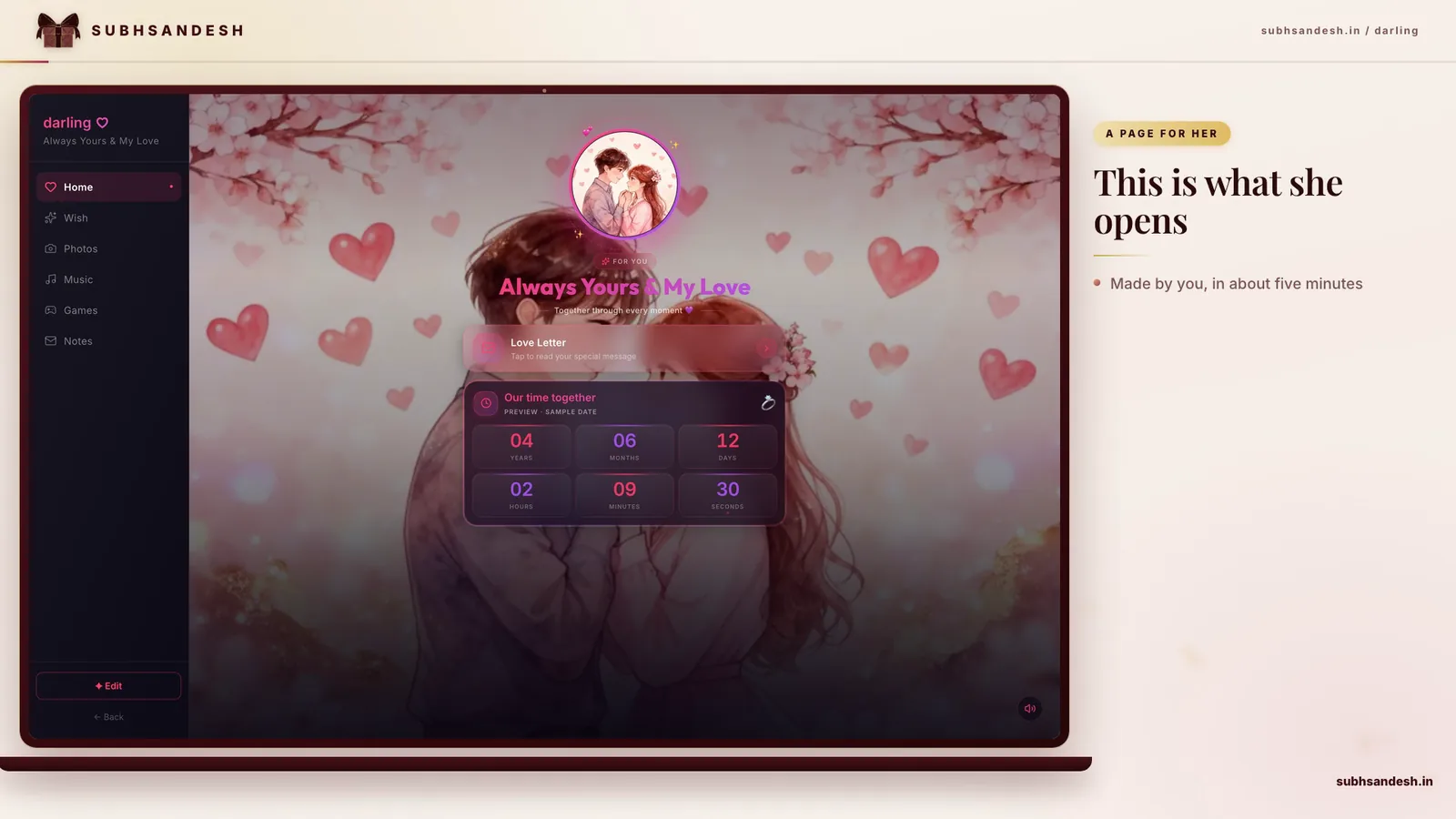
Once the words are settled the container is a smaller decision. The romantic "I love you" page types the letter out on its cover, with a Love Quiz, a Truth or Dare round and an "Our Story" timeline behind it.
If your letter is darker than that, the Darling romantic page suits that register — fourth most-created here at 349 pages, 10.3% of the total. Browse the full template set if neither fits.
Why machine translation gets Assamese wrong
Do not run the letter through a translator. Assamese is genuinely low-resource, and the systems that work best on it get there by going through Bangla.
In "Zero-shot English–Assamese neural machine translation", published open-access in Scientific Reports on 17 March 2026, Basab Nath and Yonis Gulzar report that NMT for low-resource languages such as Assamese is held back by the scarcity of parallel corpora, and build a system exploiting Assamese–Bangla proximity to translate English to Assamese with no direct parallel data. It reaches a BLEU score of 28.65, which they report as 7.53 points above direct-translation baselines.
A purpose-built research system scores 28.65 by routing English through Bangla. The paper makes no claim about its output confusing the two scripts, and neither do I. But a consumer translator with none of that engineering is not what you want deciding whether your letter says মৰম or মরম.
When an Assamese love letter is the wrong choice
She does not read the script. Many fluent Assamese speakers read English or Latin-script Assamese faster than অসমীয়া, especially outside Assam. A letter she has to decode is a letter she reads once.
Your Assamese is shakier than your English. A wrong pronoun or a Bangla র reads as effort you did not put in — worse than a sincere letter in the language you think in. If you cannot check it, write in English and carry one verified Assamese line inside it.
She is in the same room. Hand her paper. A link is for distance.
You need it locked down. 42.8% of creators here password-protect a page before sharing — 1,444 of 3,377 — the right instinct for a letter, but friction at the moment you meant to hand her the phone.
A limit on our side: SubhSandesh has no Assamese interface and no template that writes Assamese for you. The page is the container; the ৰ and ৱ are your job. Have a native speaker read the letter before you send it.
Sources
- Mahanta, "Assamese," Journal of the International Phonetic Association 42/2, 2012.
- Boruah, "Pro-drop and subject pronouns in Assamese," IJLLT 3(7), 2020, CC BY.
- The Unicode Standard, Version 16.0, Chapter 12, 10 September 2024.
- Biswas, "Language, Identity and Conflict," Space and Culture, India 12(3), 29 November 2024, CC BY.
- Nath and Gulzar, "Zero-shot English–Assamese neural machine translation," Scientific Reports 16:13732, 17 March 2026.
- English Wiktionary, Assamese entries for ভালপোৱা, তুমি, তই, আপুনি, মৰম, আদৰ, জীৱন, চিঠি and অসমীয়া. Continuously edited; no publication date.
Frequently Asked Questions
Turn this inspiration into an unforgettable surprise
Build a page with photos, a heartfelt message, music and a ready-to-share link.
- Photos, message & music
- Ready-to-share link

Written by
Suyash Agrahari
Founder
Suyash Agrahari is a Software Engineer at HireQuotient and the founder of SubhSandesh and DrawFlow (drawflow.in). He builds AI agents and full-stack products with Next.js, Node.js, and the OpenAI and LangChain ecosystems, having shipped autonomous multi-agent systems, AI copilots, and large-scale outreach platforms — and scaled side projects from a few hundred to millions of users. He writes about AI engineering, web development, and building products that grow through SEO and organic reach.
Stay Connected
Follow SubhSandesh
New templates, festival ideas and step-by-step walkthrough videos — first on our socials.
Product guide
See it built, step by step

Keep reading
Which Day Comes After Propose Day, and What Happens Now
Chocolate Day comes after Propose Day — Tuesday 9 February 2027. That is one sentence, so this page covers the four situations you are actually in on …
 Suyash Agrahari· 9 min
When to Propose a Girl to Be Your Girlfriend, and When Not To
The timing question, answered with conditions instead of a date: what has to be true before you ask, what politeness and fast replies do not prove, wh…
Suyash Agrahari· 9 minRomantic Proposal Room Decoration: What the Room Must Do
Romantic proposal room decoration, sorted by the work each setup takes and what the room allows: 7 setups with set-up and reversal times, lighting evi…
Suyash Agrahari· 9 min