
Love Letter for Girlfriend in Bengali: 6 Letters, 3 Pronouns
Six complete Bengali love letters in Bengali script, romanised Banglish and English, plus the তুমি/তুই decision every other page skips. Twelve language models scored 46.23–81.16% on Bangla address terms; here is how not to repeat their mistake.
Make this into a page you can send
Photos, a message, music and a ready-to-share link — in a couple of minutes.
or browse all occasionsKey takeaways
- • Bengali has three second-person pronouns; for a girlfriend তুমি (tumi) is almost always right, and তুই (tui) only once she already says তুই to you.
- • Twelve language models scored 46.23%–81.16% on Bangla address terms and erred towards over-politeness, so an AI-written Bengali letter usually sounds too formal rather than ungrammatical.
- • Each of the six letters here is given in Bengali script, romanised Banglish and English, so you can send whichever form her phone and her reading habits support — and read whichever you pick back to a Bengali speaker first, because these were composed the same way the benchmark tested.
- • 50.3% of SubhSandesh's 40,864 recorded views are on a phone, and a shared page carries the Bengali font itself, so nothing installs on her side.
- • 42.9% of creators password-protect the page before sharing it (1,432 of 3,335 pages).
On this page
Love Letter for Girlfriend in Bengali: 6 Letters, 3 Pronouns
A love letter for your girlfriend in Bengali turns on one decision every page ranking for this skips: whether you address her as তুমি (tumi) or তুই (tui). Choose wrong and a flawless letter reads as cold or disrespectful, because Bengali puts the relationship in the pronoun.
Below are six complete letters — first confession, long distance, after a fight, birthday, no reason at all, a four-line note — each in Bengali script, romanised Banglish and English. Delivery advice comes from our own database: 14,396 of 40,864 recorded views (35.2%) land on one romantic template, and 50.3% open on a phone — which decides whether Bengali script arrives readable.
What a Bengali love letter is, and why a translation is not one
A Bengali love letter (বাংলা প্রেমপত্র, or চিঠি) is a letter whose weight sits in its address form, not only its vocabulary. English has one "you"; Bengali has three.
Md. Afaz Uddin's 2020 study of second-person deixis (IJEL 10(1)) sets out the system: Bengali encodes relative rank, deference, formality and social distance in the pronoun, English almost none of it. A translated letter can be word-perfect and still land wrong.
আপনি, তুমি, তুই — the pronoun the letter turns on
আপনি (apni) is formal: elders, strangers, authority. তুমি (tumi) is neutral familiarity between peers. তুই (tui) is intimacy — close friends, siblings, children — and aimed at the wrong person it is an insult.
For a girlfriend, তুমি is almost always right. তুই is right only once she already says তুই to you: a register you fall into together, never one you announce. আপনি reads as a form filled in by a stranger.
This is where machine-written Bengali fails, measurably. BanglaSocialBench (preprint, 16 March 2026), a benchmark of 1,719 scenarios written and verified by native Bangla speakers, tested twelve language models on Bangla address terms: accuracy ran from 46.23% to 81.16%.
The errors were not random. For most models a binomial test found over-politeness significantly more frequent than under-politeness (p<0.05), with DeepSeek V3.1 and Gemma 3 12B defaulting to আপনি where তুমি or তুই was preferred, and failures clustering in informal contexts.
Send a generated letter unread and the likely defect is not grammar. It is a letter addressing her father. That includes the six letters below — drafted the same way, so read each back to a Bengali speaker first.
6 Bengali love letters in Bengali script, Banglish and English
Each comes three ways, with a note on when it fits. Five of the six use তুমি; only letter 5 uses তুই, and its verb endings shift with it.
1. The first letter, before she has said yes
Bengali: প্রিয়, মুখে বলতে গেলে গলা শুকিয়ে যায়, তাই লিখেই ফেললাম। তোমার সঙ্গে কথা বলার পর সারাদিনটা অন্যরকম কাটে। তুমি "না" বললেও রাগ করব না — শুধু চাইছিলাম তুমি জানো। — তোমার [নাম]
Banglish: Priyo, mukhe bolte gele gola shukiye jay, tai likhe-i phellam. Tomar songe kotha bolar por saradinta onnorokom kate. Tumi "na" bolleo rag korbo na — shudhu chaichhilam tumi jano. — Tomar [naam]
English: My throat dries up out loud, so I wrote it instead. The day goes differently after I talk to you. If you say no, I won't mind.
Use when: she does not know yet. তুমি, never তুই — তুই assumes an answer she has not given.
2. Long distance, on an ordinary day
Bengali: ট্রেনে ফিরছিলাম — জানলার বাইরে ধানখেত, আর ভাবছি তুমি এখন কী করছ। [৪৭০] কিলোমিটার তোমাকে দূরে রাখতে পারে, আমার অভ্যাস থেকে পারে না। পরের বার শুধু তোমার পাশে বসে থাকব। — [নাম]
Banglish: Trene phirchhilam — janlar baire dhankhet, ar bhabchhi tumi ekhon ki korchho. [470] kilometer tomake dure rakhte pare, amar obhyas theke pare na. Porer bar shudhu tomar pashe boshe thakbo. — [naam]
English: On the train home. Paddy fields past the window, me wondering what you're doing. [470] kilometres can keep you away; they can't keep you out of my habits. Next time, just sitting beside you.
Use when: different cities. Put the real distance in; a number does work "I miss you" cannot.
3. After a fight, the morning after
Bengali: শোনো, কাল রাতে যা বলেছি, তার জন্য সত্যিই লজ্জিত। রাগের মুখে বলেছি — সেটা কারণ নয়, ব্যাখ্যা। তুমি ভুল ছিলে না; আমি শুনিনি, শোনার ভান করেছি। আজ ফোন করব না; তুমি তৈরি হলে বলো। — [নাম]
Banglish: Shono, kal rate ja bolechhi, tar jonno sotti-i lojjito. Rager mukhe bolechhi — seta karon noy, byakkha. Tumi bhul chhile na; ami shunini, shonar bhan korechhi. Aj phone korbo na; tumi toiri hole bolo. — [naam]
English: Listen. I'm ashamed of what I said last night. Anger isn't a reason, only an explanation. You weren't wrong; I didn't listen, I pretended to. Tell me when you're ready.
Use when: you were at fault. Name the specific thing, or it reads as a request to stop being angry.
4. Her birthday
Bengali: শুভ জন্মদিন। আজকের দিনটা তোমার, তাই একটা কথা শুধু। তোমার সঙ্গে দেখা হওয়ার আগে জন্মদিন নিয়ে এত ভাবতাম না। এখন সারা বছর ভাবি, এই দিনে তোমাকে কী দেব। তোমার হাসিটা প্রথম দিনের মতোই আছে। — [নাম]
Banglish: Shubho jonmodin. Ajker dinta tomar, tai ekta kotha shudhu. Tomar songe dekha howar age jonmodin niye eto bhabtam na. Ekhon sara bochhor bhabi, ei dine tomake ki debo. Tomar hashita prothom diner motoi achhe. — [naam]
English: Happy birthday. Today is yours, so one thing only. Before you I didn't think much about birthdays. Now I spend the year wondering what to give you. Your smile hasn't changed since day one.
Use when: the letter is the part she keeps.
5. No reason at all
Bengali: এই, কোনো কারণ নেই। কিছু হয়নি। চা খেতে খেতে মনে হল তোকে বলি — তুই যে আছিস, এটা আমার জীবনের সবচেয়ে সহজ ব্যাপার। বাকি সব নিয়ে ভাবতে হয়, তোকে নিয়ে হয় না। — তোর [নাম]
Banglish: Ei, kono karon nei. Kichhu hoyni. Cha khete khete mone holo toke boli — tui je achhish, eta amar jiboner shobcheye sohoj byapar. Baki shob niye bhabte hoy, toke niye hoy na. — Tor [naam]
English: Hey. No reason. Nothing happened. Over tea I thought I'd tell you: you existing is the easiest thing in my life. Everything else I have to think about; not you.
Use when: she already says তুই to you. Verbs move with the pronoun — আছিস, তোর — so you cannot swap তুমি for তুই and leave the rest.
6. The four-line one
Bengali: আজ কিছু লিখব না। শুধু এটুকু — তোমার নামটা দিনে যতবার ভাবি, তার চেয়ে কম বার বলি। ভাবলাম আজ একবার লিখেই ফেলি। ভালোবাসি। ব্যাস। — [নাম]
Banglish: Aj kichhu likhbo na. Shudhu etuku — tomar namta dine jotobar bhabi, tar cheye kom bar boli. Bhablam aj ekbar likhe-i pheli. Bhalobashi. Byas. — [naam]
English: I won't write much today. Only this — I say your name fewer times a day than I think it, so I wrote it once. I love you. That's all.
Use when: an ordinary Tuesday. Four lines beat four hundred when nothing is being marked.
Bengali script, Banglish or English — which form to send
Plenty of Bengali speakers type their language in Roman letters, so this is a real choice. A 12-month, 120,000-token corpus study of Bangla–English code-mixing across four platforms (Digital Applied Linguistics, September 2025) indexed Bangla script and Latin transliterations side by side, and found stable insertional patterns with Bangla as the matrix language — English dropped into Bengali grammar, not the reverse.
| Form | Keyboard needed | WhatsApp and Instagram | Register | Who it suits |
|---|---|---|---|---|
| Bengali script (চিঠি) | Bengali, Avro or Google phonetic — one install | Renders in messages and captions; Story fonts break conjuncts like ক্ষ | Literary চিঠি register, unmistakably a letter | She reads Bengali daily. A shared page supplies the font: 50.3% of our 40,864 views are already on a phone |
| Romanised Banglish | The English keyboard you have | Renders everywhere, no font risk | Everyday spoken register, like her texts | Either of you fumbles the Bengali keyboard |
| English | The English keyboard you have | Renders everywhere | Flattest; a Bengali reader hears translation | Only as the gloss under the Bengali |
Bengali script for the letter, Banglish for the messages around it, English as a gloss.
Do not trust a converter with the Bengali. BanglaTLit (Findings of EMNLP, November 2024) needed a 42.7k-sample transliteration dataset and a 245.7k-sample romanised corpus because romanised text "often lack[s] the structure and consistency needed to provide insights"; BhasaBodh (BanglaLP 2025) reaches 87.44 BLEU on romanised-to-standard normalisation only after fine-tuning mBART-50.
Delivering it so it renders on her phone
A photo of handwriting is the safest delivery: no font, no keyboard, no rendering risk. But she cannot search it, and it reads poorly on a phone screen.
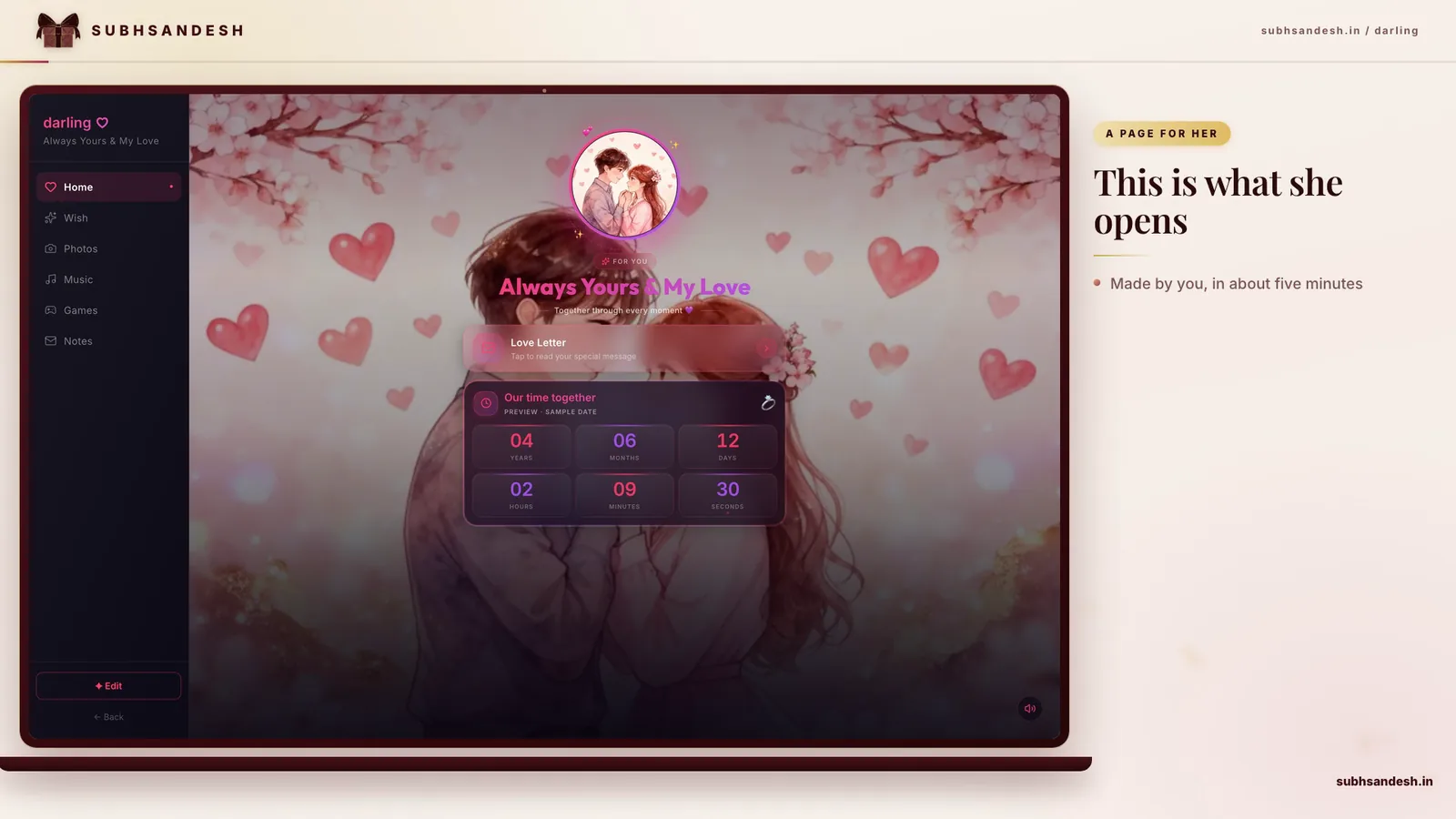
A shared web page solves the font problem from the other side: the page carries the Bengali typeface, so her device needs nothing. Our most-viewed template is the romantic "I love you" page for a girlfriend, holding the letter, gallery, music, notes and games behind an optional password. 42.9% of creators set that password before sharing (1,432 of 3,335 pages).
One number changed my advice: nobody writes these in one sitting. Median gap between first save and last edit is 6.9 hours across 975 pages, so being able to fix a তুমি you regret matters more than the animation.
When a Bengali letter is the wrong choice
If she grew up outside Bengal and reads Bengali slowly, a Bengali-script letter turns your love letter into homework. Send the Banglish version.
If your own Bengali is shaky, do not paste in something you cannot read back. A native reader catches a wrong verb ending instantly, and a register leak is worse than an honest English letter.
If you want drama rather than tenderness, a letter is the wrong instrument. The dark, dramatic romantic page for a partner carries that register better than any চিঠি — our fourth most-created page, 343 pages, 10.3% of the total.
Write the letter first, in a script you can read back — then put it on a private "I love you" page.
Sources
- Uddin, "Second Person Pronouns as Person Deixis in Bengali and English", IJEL 10(1), 2020 — ccsenet.org
- Sijan et al., "BanglaSocialBench", arXiv preprint, 16 March 2026 — arxiv.org
- Fahim et al., "BanglaTLit", Findings of the ACL: EMNLP 2024 — aclanthology.org
- Sweet et al., "Banglalish on social media", Digital Applied Linguistics 3, 2025 — castledown.com
- Bhuiyan et al., "BhasaBodh", BanglaLP 2025 — aclanthology.org
SubhSandesh figures: our own database, 1 September 2026.
Frequently Asked Questions
Turn this inspiration into an unforgettable surprise
Build a page with photos, a heartfelt message, music and a ready-to-share link.
- Photos, message & music
- Ready-to-share link

Written by
Suyash Agrahari
Founder
Suyash Agrahari is a Software Engineer at HireQuotient and the founder of SubhSandesh and DrawFlow (drawflow.in). He builds AI agents and full-stack products with Next.js, Node.js, and the OpenAI and LangChain ecosystems, having shipped autonomous multi-agent systems, AI copilots, and large-scale outreach platforms — and scaled side projects from a few hundred to millions of users. He writes about AI engineering, web development, and building products that grow through SEO and organic reach.
Stay Connected
Follow SubhSandesh
New templates, festival ideas and step-by-step walkthrough videos — first on our socials.
Product guide
See it built, step by step

Keep reading
Which Day Comes After Propose Day, and What Happens Now
Chocolate Day comes after Propose Day — Tuesday 9 February 2027. That is one sentence, so this page covers the four situations you are actually in on …
 Suyash Agrahari· 9 min
When to Propose a Girl to Be Your Girlfriend, and When Not To
The timing question, answered with conditions instead of a date: what has to be true before you ask, what politeness and fast replies do not prove, wh…
Suyash Agrahari· 9 minRomantic Proposal Room Decoration: What the Room Must Do
Romantic proposal room decoration, sorted by the work each setup takes and what the room allows: 7 setups with set-up and reversal times, lighting evi…
Suyash Agrahari· 9 min