
Love Letter for Girlfriend in Gujarati, in Script and Roman
Five complete Gujarati love letters for a girlfriend, each in Gujarati script, romanised Gujarati and English — plus the તું/તમે register choice no ranking page mentions, and what to do when she speaks Gujarati but was never taught to read it.
Make this into a page you can send
Photos, a message, music and a ready-to-share link — in a couple of minutes.
or browse all occasionsKey takeaways
- • Write the letter twice — Gujarati script, then romanised underneath. Desai's survey of 189 Gujarati households found 38.8% of youngest children could not read the script at all, though 96.3% of parents spoke the language fairly well or better.
- • The તું / તમે choice is the letter's loudest signal: તમે is what Gujarati families use with elders, while તું is also the form used for God and one's own mother.
- • The romantic "I love you" page is the most-created template on SubhSandesh — 975 pages, 29.2% of the 3,335 built since 2026-03-12 — and takes 14,396 of 40,864 recorded views.
- • Nobody finishes one of these in a single sitting: the median gap between first save and last edit on that template is 6.9 hours (n=975).
- • 42.9% of creators here password-protect the page before sharing it (1,432 of 3,335), which is what makes a private bilingual letter shareable at all.
On this page
Love Letter for Girlfriend in Gujarati, in Script and Roman
A love letter for your girlfriend in Gujarati works best written twice: once in ગુજરાતી script, once romanised directly underneath. That single habit solves the problem every page ranking for this phrase ignores — she may speak Gujarati fluently and still not read the script.
Five complete letters are below, each in all three forms. The romantic "I love you" page is the most-created template on SubhSandesh — 975 pages, 29.2% of the 3,335 built since 2026-03-12 — and the most-viewed, taking 14,396 of 40,864 views. The median gap between its first save and last edit is 6.9 hours (n=975).
તું or તમે: the pronoun that decides how the letter lands
Gujarati has two words for "you" and they are not interchangeable in a love letter. તમે (tame) is the respectful form Gujarati families use with elders; તું (tu) addresses an equal.
That makes તું the obvious pick, and usually it is. But Usha Desai's 1997 doctoral study of Gujarati in South Africa records the nuance that matters here: તું is also the form used to address God and one's own mother, where, she writes, it "expresses a close bond between the two" rather than any disrespect.
So the pronoun is not a politeness dial but a claim about closeness. Use તું for anyone you already call તું out loud; switching to તમે in writing reads as a step backwards unless the distance is deliberate.
One trap gives away machine translation instantly: in past-tense sentences તું becomes તેં — "તેં જે કર્યું" (te je karyu, "what you did"), never "તું જે કર્યું". Translation tools routinely miss it.
Five Gujarati love letters, in script, roman and English
Replace [નામ] with her name. Gujarati agrees with the writer's gender, so a woman writing these should change તારો → તારી, ગણી રહ્યો છું → ગણી રહી છું and વહેલો → વહેલી. The forms for her — તું, તને, તારી — never change.
1. The first letter, in તમે on purpose
Gujarati: પ્રિય [નામ], આ પત્ર લખતાં થોડી બીક લાગે છે, પણ મોઢે કહેવાનું મને ફાવતું નથી. તમારી સાથે વાત કરું છું ત્યારે દિવસ સહેલો લાગે છે. જવાબ ન આપો તો પણ વાંધો નથી. લિ. તમારો [નામ]
Roman: Priya [naam], aa patra lakhtaan thodi beek laage chhe, pan modhe kahevaanu mane faavtu nathi. Tamaari saathe vaat karu chhu tyaare divas sahelo laage chhe. Javaab na aapo to pan vaandho nathi. Li. tamaaro [naam]
English: Dear [name], I'm a little afraid writing this, but saying it out loud isn't something I'm good at. When I talk to you the day feels easier. It's fine if you don't reply.
Use when: nothing has been said yet. The તમે says you are not presuming.
2. Long distance
Gujarati: વહાલી [નામ], આજે તારો ફોન કપાઈ ગયો ને ઘર એકદમ શાંત થઈ ગયું. તારે ત્યાં અત્યારે રાત હશે — સૂતાં પહેલાં આટલું વાંચી લે: હું દિવસો ગણી રહ્યો છું. તારો જ, [નામ]
Roman: Vahaali [naam], aaje taaro phone kapaai gayo ne ghar ekdam shaant thai gayu. Taare tyaan atyaare raat hashe — sootaan pahelaan aatlu vaanchi le: hu divaso gani rahyo chhu. Taaro ja, [naam]
English: Beloved [name], your call dropped today and the house went quiet. It'll be night where you are — read this before you sleep: I'm counting the days.
Use when: she is in another time zone. Name her time, not yours.
3. After a fight
Gujarati: [નામ], કાલે મેં જે કહ્યું એ ખોટું હતું. ગુસ્સામાં કહ્યું હતું, પણ એથી ઓછું ખોટું નથી થતું. તું સાચી હતી. તું તૈયાર થાય ત્યારે વાત કરીએ. હું અહીં જ છું.
Roman: [naam], kaale me je kahyu e khotu hatu. Gussaamaa kahyu hatu, pan ethi ochhu khotu nathi thatu. Tu saachi hati. Tu taiyaar thaay tyaare vaat kariye. Hu ahi ja chhu.
English: [name], what I said yesterday was wrong. I said it in anger, but that doesn't make it less wrong. You were right. Let's talk when you're ready. I'm right here.
Use when: you were wrong. No વહાલી here — an endearment before an apology reads as a bribe.
4. No reason at all
Gujarati: [નામ], કોઈ ખાસ કારણ નથી. બસ, સાંજે ચા બનાવતાં તારો વિચાર આવ્યો અને એ જવાનું નામ નથી લેતો. મોટી વાતો કરતાં આ નાની વાતો જ યાદ રહી જાય છે.
Roman: [naam], koi khaas kaaran nathi. Bas, saanje chaa banaavtaan taaro vichaar aavyo ane e javaanu naam nathi leto. Moti vaato kartaan aa naani vaato ja yaad rahi jaay chhe.
English: [name], no special reason. While making tea this evening the thought of you turned up and refused to leave. Small things stay, not big ones.
Use when: nothing is happening. This is the letter that gets kept, because it was not owed.
5. Two lines
Gujarati: [નામ], તારા વગરનો દિવસ પણ પસાર થઈ જાય છે — એ જ સૌથી અઘરી વાત છે. આજે વહેલો આવીશ.
Roman: [naam], taara vagarno divas pan pasaar thai jaay chhe — e ja sauthi aghari vaat chhe. Aaje vahelo aavish.
English: [name], a day without you passes too — that's the hardest part. I'll come home early today.
Use when: you live together. Short is correct here, not lazy.
Gujarati script, romanised Gujarati or English: what to send
The three forms are not ranked. They fail in different places, and the failure is usually on her phone rather than in your Gujarati.
| Form | Keyboard needed | Renders in WhatsApp / Instagram | Register, and who it suits |
|---|---|---|---|
| Gujarati script | Gujarati keyboard, or a transliteration keyboard that takes Latin keys and outputs the script | Yes in both; Instagram Story font packs revert to the system face | The register her grandparents read. Suits anyone taught the script; 50.3% of views here are on a phone (20,561 of 40,864), so send a page, not a screenshot |
| Romanised Gujarati | Any English keyboard | Yes, everywhere — plain ASCII | Same words, same intimacy, no literacy assumed. Suits a partner who speaks Gujarati but was never taught to read it |
| English only | Any keyboard | Yes | Flatter, and the language of everything else in her day. Suits someone who prefers English, or a line her parents will read too |
Stacking the first two is the default, and it is what the five letters above do. The Gujarati block is encoded at U+0A80–U+0AFF, so the script is not the fragile part — the font on her device is.
When she speaks Gujarati but cannot read the script
Reading and writing are the first skills a heritage speaker loses: the language is learned at home while schooling happens in English. A 2025 study in Frontiers in Psychology of 51 immigrant parents found a strong link between valuing the heritage language and teaching literacy at home (rs = 0.651, p < 0.001): literacy is taught deliberately or not at all.
Desai's survey sizes the gap. Of 189 returned questionnaires from the Gujarati community in South Africa, 96.3% of respondents spoke Gujarati fairly well or better, but 16.5% could not read it at all and 21.8% could not write it. For the youngest child in the household those figures rose to 38.8% and 47.2%.
She also records the workaround the community found on its own: members who could not read the Gujarati script had bhajans transliterated into English. Romanised Gujarati is not a modern shortcut — it is a decades-old answer to this exact problem.
Britain shows the same direction. A 2018 study of 66 transnational UK families found 90% of children in second- and third-generation Pakistani households used English for 75–100% of their speech; Gujarati fell from 213,094 main-language speakers in England and Wales to 188,956 between the 2011 and 2021 censuses.
So send both scripts, somewhere that renders Gujarati as text — not a screenshot, because she cannot copy a word she does not recognise out of an image. A romantic "I love you" page for a girlfriend keeps the letter as text beside photos and a song, and its optional password keeps it out of a chat thread: 42.9% of creators lock the page first (1,432 of 3,335).
When a Gujarati letter is the wrong move
If she does not read Gujarati and does not really speak it — understands her parents, answers in English — a Gujarati letter is a test she did not sign up for. Write it in English with one Gujarati line inside.
Skip it too if the two of you have never used Gujarati with each other. Switching language mid-relationship reads as performance, and she will notice by the second sentence.
A page is the wrong container if she has no smartphone: 50.3% of the 40,864 views here are on a phone, and paper needs no device at all — handwritten Gujarati carries something no font does.
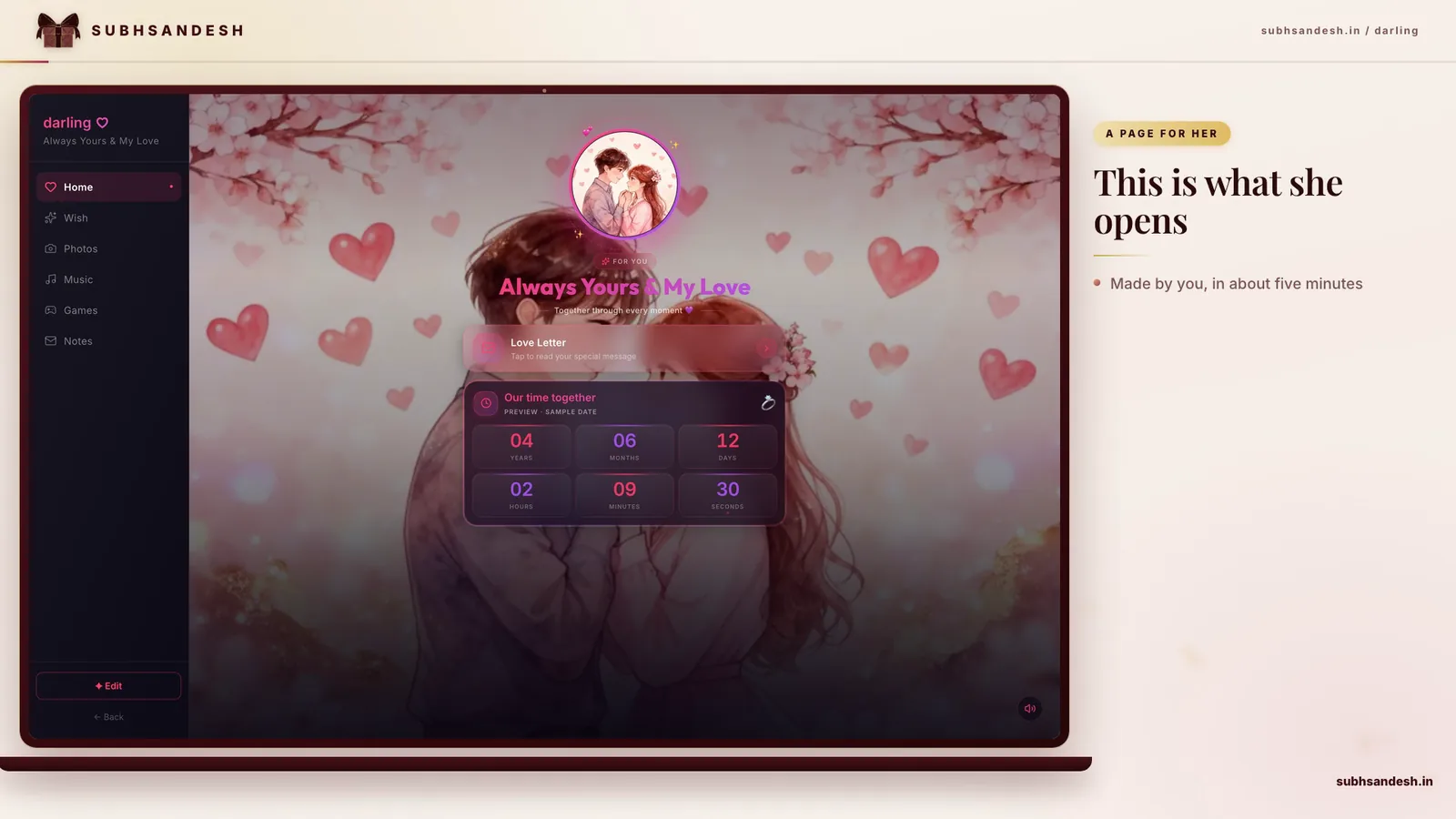
But if the register you want is darker than પ્રિય and વહાલી allow, the dark, dramatic romantic page for a partner carries that mood better than prose will.
Sources
- Desai, Usha (1997). Factors influencing maintenance and shift of the Gujarati language in South Africa. PhD thesis, University of Durban-Westville. researchspace.ukzn.ac.za
- Bilgory-Fazakas & Armon-Lotem (10 April 2025). Resilient heritage language maintenance. Frontiers in Psychology 16. frontiersin.org
- Curdt-Christiansen & La Morgia (2018). Managing heritage language development. Multilingua 37(2). purehost.bath.ac.uk
- Office for National Statistics (29 November 2022). Language, England and Wales: Census 2021. ons.gov.uk
Frequently Asked Questions
Turn this inspiration into an unforgettable surprise
Build a page with photos, a heartfelt message, music and a ready-to-share link.
- Photos, message & music
- Ready-to-share link

Written by
Suyash Agrahari
Founder
Suyash Agrahari is a Software Engineer at HireQuotient and the founder of SubhSandesh and DrawFlow (drawflow.in). He builds AI agents and full-stack products with Next.js, Node.js, and the OpenAI and LangChain ecosystems, having shipped autonomous multi-agent systems, AI copilots, and large-scale outreach platforms — and scaled side projects from a few hundred to millions of users. He writes about AI engineering, web development, and building products that grow through SEO and organic reach.
Stay Connected
Follow SubhSandesh
New templates, festival ideas and step-by-step walkthrough videos — first on our socials.
Product guide
See it built, step by step

Keep reading
Which Day Comes After Propose Day, and What Happens Now
Chocolate Day comes after Propose Day — Tuesday 9 February 2027. That is one sentence, so this page covers the four situations you are actually in on …
 Suyash Agrahari· 9 min
When to Propose a Girl to Be Your Girlfriend, and When Not To
The timing question, answered with conditions instead of a date: what has to be true before you ask, what politeness and fast replies do not prove, wh…
Suyash Agrahari· 9 minRomantic Proposal Room Decoration: What the Room Must Do
Romantic proposal room decoration, sorted by the work each setup takes and what the room allows: 7 setups with set-up and reversal times, lighting evi…
Suyash Agrahari· 9 min