
Love Letter for Girlfriend in Malayalam: What to Write
A love letter for girlfriend in Malayalam turns on two choices: address her as നീ (nee), not താങ്കൾ (thaankal), and pick Malayalam script or Manglish. Four short letters with romanisation and literal English, plus the 1971 script reform research and data from 987 "I love you" pages.
Make this into a page you can send
Photos, a message, music and a ready-to-share link — in a couple of minutes.
or browse all occasionsKey takeaways
- • Address her as നീ (nee), the intimate second person singular — താങ്കൾ (thaankal) is the honorific Malayalam keeps for elders and formal letters, and to a girlfriend it reads as coldness or parody.
- • Malayalam's traditional orthography carries more than 1,200 unique graphemes; a 1971 government reform simplified them, and a 2023 study found both older and younger readers read the reformed script faster.
- • Write in Malayalam script if she reads it comfortably and in romanised Manglish if you are unsure — romanised Malayalam has no settled spelling convention to get wrong.
- • The "I love you" page is SubhSandesh's most-created template at 987 of 3,377 pages (29.2%), with a median 7.2 hours between a creator's first save and last edit (n=987).
- • 42.8% of creators password-protect the page before sharing it (1,444 of 3,377) — worth doing for a letter you would not want forwarded.
On this page
Love Letter for Girlfriend in Malayalam: What to Write
A love letter for girlfriend in Malayalam should address her as നീ (nee) — the intimate second person singular — and never താങ്കൾ (thaankal), the elevated form Malayalam keeps for elders, superiors and formal correspondence. That one choice decides whether the letter reads as love or as a bank notice. Everything else is shorter than people expect: four lines in Malayalam land harder than four paragraphs in English.
Two numbers from our own database, measured 2 September 2026. The "I love you" page is the most-created template on SubhSandesh — 987 of 3,377 pages built since 12 March 2026, 29.2% of everything created.
On that same template the median gap between a creator's first save and their last edit is 7.2 hours (n=987). Nobody sends the first draft. Half the audience reads on a phone: 50.3% of 41,486 recorded views.
What follows: the register choice, the script choice, four short letters with romanisation and literal English, the ways of sending one compared, and when a Malayalam letter is the wrong call.
What a Malayalam love letter actually is
A Malayalam love letter is a letter written in Malayalam, addressed to one named person, with a body in the second person and a sign-off. That is the full definition, and it is what separates a letter from a Malayalam love SMS or a WhatsApp status line: a letter has her name at the top and yours at the bottom.
A letter is addressed to one person; a shared page is not read by one. Across 41,486 recorded views the average created page has been opened 12.3 times, so write the line you would not mind a second reader seeing.
Malayalam has roughly 38 million native speakers, and its script evolved from Brahmi through the Grantha alphabet and Vattezhuthu writing systems into a system with more than 1,200 unique graphemes — the figures come from Kavya Manohar and Santhosh Thottingal's paper on Malayalam orthographic reforms, in Grapholinguistics and Its Applications, Volume 1 (2019).
Almost none of what goes wrong is vocabulary. The four letters below run between one and three lines each.
നീ or താങ്കൾ: how to address her
Use നീ (nee). It is the singular intimate second person, and it is what couples in Kerala actually use with each other.
താങ്കൾ (thaankal) is the honorific; നിങ്ങൾ (ningal) is the polite plural you would use with a colleague. Both put distance in the sentence, and to a girlfriend that distance reads as coldness or as parody.
This is exactly where a general translation tool fails you. Register variation and diglossia in Malayalam are named as a specific barrier for language technology in A. G. Saithya's 2025 review of Malayalam natural language processing, published 31 December 2025 in the International Journal of Multilingualism and Languages for Specific Purposes, alongside code-mixing with English and non-standard romanised spelling.
A tool that flattens നീ into താങ്കൾ has not made a spelling mistake; it has changed who you are to her. One exception: if the letter will be read aloud in front of her family, keep നീ for her and നിങ്ങൾ for them.
Malayalam script or Manglish?
Write in Malayalam script if she reads Malayalam comfortably. Write in Manglish — Malayalam typed in Latin letters — if she does not, or if you genuinely do not know.
Script is not a neutral container. Malayalam went through a government script reform in 1971 that simplified its glyphs, and a 2023 study by Krithika Nambiar, K. N. V. S. Kishore and Pranesh Bhargava compared elderly readers literate in the traditional script with younger readers who learned the reformed one.
Both groups read the reformed script faster, and the elderly group still largely wrote in the traditional script. Age changes what her eye is fluent in, not just what she can decode.
Reading Malayalam is also not automatic inside Malayalam-speaking families. In a 2020 study of Malayalam classes run by the community in Singapore, Suvita Thanagopalasamy and Anitha Devi Pillai record that most Malayalee children there study Tamil or Hindi at school in place of Malayalam, and that the language is maintained by volunteer-run classes rather than institutional support. If she grew up outside Kerala, assume speech before script.
The romanisation on this page is the everyday kind: long vowels doubled (നീ → nee), ത as th, ച as ch, ം as m. It is not a standard, and Saithya's review is explicit that romanised Malayalam has no settled convention. So if you send Manglish, spell her name the way she spells it and stop worrying about the rest.
Four short Malayalam love letters, with romanisation
Each of these gives the Malayalam, a romanisation, a literal English reading, and the one thing you should change before sending it. They are starting points, not finished letters — the point of the median 7.2-hour editing window on our love pages is that the good version is the third one.
1. The one-line letter
എനിക്ക് നിന്നെ ഇഷ്ടമാണ് — enikku ninne ishtamaanu — "I love you." This is the ordinary, unembarrassed way of saying it in Malayalam, and it is stronger than the more literary ഞാൻ നിന്നെ സ്നേഹിക്കുന്നു (njaan ninne snehikkunnu), which reads like a subtitle.
It suits a first declaration, and it takes about a minute to write. Change nothing except what you put around it — a date, a place, the reason you are saying it today.
2. The long-distance letter
നീ കൂടെയുള്ളപ്പോൾ എല്ലാം എളുപ്പമാണ്. എനിക്ക് നിന്നെ ഇഷ്ടമാണ്. — nee koodeyullappol ellaam eluppamaanu. enikku ninne ishtamaanu. — "When you are beside me everything is easy. I love you." Four lines is the ceiling here; distance letters go wrong by getting long.
It suits different cities with no fixed date to meet. Change the middle line to one concrete thing you did this week without her.
3. The anniversary letter
എന്റെ പ്രിയപ്പെട്ടവളേ, നീ എന്റെ ജീവിതമാണ്. എന്നും നിന്റെ സ്വന്തം. — ente priyappettavale, nee ente jeevithamaanu. ennum ninte swantham. — "My beloved, you are my life. Always your own." The last phrase is a real Malayalam letter sign-off and does most of the work.
It suits a dated milestone. Change it by naming the date in numerals — an anniversary letter without the date is a general-purpose letter.
4. The ordinary-Tuesday letter
നിന്റെ ചിരി എനിക്ക് ഏറ്റവും ഇഷ്ടമാണ്. ഒരുപാട് സ്നേഹത്തോടെ. — ninte chiri enikku ettavum ishtamaanu. orupaadu snehathode. — "Your smile is what I love most. With much love." No occasion, which is why it works.
It suits a long relationship where the big letters are already sent. Change "ചിരി" (chiri, smile) for whatever is actually true — her handwriting, her cooking, the way she argues.
A note on spelling that trips people up: എന്റെ (ente, "my") is written ന + ് + റ, so a strict transliteration produces enṟe rather than ente. The same digraph sits inside നിന്റെ (ninte, "your"). The everyday spelling is the one above.
How to send a Malayalam love letter, compared
The letters differ less than the delivery does. This compares the four above on length, occasion, and which SubhSandesh page type they suit, with our own creation counts in the last column.
| Letter | Lines in Malayalam | Best for | Page type it suits (created since 12 Mar 2026) |
|---|---|---|---|
| One-line letter | 1 | A first "I love you" | "I love you" page — 987 pages, 29.2% of all |
| Long-distance letter | 2 | Different cities, no date to meet | "I miss you" page — outside the top five types |
| Anniversary letter | 3 | A dated milestone | "I love you" page — median 7.2 h of editing, n=987 |
| Ordinary-Tuesday letter | 2 | No occasion at all | Darling page — 349 pages, 10.3% of all |
The takeaway from that last column: the "I love you" page carries 987 of the 3,377 pages people have built, and it is also the most-viewed template at 14,607 views, 35.2% of the 41,486 recorded.
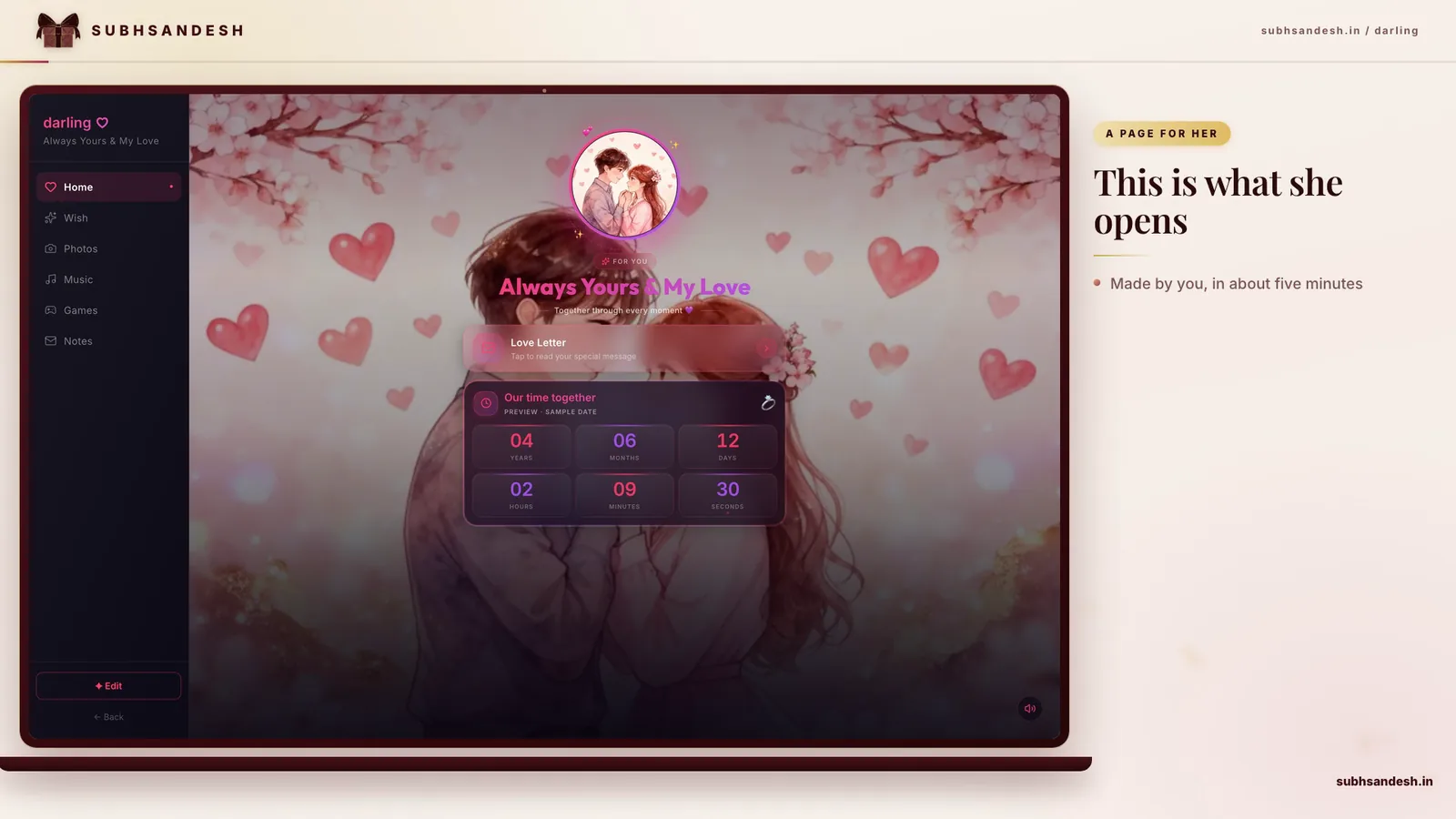
If you want the letter to arrive as something she opens rather than scrolls past, that is the shape most people reach for — an animated "I love you" page that types your letter out on the cover, with a Love Quiz and a Truth-or-Dare round behind it. For a darker register there is the Darling page, at 349 pages and 10.3% of everything created. If the letter is mostly about distance, an "I miss you" page for a partner fits better than either.
Two more numbers worth knowing before you send. 42.8% of creators password-protect the page before sharing it (1,444 of 3,377), which matters more for a Malayalam letter than an English one — it is often the letter you would not want a family group chat forwarding.
And 99.5% of started pages do get published and shared (3,359 of 3,377), so abandonment is not the risk here.
When a Malayalam love letter is the wrong choice
Three cases, plainly.
If she does not read Malayalam script and would not want Manglish either, a Malayalam letter is a puzzle you are handing her. Write it in English and put one Malayalam line in it. One line she can carry.
If you are in the same room, write it on paper. A 2024 paper in Trends in Psychology sets out letter writing as a narrative-therapy tool for couples, with rules, procedures and a worked example — none of which needs a link to work. Handwriting also sidesteps the script question, because your hand makes whichever forms you learned.
And if the relationship is in trouble, a love letter is the wrong instrument. An apology is a different document with a different structure, and mixing the two produces a letter that asks for credit while apologising.
Sources
- Kavya Manohar and Santhosh Thottingal, "Malayalam Orthographic Reforms. Impact on Language and Popular Culture", Grapholinguistics and Its Applications, Volume 1, pp. 329–351 (2019).
- Krithika Nambiar, K. N. V. S. Kishore and Pranesh Bhargava, "The effect of script reform on levels of orthographic knowledge: Evidence from alphasyllabary Malayalam scripts", PLoS ONE, 3 August 2023 (CC BY).
- A. G. Saithya, "Challenges in Natural Language Processing for Malayalam: A Low-Resource Language Perspective", International Journal of Multilingualism and Languages for Specific Purposes, 31 December 2025.
- Suvita Thanagopalasamy and Anitha Devi Pillai, "Home and school literacy practices of children attending Malayalam classes in Singapore", Journal of Modern Languages, Vol. 30 No. 2, 31 December 2020.
- Eman Tadros, Sarah Presley and Abrea Ramadan, "Dear John: Letter Writing as a Narrative Therapy Intervention", Trends in Psychology, 27 September 2024 (CC BY).
First-party figures are from the SubhSandesh product database, measured 2 September 2026.
Frequently Asked Questions
Turn this inspiration into an unforgettable surprise
Build a page with photos, a heartfelt message, music and a ready-to-share link.
- Photos, message & music
- Ready-to-share link

Written by
Suyash Agrahari
Founder
Suyash Agrahari is a Software Engineer at HireQuotient and the founder of SubhSandesh and DrawFlow (drawflow.in). He builds AI agents and full-stack products with Next.js, Node.js, and the OpenAI and LangChain ecosystems, having shipped autonomous multi-agent systems, AI copilots, and large-scale outreach platforms — and scaled side projects from a few hundred to millions of users. He writes about AI engineering, web development, and building products that grow through SEO and organic reach.
Stay Connected
Follow SubhSandesh
New templates, festival ideas and step-by-step walkthrough videos — first on our socials.
Product guide
See it built, step by step

Keep reading
Which Day Comes After Propose Day, and What Happens Now
Chocolate Day comes after Propose Day — Tuesday 9 February 2027. That is one sentence, so this page covers the four situations you are actually in on …
 Suyash Agrahari· 9 min
When to Propose a Girl to Be Your Girlfriend, and When Not To
The timing question, answered with conditions instead of a date: what has to be true before you ask, what politeness and fast replies do not prove, wh…
Suyash Agrahari· 9 minRomantic Proposal Room Decoration: What the Room Must Do
Romantic proposal room decoration, sorted by the work each setup takes and what the room allows: 7 setups with set-up and reversal times, lighting evi…
Suyash Agrahari· 9 min