
Love Letter for Girlfriend in Marathi, Written to Be Kept
Six complete Marathi love letters for a girlfriend, each in Devanagari with a romanised version and an English gloss — plus the तू/तुम्ही register choice, and what 975 SubhSandesh love pages show about how long a letter should actually be.
Make this into a page you can send
Photos, a message, music and a ready-to-share link — in a couple of minutes.
or browse all occasionsKey takeaways
- • A Marathi prem patra lands hardest at 40–50 words in Devanagari, written in तू, and signed तुझाच if you are a man or तुझीच if you are a woman.
- • The "I love you" page is SubhSandesh's most-created template — 975 pages, 29.2% of the 3,335 built since 2026-03-12.
- • Expect to rewrite: the median gap between first save and last edit on that page is 6.9 hours (n=975).
- • 42.9% of creators (1,432 of 3,335) password-protect the page before sharing the link, which matters if she shares a phone with family.
- • In Slatcher and Pennebaker's 2006 study of 86 dating couples, those who wrote about the relationship for three days were significantly more likely to still be dating three months later.
On this page
Love Letter for Girlfriend in Marathi, Written to Be Kept
A love letter for a girlfriend in Marathi lands hardest at 40 to 50 words in Devanagari, written in तू rather than तुम्ही, and signed with a form matching your own gender — तुझाच if you are a man, तुझीच if you are a woman. Six complete letters follow, each in Devanagari, romanised, and glossed in English.
Length matters here. On SubhSandesh the "I love you" page is the most-created template of all — 975 pages, 29.2% of the 3,335 built since 2026-03-12 — and the median gap between a creator's first save and their last edit on it is 6.9 hours (n=975). People come back hours later and cut it.
What a Marathi prem patra is, and how it differs from a forwarded shayari
A prem patra (प्रेम पत्र) is a love letter written as an actual letter: addressed to one named person, in the second person, about specific things that happened between the two of you. That is the whole difference from the shayari couplets filling most Marathi love-letter pages — a couplet is about love, a prem patra is about her.
The shape has four parts: a salutation (प्रिय + her name), three to five short paragraphs, one concrete detail only she would recognise, and a sign-off marked for your gender.
Specificity is not a style preference. In Slatcher and Pennebaker's 2006 study of 86 dating couples, one partner wrote about their deepest thoughts and feelings about the relationship for three consecutive days; those participants were significantly more likely to still be dating three months later. Writing about love in general was the control.
तू or तुम्ही: the register choice that decides how the letter reads
Marathi has two second-person pronouns, and choosing between them is the letter's first real decision. तू is intimate and singular; तुम्ही is plural and respectful, and in older Marathi households a wife used it for her husband.
For a girlfriend, तू, almost always. तुम्ही reads as distance, with one honest exception: in a genuine first letter, before you have earned तू, the formality can be the point.
Three things mark Marathi a person wrote rather than translated. The feminine vocative particle ग, as in तुझी आठवण येते ग. Verbs marked for her gender: तू आहेस, तू होतीस. And the sign-off — a man who pastes तुझीच has pasted a woman's letter.
Register matters because written practices do not travel unchanged: the 2025 PNAS meta-analysis of gratitude interventions across cultures pooled 145 papers and 24,804 participants from 28 countries, found an overall effect of Hedges' g = 0.19, and significant differences between countries.
6 Marathi love letters, from 17 to 45 words
Swap स्नेहा and आदित्य for your names before sending.
1. पहिलं पत्र — the first letter (44 words)
When to send: you keep failing to say it aloud.
प्रिय स्नेहा,
हे लिहायला मला तीन आठवडे लागले. रोज ठरवायचो, आज बोलणार — आणि तुझ्यासमोर आलं की शब्द संपायचे.
तुझं हसणं आवडतं, हे खरं. पण त्याहून जास्त आवडतं ते तू ऐकतेस तेव्हाचं तुझं शांत असणं.
घाई करायची नाही मला. फक्त हे कळावं म्हणून लिहिलं.
तुझाच, आदित्य
Romanised: Priya Sneha, He lihaayla mala teen aathavade laagle. Roj tharavaaycho, aaj bolnaar — aani tujhyaasamor aala ki shabd sampaayche. Tujha hasna aavadta, he khara. Pan tyaahun jaast aavadta te tu aiktes tevhaacha tujha shaant asna. Ghaai karaaychi naahi mala. Fakt he kalaava mhanun lihila. Tujhaach, Aditya
In English: Three weeks to write this. What I like most isn't your laugh, it's how quiet you go when you're listening.
2. लांब अंतर — long distance (45 words)
When to send: different cities, and calls feel like a formality.
प्रिय स्नेहा,
पुण्याहून निघून आज सत्तावीस दिवस झाले. मोजतोय, हे कबूल.
इथे संध्याकाळी चहा घेताना तुझ्या गच्चीवरचा वारा आठवतो. तिथला आवाज, तिथलं भांडण, सगळंच.
व्हिडिओ कॉल होतो रोज, पण त्यात तुझा वास नाही ग.
पुढच्या महिन्यात चार दिवस येतो. तेवढे दिवस फक्त तुझे.
तुझाच, आदित्य
Romanised: Priya Sneha, Punyaahun nighun aaj sattaavis divas jhaale. Mojtoy, he kabool. Ithe sandhyaakaali chaha ghetaana tujhya gachchivarcha vaara aathavto. Tithla aavaaj, tithla bhaandan, sagalacha. Video call hoto roj, pan tyaat tujha vaas naahi ga. Pudhchya mahinyaat chaar divas yeto. Tevadhe divas fakt tujhe. Tujhaach, Aditya
In English: Twenty-seven days since I left Pune, and yes, I'm counting. Four days next month, all four yours.
3. भांडणानंतर — after a fight (41 words)
When to send: within a day, after you stop defending yourself.
स्नेहा,
काल मी चुकलो. वाद कोणाचा बरोबर होता याचा विचार करत बसलो, आणि तू रडत होतीस हे उशिरा लक्षात आलं.
तुला जिंकायचं नव्हतं. तुला ऐकून घ्यायचं होतं. तेवढं मला जमलं नाही.
आज मी फक्त ऐकतो. तू बोल, कितीही वेळ.
तुझाच, आदित्य
Romanised: Sneha, Kaal mi chuklo. Vaad konaacha barobar hota yaacha vichaar karat baslo, aani tu radat hotees he ushira lakshaat aala. Tula jinkaycha navhta. Tula aikun ghyaayacha hota. Tevadha mala jamla naahi. Aaj mi fakt aikto. Tu bol, kitihi vel. Tujhaach, Aditya
In English: I sat working out who was right and noticed too late that you were crying.
4. वाढदिवस — her birthday (41 words)
When to send: the morning of, before the group-chat wishes start.
प्रिय स्नेहा,
आज तुझा सत्ताविसावा. जे मागायचं ते तू आधीच मिळवलं आहेस, म्हणून मी काही मागत नाही.
गेल्या वर्षी तू नोकरी सोडली त्या दिवशी मला तुझा जास्त अभिमान वाटला होता — केक कापण्यापेक्षा.
वाढदिवसाच्या शुभेच्छा. हे धाडस असंच टिकावं.
तुझाच, आदित्य
Romanised: Priya Sneha, Aaj tujha sattaavisaava. Je maagaaycha te tu aadhich milavla aahes, mhanun mi kaahi maagat naahi. Gelya varshi tu nokri sodli tya divshi mala tujha jaast abhimaan vaatla hota — cake kaapanyaapeksha. Vaadhdivsaachya shubhechchha. He dhaadas asacha tikaava. Tujhaach, Aditya
In English: Today is your twenty-seventh. The day you quit your job last year made me prouder than any cake has.
5. उगाच — just because (41 words)
When to send: an ordinary weekday with no occasion attached.
स्नेहा,
काही कारण नाही. मंगळवार आहे, पाऊस आहे, आणि तुझी आठवण आली.
तू सकाळी डबा भरून देतेस तेव्हा वरती एक चमचा जास्त लोणचं टाकतेस, ते मला माहीत आहे. तू कधी सांगत नाहीस.
अशा छोट्या गोष्टींवरच माझं प्रेम टिकून आहे.
तुझाच, आदित्य
Romanised: Sneha, Kaahi kaaran naahi. Mangalvaar aahe, paaus aahe, aani tujhi aathavan aali. Tu sakaali dabba bharun detes tevha varti ek chamcha jaast lonacha taaktes, te mala maahit aahe. Tu kadhi saangat naahis. Ashaa chhotya goshtinvarach maajha prem tikun aahe. Tujhaach, Aditya
In English: No reason. It's Tuesday, it's raining, and I missed you. You add a spoon of pickle to my lunchbox and never mention it.
6. तीन ओळी — the very short one (17 words)
When to send: when saying nothing would be worse.
स्नेहा,
आज काहीच सांगायचं नाही. फक्त एवढंच — तू आहेस, म्हणून बाकी सगळं सहन होतं.
तुझाच, आदित्य
Romanised: Sneha, Aaj kaahich saangaaycha naahi. Fakt evadhach — tu aahes, mhanun baaki sagala sahan hota. Tujhaach, Aditya
In English: Nothing to say today. Only this: you exist, and everything else becomes bearable.
Devanagari, romanised Marathi or English: which to actually send
Script is a decision about her phone and reading habits, not a test of how Marathi you are.
| Option | Keyboard and setup | On a phone (50.3% of 40,864 recorded views) | Register, and who it suits |
|---|---|---|---|
| Devanagari Marathi | Marathi keyboard, or Google Input Tools | Renders on stock Android and iOS; check क्ष and ज्ञ once | Highest. She reads Marathi easily; a letter meant to be kept |
| Romanised Marathi | Default English keyboard, no setup | Always renders; about 20% longer, so it scrolls more | Casual, like your voice on WhatsApp. Suits typing at 1 a.m. |
| English | Default English keyboard | Always renders, shortest of the three | Lowest for a Marathi-first reader. Couples who default to English |
The safest first attempt is a Devanagari letter with a romanised sign-off line, which survives any font problem. Romanised Marathi is not a fallback: the L3Cube-MeCorpus released at IJCNLP-AACL 2023 paired 5 million Roman-script Marathi-English social-media samples with 5 million in Devanagari, the first corpus of code-mixed Marathi.
What happens to the letter after you paste it into WhatsApp
It becomes a message. Messages are ordered by time, so a letter you spent an evening on sits four hundred messages up by Sunday.
That is the difference a page makes. love-gf pages hold 14,396 views — 35.2% of all 40,864 recorded views — against an average of 12.3 views per created page, so pages get reopened rather than read once. And 42.9% of creators (1,432 of 3,335) password-protect the page before sharing, which matters if she shares a phone with family.
A 2024 field study of mobile expressive writing interfaces found participants preferred keyboard text entry over voice messages for its privacy and its more reflective quality.
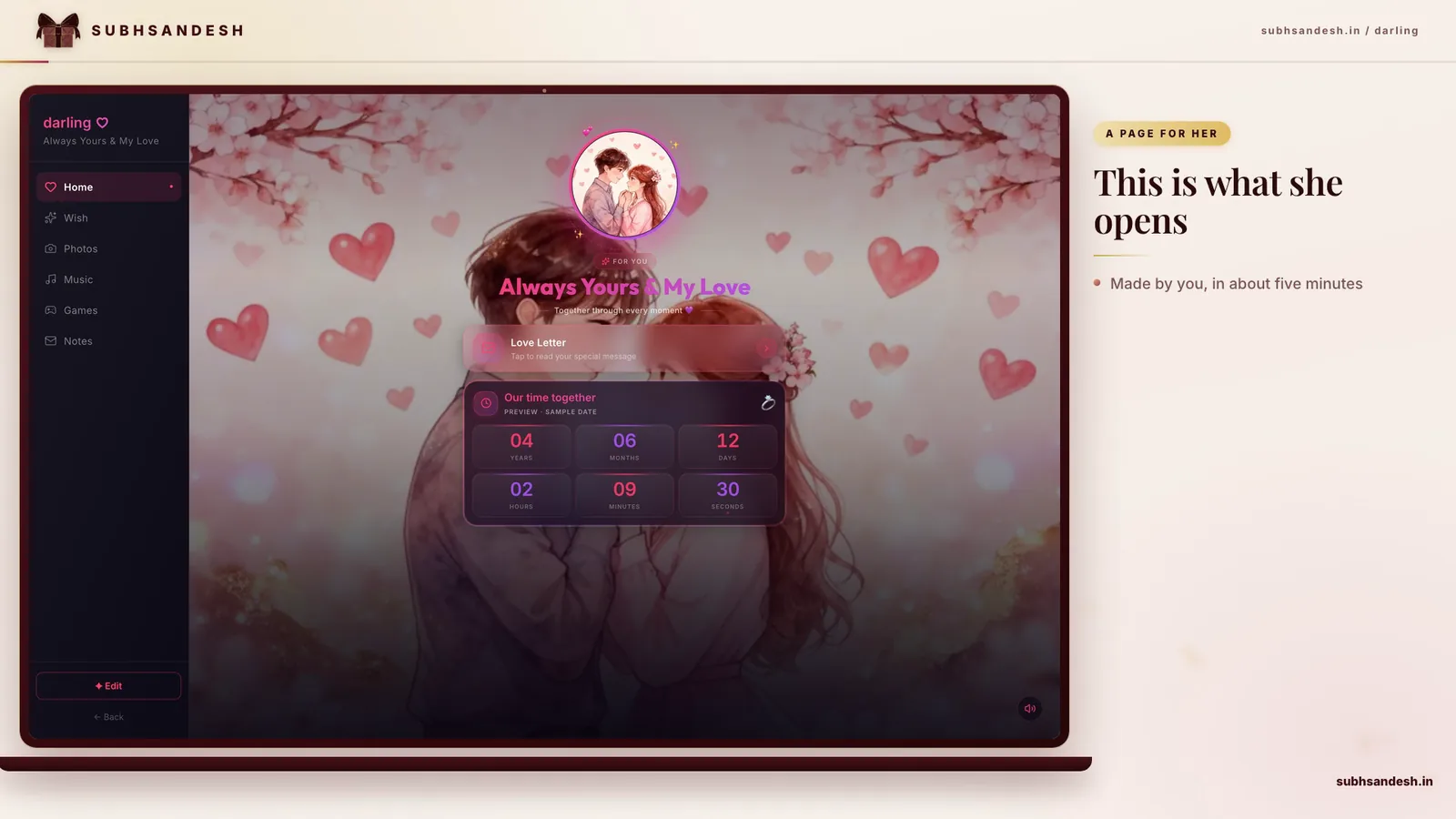
For a letter that sits inside a photo gallery, background music and a Love Quiz, the romantic "I love you" page for a girlfriend is built for exactly this. For something darker and more cinematic, the dark dramatic Darling page for a partner is the alternative — 343 pages, the fourth most-created template on the site.
Expect to edit: good letters get shortened, and that 6.9-hour median is the honest number.
When a Marathi letter is the wrong thing to send
If she reads English faster than Devanagari — common among Marathi speakers schooled in English — a Devanagari letter arrives as homework. Send the romanised version instead.
A letter is not risk-free for the writer either. In a 2026 study merging three gratitude-letter experiments across 487 participants, one of the three clusters — the authors named it "Backfired" — showed decreases in positive feeling and increases in negative affect, consisting of people already high in gratitude and feeling good.
Do not oversell it. The 2025 PLOS ONE review of positive expressive writing covered 51 studies across seven techniques and rated every one poor or fair in quality.
And if she is in the same room, hand her paper. A link loses to paper at zero distance, and paper needs no password.
Sources
- Slatcher and Pennebaker, Psychological Science, August 2006 — 86 dating couples; abstract only was readable.
- Gratitude interventions across cultures, PNAS, 8 July 2025 — 145 papers, 24,804 participants, g = 0.19.
- Writing a gratitude letter, Behavioral Sciences, 5 February 2026 — N = 487, three clusters including "Backfired".
- Positive expressive writing and wellbeing, PLOS ONE, 21 May 2025 — 51 studies, all rated poor or fair.
- Code-mixed Marathi corpora, Findings of ACL, November 2023 — 5M Roman-script and 5M Devanagari samples.
- Mobile expressive writing interfaces, arXiv, 1 October 2024 — keyboard preferred over voice for privacy.
Frequently Asked Questions
Turn this inspiration into an unforgettable surprise
Build a page with photos, a heartfelt message, music and a ready-to-share link.
- Photos, message & music
- Ready-to-share link

Written by
Suyash Agrahari
Founder
Suyash Agrahari is a Software Engineer at HireQuotient and the founder of SubhSandesh and DrawFlow (drawflow.in). He builds AI agents and full-stack products with Next.js, Node.js, and the OpenAI and LangChain ecosystems, having shipped autonomous multi-agent systems, AI copilots, and large-scale outreach platforms — and scaled side projects from a few hundred to millions of users. He writes about AI engineering, web development, and building products that grow through SEO and organic reach.
Stay Connected
Follow SubhSandesh
New templates, festival ideas and step-by-step walkthrough videos — first on our socials.
Product guide
See it built, step by step

Keep reading
Which Day Comes After Propose Day, and What Happens Now
Chocolate Day comes after Propose Day — Tuesday 9 February 2027. That is one sentence, so this page covers the four situations you are actually in on …
 Suyash Agrahari· 9 min
When to Propose a Girl to Be Your Girlfriend, and When Not To
The timing question, answered with conditions instead of a date: what has to be true before you ask, what politeness and fast replies do not prove, wh…
Suyash Agrahari· 9 minRomantic Proposal Room Decoration: What the Room Must Do
Romantic proposal room decoration, sorted by the work each setup takes and what the room allows: 7 setups with set-up and reversal times, lighting evi…
Suyash Agrahari· 9 min