
A Love Letter for Girlfriend in Nepali, Line by Line
A love letter for girlfriend in Nepali hinges on the pronoun: तिमी, not तपाईं. Eight Nepali lines you can check page by page in Turner's 1931 dictionary, the three-way honorific choice explained, and what SubhSandesh's 987 /love-gf pages do and do not tell you.
Make this into a page you can send
Photos, a message, music and a ready-to-share link — in a couple of minutes.
or browse all occasionsKey takeaways
- • Use तिमी (timī), not तपाईं: Turner's 1931 Nepali dictionary (p. 284) records तिमि as "less familiar than tã, less formal than tapāĩ" and notes "It takes the second person plural of the verb" — so it is तिमी हौ, never तिमी हो.
- • Nepali linguists disagree on the size of the system: Pathak (Gipan, 2019) treats it as "the canonical three-level honorific system", while Tumbahang (Dristikon, 2022) describes "five-layered honorific pronominal subjects with parallel verb conjugations".
- • Four of the eight lines here are printed in Turner as given — मलाई माया लाग्यो (p. 504) and माया न मार, "don't forget me" (p. 504), among them; the other four are assembled from separate entries and labelled as assembled.
- • SubhSandesh's "I love you" page is 987 of the 3,377 pages created since 2026-03-12 and carries 14,607 views, 35.2% of all views — platform totals across every language, not Nepali-speaker figures, because the database stores no page-language field.
- • 42.8% of creators set a password before sharing, and the median gap from first save to last edit on /love-gf is 7.2 hours — long enough to get the Nepali checked before it is sent.
On this page
A Love Letter for Girlfriend in Nepali, Line by Line
A love letter for girlfriend in Nepali turns on one grammatical choice before you write a word: तिमी (timī), not तपाईं (tapāĩ). Turner's 1931 dictionary of Nepali records तिमि as "less familiar than tã, less formal than tapāĩ", used "between friends", and — the part almost every sample letter online gets wrong — "it takes the second person plural of the verb."
This post gives eight Nepali lines with a page number attached to each, so you can check them yourself. It is grounded in the template SubhSandesh's users reach for hardest: the "I love you" page is 987 of the 3,377 pages created on the platform since 2026-03-12, and it has drawn 14,607 views, 35.2% of every view recorded.
Those numbers count every SubhSandesh page in every language: the database stores no page-language field, so none of them is a Nepali-speaker figure.
What is a Nepali प्रेमपत्र (prem patra)?
A प्रेमपत्र is a love letter written in Nepali, in Devanagari script, using the affectionate second person तिमी and the Nepali word माया. Turner glosses पत्र (patra) as "letter; document, deed", so प्रेमपत्र is a transparent compound: love plus letter.
What makes it a Nepali letter rather than a Hindi one transliterated is grammar, not vocabulary. The copula differs, the verb endings differ, and the second-person system has more rungs than Hindi's two.
A note on how the Nepali here is written. Devanagari follows modern standard spelling (तिमी, तिमीलाई); romanisations use macrons for long vowels, ~ for nasalisation, chh for छ and ch for च.
Quotations keep Turner's own 1931 spelling and romanisation verbatim — he headwords तिमि with a short i and writes ch for छ. The two systems disagree, so both are shown rather than silently merged.
Which "you" do you use — तँ, तिमी or तपाईं?
Use तिमी. Turner makes the three-way contrast explicit: तँ (tã) is "used in very familiar address, or by a superior to his greatly inferior", and तिमि sits above it, below तपाईं. To a girlfriend तपाईं reads as distance or as a joke; तँ reads as intimate or as contempt depending entirely on who you already are to her.
This is not settled etiquette but a live grammatical system, and Nepali linguists disagree on how many rungs it has. Lekhnath Sharma Pathak's 2019 paper in Gipan treats "the canonical three-level honorific system" as a reference point for what he calls psychologically motivated fluctuation, and reports that the significant influences on which honorific a speaker picks are "fluctuation in state of mind and proximality." Mohan Kumar Tumbahang's 2022 paper in Dristikon describes something wider: "The Nepali language exhibits the five-layered honorific pronominal subjects with parallel verb conjugations".
Three levels or five, the consequence is the same: in Nepali the pronoun changes the verb. तिमी takes the second-person plural, so it is तिमी हौ, not तिमी हो. Pathak's data set includes the language of marital discord — honorific choice moves with feeling, which is why a letter is a place to decide it rather than default into it.
Eight Nepali lines for a love letter, each one checkable
Each line gives the Devanagari, a romanisation, the meaning, and where it is verified. Four are quoted from Turner as printed. Four are assembled from words he documents separately, and are marked as assembled — that distinction matters more than a longer list would.
1. प्यारी
pyārī — "dear, loved, darling", feminine.
- Verified: Turner, p. 382, under पियारो (piyāro, "or pyāro"): "Affection, love, fondness… adj. (f. -i) Dear, loved, darling."
- Use: as the salutation; the same entry gives प्यारो गर्नु, "to love, like".
2. मलाई माया लाग्यो
malāi māyā lāgyo — "I have fallen in love."
- Verified: Turner, p. 504, printed as an example under माया in exactly this form.
- Use: the strongest line here, because nothing about it is assembled — it is a dictionary example sentence, romanisation included.
3. म तिमीलाई माया गर्छु
ma timīlāī māyā garchhu — "I love you."
- Assembled: माया from p. 504, गर्नु from p. 137, where Turner notes it is "frequently used with substantives to form verbal expressions."
- Note: the full sentence is not printed in Turner.
4. तिमी मेरो हौ
timī mero hau — "you are mine."
- Assembled: हौ is the तिमी form in Turner's हुनु paradigm on p. 641 (
hũ, hos, ho, haũ, hau, hun). - Use: this is where a Hindi habit does the most damage — तिमी हो is wrong.
5. मेरो मुटु पिलिन्छ
mero muṭu pilincha, in Turner's romanisation — "my heart is full of anxiety."
- Verified: Turner, p. 512 — मुटु (muṭu) is "The heart; feelings; courage", and
mero m˚ pilinchais his example of मुटु पिलिनु, "to be full of anxiety."
6. म तिमीलाई सम्झन्छु
ma timīlāī samjhanchhu — "I think of you."
- Assembled: सम्झनु, p. 588, "To remember; understand; feel."
- Use: the third gloss is the useful one — this carries more warmth than "I remember you" does in English.
7. अँगालो मार्नु
ãgālo mārnu — "to embrace, to clasp."
- Verified: Turner, p. 1, under अँगालो: "The bent arm; armful; embrace", with
ã˚ mārnuglossed "to embrace, to clasp". - Use: kept as the phrase, because the conjugated forms are not in the entry.
8. माया न मार
māyā na māra — "don't forget me."
- Verified: Turner, p. 504, printed verbatim under माया मार्नु, "to forget."
- Use: the literal sense is "don't kill the love", and it is the best closing line in Nepali precisely because it does not translate cleanly.
Two more words worth having: सधैँ (sadhaĩ), "always", p. 583, and पर्खनु (parkhanu), "To wait, remain; — have patience", p. 367 — assembled into म सधैँ पर्खन्छु, ma sadhaĩ parkhanchhu, "I will always wait."
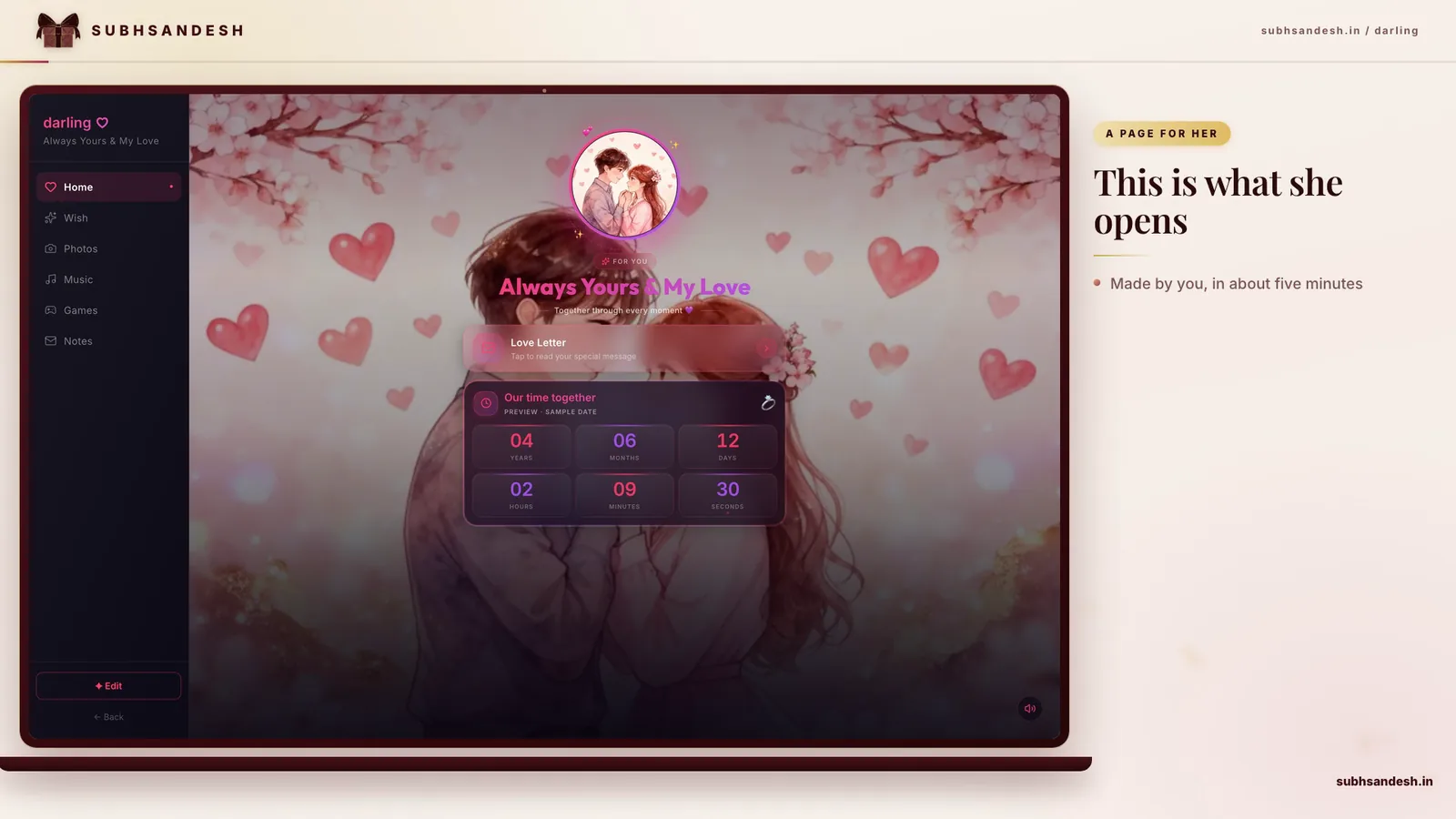
If you want the letter typed out on screen instead of pasted into a chat window, the SubhSandesh "I love you" page types it across its cover and keeps photos, a Love Quiz and a Truth-or-Dare round behind separate tabs. For a darker register, the Darling romantic page is the other one people pick — 349 pages, 10.3% of everything created.
Nepali is not Hindi in Devanagari: three places they split
The script is shared; the language is not. If you have only ever written Hindi, these are where the leak happens.
The copula. Hindi तुम हो, Nepali तिमी हौ. Turner's हुनु paradigm on p. 641 lists hau for the second-person plural — the form तिमी requires.
छ, not है. Turner treats छनु (chanu) as a separate verb on p. 191, "To exist, be alive, be", and prints its present tense: chu, chas, cha, chaũ, chau, chan — so म छु, तिमी छौ. Nothing in that paradigm resembles Hindi है.
माया as a word for love. Turner's माया entry on p. 504 glosses it "Infatuation, folly; — (pop.) magic; — love; pity", from Sanskrit माया, "art". Love is a listed dictionary sense of माया in Nepali — which is why it is the word a Nepali letter reaches for.
One orthographic gap worth knowing: Turner's 1931 headword is तिमि, short i; modern standard Nepali writes तिमी. Neither is a typo — the spelling standardised in between.
How the letter actually reaches her
Four routes, with the constraint each imposes. The last column is SubhSandesh's own data, counting all pages in all languages; it is not a Nepali-specific figure.
| Delivery route | What she needs | Devanagari renders | SubhSandesh signal (all pages, all languages) |
|---|---|---|---|
| Posted handwritten letter | A postal address | Your own handwriting | — |
| Pasted into a chat message | A device with a Devanagari font | Depends on her installed fonts | 50.3% of views are on a phone |
| Shared SubhSandesh page | One link | Rendered by the page itself | 987 /love-gf pages, 14,607 views |
| Shared page with a password set | The link plus the password | Same | 42.8% of creators set a password |
The takeaway is narrow: a page beats a paste for Devanagari because it controls its own typeface instead of borrowing hers.
If she grew up in Darjeeling or Sikkim, not Nepal
Nepali is not only Nepal's language. It is one of the 22 languages listed in the Eighth Schedule of the Indian Constitution, so the audience for this phrase straddles Nepal, Darjeeling, Sikkim, Assam and the diaspora.
Here honesty is cheaper than a guess. The 3,377 pages, the 987 on /love-gf and the 42.8% who set a password are platform-wide totals. The database records no language attribute on a page, so we cannot tell you how many were written in Nepali, and any post that gives you a Nepali-speaker breakdown of platform data is inventing it.
What the data does support is a workflow claim: 99.5% of started pages get published and shared, and the median gap between first save and last edit is 7.2 hours on /love-gf. Writing in a script you are not fluent in, that gap is the useful part — it is time to get the lines checked.
When a Nepali love letter is the wrong choice
Turner records a Nepali proverb under माया on p. 504: māyā le kāyā hũdaina, "the body does not live by love." It is a fair corrective for a page like this one.
A letter in a script you cannot read is a risk you take with her, not for her. If your Nepali is assembled from a dictionary and she is fluent, she will see the seams — and eight lines from a source you can name land better than forty you cannot vouch for. If she reads Nepali only in Roman script, Devanagari is an obstacle rather than a gift.
A shared page is the wrong medium in two cases. If she is in the same room, hand her paper. And if the letter is really about absence rather than declaration, the I miss you page fits better.
Sources
- R. L. Turner, A Comparative and Etymological Dictionary of the Nepali Language (1931), digitised by Digital Dictionaries of South Asia, University of Chicago — माया, p. 504 and तिमि, p. 284.
- Lekhnath Sharma Pathak, "Honorification in Nepali: a psycholinguistic perspective", Gipan, 31 December 2019.
- Mohan Kumar Tumbahang, "A Case of Lenition-Fortition and Honorific Asymmetry in Limbu Native's Nepali Speech", Dristikon: A Multidisciplinary Journal 12(1), 110–120, 5 July 2022.
- Department of Official Language, Government of India, "Languages Included in the Eighth Schedule of the Indian Constitution". The page states no publication date.
- First-party figures are from SubhSandesh's own database, measured 2026-09-02.
Frequently Asked Questions
Turn this inspiration into an unforgettable surprise
Build a page with photos, a heartfelt message, music and a ready-to-share link.
- Photos, message & music
- Ready-to-share link

Written by
Suyash Agrahari
Founder
Suyash Agrahari is a Software Engineer at HireQuotient and the founder of SubhSandesh and DrawFlow (drawflow.in). He builds AI agents and full-stack products with Next.js, Node.js, and the OpenAI and LangChain ecosystems, having shipped autonomous multi-agent systems, AI copilots, and large-scale outreach platforms — and scaled side projects from a few hundred to millions of users. He writes about AI engineering, web development, and building products that grow through SEO and organic reach.
Stay Connected
Follow SubhSandesh
New templates, festival ideas and step-by-step walkthrough videos — first on our socials.
Product guide
See it built, step by step

Keep reading
Which Day Comes After Propose Day, and What Happens Now
Chocolate Day comes after Propose Day — Tuesday 9 February 2027. That is one sentence, so this page covers the four situations you are actually in on …
 Suyash Agrahari· 9 min
When to Propose a Girl to Be Your Girlfriend, and When Not To
The timing question, answered with conditions instead of a date: what has to be true before you ask, what politeness and fast replies do not prove, wh…
Suyash Agrahari· 9 minRomantic Proposal Room Decoration: What the Room Must Do
Romantic proposal room decoration, sorted by the work each setup takes and what the room allows: 7 setups with set-up and reversal times, lighting evi…
Suyash Agrahari· 9 min