
Love Letter for Girlfriend in Urdu, Written to Be Read
Five complete Urdu love letters in Nastaliq, Roman Urdu and English, with the آپ/تم/تُو register rules, a four-script comparison, and why Nastaliq breaks in chat apps.
Make this into a page you can send
Photos, a message, music and a ready-to-share link — in a couple of minutes.
or browse all occasionsKey takeaways
- • Urdu forces a register choice on the first line: تم for an established relationship, آپ for a first letter or an apology, تُو only inside a deliberately poetic letter.
- • Nastaliq letter shapes depend on the following letter, so Urdu fonts need hundreds to thousands of glyphs — and the W3C notes the simplified typewriter style is generally the browser default for Arabic script.
- • Roman Urdu has no standardised Romanization table, so there is no spelling to get wrong; machine transliteration back to Nastaliq now scores 96.37 Char-BLEU.
- • The "I love you" page is SubhSandesh's most-created template (975 pages, 29.2%) and most-viewed (14,396 views, 35.2% of 40,864), and 42.9% of creators password-protect before sharing.
- • Urdu-in-Devanagari is a real option for Indian readers: Ahmad's 2011 Delhi study found Muslims there no longer treat the Arabic script as necessary to Urdu.
On this page
Love Letter for Girlfriend in Urdu, Written to Be Read
Settle three things first: the pronoun (آپ, تم or تُو), the script, and where the letter lives. The "I love you" page is SubhSandesh's most-created template — 975 pages, 29.2% of everything built since 12 March 2026 — and its most-viewed, at 14,396 views, 35.2% of all 40,864 page views.
That is where the real problem sits: 50.3% of those views are on a phone (20,561 of 40,864), and a phone is where right-to-left Nastaliq is least likely to render as typed.
Below: five letters in Nastaliq with Roman Urdu and an English gloss, the register rules, and a four-script table.
What an Urdu khat is, and why shayari sets the bar
An Urdu love letter — خط, khat — is short prose for one reader: two or three paragraphs, one thing said plainly, a turn in the last line.
The bar is higher in Urdu, and that is not sentiment. Urdu has a living mainstream poetry register: the ghazal is what plays in the car, and Rekhta, the Indian Urdu archive, went from 50 poets in 2013 to over 5,000 writers, as TIME reported in September 2023. Assume she has heard better lines; write plainer.
آپ, تم or تُو — the pronoun that decides the letter
English "you" hides the choice. Urdu prints one of three levels on line one.
آپ (aap) — respectful, slightly formal: tenderness at a careful distance. Right for a first letter, and after a fight, because the formality says you are not casual.
تم (tum) — the settled register of an established relationship: warm, equal, everyday. Write آپ after a year together and it reads as cold.
تُو (tu) — the ghazal register. In a poem it is the standard address to the beloved; in ordinary adult speech it is close to insulting. Use it once, or never.
Urdu verbs are gendered for the speaker too: a man writes لوں گا (loonga), a woman لوں گی (loongi). Copied letters carry the wrong one, and it is the first thing she notices.
5 Urdu love letters for your girlfriend, in Nastaliq and Roman
Each gives Nastaliq, Roman Urdu, an English gloss and the case it fits.
1. پہلا خط — the first letter (آپ, 32 words)
Urdu: آپ کے نام، یہ پہلا خط ہے، اِس لیے الفاظ کم پڑ رہے ہیں۔ کئی بار کہنا چاہا، ہر بار بات ہنسی میں ٹال دی۔ سچ یہ ہے کہ آپ سے محبت ہے۔ جواب کی جلدی نہیں — خط سنبھال لیجیے، بس۔
Roman: Aap ke naam, Yeh pehla khat hai, is liye alfaaz kam pad rahe hain. Kai baar kehna chaaha, har baar baat hansi mein taal di. Sach yeh hai ke aap se mohabbat hai. Jawaab ki jaldi nahin — khat sambhaal lijiye, bas.
English: My first letter, so the words fall short. I kept laughing it off. The truth is, I love you.
Use when: You have not said it yet; آپ stops it sounding presumptuous.
2. دوری کا خط — long distance (تم, 30 words)
Urdu: میری جان، آج بھی وہی وقت ہوا اور تم پاس نہیں تھیں۔ فون پر آواز آ جاتی ہے، ہاتھ نہیں آتا۔ اِس دوری کا سب سے لمبا دن بھی تمہارے نام کے ساتھ کٹ جاتا ہے۔ اگلی بار ٹکٹ میں لوں گا۔
Roman: Meri jaan, Aaj bhi wohi waqt hua aur tum paas nahin theen. Phone par aawaaz aa jaati hai, haath nahin aata. Is doori ka sab se lamba din bhi tumhaare naam ke saath kat jaata hai. Agli baar ticket main loonga.
English: The hour came round and you were not here. The phone gives me your voice, not your hand. Next time I book the ticket.
Use when: Different cities, after the call; the promise stops it reading as complaint.
3. لڑائی کے بعد — after a fight (آپ, 29 words)
Urdu: میں غلط تھا۔ جو کہا وہ نہیں کہنا چاہیے تھا، اور جس لہجے میں کہا وہ اُس سے بھی زیادہ غلط تھا۔ آج "آپ" لکھ رہا ہوں، "تم" نہیں — کیونکہ اِس وقت مذاق کی جگہ نہیں ہے۔ جب آپ تیار ہوں، بات کر لیں۔
Roman: Main ghalat tha. Jo kaha woh nahin kehna chaahiye tha, aur jis lahje mein kaha woh us se bhi zyada ghalat tha. Aaj "aap" likh raha hoon, "tum" nahin — kyunke is waqt mazaaq ki jagah nahin hai. Jab aap tayyaar hon, baat kar len.
English: I was wrong; the tone worse than the words. Today I write aap, not tum. Talk when you are ready.
Use when: You are at fault; the register shift does the apologising.
4. بغیر کسی وجہ — just because, or her birthday (تم, 31 words)
Urdu: کوئی موقع نہیں ہے۔ آج تم چائے بناتے ہوئے کچھ گنگنا رہی تھیں، اور مجھے یاد آیا کہ میں نے کبھی بتایا ہی نہیں کہ گھر "گھر" کیوں لگتا ہے۔ تم سے محبت ہے۔ بس یہی خبر تھی۔ اب چائے ٹھنڈی ہو رہی ہے۔
Roman: Koi mauqa nahin hai. Aaj tum chai banaate hue kuchh gungunaa rahi theen, aur mujhe yaad aaya ke main ne kabhi bataaya hi nahin ke ghar "ghar" kyun lagta hai. Tum se mohabbat hai. Bas yehi khabar thi. Ab chai thandi ho rahi hai.
English: No occasion. You were humming over the tea and I realised I had never told you why home feels like home. Now the tea is going cold.
Use when: Nothing is happening. For a birthday, swap the opening for سالگرہ مبارک.
5. تین لائنیں — the very short one (تُو, 20 words)
Urdu: تُو نے پوچھا تھا کہ محبت میں کیا ملتا ہے۔ کچھ نہیں ملتا۔ ایک عادت لگ جاتی ہے — اور لوگ اُس عادت کا نام محبت رکھتے ہیں۔
Roman: Tu ne poochha tha ke mohabbat mein kya milta hai. Kuchh nahin milta. Ek aadat lag jaati hai — aur log us aadat ka naam mohabbat rakhte hain.
English: You asked what one gets from love. Nothing. You pick up a habit — and people call that habit love.
Use when: A chat window or a caption — the only one here in تُو.
5 rules that borrow shayari's cadence without writing a bad ghazal
Shayari runs on compression, not vocabulary. Five rules transfer.
Keep lines short. A couplet is two lines; a six-line paragraph is an essay about love.
One image, not five. Tea going cold, a train ticket, an hour come round again. The second image cancels the first.
Put the turn at the end. The closing line reverses the opening — "there is no occasion", then "the tea is going cold".
Understate. مجھے تم پر فخر ہے, three words, beats a paragraph on it.
Do not quote. Faiz and Faraz are in copyright, a forwarded couplet is not writing, and she can reverse-search it in seconds. One of the two 2014 pages still ranking here carries a public comment asking for it to be deleted: the reader had sent it verbatim and feared she would find the original.
If the dramatic register is what you want, the dark, cinematic romantic page for a partner suits تُو better than a bright pastel layout — the fourth most-created template here, at 343 pages and 10.3%.
4 scripts, one letter: what actually arrives
The third column is what people find out too late. Row three exists because Ahmad's Delhi study in Language in Society, June 2011, found Muslims there no longer treat the Arabic script as necessary to Urdu.
| Script | Keyboard | Renders right in WhatsApp / Instagram | Register | Who it suits |
|---|---|---|---|---|
| Nastaliq Urdu (خط) | Urdu, or type-and-convert | Often falls back to Naskh; emoji can flip line order | Highest — reads as a letter | Arabic-script readers, where you control the font: 42.9% lock the page (1,432 of 3,335) |
| Roman Urdu (khat) | None | Always | Warm, everyday | Almost everyone; survives all 40,864 views logged, 50.3% on a phone |
| Urdu in Devanagari | Devanagari | Always | Same words, no ornament | Speaks Urdu, reads Devanagari |
| English | None | Always | Lowest here | Does not read Urdu; mixed-language couples |
Roman Urdu is the safe default, Nastaliq the better letter, and having both means a surface that controls its own typography.
Why Nastaliq breaks in WhatsApp and Instagram
Nastaliq is not merely right-to-left. Each letter's shape depends on the one that follows, so an Urdu font needs hundreds of glyphs — "in some cases even thousands" — to look right, per the W3C's Arabic and Persian layout requirements of 2 October 2025, which adds that the typewriter-style simplification reusing one glyph per position "is generally the browser default font for the Arabic script".
So the letter you typed and the letter she sees are not reliably the same; one emoji can make the bidirectional algorithm reorder the line.
Two fixes. Type in Roman Urdu and convert: transliteration now scores 96.37 character-level BLEU Urdu-to-Roman and 97.44 back, in a 2025 ACL LoResMT paper that beat GPT-4o Mini — trust it with a proofread. Roman Urdu has no standard Romanization table anyway, per a 2020 paper in the International Journal of Linguistics and Culture.
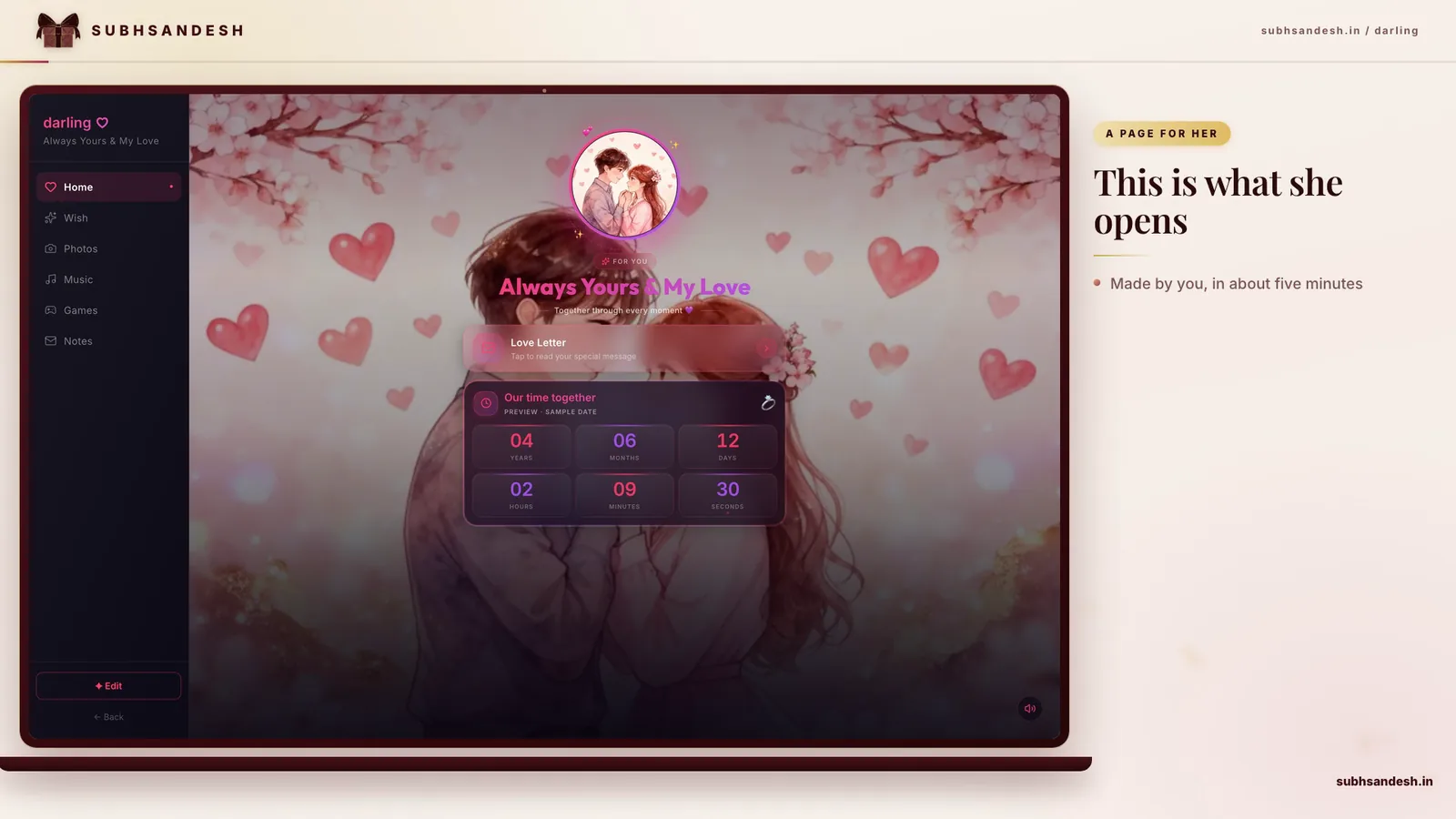
Or stop using a chat window. An Urdu love letter page for a girlfriend with photos, background music and an optional password sets the font and direction itself, so what she opens is what you wrote. 42.9% of creators password-protect before sharing (1,432 of 3,335), and the median gap between first save and last edit there is 6.9 hours (n=975).
When an Urdu letter is the wrong thing to send
She does not read the script. Plenty of people who speak Urdu at home never learned Nastaliq. Send the Roman or Devanagari version.
Her family shares the phone. An Urdu letter in a household where the script identifies the writer is not private. Password-protect it or do not send it.
You are in the same room. Say it out loud. A letter is a technology for distance; 99.5% of pages started here get published (3,317 of 3,335), averaging 12.3 views, but a link handed to someone next to you is worse than one sentence.
Sources
- Butt et al., Low-Resource Transliteration for Roman-Urdu and Urdu, LoResMT, 2025 — https://aclanthology.org/2025.loresmt-1.13/
- Ansari et al., Use of Roman Script for Writing Urdu, Int. J. of Linguistics and Culture 1(2), Dec 2020 — https://pdfs.semanticscholar.org/100d/1a15989e9e6eaee6658882c9e99216df5d6a.pdf
- Ahmad, Urdu in Devanagari, Language in Society 40(3), June 2011 (abstract only) — https://www.cambridge.org/core/journals/language-in-society/article/abs/urdu-in-devanagari-shifting-orthographic-practices-and-muslim-identity-in-delhi/F89F162B15A6720008639E627D6F0242
- Irfan, The Fight to Preserve the Urdu Script, TIME, 27 Sep 2023 — https://time.com/6317817/urdu-nastaliq-digital/
- Arabic & Persian Layout Requirements, W3C i18n WG, 2 Oct 2025 — https://www.w3.org/TR/alreq/
Frequently Asked Questions
Turn this inspiration into an unforgettable surprise
Build a page with photos, a heartfelt message, music and a ready-to-share link.
- Photos, message & music
- Ready-to-share link

Written by
Suyash Agrahari
Founder
Suyash Agrahari is a Software Engineer at HireQuotient and the founder of SubhSandesh and DrawFlow (drawflow.in). He builds AI agents and full-stack products with Next.js, Node.js, and the OpenAI and LangChain ecosystems, having shipped autonomous multi-agent systems, AI copilots, and large-scale outreach platforms — and scaled side projects from a few hundred to millions of users. He writes about AI engineering, web development, and building products that grow through SEO and organic reach.
Stay Connected
Follow SubhSandesh
New templates, festival ideas and step-by-step walkthrough videos — first on our socials.
Product guide
See it built, step by step

Keep reading
Which Day Comes After Propose Day, and What Happens Now
Chocolate Day comes after Propose Day — Tuesday 9 February 2027. That is one sentence, so this page covers the four situations you are actually in on …
 Suyash Agrahari· 9 min
When to Propose a Girl to Be Your Girlfriend, and When Not To
The timing question, answered with conditions instead of a date: what has to be true before you ask, what politeness and fast replies do not prove, wh…
Suyash Agrahari· 9 minRomantic Proposal Room Decoration: What the Room Must Do
Romantic proposal room decoration, sorted by the work each setup takes and what the room allows: 7 setups with set-up and reversal times, lighting evi…
Suyash Agrahari· 9 min