
48 Love Quiz Questions for Your Girlfriend, in Four Tiers
48 love quiz questions for your girlfriend in four escalating tiers, with how many of each to use in a 10-question round, which tiers survive a video call, and why the "does she really love you" grading quiz is the wrong format.
Make this into a page you can send
Photos, a message, music and a ready-to-share link — in a couple of minutes.
or browse all occasionsKey takeaways
- • Play 10 to 12 questions in one round drawn from four tiers — warm-up, memory, preference, deep — with only 1 to 2 deep questions, and finish on an easy one.
- • The escalation is what works, not the framing: Aron et al. (1997) recorded closeness about 0.88 standard deviations above a matched small-talk task, and found no effect from telling pairs to "get close".
- • "Does she really love you?" quizzes have exactly one player, so they cannot produce reciprocity — the mechanism the closeness research actually identifies.
- • A video call costs nothing: Sprecher (2021) found no significant closeness or liking difference versus face-to-face. Texting does cost you, with lower self-disclosure across 572 participants in 2025.
- • SubhSandesh's /love-gf page is 975 of 3,335 pages created (29.2%) and 14,396 of 40,864 views (35.2%); its median build spans 6.9 hours because the "Our Story" history keeps every answer.
On this page
48 Love Quiz Questions for Your Girlfriend, in Four Tiers
A love quiz for your girlfriend works when it is a game you both play, not a test you set for her. Use 48 questions in four escalating tiers — warm-up, memory, preference, deep — play 10 to 12 in one round, and end on an easy one.
We can be specific because the "I love you" page for a girlfriend is SubhSandesh's most-built template: 975 of the 3,335 personalised pages created since 12 March 2026, 29.2% of everything made, and the most-viewed at 14,396 views, 35.2% of all 40,864 recorded views. Below: all 48 questions, the dosage per tier, and the rules that keep a round from becoming an argument.
What a love quiz for a girlfriend actually is
A love quiz for a girlfriend is a short, turn-taking round of questions whose answers only the two of you can score, played together rather than filled in alone by one person.
Arthur Aron and four co-authors published a 45-minute laboratory version in 1997 — three question sets, 15 minutes each, escalating in intensity — and recorded closeness roughly 0.88 standard deviations above a matched small-talk task. Studies 2 and 3 in that paper found no closeness effect from telling pairs they would probably like each other, or making "get close" an explicit goal.
The escalation did the work, not the framing. A shorter clinical version exists: the Relationship Closeness Induction Task is 29 questions in lists of 7, 12 and 10, timed at 1, 3 and 5 minutes.
48 love quiz questions for your girlfriend, in four tiers
Order is the mechanic. Each tier states its job, dosage, and failure mode.
Tier 1 — Warm-up: 12 questions she can answer in five seconds
For proving you both notice ordinary things; fine for a couple three weeks old. Use 3 to 4 as the opener.
Nothing here can go wrong, which makes it the safest place to finish.
- What's my usual order at our regular place?
- Which side of the bed do I sleep on?
- How do I take my chai — cutting, adrak, or full glass?
- What's on my phone wallpaper right now?
- What do I order after a bad day?
- Which friend do I call first with good news?
- How many alarms do I set?
- Do I say "haan" or "yeah" more?
- Which song do I skip every time?
- What colour shirt do I wear far too much?
- Which chore will I always volunteer for?
- What time do I actually fall asleep?
Tier 2 — Memory: 12 questions about the first time
For building a shared record you can check against each other. Needs six months of history; use 3 to 4, after the warm-up.
One of you will misremember. Treat a mismatch as a story, not a verdict.
- Where were we standing the first time we met?
- Who messaged first, and what did it say?
- What did we eat on our first proper date?
- What was the first film we watched together?
- Who said "I love you" first, and how far in?
- What was the first thing I ever gave you?
- What was the first song we both claimed as ours?
- Where was our first trip, and what went wrong?
- What was our first real fight about?
- Which nickname was the first to stick?
- Who was the first person I told about you?
- What did I wear to your first family function?
Tier 3 — Preference: 12 "would I rather" questions with a right answer
For testing how accurately she reads you — the part that feels like a quiz, and the fastest to mark. Use 2 to 3.
One works as a palate cleanser after a heavy question. It fails only if you argue about the marking.
- Would I rather a beach holiday or a hill station?
- Would I rather host at home or go out?
- Surprise party or quiet dinner?
- Would I rather be praised in public or thanked in private?
- Would I rather lose my phone or my wallet?
- Would I rather sort a problem tonight or sleep on it?
- Would I rather your family visit us or we visit them?
- Would I rather be given a book or a playlist?
- Window seat or aisle?
- Would I rather be woken early or left till noon?
- Would I rather be handed a plan or asked to make one?
- Teased or fussed over?
Tier 4 — Deep: 12 questions that create the moment
For the one part the whole round exists for. Needs a relationship secure enough that an honest answer will not be used against her later.
Use 1 to 2, never as the opener. Asked cold it is an interrogation; asked third, trust.
- When did you first think this might be long-term?
- What do I do that you've never told me you love?
- Which version of me do you like best?
- What do you think I'm most afraid of?
- If you could keep only one of my habits, which?
- What's a moment with me you replay?
- When have you felt most sure about us?
- What do you want me to ask you more often?
- What do you think I underestimate about myself?
- What small thing mattered more than I realised?
- What have you forgiven me for without saying so?
- What do you need from me that's hard to ask for?
Which tier to use when: planning a 10-question round
The four tiers on the axes that matter while building a round.
| Tier | What it's for | Per 10–12 question round | Works over a video call? |
|---|---|---|---|
| Warm-up (12) | Showing you notice small things | 3–4, opener and closer | Yes — best opener on a call |
| Memory (12) | Building a checkable shared record | 3–4, second slot | Yes, fills silence well |
| Preference (12) | Scoring how well she reads you | 2–3, palate cleanser | Yes, fastest to mark |
| Deep (12) | The moment the round exists for | 1–2, third slot only | Yes, never first or last |
One deep question per round of eleven is the right ratio; two is the ceiling.
To keep the answers rather than lose them, the Love Quiz and Truth-or-Dare rounds on the "I love you" page for a girlfriend write each round into an "Our Story" history.
Three numbers from those 975 pages shape the round:
| What we measure on /love-gf | Value | What it changes |
|---|---|---|
| First save to last edit (median) | 6.9 hours, n=975 | Build it across an evening, not one sitting |
| Views opened on a phone | 50.3% (20,561 of 40,864) | Keep questions short enough to read on a phone |
| Password-protected before sharing | 42.9% (1,432 of 3,335) | Tier 4 answers stay private on a page |
Six rules that stop a round becoming an argument
Nobody writes these down, and each exists because the alternative failed.
1. Cap the round at 10 to 12 questions. Aron's version ran 45 minutes with a researcher enforcing it. At home, attention gives out around twelve.
2. Never ask a question whose wrong answer is a grievance. "When is my mother's birthday?" is not a quiz question. It is an accusation with a scoreboard.
3. One question about an ex per round, and only in Tier 4. Two is a pattern, and a pattern reads as an audit.
4. Both of you answer everything. The moment one person is being marked, the closeness effect is gone and it is a job interview.
5. Escalate in order, end on an easy one. Warm-up, memory, preference, deep, then back to Tier 1 or 3 so the round closes light.
6. Write the answers down. Kardas, Kumar and Epley found across a dozen experiments that people underestimate how well deep conversations will go: they felt less awkward and more connecting than expected.
Why "does she really love you?" quizzes are the wrong format
A whole genre of girlfriend quiz grades her: multiple-choice questions about how often she texts back, a score out of 100, a verdict. One has over 220,000 attempts.
The problem is not the unscientific scoring, though it is that. It is that the quiz has one player: she never answers anything and is not in the room. A one-player quiz cannot produce reciprocity, and reciprocity is the entire mechanism in the research.
It is also insulting if she finds out. Once she knows you took a test to decide whether she loves you, the result stops mattering.
Video call, same room, or texting: what changes
Less than you would think, in one direction. Susan Sprecher ran the Aron task with dyads assigned to video-chat or face-to-face and found no significant differences in closeness or liking by mode of communication. All four tiers survive a video call intact.
Texting is the mode that costs you something. A 2025 study of 286 dyads — 572 people — found intimate conversation beat small talk in both mediums, but texting produced lower self-disclosure than face-to-face, feeding through to lower closeness.
That argues for building the round on a page rather than in the chat thread.
When a love quiz is the wrong idea
Three cases worth naming. Mid-argument, a quiz avoids the conversation you need and Tier 4 becomes a weapon. Under three months in, Tier 2 has nothing to draw on and the round collapses into Tier 1.
And if she is not a games person, the format is a chore dressed as romance. Some people find being asked to perform affection worse than not being asked, and question design cannot fix that.
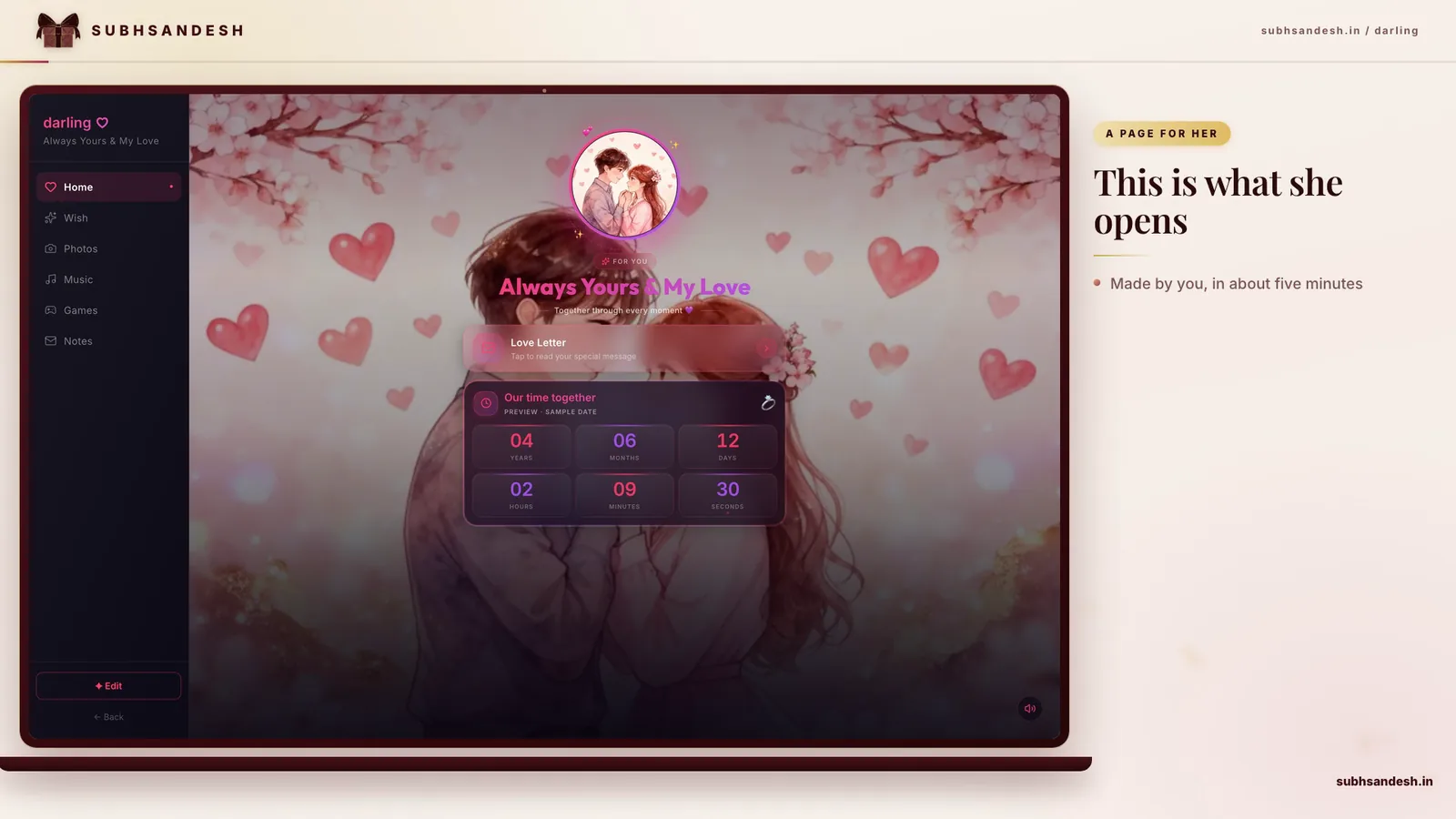
For that group the moodier option beats the cute one: the dark, cinematic Darling romantic page carries a declaration instead of a quiz, and is the fourth most-built template here at 343 pages, 10.3%.
Sources
- Aron et al., The Experimental Generation of Interpersonal Closeness, PSPB 23(4), April 1997.
- Sedikides et al., The Relationship Closeness Induction Task, Representative Research in Social Psychology 23, 1999.
- Kardas, Kumar & Epley, Overly Shallow?: Miscalibrated Expectations, JPSP 122(3), 30 September 2021.
- Sprecher, Fast Friends procedure and mode of communication, JSPR 38(5), 24 February 2021. Abstract only.
- Leckfor et al., Not such fast friends?, JSPR, 21 August 2025. Abstract only.
Frequently Asked Questions
Turn this inspiration into an unforgettable surprise
Build a page with photos, a heartfelt message, music and a ready-to-share link.
- Photos, message & music
- Ready-to-share link

Written by
Suyash Agrahari
Founder
Suyash Agrahari is a Software Engineer at HireQuotient and the founder of SubhSandesh and DrawFlow (drawflow.in). He builds AI agents and full-stack products with Next.js, Node.js, and the OpenAI and LangChain ecosystems, having shipped autonomous multi-agent systems, AI copilots, and large-scale outreach platforms — and scaled side projects from a few hundred to millions of users. He writes about AI engineering, web development, and building products that grow through SEO and organic reach.
Stay Connected
Follow SubhSandesh
New templates, festival ideas and step-by-step walkthrough videos — first on our socials.
Product guide
See it built, step by step

Keep reading
Which Day Comes After Propose Day, and What Happens Now
Chocolate Day comes after Propose Day — Tuesday 9 February 2027. That is one sentence, so this page covers the four situations you are actually in on …
 Suyash Agrahari· 9 min
When to Propose a Girl to Be Your Girlfriend, and When Not To
The timing question, answered with conditions instead of a date: what has to be true before you ask, what politeness and fast replies do not prove, wh…
Suyash Agrahari· 9 minRomantic Proposal Room Decoration: What the Room Must Do
Romantic proposal room decoration, sorted by the work each setup takes and what the room allows: 7 setups with set-up and reversal times, lighting evi…
Suyash Agrahari· 9 min