
Love Website for Girlfriend Without Coding: What Actually Breaks
Four things break a love website for a girlfriend built without coding: it never gets finished, anyone with the link can read it, it was only ever opened on a laptop, and a year later the link is dead. Each failure is priced across all three routes, with a 6.9-hour median measured over 975 pages.
Make this into a page you can send
Photos, a message, music and a ready-to-share link — in a couple of minutes.
or browse all occasionsKey takeaways
- • The "I love you" page is 975 of the 3,335 pages created since 12 March 2026 — 29.2% of everything — and draws 14,396 views, 35.2% of all 40,864 recorded.
- • The honest time cost is a 6.9-hour median from first save to last edit on that template (n=975), not the few minutes the category advertises.
- • 42.9% of creators password-protect the page before sharing it (1,432 of 3,335), which is the one thing a free static host cannot do unless you write a login.
- • 50.3% of the 40,864 recorded views happen on a phone (20,561), so a page tested only on a laptop has been tested in the minority case.
- • If you already write front-end code, code it yourself: a MODELS 2024 experiment found coding skill saved only four minutes of median build time on a no-code builder (23 vs 19, p = 0.879, n = 10).
On this page
Love Website for Girlfriend Without Coding: What Actually Breaks
You can make a love website for girlfriend without coding, and the useful question is not which route is best but which way the page breaks on you. The romantic page is the most-made thing on SubhSandesh: the "I love you" template accounts for 975 of the 3,335 pages created since 12 March 2026 — 29.2% of everything — and 14,396 views, 35.2% of all 40,864 views recorded.
Four things go wrong, and they go wrong in order: the page never gets finished, anyone holding the link can read it, it was only ever opened on a laptop, and a year later the link is dead. The median gap between a creator's first save and their last edit is 6.9 hours (n=975), not the few minutes this category advertises, ours included — which is where the first failure starts.
What "without coding" actually rules out
"Without coding" means you never write or edit HTML, CSS or JavaScript and never touch a deploy step: you type into a form or drag a block, and a hosted page appears at a link. It does not mean no work, and it does not mean no decisions.
What it rules out is structural change. Across the 15 page types on SubhSandesh the structure of each is fixed: you cannot move a section the template will not move, and you cannot add an interaction nobody built.
That leaves three routes, and they are not equivalent. You can write the HTML yourself and put the files on a free static host, keeping every decision and every file. You can repurpose a general drag-and-drop website builder, which asks no code but hands you a starting layout designed for a bakery's opening hours rather than a love letter.
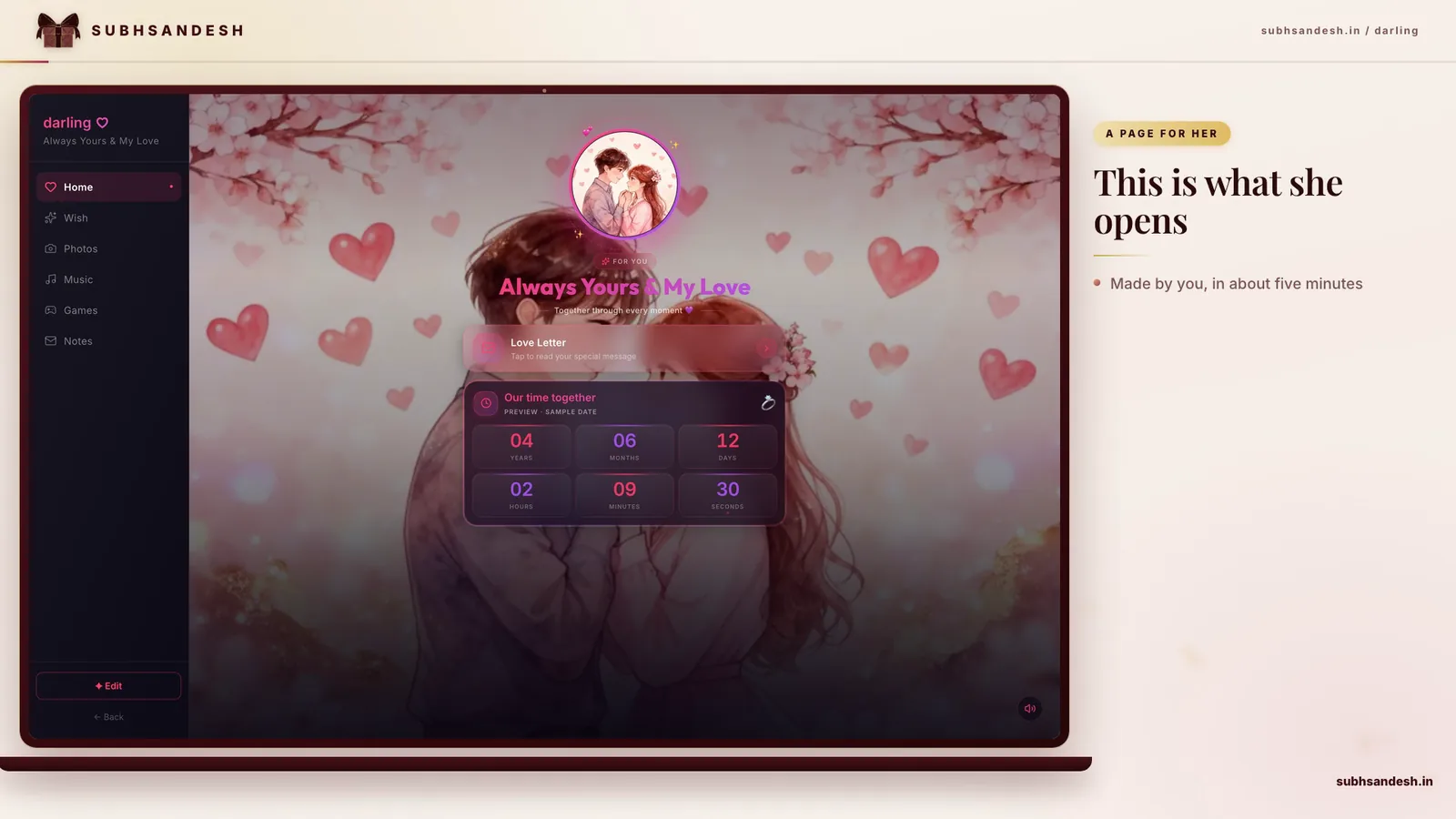
Or you can fill in a purpose-built romantic template — a letter, a photo gallery, background music, private notes, a quiz, an optional password — where the words are yours and the structure was settled before you arrived. Each of the four failures below lands on those three routes differently, and that is the comparison that actually decides anything.
Failure 1: it never gets finished, and the mood is usually why
Every product in this category, ours included, advertises minutes. Measured against our own database that is true of the first publish and false of the finished page: the median first-save-to-last-edit gap on the romantic "I love you" page for a girlfriend is 6.9 hours across all 975 pages made from it.
That gap is not friction, it is rewriting. 99.5% of started pages do get published and shared (3,317 of 3,335), so on a template almost nobody abandons — they publish, then reopen the letter and change the wording.
Coding skill does not shorten it. In a MODELS 2024 experiment comparing programmers with non-programmers on a no-code builder, median build time was 23 minutes for the group with no programming experience against 19 minutes for the group with it, at p = 0.879 and a negligible effect size. That was 10 student participants building a small business app, so read it as a direction rather than a law.
On the hand-coded route the thing that stalls people is rarely the markup either. It is the design: making a page exist is quick, and making it look intended is a separate skill with no template underneath it.
The decision that stalls every route is the mood. A soft, bright letter-and-gallery page reads as sincere; a dark, dramatic one reads as intense, and SubhSandesh's dark, dramatic romantic page for a partner is the fourth most-created template with 343 pages, 10.3% of everything made — so a real minority wants intensity rather than sweetness.
Browsing for that answer makes it harder to reach. A meta-analysis of 99 choice-overload observations covering 7,202 participants found overload rises with preference uncertainty, which means that if you do not already know which mood fits her, a longer gallery of SubhSandesh templates makes the decision worse rather than easier. Write the mood down in one sentence first, pick the page that matches that sentence, and stop scrolling.
Failure 2: anyone who has the link can read it
42.9% of SubhSandesh creators password-protect the page before sharing it — 1,432 of 3,335. That is not a niche preference, and it is the failure this category almost never prices.
On the free static-host route it is not a setting you switch on, it is a login you write. A static host serves files to whoever asks for them, so privacy there has to be built rather than enabled — which is precisely the coding this query is trying to avoid.
The free tier is worse than neutral about it. GitHub's published GitHub Pages usage limits state that on GitHub Free, Pages works only in a public repository, so the photos and the letter sit somewhere readable by anyone who finds it, alongside a 1 GB site cap and a 100 GB monthly bandwidth soft limit.
General builders usually keep the password behind a paid plan. A purpose-built romantic template has it in the form, which is why nearly half of real creators end up using it.
Failure 3: it was only ever opened on a laptop
50.3% of all 40,864 recorded views happen on a phone (20,561 of them) and 50.5% on some touch device. So a page you have only ever opened on a laptop has been tested in the minority case.
This failure has the shortest fix and the highest cost for skipping it. Open the finished page on an actual phone, on mobile data, before the link goes anywhere near her.
On a hand-coded page that check is the entire mobile layout, and a narrow desktop window is not a substitute for a real handset. On a template the rendering is somebody else's problem, and this is the one place in this post where "somebody else's problem" counts as an argument in favour.
Failure 4: the link is gone within a year
This is the failure absent from every page selling a romantic template, ours included. Pew Research Center's May 2024 link-rot analysis found that 25% of webpages sampled from 2013 to 2023 were no longer accessible by October 2023, and roughly one in five pages from the 2021 snapshot were gone within two years.
The template route carries it most sharply, and the reason is ownership. If the platform goes away the link goes with it, and you cannot move the page elsewhere because you never held the files.
Hand-coding does not escape this, it moves the deadline onto you. Attach a custom domain and the page dies the month you forget the renewal, and a general builder's page lives exactly as long as the subscription does. A copy of the letter and the photos kept somewhere you control is the only version of this gift that outlives all three routes.
The three routes, priced against those four failures
Two things that decide a route carry no hard values and are settled in the sections above: the skills each route needs, and how much structure you keep. The five below do carry values, and three of those columns come from our own database rather than a marketing page.
| Approach | Cash cost | Time to a finished page | Password on the page | Renders on her phone | Alive in a year |
|---|---|---|---|---|---|
| Code it yourself | ₹0 on a free static tier; a custom domain adds an annual renewal | A weekend, plus debugging | Only if you build a login, which is coding | Only if you test on a phone yourself | Yours while you renew |
| General website builder | Recurring subscription; the no-cost tier adds the builder's branding and subdomain | Hours, mostly spent removing business blocks | Typically a paid-plan feature | Depends on the template you started from | Yours while you pay |
| Purpose-built romantic template | No hosting bill or domain renewal of your own; you pay what the platform sets | Minutes to publish, 6.9h median to stop editing (n=975) | Built in; 42.9% of creators use it (1,432 of 3,335) | Mobile-first; 50.3% of views are on a phone (20,561 of 40,864) | Alive while the platform is |
The result is a split decision, not a winner. Coding survives failure 4 and loses failures 2 and 3; the template clears 2 and 3 on measured behaviour and is the most exposed to 4.
When you should just code it yourself
If you already write front-end code, code it. You get a page nobody else has and files you keep, and the experiment above says the skill will not even buy you time on the alternative, so convenience is the only thing a template is selling you.
Two other cases favour coding. If the page needs an interaction no template offers — a game you invented, a map of the cities you have lived in — a template will not bend that far, and the same MODELS 2024 paper found flexibility to be the standard objection, with surveyed companies reporting that low-code tools "might offer too few functions or insufficient flexibility".
And if the link has to outlive the platform, own it. Failure 4 has no template-side fix, so files you hold and back up are the fix.
Here is the counterweight, and the reason most people should not code it. A 2010 experiment with 82 participants found that power users rated content quality higher on a customisable interface while non-power users preferred a system-tailored page — so if you are not a power user, the control on offer is not a benefit you will feel.
Sources
- GitHub Pages limits, GitHub Docs — 1 GB site cap, 100 GB monthly soft bandwidth, public repository required on GitHub Free.
- Low-code vs. the developer, Guthardt, Kosiol and Hohlfeld, MODELS Companion '24, 22 September 2024 — median 23 versus 19 minutes, p = 0.879, n = 10.
- Choice overload: a conceptual review and meta-analysis, Chernev, Böckenholt and Goodman, Journal of Consumer Psychology, 29 August 2014 — 99 observations, N = 7,202.
- Personalization versus customization, Sundar and Marathe, Human Communication Research, 2010 — N = 82, power versus non-power users.
- When online content disappears, Pew Research Center, 17 May 2024 — 25% of 2013–2023 pages inaccessible by October 2023.
Frequently Asked Questions
Turn this inspiration into an unforgettable surprise
Build a page with photos, a heartfelt message, music and a ready-to-share link.
- Photos, message & music
- Ready-to-share link

Written by
Suyash Agrahari
Founder
Suyash Agrahari is a Software Engineer at HireQuotient and the founder of SubhSandesh and DrawFlow (drawflow.in). He builds AI agents and full-stack products with Next.js, Node.js, and the OpenAI and LangChain ecosystems, having shipped autonomous multi-agent systems, AI copilots, and large-scale outreach platforms — and scaled side projects from a few hundred to millions of users. He writes about AI engineering, web development, and building products that grow through SEO and organic reach.
Stay Connected
Follow SubhSandesh
New templates, festival ideas and step-by-step walkthrough videos — first on our socials.
Product guide
See it built, step by step

Keep reading
How to Surprise Someone on Their Birthday at Midnight
The Indian midnight birthday wish, treated as a timing problem: aim for 23:55 rather than 00:00, check the Bedtime schedule that silences a 00:00 noti…
 Suyash Agrahari· 9 min
How to Surprise Husband on Birthday When the Day Is His Alone
A birthday is his day, not a shared one, so unlike an anniversary the contents can genuinely surprise him — and the gesture fails when it becomes abou…
Suyash Agrahari· 9 minHow to Surprise Best Friend on Friendship Day in India
Friendship Day in India falls on the first Sunday of August — a different date from the UN's International Day of Friendship on 30 July. Four things w…
Suyash Agrahari· 9 min