
Never Have I Ever Questions for Couples, and How to Run the Round
Never have I ever is a disclosure game: the person asking reveals what they suspect, the person answering reveals their past. Forty prompts grouped by what each one teaches you, the reciprocity rule that keeps a round from turning into an interview, and numbers from 987 SubhSandesh love pages.
Make this into a page you can send
Photos, a message, music and a ready-to-share link — in a couple of minutes.
or browse all occasionsKey takeaways
- • Never have I ever is a disclosure game, not a question game — the admission is the move, which is why it is the only couple game with a built-in imbalance: the asker reveals what they suspect, the answerer reveals a fact about their past.
- • One rule fixes that: whoever sets the statement answers it too. Add one follow-up question per admission and a free pass, and 40 prompts — grouped by what each one teaches you, 10 or 12 played at a time — is enough.
- • Adding video does not raise disclosure — in an experiment with 81 pairs of strangers, text-only and webcam chat produced the same amount and both beat face-to-face, with direct questioning as the only surviving mediator.
- • History prompts are the ones that misfire: a Harvard dissertation on retroactive jealousy, drawn from 299 adults, lists information-seeking and reassurance-seeking among the behaviours involved.
- • The answers evaporate unless they are written down — the "I love you" page is the most-created SubhSandesh template at 987 pages, 29.2% of 3,377, and its median build spans 7.2 hours from first save to last edit.
On this page
Never Have I Ever Questions for Couples, and How to Run the Round
Never have I ever questions for couples work because this is a disclosure game rather than a question game: one of you says a statement, and the other answers by admitting something they have actually done. The version worth playing is short — around 40 prompts, drawn 10 or 12 at a sitting — and it follows one rule most long lists skip: whoever sets the statement answers it too.
We build the shareable pages these rounds tend to end on, so two of our own numbers are relevant. The "I love you" page (/love-gf) is the most-created template on SubhSandesh, at 987 pages and 29.2% of the 3,377 built since 12 March 2026, and 42.8% of creators lock their page with a password before they send it. Below: the mechanic, 40 prompts sorted by what each one teaches you, where to play, and when to stop.
What makes never have I ever different from a question game?
A question game asks you to answer. Never have I ever asks you to admit — the prompt is a statement about something not done, and the move is confessing that you have done it. That changes who is exposed: the person speaking reveals only what they were curious enough to ask about, while the person answering hands over a fact about their own past.
It also arrives with baggage. Wikipedia's entry for never have I ever describes a drinking game, also called "ten fingers", with a variant scored on fingers instead of drinks. Keep the finger-counting and drop the rest: a couples round needs no forfeit, since the admission is the stake.
The rule that fixes a one-sided round
Answer every statement you set, out loud, before your partner does. Without it, one of you confesses for an hour and the other collects, and the round turns into an interview.
Comparing 74 Japanese and 93 American students, Schug, Yuki and Maddux found that how much people disclose tracks how easily relationships form and end around them, and concluded that disclosure works as a "social commitment device". Those were friends in two countries rather than Indian couples, so take the direction and not the size of it: an admission commits the person making it, and one that is never matched commits only one of you.
Two smaller rules do the rest. One follow-up question per admission — ask "when?" once, then move on. And either of you can pass, no reason given, no forfeit.
What does a round tell you about the person you see every day?
That their ordinary week holds details you were never in a position to ask for. "What are your habits" is not a question anyone can answer about themselves; a statement they must admit to gets you one habit at a time. These 16 prompts cost nothing to own up to, so the answers come back instantly and a round opens here — sorted by what they teach rather than by how bold they are, so the last one never turns into a dare.
Habits, firsts and small vanities
Never have I ever: kept a gift I quietly hated; re-read one message five times before sending it; pretended to like a film someone else loved; skipped breakfast for a whole week; slept through an alarm on an important morning; learned a recipe for one specific person; cried at an advertisement; had a haircut I regretted for months.
The mishaps nobody minds admitting
The funny ones; they land because nothing is at stake. Never have I ever: forgotten someone's name mid-conversation; sent a voice note to the wrong chat; walked into a glass door; searched for my own name online; hidden from a neighbour; blamed a pet for something I did; lost a phone inside my own house; argued with a chatbot.
What does it tell you about the years you were not there for?
Ask directly about someone's twenties and you get a résumé; state the thing and wait, and you get the week they moved city. These 16 prompts cover the half of a partner's life you can only be told about — and the half to ration, since the stop rule further down is written for exactly this material.
Decisions from before you met
Never have I ever: moved city on a week's notice; failed the same subject twice; taken a job I quit within a month; started an argument I knew I would lose; skipped an exam; lied on an official form; travelled alone for more than a week; kept a diary I would show nobody.
Stories you would not have known to ask for
These buy an anecdote, not a confession. Never have I ever: appeared in a stranger's wedding photo; missed a flight on purpose; eaten something I could not identify; swum somewhere I should not have; slept in a railway station; sung in public completely sober; taken a bus to its last stop for no reason; been mistaken for someone famous.
What does it tell you about the relationship you are already in?
That a good deal has been happening without being said. These 8 prompts are the only ones where both answers are new information, because you were both there and neither of you narrated it. They surface the two categories with no natural moment: the thing done quietly, and the thing nearly said.
Things done quietly and never mentioned
Never have I ever: re-read our old chats; moved a plan so I could see you sooner; kept something you gave me that you have forgotten about; noticed you were upset and said nothing.
Things nearly said
Never have I ever: deleted a message to you before sending it; wanted to call and talked myself out of it; rehearsed telling you something a week before I said it; been jealous of a friend of yours.
Playing never have I ever over text, on a call, or on a page you both keep
Text is the most common venue, and not the worst. In an experiment with 81 pairs of strangers, Schouten, Valkenburg and Peter found disclosure was lower face-to-face than through chat, and that adding a webcam changed nothing; of four candidate explanations, only asking more direct questions survived. Strangers meeting once are not a couple of two years, so direction only — but it undercuts the assumption that a round needs a video call to count.
| Where you run the round | Prompts that survive it | What breaks | What our own data says |
|---|---|---|---|
| Text through the day | All 40; the everyday ones land best | No tone — "yeah, I have" reads as a shrug | Not measured — we hold no per-round telemetry |
| Voice call | The past and "us" prompts, where the follow-up matters | Nothing survives the call | Not measured |
| Video call | The "us" prompts, where a face is most of the answer | Needs you both free at the same hour | Not measured |
| A page you both open | Whatever you type into it; the round outlives itself | Needs a phone and a link | 50.3% of 41,486 views open on a phone; 42.8% of creators lock the page first |
Do new couples and married couples need different prompts?
Yes, and the split runs along the same three groups. For new couples the everyday prompts and the stories from the years you missed carry the round: the unshared past is large and almost none of it is loaded yet. Leave the "us" prompts until there is shared history for them to land in.
For married couples it inverts. The "us" prompts become the richest and the before-we-met decisions the ones to ration, since that past has usually been covered once.
Play does not stop mattering later: across 116 middle-to-older couples, Brauer and colleagues reported that other-directed and whimsical playfulness had the numerically strongest links to relationship satisfaction in their 2021 analysis, though mainly among the women in the sample. Other-directed is the facet a reciprocated round exercises — play aimed at the other person, not performed at them; an anniversary page for a partner is a sensible place to park one.
When never have I ever is the wrong game
When the prompts are really about your partner's romantic past, stop the round. Retroactive jealousy — "intrusive thoughts, compulsive behaviors, and emotional distress in response to a romantic partner's past relationships" — is the subject of a 2025 Harvard dissertation by Michael Osorio built on 299 adults, and two of the behaviours it measures are information-seeking and reassurance-seeking. A history prompt is an open invitation to both.
It is a dissertation, not a peer-reviewed paper, and its findings are cautious — the symptoms did not form a coherent syndrome — but the description is warning enough.
Two more cases where a page from us loses. If your partner is in the same room, play out loud; a link is a worse version of a conversation you could have. And if they are not comfortable on a smartphone, a written page is a poor fit — 50.3% of the 41,486 views we have recorded open on a phone.
Where the round goes after the last prompt
Nowhere, usually — the real weakness of a 200-prompt list: the answers were the whole point and they evaporate by morning. The fix is to write them somewhere the other person will open again — which is what our pages are for.
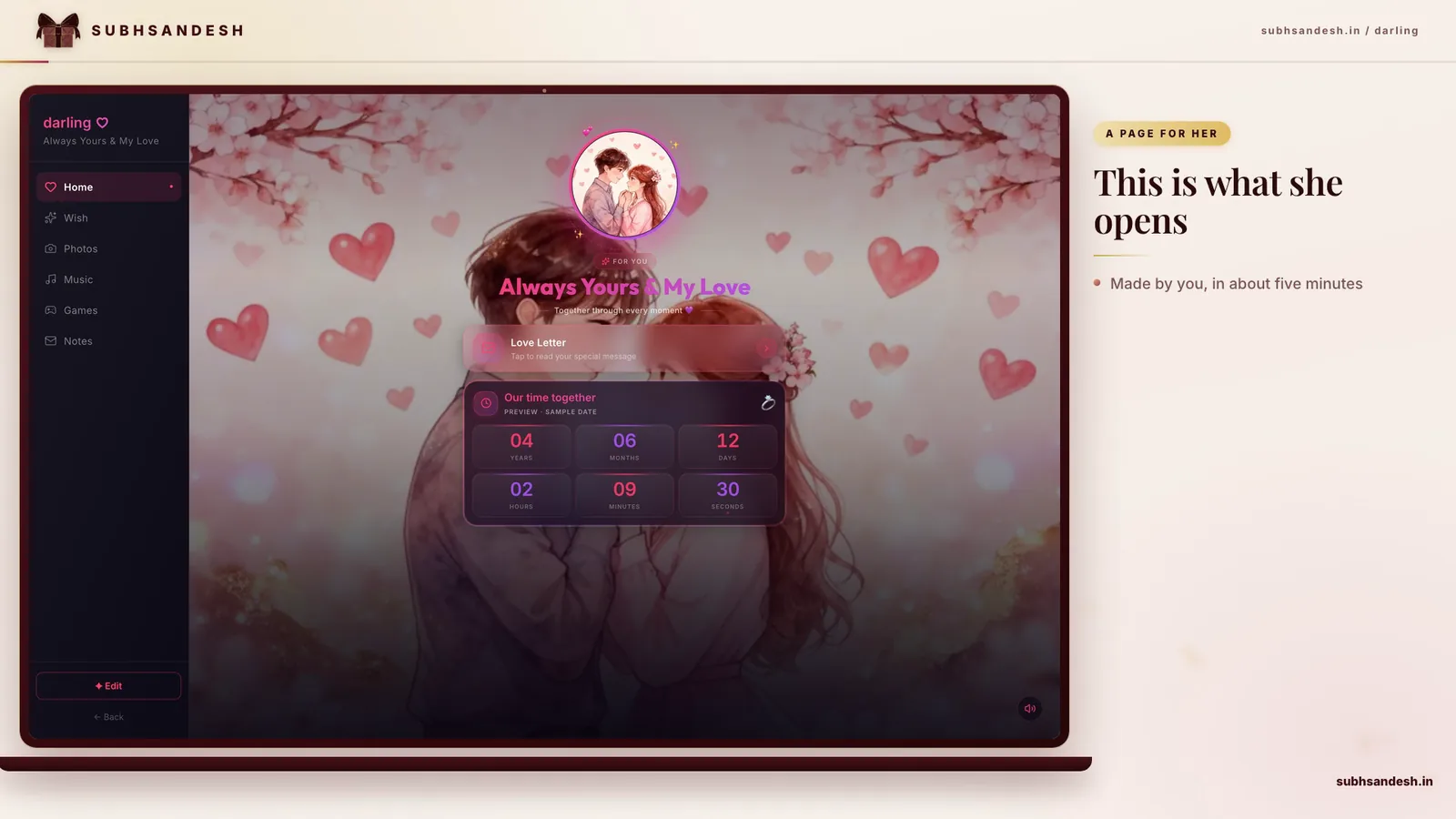
The I-love-you page for a partner has a Games tab holding a Love Quiz, a Truth-or-Dare round and an "Our Story" history alongside the typed letter; it is our most-viewed template at 14,607 views, 35.2% of all 41,486. The darker, more dramatic Darling page does the same job in a darker register and accounts for 349 pages, 10.3% of everything created.
One number worth knowing first: the median gap between a page's first save and its last edit is 7.2 hours on /love-gf, sampled across all 987 of them. People build these over more than one sitting, so do not plan to finish just after a round.
Sources
- Schug, Yuki & Maddux (2010), self-disclosure and relational mobility, Psychological Science 21(10), 1471–1478.
- Schouten, Valkenburg & Peter (2009), self-disclosure in computer-mediated communication, Cyberpsychology 3(2).
- Brauer et al. (2021), adult playfulness and relationship satisfaction, International Journal of Applied Positive Psychology 8(S2), CC BY 4.0.
- Osorio (2025), characterizing retroactive jealousy, doctoral dissertation, Harvard University.
- Wikipedia, never have I ever — the game's origin; no publication date given.
Frequently Asked Questions
Turn this inspiration into an unforgettable surprise
Build a page with photos, a heartfelt message, music and a ready-to-share link.
- Photos, message & music
- Ready-to-share link

Written by
Suyash Agrahari
Founder
Suyash Agrahari is a Software Engineer at HireQuotient and the founder of SubhSandesh and DrawFlow (drawflow.in). He builds AI agents and full-stack products with Next.js, Node.js, and the OpenAI and LangChain ecosystems, having shipped autonomous multi-agent systems, AI copilots, and large-scale outreach platforms — and scaled side projects from a few hundred to millions of users. He writes about AI engineering, web development, and building products that grow through SEO and organic reach.
Stay Connected
Follow SubhSandesh
New templates, festival ideas and step-by-step walkthrough videos — first on our socials.
Product guide
See it built, step by step

Keep reading
Which Day Comes After Propose Day, and What Happens Now
Chocolate Day comes after Propose Day — Tuesday 9 February 2027. That is one sentence, so this page covers the four situations you are actually in on …
 Suyash Agrahari· 9 min
When to Propose a Girl to Be Your Girlfriend, and When Not To
The timing question, answered with conditions instead of a date: what has to be true before you ask, what politeness and fast replies do not prove, wh…
Suyash Agrahari· 9 minRomantic Proposal Room Decoration: What the Room Must Do
Romantic proposal room decoration, sorted by the work each setup takes and what the room allows: 7 setups with set-up and reversal times, lighting evi…
Suyash Agrahari· 9 min