
Personalised Raksha Bandhan Card With Name: Post It or Send It?
Posted, a rakhi card takes 4-5 days across India and 4-7 days to the US. Sent as a link, it arrives in seconds. Here is the delivery maths, what to write beside the name, and when paper still wins.
Make this into a page you can send
Photos, a message, music and a ready-to-share link — in a couple of minutes.
or browse all occasionsKey takeaways
- • India Post's published standards put a card at 1-2 days locally, 4-5 days to the rest of India and 4-7 days to the United States, with customs holding time excluded.
- • A name-personalised page arrives in seconds and gets reopened: SubhSandesh's 2,718 pages average 12.0 views each, and 51.9% of those views are on a phone.
- • 44.3% of creators password-protect the page before sharing it (1,205 of 2,718), which is what keeps a sibling card out of a forty-person family group.
- • Writers underestimate how a written message lands: in a 2018 Psychological Science study, 107 letter-writers underestimated recipients' positive mood (d = 0.74) and overestimated awkwardness.
- • The artefact is not the active ingredient. A 2021 BMJ randomised study of 1,469 people found a posted card moved response rates from 85.4% to 85.3% - the name and the specific line are what work.
On this page
Personalised Raksha Bandhan Card With Name: Post It or Send It?
A personalised Raksha Bandhan card with a name is a card that carries your sibling's actual name — the one you call them at home, not the one on their Aadhaar — and you have exactly two ways to get it to them. Posted, it travels at the Department of Posts' published service standards: 1–2 days local, 4–5 days to the rest of the country, 4–7 days to the United States.
Sent as a link it arrives in seconds, and on SubhSandesh's own numbers 51.9% of the 32,683 recorded views of shared pages happen on a phone, while 44.3% of the 2,718 pages created since 12 March 2026 were password-protected before sharing. Raksha Bandhan falls on Friday 28 August 2026, so below is the lead-time maths, the five things the card has to carry beside the name, and the cases where paper still wins.
What is a personalised Raksha Bandhan card with a name?
It is a Raksha Bandhan greeting whose text names one specific person — "For my brother Aarav" instead of "To my dear brother" — usually alongside a line only the two of you would understand. The name is the mechanism, not the decoration: it turns a mass-produced sentiment into an addressed one.
Two formats do this, and they behave differently. A printed card is personalised at the press and then posted, so the wording is frozen the moment you check out. A digital card is personalised in a browser, published to a private link and delivered over WhatsApp, email or a shared album — editable up to the minute you send it.
That editability matters more than it sounds. On SubhSandesh, 99.4% of started pages are actually published and shared (2,701 of 2,718), so the wording step is rarely where people abandon a card — running out of postal days is.
The lead-time maths for Friday 28 August 2026
Raksha Bandhan 2026 falls on Friday 28 August, listed as a restricted holiday in the official 2026 holiday list issued in December 2025. That gives a card posted on 18 August ten days of runway, which sounds generous until you read the actual norms.
The Department of Posts Citizens' Charter sets Speed Post at 1–2 days local, 1–3 days metro to metro, 1–4 days within a state and 4–5 days for the rest of the country. Ordinary first-class letter post — which is what most greeting cards travel as — is slower: 2 days local, 2–4 metro to metro, 3–5 between state capitals and 5–6 days for the rest of India.
International is where the plan usually breaks. The same charter gives end-to-end EMS standards of 2–6 days to the UK, 4–7 to the United States, 4–8 to the UAE and Australia, 5–9 to Canada and 3–6 to Singapore — explicitly excluding time held for customs examination, and only for articles booked in Delhi, Mumbai, Kolkata, Chennai or Kochi. Book from anywhere else and the domestic leg is added on top.
Read together: inside India, ten days is enough if you post this week. For a brother in Toronto, 5–9 days plus customs against a 28 August deadline is a coin toss, and that is the case where a Raksha Bandhan page for your brother with his name on it beats a parcel, because it has no transit time at all.
Five things a name-personalised rakhi card needs
Each item states what it is, who it suits, what it costs and how long it takes.
1. The name they actually answer to
What it is: the name used at home — Chhotu, Didi, Bhai, a school nickname — rather than the legal one. Who it suits: anyone whose sibling has a formal name nobody in the family uses.
Cost: nothing on either format. Time: under a minute, and it is the highest-return minute in the whole job, because a card addressed to "Aarav" and a card addressed to "Chhotu" are read as two different objects.
2. One dated memory instead of a stock line
What it is: a sentence naming a place, a year or an argument — "the 2019 Diwali you drove six hours to reach". Who it suits: siblings you have real history with, which is most of them.
Cost: nothing. Time: five to ten minutes of thinking, and worth it — a CHI 2022 study built a corpus of 18,559 stock greeting-card messages from eight card publishers and found them heavily patterned by the recipient's gender, which makes the pre-printed line the least personal thing on the card.
3. The protection promise in your own words
What it is: the rakshan half of Raksha Bandhan — the thread is a promise, so say what you are actually promising this year. Who it suits: cards for a younger sibling, and any card where "happy rakhi" alone feels thin.
Cost: nothing. Time: two minutes, and be concrete — "I will pick up the phone this year" is a promise, while "always there for you" is a greeting-card default.
4. A photo, or last year's thali
What it is: one image — the two of you, or the plate with the rakhi, roli and sweets from last year. Who it suits: siblings who have not been in the same room in months.
Cost: free on a digital card, while on printed cards a photo upload is normally a paid upgrade. Time: five minutes to find the file, which is usually the longest step.
5. A delivery route decided before you design anything
What it is: choosing post versus link first, because the choice dictates the format, the deadline and the length of the message. Who it suits: everyone, and it is the step most people skip.
Cost: nothing. Time: one minute, spent holding the charter windows above against today's date.
Printed card, digital card or both
The comparison below uses the Citizens' Charter standards for transit and SubhSandesh's own view data for what happens after delivery.
| Option | Same city | Rest of India | Sibling in the USA | After it arrives |
|---|---|---|---|---|
| Card by first-class letter post | 2 days | 5–6 days | Not covered by the charter's standards | No reopen data exists |
| Card by Speed Post | 1–2 days | 4–5 days | 4–7 days, customs time excluded | Tracked to the door |
| Name-personalised page sent as a link | Seconds | Seconds | Seconds | 12.0 views per page on average, 51.9% of them on a phone |
| Link on the day, card posted after | Seconds, then 1–2 days | Seconds, then 4–5 days | Seconds, then 4–7 days | Meets the date and leaves an object |
The takeaway: paper is the better object and the worse courier, so if the date is inside a week and the sibling is overseas, send the link first and let the card arrive late on purpose.
What belongs beside the name on the card
Most people underrate how much this lands. In a 2018 Psychological Science study, 107 MBA students wrote letters of gratitude and predicted their recipients' reactions; among the 80 recipients who responded, writers significantly underestimated how surprised and how positive the recipients felt (d = 0.74 for mood) and overestimated how awkward it would be.
The practical reading for a rakhi card: the sentence you are embarrassed to write is usually the one worth writing. Name the thing they did, not the category of thing.
Give yourself more than one sitting. On SubhSandesh the median gap between a page's first save and its last edit is 6.9 hours, sampled across 913 pages of one template — people write the name immediately and come back to the message later, which a printed card's checkout flow does not allow.
And decide who else can see it. 44.3% of creators password-protect the page before sharing, which for a sibling card is less about secrecy than about it not being forwarded into a family group of forty people. If you want to see how the finished thing reads before writing anything, the SubhSandesh template gallery shows the published versions.
When a printed card beats a link — and when both lose
A physical card wins outright in three cases: the sibling is in the same city and you can hand it over, the sibling does not use a smartphone comfortably, or you want an object that survives a phone change. A link is a URL; a card is ephemera, and ephemera is what people find in a box twenty years later.
A card also does nothing on its own. In a randomised study published in The BMJ in December 2021, researchers sent Christmas cards to 1,469 trial participants across eight host trials and measured follow-up completion: 85.3% for the card group versus 85.4% for no card, at £0.76 and roughly 140 g of CO₂ equivalent per card.
Those were institutional cards to strangers, not a named card from a sibling. They are still a fair warning that the artefact is not the active ingredient — the name and the specific line are.
SubhSandesh is the wrong choice in the same-room case, and it is the wrong choice if your sibling reads nothing on a phone: 51.9% of views are mobile, which is a strength only when the recipient is one of those people. It is also the wrong choice if you want something framed — the page is not a print product, and it will not survive a dead link.
Sources
- Department of Posts, Citizens' Charter (2021) — Speed Post, first-class mail and international EMS service standards.
- Coleman E, et al., "Bah humbug! Association between sending Christmas cards to trial participants and trial retention", The BMJ, 14 December 2021.
- Kumar A, Epley N, "Undervaluing Gratitude: Expressers Misunderstand the Consequences of Showing Appreciation", Psychological Science 29(9), 2018.
- Sun J, Wu T, Jiang Y, Awalegaonkar R, Lin XV, Yang D, "Pretty Princess vs. Successful Leader: Gender Roles in Greeting Card Messages", CHI 2022, 29 April 2022.
- Kendriya Vidyalaya list of holidays for 2026 (issued 22 December 2025) — Raksha Bandhan on 28 August 2026.
Frequently Asked Questions
Turn this inspiration into an unforgettable surprise
Build a page with photos, a heartfelt message, music and a ready-to-share link.
- Photos, message & music
- Ready-to-share link

Written by
Suyash Agrahari
Founder
Suyash Agrahari is a Software Engineer at HireQuotient and the founder of SubhSandesh and DrawFlow (drawflow.in). He builds AI agents and full-stack products with Next.js, Node.js, and the OpenAI and LangChain ecosystems, having shipped autonomous multi-agent systems, AI copilots, and large-scale outreach platforms — and scaled side projects from a few hundred to millions of users. He writes about AI engineering, web development, and building products that grow through SEO and organic reach.
Stay Connected
Follow SubhSandesh
New templates, festival ideas and step-by-step walkthrough videos — first on our socials.
Product guide
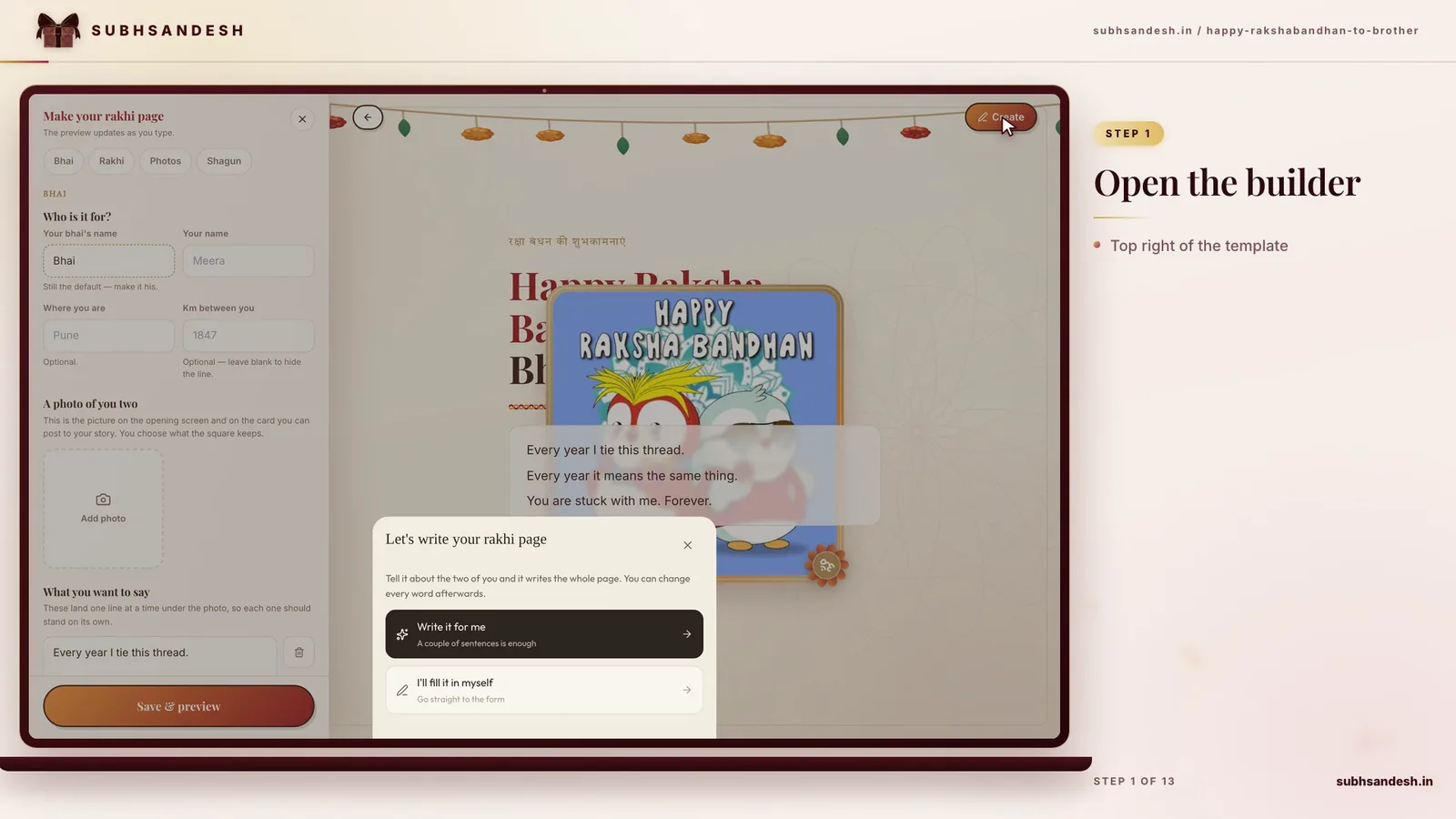
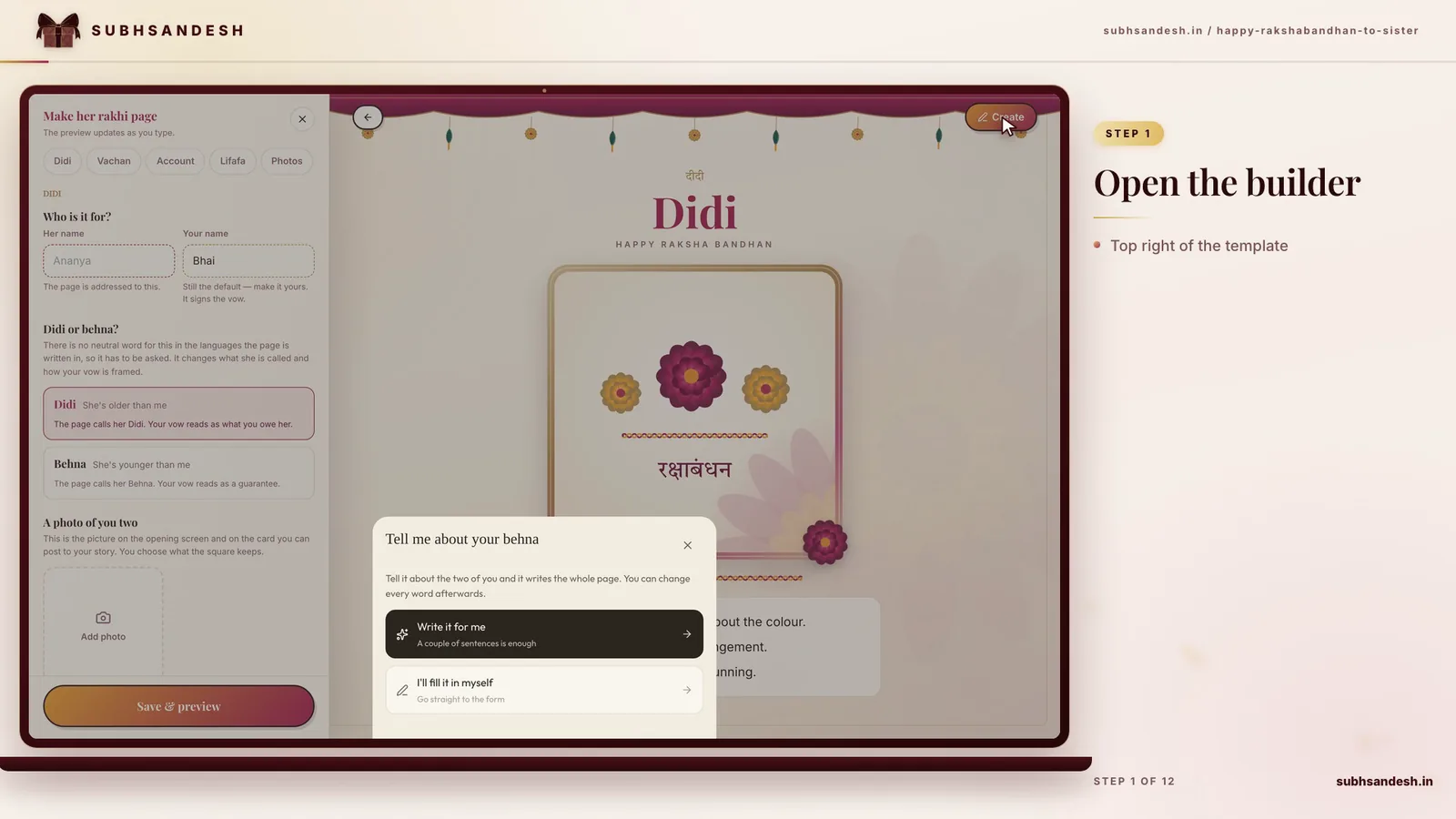
See it built, step by step
Keep reading
Thala Deepavali: A Couple's First Deepavali at the Bride's Home
Thala Deepavali is a Tamil couple's first Deepavali after marriage, at the bride's home. In 2027 it is Thursday 28 October, oil bath 4:40–6:01 AM in C…
 Suyash Agrahari· 9 min
Sugar-Free Diwali Sweets: Swaps, Label Warnings and the Evidence
Five original no-added-sugar Diwali sweets, why jaggery and honey do not count, the warnings FSSAI requires on a sugar-free box, and what an Indian su…
Suyash Agrahari· 9 minShort Diwali Quotes: 34 Original One-Liners Under 10 Words
34 original short Diwali quotes, each under ten words and marked with its word and character count, grouped by mood: lamps, family, friends, gratitude…
Suyash Agrahari· 9 min