How to Make a Personalised Raksha Bandhan Website for a Sibling
A personalised Raksha Bandhan website is a page you send your sibling, not a card you download. Six things it needs, drawn from 2,973 personalised pages built by 2,466 creators — including the 44.2% who lock the page before sharing it.
Make this into a page you can send
Photos, a message, music and a ready-to-share link — in a couple of minutes.
or browse all occasionsKey takeaways
- • A card is a file you download; a personalised Raksha Bandhan website is a page you send — one address, openable, lockable, and still there next August.
- • 2,973 personalised pages have been built here across 15 page types by 2,466 registered creators, and 99.4% of started pages get published and shared.
- • 44.2% of creators lock the page with a password before sharing it (1,315 of 2,973) — a stricter habit than the ~30% of Facebook users who ever touch fine-grained sharing controls.
- • Personalisation, not polish, is what lands: across four experiments, recipients appreciated customised gifts more regardless of the time the giver spent.
- • Our rakhi templates are new and lightly used — 3 pages and 39 of 36,202 recorded views — so the page mechanic is proven but the rakhi designs are not yet.
On this page
How to Make a Personalised Raksha Bandhan Website for a Sibling
A personalised Raksha Bandhan website is one web page built for one sibling — their name inside it, your photos in it, your message at the end — sent as a private link instead of a file they have to download. On SubhSandesh, 2,973 personalised pages have been created across 15 page types by 2,466 registered creators, and 44.2% of those creators put a password on the page before sharing it (1,315 of 2,973). It takes an evening, not a courier. Below: what belongs on a sibling page, why a page is a different object from a card, why so many people lock theirs, and when a website is the wrong call.
What a personalised Raksha Bandhan website actually is
It is a single web page that lives at its own link, made for one named person. You add their name, a few photographs, a message, optionally music and a countdown, publish, and send the link — nothing is installed, printed or downloaded at either end.
The word carrying the weight is for. A card template is for whoever picks it up. A page for your sister has her name written into it rather than typed next to it in a WhatsApp caption.
The format also holds attention while you build it: 99.4% of pages started here are published and shared (2,956 of 2,973). Half-finished pages are rare in a way half-written messages are not. And a page is not tied to a date unless you put one on it, which matters when Rakhi 2027 lands on Tuesday 17 August 2027 and you are reading this a year early.
A card you download versus a page you send
Almost every result for this search treats four things as one option: a card maker, a printed photo rakhi, a QR-code rakhi, and an actual web page. They fail differently.
A card is a file. You design it, download a JPG, forward it. It arrives inside a chat, competes with forty other forwards that morning, gets compressed, and nothing on it is only theirs.
A page is a place. One address, it opens rather than downloads, it can hold a gallery and audio, and it can be locked. Send it again next August and it is still there.
The personalising does more work than the production values. In four experiments reported by the University of Bath in December 2024, recipients of customised gifts appreciated them more regardless of how much time the giver spent — 74 participants in the first study changed fewer items of a personalised clothing gift, and 134 in the second rated a customised T-shirt above one chosen by browsing. The researchers call it vicarious pride: the recipient feels the intention, not the labour.
Good news for a page. You do not need to be a designer. You need to know which three photographs your brother will stop on.
Six things a sibling page needs on it
In the order they should appear on the page, not by importance.
1. Their name, used inside the page
What it is: the name rendered as part of the page — a heading, a banner, a signed line — not sitting in the message you send with the link. Who it suits: everyone; this is why the search exists. What it costs you: nothing but the spelling — use the name they are called at home, not the Aadhaar one. How long: under a minute.
2. Three photographs, not thirty
What it is: two or three images that carry a memory, ideally from before either of you chose your own haircut. Who it suits: siblings with a shared childhood, which is most of them. What it costs you: the real cost of the build — twenty minutes of scrolling backwards. How long: 20–30 minutes, and the step people underestimate.
3. Something to open rather than only read
What it is: one interaction — a wrapped box, a page-turn, a countdown that resolves. A page you only read is a card with extra steps. Who it suits: siblings who will not sit through three paragraphs of feeling. What it costs you: nothing if the template includes it, so choose on this. How long: seconds.
4. Your actual words, at the end
What it is: the message, placed after the photographs have earned the attention rather than at the top where it gets skimmed. Who it suits: anyone with something specific to say — if you have not, write two honest lines rather than six generic ones. What it costs you: the hardest quarter-hour of the build. How long: 15 minutes to write, longer to stop editing.
5. A private link, and a password if it needs one
What it is: an unlisted link, optionally locked so only the sibling holding the password opens it. Who it suits: anyone sending something they would not post publicly — close to half of all creators here. What it costs you: one extra thing to tell them. How long: seconds; see the section below.
6. A reason to come back to it
What it is: anything worth reopening — a gallery they will scroll again, a note dated to the year, a promise. Who it suits: siblings in different cities who will not meet before next Rakhi. What it costs you: nothing, but it changes what you write. How long: a decision, not a task.
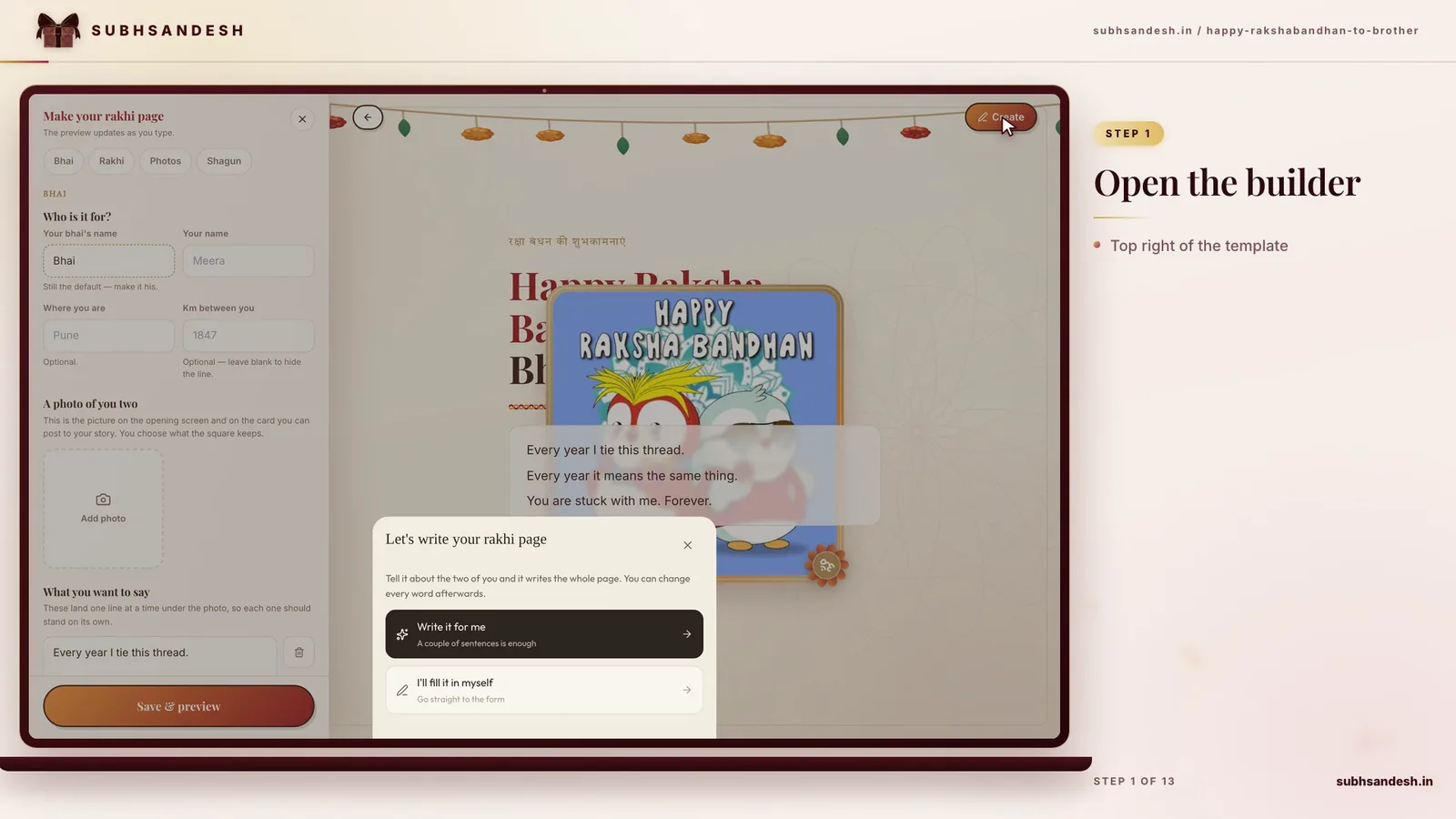
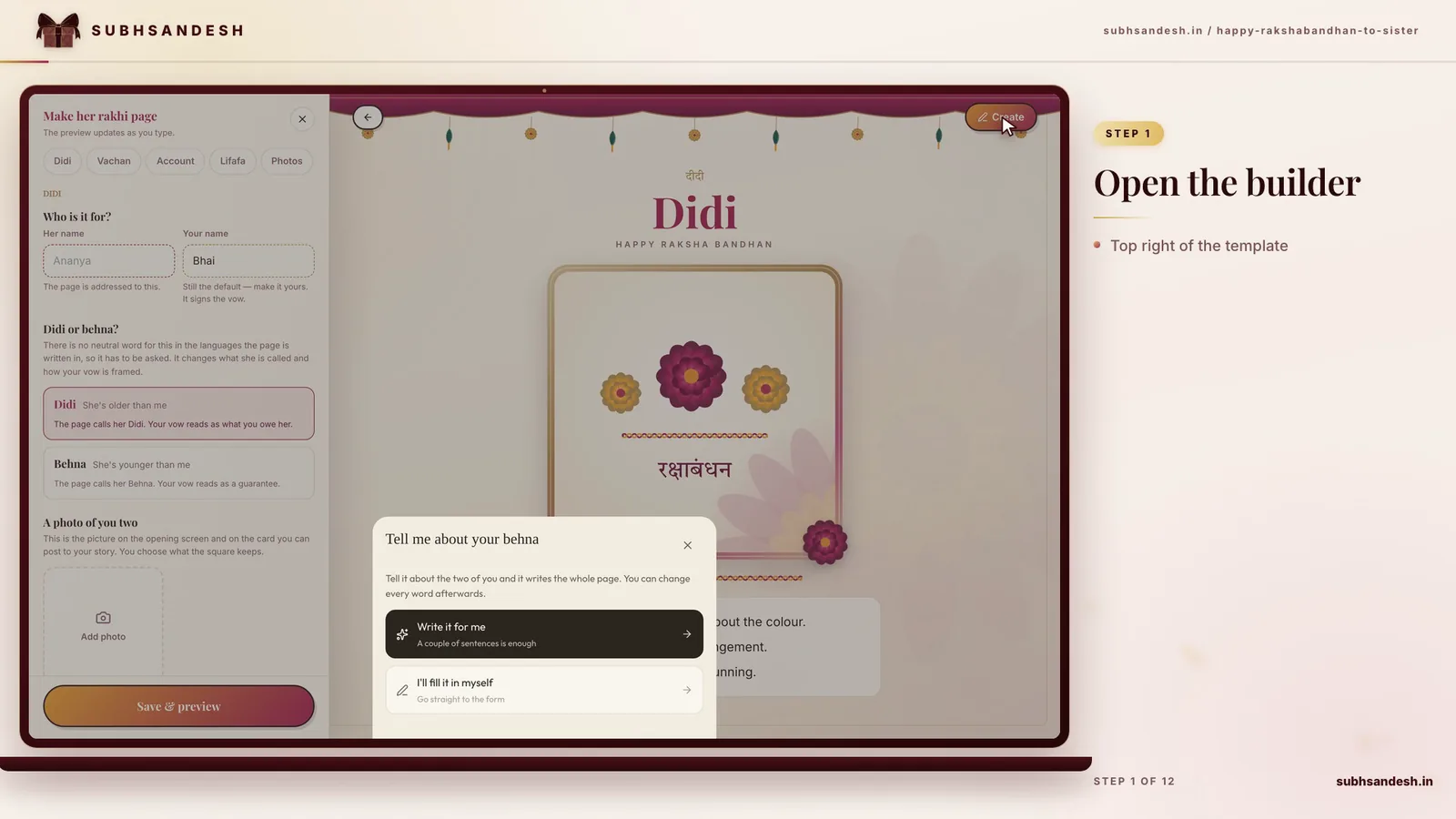
Both directions are already built: a Raksha Bandhan page for a brother with the tilak, aarti and rakhi-tying scenes animated, and a Raksha Bandhan page for a sister.
What people actually build here, and how new the rakhi page is
Our own creation data, measured 25 August 2026, including the number that does not flatter us.
| Page type | Pages created | Share of all 2,973 pages |
|---|---|---|
| "I love you" page (/love-gf) | 931 | 31.3% |
| Digital bouquet (/bouquet-gf) | 732 | 24.6% |
| Apology dashboard (/apology-dashboard) | 628 | 21.1% |
| Birthday page for a partner (/birthday-gf) | 188 | 6.3% |
| Raksha Bandhan pages, both directions | 3 | 0.1% |
The takeaway is honest rather than promotional. Our romantic templates have real mileage — the "I love you" page alone accounts for 13,581 of 36,202 recorded views — while the rakhi templates are new and lightly used, at 39 views in total. The page mechanic is well tested; the rakhi designs on top of it are not yet. If you want the most-proven layout rather than the most festive one, browse the full template library and pick on design.
Why 44.2% of creators lock the page before sending it
Password-protecting a page sounds paranoid until you look at how people already treat anything personal. Across 11,141 Facebook posts from 181 participants over three months, published in Heliyon in 2020, only 12% of posts were public and around 30% of participants ever used the fine-grained sharing controls — roughly half went to friends only, and a quarter were shared more narrowly still.
Our rate is higher: 44.2% of creators lock the page. The measures are not directly comparable, but the direction is: the stricter option is what people reach for when the content is about one person.
That study also found selective sharing associated with higher bonding social capital, self-censorship with lower. Restricting who can see something is not the same as saying less — you can be more direct on a locked page than in a family group.
The inconvenient finding about siblings and extra channels
Every page selling a digital rakhi gift assumes more digital contact means closer siblings. The research is messier, and a page that wants to be trusted should say so.
A 2026 study of adult siblings in the Journal of Social and Personal Relationships tested media multiplexity theory — the idea that stronger ties use more channels. Emotional closeness rose with the frequency of phone calls and emails but fell with the frequency of person-to-person media sharing, and the sheer number of channels siblings used was negatively associated with closeness in the first of its two studies. Overall frequency of use, though, tracked positively with closeness and life satisfaction. Only 29% of participants named a sibling among their most important relationships at all.
Read plainly: forwarding more things to your brother is not closeness. Using one channel properly is. A page earns its place because it is one deliberate thing, not because it is another app in the rotation.
Ritual carries the same double edge. An open-access 2025 study in Frontiers in Psychology found family ritual communication improved well-being mainly through family intimacy, the largest mediating path at 0.203, resilience next at 0.155 — but cultural identity was a negative mediator at −0.040. Ritual performed as obligation does not pay what ritual performed as contact pays.
When a personalised website is the wrong choice
If your sibling is in the same house that morning, send nothing. Tie the rakhi, hand over the sweets. A link between two people in one room is a worse version of a conversation.
A page assumes a phone and a connection. 51.1% of views on shared pages here happen on a phone (18,497 of 36,202), which is the format's strength and its dependency: a sibling on a borrowed handset with patchy data gets a slow page, and a relative who never opens links will not open this one.
It also does not replace the thread. Raksha Bandhan is a physical rite and the rakhi still has to reach a wrist. If your brother is in Dubai, post the rakhi three weeks early and send the page on the morning.
And done properly it is not a five-minute job. The median gap between a creator's first save and last edit on our most-used template is 6.9 hours (sampled on the "I love you" page, n=931). People come back and change the words. Budget an evening — an honest voice note beats a rushed page.
Sources
- Corder, M. D., Hall, J. A., Pennington, N., & Holmstrom, A. J. (2026). Adult sibling relationships and media multiplexity theory. Journal of Social and Personal Relationships, 43(1), 181–200. Abstract only; full text paywalled.
- University of Bath (27 December 2024). Personalized gifts create lasting emotional connections, on Acuti et al., "Vicarious pride in customized gift exchange".
- Ban, Z., et al. (7 April 2025). Dual effects of family ritual communication on adolescents' well-being. Frontiers in Psychology, 16. Open access.
- Toch, E., et al. (2020). Selectivity in posting on social networks. Heliyon, 6(2), e03298. Open access.
- SubhSandesh platform data, measured 25 August 2026.
Frequently Asked Questions
Turn this inspiration into an unforgettable surprise
Build a page with photos, a heartfelt message, music and a ready-to-share link.
- Photos, message & music
- Ready-to-share link

Written by
Suyash Agrahari
Founder
Suyash Agrahari is a Software Engineer at HireQuotient and the founder of SubhSandesh and DrawFlow (drawflow.in). He builds AI agents and full-stack products with Next.js, Node.js, and the OpenAI and LangChain ecosystems, having shipped autonomous multi-agent systems, AI copilots, and large-scale outreach platforms — and scaled side projects from a few hundred to millions of users. He writes about AI engineering, web development, and building products that grow through SEO and organic reach.
Stay Connected
Follow SubhSandesh
New templates, festival ideas and step-by-step walkthrough videos — first on our socials.
Product guide
See it built, step by step
Keep reading
Thala Deepavali: A Couple's First Deepavali at the Bride's Home
Thala Deepavali is a Tamil couple's first Deepavali after marriage, at the bride's home. In 2027 it is Thursday 28 October, oil bath 4:40–6:01 AM in C…
 Suyash Agrahari· 9 min
Sugar-Free Diwali Sweets: Swaps, Label Warnings and the Evidence
Five original no-added-sugar Diwali sweets, why jaggery and honey do not count, the warnings FSSAI requires on a sugar-free box, and what an Indian su…
Suyash Agrahari· 9 minShort Diwali Quotes: 34 Original One-Liners Under 10 Words
34 original short Diwali quotes, each under ten words and marked with its word and character count, grouped by mood: lamps, family, friends, gratitude…
Suyash Agrahari· 9 min