
Rakhi 2026 Is on Friday 28 August: The Countdown Plan
Rakhi 2026 falls on Friday 28 August 2026, a working day in most of India. A backwards calendar from T-14 to T-0: what to decide when, which delivery promises are verifiable, and the point where a sent link is the only route left.
Make this into a page you can send
Photos, a message, music and a ready-to-share link — in a couple of minutes.
or browse all occasionsKey takeaways
- • Rakhi 2026 is Friday 28 August 2026 — gazetted in nine states and UTs, and an ordinary working day everywhere else.
- • Count backwards, not forwards: T-14 fix the real deadline, T-10 choose physical or digital, T-3 book the courier, T-1 build the message, T-0 send at a decided minute.
- • Blue Dart's guaranteed next-business-day 10:30 delivery covers select pin codes in seven cities only; outside that list, no delivery window in this post is verified.
- • A shared page has no lead time at all and averages 12.2 views across 36,202 recorded views, which makes it the one route still open on Friday morning.
- • Rakhi 2027 is Tuesday 17 August — eleven days earlier than 2026, so a plan copied from this year's dates starts eleven days late.
On this page
- 1. T-14 — fix the deadline you are actually working to (Friday 14 August 2026)
- 2. T-10 — decide physical or digital while both are still open (Tuesday 18 August 2026)
- 3. T-3 — book the courier while next-business-day still lands before Friday (Tuesday 25 August 2026)
- 4. T-1 — separate the message from the parcel (Thursday 27 August 2026)
- 5. T-0 — send at a decided time, not "sometime on the day" (Friday 28 August 2026)
Rakhi 2026 Is on Friday 28 August: The Countdown Plan
Rakhi 2026 falls on Friday 28 August 2026, which is a working day across most of India — and that is what decides the plan, not the wording of the wish. A parcel has to clear a courier's business-day clock before Friday morning. A link does not. Across SubhSandesh's own database, shared pages have drawn 36,202 recorded views, an average of 12.2 views per created page, and 99.4% of pages people start get published and shared (2,956 of 2,973). This is not the tithi-and-muhurat guide. It is the backwards calendar: what you decide on which day, which routes are still open at T-3, and the point where a physical rakhi stops being possible and a sent link is the only thing that can still arrive.
When is Rakhi 2026, and why the weekday matters more than the date
Raksha Bandhan 2026 is Friday 28 August. The holidays reference publicholidays.in lists it as a gazetted holiday in nine states and union territories — Chhattisgarh, Daman & Diu, Dadra & Nagar Haveli, Gujarat, Haryana, Madhya Pradesh, Rajasthan, Uttarakhand and Uttar Pradesh — and as an ordinary working day everywhere else.
So for a sister in Bengaluru with a brother in Pune, 28 August is a Friday that both of them have to work through. The ceremony gets squeezed into a morning slot or an evening one, and the parcel, if there is a parcel, lands during office hours at an address where nobody is home.
The weekday is not a footnote. It changes who signs for the courier, when the video call can realistically happen, and whether a missed delivery rolls forward one day or three.
How to count backwards from 28 August
Most rakhi planning runs forwards: today I will look at rakhis, then I will order, then I will post. Forwards planning is exactly what produces a parcel still in transit on the day of the festival.
There is direct evidence for the alternative. Across four experiments on backward planning published in Judgment and Decision Making in March 2016, Wiese, Buehler and Griffin found that people who built a plan from the end goal backwards predicted later, less optimistic completion times.
In their Study 4, participants expected to finish 3.25 days before their deadline and actually finished 2.15 days before it (n = 125) — and that underestimation disappeared entirely in the backward-planning condition.
So start at Friday and walk back. Five decision points, with the 2026 dates attached.
1. T-14 — fix the deadline you are actually working to (Friday 14 August 2026)
The deadline is not 28 August. It is the last moment the recipient can receive the thing, which for a courier is the previous business day. Writing the real date down is the whole exercise. In Ariely and Wertenbroch's deadline studies at MIT and INSEAD, published in Psychological Science in 2002, students left free to choose their own submission dates still set them a mean 21.2 days early — people know they need an earlier deadline than the official one. Cost: five minutes. Applies to everyone.
2. T-10 — decide physical or digital while both are still open (Tuesday 18 August 2026)
This is the only decision point where you genuinely have both options. A hand-tied thread on a wrist and a page on a phone are not substitutes, and pretending otherwise at T-2 is how people end up sending neither properly. Decide by recipient, not by preference: same city, go in person; different city, parcel plus a message; different country, do not start with the parcel. A Raksha Bandhan page for a brother or for a sister is the route that has no lead time at all.
3. T-3 — book the courier while next-business-day still lands before Friday (Tuesday 25 August 2026)
Express services are narrower than their marketing suggests. Blue Dart's own service guide states that Domestic Priority 1030 is a guaranteed door-to-door delivery by the next possible business day by 10:30 hours, with a money-back guarantee — but only to selected pin codes in Chennai, Delhi, Ahmedabad, Mumbai, Bangalore, Navi Mumbai and Gurgaon.
Seven cities, selected pin codes. Outside that list you are buying a best effort, not a commitment, and the T-3 date above is the wrong one for you.
4. T-1 — separate the message from the parcel (Thursday 27 August 2026)
The parcel and the wish should not be the same delivery. If the rakhi is in transit, the message still has to land on Friday morning by itself. Build it the day before and hold it. Median time between a page's first save and its last edit on SubhSandesh is 6.9 hours (sampled on the "I love you" page, n = 931), so treating it as a ten-minute job the morning of is optimistic for most people.
5. T-0 — send at a decided time, not "sometime on the day" (Friday 28 August 2026)
On a working Friday, "I'll send it later" competes with a full day of meetings. Pick the minute — before the office, or in the evening gap after it — and put it in the calendar. This is the one step that costs nothing and is skipped most often. Applies to every route, including the ones where the parcel already arrived.
What each route still costs you at T-3
The useful comparison is not speed. It is the latest moment you can still start and have the thing arrive, and how much of that is verifiable rather than hoped for.
| Route | Latest you can start | Where it actually works | What can be verified |
|---|---|---|---|
| Blue Dart Domestic Priority 1030 | Pickup on Thursday 27 August | Selected pin codes in 7 named cities | Guaranteed next possible business day by 10:30, money-back |
| Standard domestic courier or post | Unknown | — | No timeframe verified from a non-India-Post source |
| International parcel | Weeks, unquantified | — | No timeframe verified from a non-India-Post source |
| Shareable rakhi page | Friday 28 August itself | Anywhere with a phone | 12.2 average views per page across 36,202; 51.1% opened on a phone |
| Plain WhatsApp message | Friday 28 August itself | Anywhere | Nothing measurable — you never learn if it was read |
Two rows say "unknown" on purpose. India Post is the primary source for ordinary and international mail timings and it is deliberately not cited here, so rather than repeat a figure second-hand, the honest entry is that the window was not verified. Treat any specific number you see for those two routes as unchecked.
The Friday problem, in practice
A Friday festival creates three concrete risks that a Saturday one does not. First, delivery windows collide with work hours, so somebody has to be at the address or the parcel comes back. Second, a courier phrase like "next possible business day" means a Friday miss does not become a Saturday save in most service tiers.
Third, and least obvious: both siblings are on a clock. In 2025 Raksha Bandhan fell on Saturday 9 August, which gave families an unhurried day. 2026 does not, and neither does 2027.
The practical response is to move everything one working day earlier than instinct says, and to decide the send time in advance rather than on the day.
Rakhi 2027 is Tuesday 17 August — eleven days earlier
Here is the calendar fact almost nobody puts in a table. Rakhi fell on Saturday 9 August in 2025, Friday 28 August in 2026, and lands on Tuesday 17 August in 2027 — a gap of 384 days, then a gap of 354.
In plain terms the date jumped nineteen days later in 2026 and moves eleven days earlier in 2027. If you plan 2027 from the date you used in 2026, you are eleven days late before you begin.
The 2027 shape is different in a useful way. Independence Day, 15 August 2027, is a Sunday, and Rakhi is the Tuesday after it — so 14 to 17 August 2027 is a Saturday-to-Tuesday stretch, a travel window that simply does not exist in 2026.
Ariely and Wertenbroch's proofreading experiment found performance was lowest of all three conditions when every task was due at once at the end of the period, and highest under evenly spaced deadlines. A festival is an immovable end-deadline. Breaking it into T-14, T-10, T-3, T-1 is the fix, and the 2027 versions of those dates are 3 August, 7 August, 14 August and 16 August 2027.
When a countdown is the wrong tool
If your brother or sister is in the same city, close this page and go. No amount of planning improves on being in the room, and a page is a poor substitute for a thread and a thali.
If the recipient has no smartphone, a link fails. 51.1% of shared pages on SubhSandesh are opened on a phone (18,497 of 36,202 views), and that is the same reason a desktop-only or feature-phone recipient is a bad fit.
And an honest limit on our own data: the rakhi templates on SubhSandesh are new and lightly used — 39 of 36,202 recorded views. The 12.2-views-per-page and 51.1%-mobile figures are platform-wide across 2,973 pages and 2,466 creators, not rakhi-specific measurements, and they should be read that way. If a hand-tied rakhi is the point of the day for your family, a countdown cannot compress a parcel, and no page will change that. When a link genuinely is the right route, you can browse the full template set and have something live before the Friday.
Sources
- Wiese, J., Buehler, R., & Griffin, D. (2016). Backward planning: Effects of planning direction on predictions of task completion time. Judgment and Decision Making, 11(2), 147–167. Published March 2016.
- Ariely, D., & Wertenbroch, K. (2002). Procrastination, Deadlines, and Performance: Self-Control by Precommitment. Psychological Science, 13(3), 219–224. Author-hosted copy, MIT.
- Blue Dart. Domestic Priority service guide. Undated service page; fetched 26 August 2026.
- Raksha Bandhan dates and state holiday status, publicholidays.in. Undated; fetched 26 August 2026.
Frequently Asked Questions
Turn this inspiration into an unforgettable surprise
Build a page with photos, a heartfelt message, music and a ready-to-share link.
- Photos, message & music
- Ready-to-share link

Written by
Suyash Agrahari
Founder
Suyash Agrahari is a Software Engineer at HireQuotient and the founder of SubhSandesh and DrawFlow (drawflow.in). He builds AI agents and full-stack products with Next.js, Node.js, and the OpenAI and LangChain ecosystems, having shipped autonomous multi-agent systems, AI copilots, and large-scale outreach platforms — and scaled side projects from a few hundred to millions of users. He writes about AI engineering, web development, and building products that grow through SEO and organic reach.
Stay Connected
Follow SubhSandesh
New templates, festival ideas and step-by-step walkthrough videos — first on our socials.
Product guide
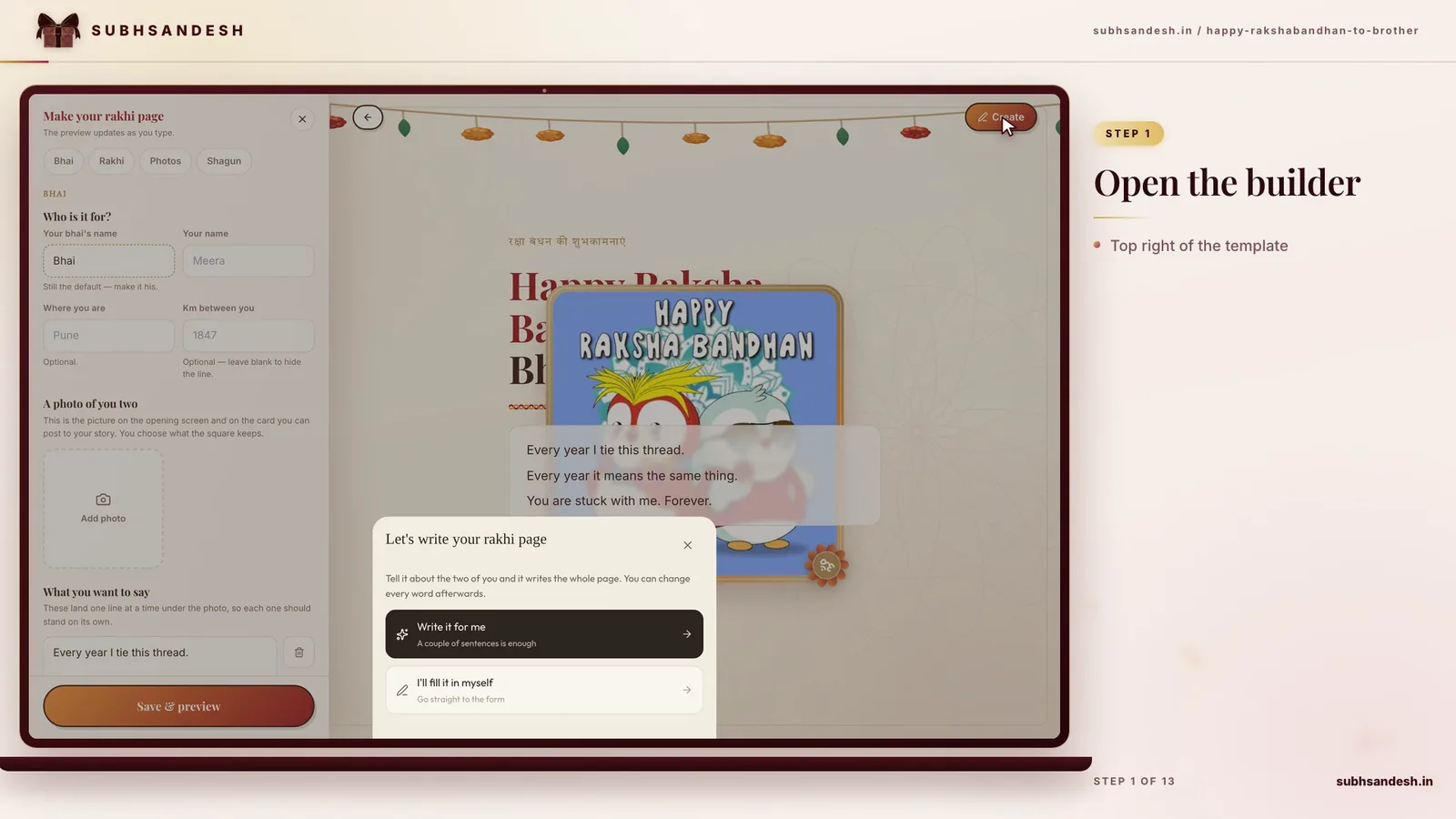
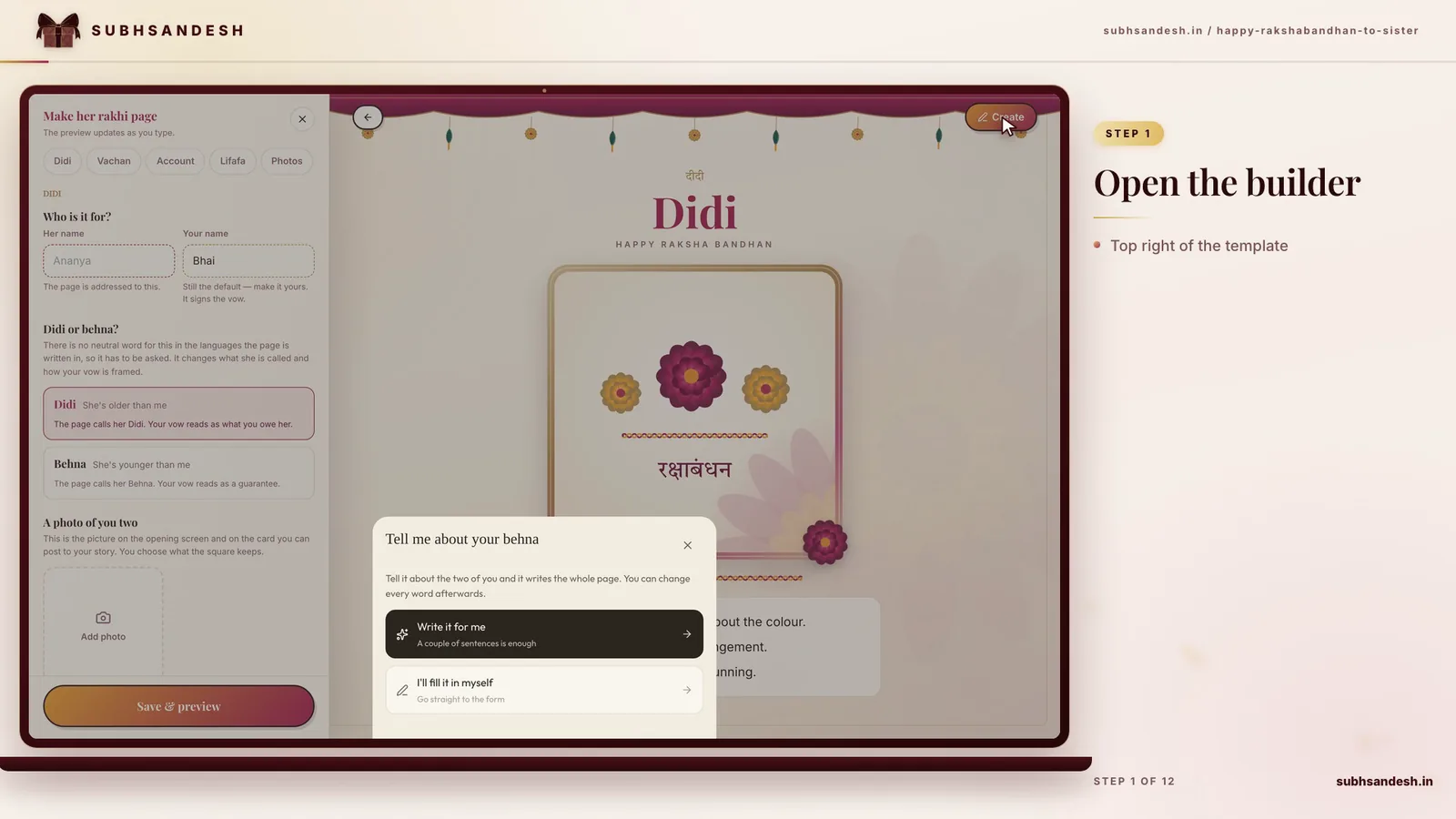
See it built, step by step
Keep reading
Thala Deepavali: A Couple's First Deepavali at the Bride's Home
Thala Deepavali is a Tamil couple's first Deepavali after marriage, at the bride's home. In 2027 it is Thursday 28 October, oil bath 4:40–6:01 AM in C…
 Suyash Agrahari· 9 min
Sugar-Free Diwali Sweets: Swaps, Label Warnings and the Evidence
Five original no-added-sugar Diwali sweets, why jaggery and honey do not count, the warnings FSSAI requires on a sugar-free box, and what an Indian su…
Suyash Agrahari· 9 minShort Diwali Quotes: 34 Original One-Liners Under 10 Words
34 original short Diwali quotes, each under ten words and marked with its word and character count, grouped by mood: lamps, family, friends, gratitude…
Suyash Agrahari· 9 min